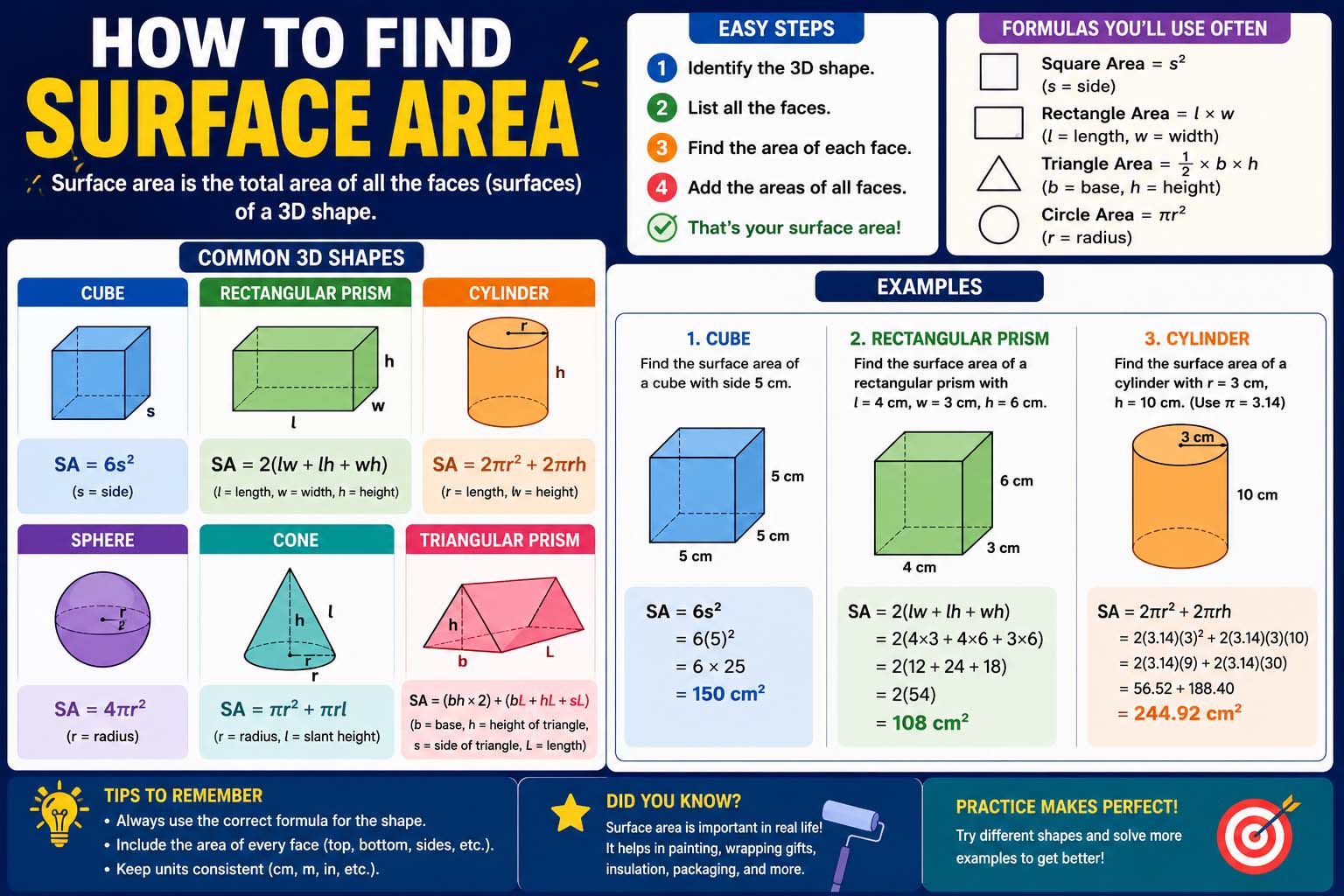
Learning how to find surface area is an important part of geometry and everyday mathematics. It measures all the exposed surfaces of shapes such as cubes, cylinders, prisms, and spheres. Students often study surface area in school because it helps develop problem-solving skills and practical understanding of measurements.
Surface area is used in many real-world situations. Architects use it when designing buildings, manufacturers calculate it for packaging materials, and engineers rely on it for construction projects. Understanding surface area also helps in painting walls, wrapping objects, or estimating the material needed for a project.
To calculate surface area correctly, it is important to identify all the faces or curved surfaces of a shape. Once the measurements are known, formulas can be applied to determine the total area. Each geometric figure has its own formula depending on its structure and dimensions.
How to Find the Surface Area of a Rectangular Prism
One of the most common geometry problems involves understanding A rectangular prism is a three-dimensional shape with six rectangular faces. Everyday examples include boxes, books, refrigerators, and storage containers.
The formula for the surface area of a rectangular prism combines the area of all six faces. The standard formula is:
SA=2lw+2lh+2wh
In this formula, “l” represents length, “w” stands for width, and “h” means height. Each pair of identical faces is multiplied by two because opposite sides have equal dimensions.
For example, imagine a rectangular prism with a length of 8 units, width of 4 units, and height of 3 units. By applying the formula, the total surface area can be calculated by finding the area of each pair of faces and adding them together.
Understanding this concept is useful in practical applications. Packaging companies calculate the surface area of boxes to determine how much cardboard is required. Painters also use surface area formulas when estimating the amount of paint needed for walls or storage units.
How to Find Surface Area of a Rectangular Prism
Many students search for how to find surface area of a rectangular prism because it appears frequently in school assignments and exams. The key to solving these problems is carefully identifying the dimensions before using the formula.
A rectangular prism contains three pairs of matching faces. The top and bottom share the same area, the front and back are equal, and the two side faces also match. By calculating the area of each pair separately, students can understand why the formula works.
For example, if a prism has dimensions of 10 units by 5 units by 2 units, each rectangular face contributes to the total surface area. Adding all the areas together gives the complete measurement of the outer surface.
Surface area calculations become especially important in industries involving shipping and manufacturing. Companies use these measurements to reduce material waste and improve packaging efficiency. Understanding rectangular prism formulas can therefore provide both academic and practical benefits.
How to Find the Surface Area of a Cylinder
Another important geometry concept involves learning how to find the surface area of a cylinder. Cylinders are shapes with two circular bases connected by a curved surface. Common examples include soda cans, pipes, candles, and water bottles.
The formula for the surface area of a cylinder includes the area of both circular bases and the curved outer surface:
SA=2πr2+2πrh
In this formula, “r” represents the radius of the circular base, while “h” represents the height of the cylinder. The first part calculates the area of the two circles, and the second part calculates the curved side surface.
For example, if a cylinder has a radius of 3 units and a height of 7 units, the formula can be used to determine the total surface area. Understanding each part of the equation helps students see how curved and flat surfaces combine in three-dimensional figures.
Cylinders appear frequently in real life, which makes this concept highly practical. Manufacturers use surface area calculations when designing cans and containers. Engineers also rely on cylinder formulas for pipes, tanks, and industrial equipment.
How to Find Surface Area of a Triangular Prism
Understanding can seem more difficult at first because the shape combines rectangles and triangles. A triangular prism has two triangular bases connected by three rectangular faces.
To calculate the surface area, students must first find the area of the triangular bases and then add the area of the rectangular sides. The general formula is:
SA=Ph+2B
In this formula, “P” represents the perimeter of the triangular base, “h” is the prism height, and “B” stands for the area of one triangular base.
units, students can calculate the total surface area step by step. First, they determine the area of the triangle, then calculate the rectangular side surfaces, and finally add everything together.
Triangular prisms are often used in architecture and construction because their shape provides strength and stability. Roof structures and bridge supports sometimes rely on triangular prism designs for durability.
Why Surface Area Is Important in Real Life
Surface area is not just a classroom topic. It plays an important role in many industries and daily activities. Construction workers use surface area measurements to estimate flooring materials, wallpaper, paint, and roofing supplies. Manufacturers calculate surface area when designing containers and packaging.
Conclusion
Learning how to find surface area is an essential geometry skill that applies to both academic studies and real-life situations. Whether calculating the surface area of a rectangular prism, cylinder, or triangular prism, understanding the formulas and dimensions is the key to success.