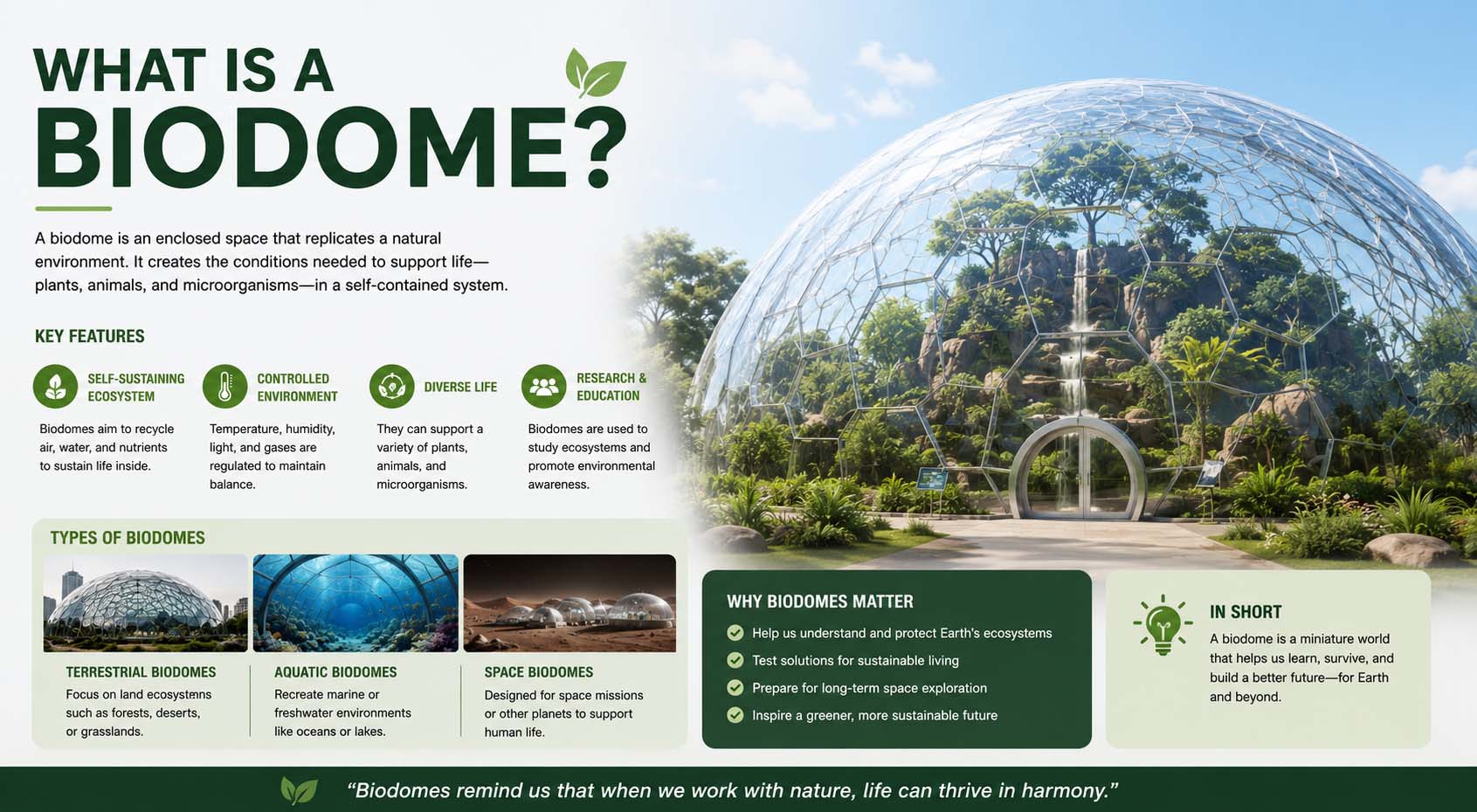
Are you wondering what is a biodome? It is a closed building that copies a natural habitat. For example, it can hold plants, animals and tiny organisms in a rainforest or desert setting. Inside, people control the temperature, humidity, air and light. As a result, scientists, teachers and visitors can study living systems up close.
Biodomes matter because they let researchers watch whole ecosystems in a safe space. Also, they keep most outside influences away, so the results stay clear. In addition, they show how life copes when conditions change.
The idea became famous through Biosphere 2 in Arizona. There, scientists tried to build a self-supporting world for people, plants and animals. Today, schools, research centers, zoos and conservation groups run biodomes around the world.
What Is a Biodome?
In short, a biodome is a mini ecosystem inside a dome or other closed building. Plants, animals, water, soil and air all work together, just as they do in nature. Therefore, the building acts like a small, living copy of a real habitat.
Some biodomes are small enough for a classroom. Others, however, are large enough to hold whole ecosystems and research teams. Either way, the goal stays the same: to copy nature in a space people can control.
Where the Word Comes From
The word joins two parts. “Bio” means life, while “dome” means a rounded roof or closed structure. Together, they describe a place where life grows inside a carefully managed space.
Many people also call these buildings biospheres, biomes or ecodomes. However, the core idea never changes: living things share one closed home.
How a Biodome Works
First of all, the building traps heat and light, much like a greenhouse. Fans, pumps and sensors then keep the air, water and temperature at the right levels. In many cases, the systems recycle water and balance oxygen with the help of plants.
Because the space reuses so much, it needs fewer outside resources. For instance, plants take in carbon dioxide and release oxygen for the animals. Meanwhile, the soil and microbes break down waste and return nutrients to the plants.
Good nutrients matter a great deal for crops grown this way. You can learn more in this guide on which nutrients limit plant growth. Similarly, many of these life-support ideas overlap with the work described in bioengineering vs biomedical engineering.
What Is a Biodome in Science
In science, a biodome works like a living laboratory. Researchers watch how organisms react to each other and to their surroundings. Since they control the space, they can change one thing at a time and see what happens.
For example, scientists can raise the temperature and track how plants grow. They can also watch how different species compete or help each other. As a result, they learn more about real ecosystems outside the dome.
Schools use biodomes too. Instead of reading only from textbooks, students can watch natural processes happen in real time. Likewise, farm researchers test new ways to save water and grow crops in tough climates.
What Is the Purpose of a Biodome
Biodomes serve several goals at once. Firstly, they support research. Secondly, they help protect rare species. Finally, they teach the public about nature and the environment.
Habitat loss and climate change threaten many plants and animals. So a biodome can give these species a safe home where they can survive and breed. In this way, conservation teams help protect biodiversity.
Museums and botanical gardens also use biodomes as hands-on attractions. For instance, visitors can walk from a hot rainforest into a dry desert in just a few steps. Along the way, they learn why each habitat matters.
Famous Examples Around the World
Biosphere 2 in Oracle, Arizona, is the best-known example. The University of Arizona runs this 3.14-acre living laboratory today. Inside, it holds a rainforest, an ocean, a mangrove, a desert and a savanna.
In the early 1990s, eight people lived sealed inside Biosphere 2 for two years. However, the team faced problems with oxygen levels and food supplies. Still, the project taught scientists a great deal about how closed systems behave.
The Eden Project in Cornwall, England, also draws huge crowds with its giant domes. Similarly, the Montreal Biodome in Canada recreates several ecosystems of the Americas under one roof.
Benefits and Limits
Biodomes offer many benefits. They protect rare species, support research and help people understand nature. They also let farmers grow food in places with harsh weather.
On the other hand, they cost a lot to build and run. Moreover, keeping a perfect balance of air, water and nutrients is very hard. For this reason, even large projects sometimes need outside help to stay healthy.
Future Uses in Space and Extreme Places
Scientists now study how domes like these could support life in deserts, in Antarctica and even on other planets. In fact, space agencies see closed habitats as a key step toward long trips beyond Earth.
Builders also need strong, light materials for these structures. For example, carbon fiber offers great strength at a low weight. Likewise, old water systems such as the aqueduct show how careful water control can support whole communities.
Conclusion
Now you know the answer to what is a biodome and why it matters. These closed ecosystems let plants, animals and people share one controlled space. Meanwhile, researchers use them to study nature in fine detail.
As technology improves, biodomes will likely play a bigger role in conservation, science and green living. So the next time you see a giant glass dome, you will know the living world it holds inside.