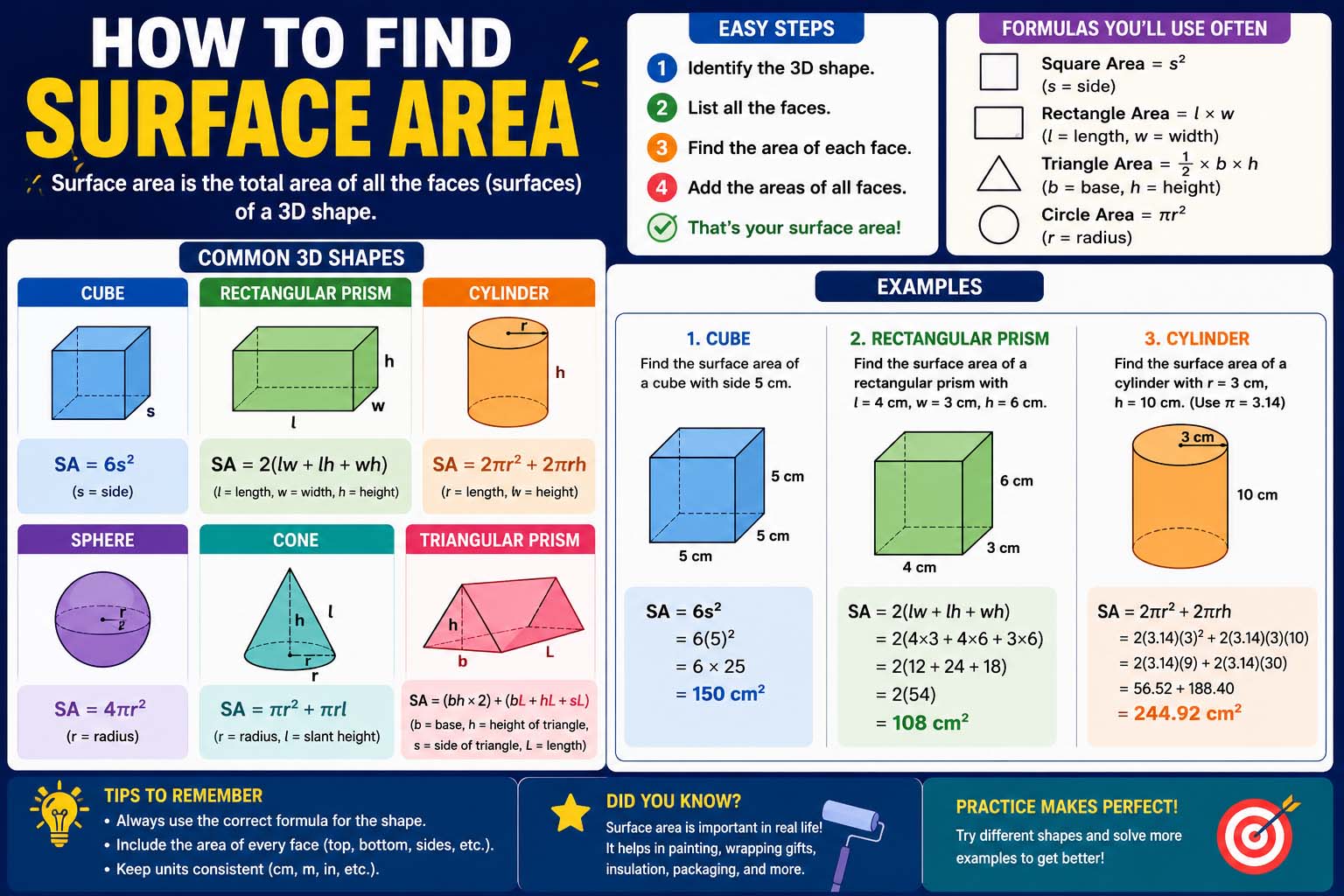
Learning how to find surface area is an important part of geometry and everyday math. Surface area measures all the outside faces of a shape, such as a cube, cylinder, prism or sphere. Also, students who master it often move on to the volume of a pyramid and other 3D topics. Later, many also learn how to find expected value in probability and statistics.
Surface area matters in real life too. For example, architects use it to design buildings, manufacturers use it to plan packaging and engineers use it on construction projects. Similarly, engineers study what is mechanical advantage to see how machines make work easier. In addition, surface area helps you paint walls, wrap gifts or estimate the material a project needs.
To get the right answer, first identify every flat face or curved surface of the shape. Then, measure each one and apply the correct formula. After all, each shape has its own formula, because each one has a different structure.
According to Wolfram MathWorld, surface area tells you how much surface a shape has. In fact, it compares to the amount of paint you would need to cover it, and you always write it in square units.
How to Find the Surface Area of a Rectangular Prism
One of the most common geometry problems is the rectangular prism. This 3D shape has six rectangular faces. For example, boxes, books, fridges and storage containers all have this shape.
The formula adds up the area of all six faces:
SA = 2lw + 2lh + 2wh
Here, “l” stands for length, “w” stands for width and “h” stands for height. Because opposite faces have the same size, you multiply each pair by two.
For instance, take a prism that is 8 units long, 4 units wide and 3 units high. First, 2 × 8 × 4 gives 64. Next, 2 × 8 × 3 gives 48. Then, 2 × 4 × 3 gives 24. Finally, 64 + 48 + 24 gives a total of 136 square units.
This skill has many practical uses. For example, packaging companies use it to work out how much cardboard a box needs. Painters also use it to estimate how much paint walls or storage units will take.
Step-by-Step Method for Box-Shaped Prisms
Many students search for this method because it shows up often in homework and exams. So the key is to identify the length, width and height carefully before you use the formula.
A box-shaped prism has three pairs of matching faces. In other words, the top and bottom match, the front and back match and the two sides match. As a result, if you work out each pair on its own, you can see exactly why the formula works.
For example, take a prism that measures 10 by 5 by 2 units. The top and bottom give 2 × 10 × 5 = 100. Next, the front and back give 2 × 10 × 2 = 40. The two sides give 2 × 5 × 2 = 20. Therefore, the total is 160 square units.
These calculations matter especially in shipping and manufacturing. For instance, companies use them to cut material waste and pack goods more efficiently.
How to Find the Surface Area of a Cylinder
Next, let’s look at the cylinder. It has two circular bases joined by a curved side. For example, soda cans, pipes, candles and water bottles are all cylinders.
The formula adds the two circles to the curved side:
SA = 2πr² + 2πrh
Here, “r” is the radius of the circular base and “h” is the height. The first part covers the two circles, while the second part covers the curved side.
For example, take a cylinder with a radius of 3 units and a height of 7 units. The two circles give 2 × π × 9 = 18π. The curved side gives 2 × π × 3 × 7 = 42π. So the total is 60π, or about 188.5 square units.
Cylinders appear everywhere, so this skill is very practical. For instance, manufacturers use it to design cans and containers. Engineers also use it for pipes, tanks and industrial equipment.
How to Find Surface Area of a Triangular Prism
A triangular prism can seem harder at first, because it mixes rectangles and triangles. It has two triangular bases joined by three rectangular faces.
First, find the area of the triangular bases. Then, add the area of the three rectangular sides. The general formula is:
SA = Ph + 2B
Here, “P” is the perimeter of the triangle, “h” is the length of the prism and “B” is the area of one triangle.
For example, imagine a prism whose triangle has sides of 3, 4 and 5 units, and whose length is 10 units. First, the triangle’s area is ½ × 3 × 4 = 6, so B = 6. Next, the perimeter is 3 + 4 + 5 = 12. Finally, SA = 12 × 10 + 2 × 6 = 132 square units.
Builders often use triangular shapes, because they give strength and stability. For example, roof structures and bridge supports sometimes use them. Also, construction projects rely on simple machines to lift, move and place heavy materials.
How to Find the Surface Area of a Cube
A cube is the easiest shape of all, because its six faces are identical squares. So you only need one measurement, the side length “s.”
SA = 6s²
For example, a cube with 5-unit sides has a surface area of 6 × 25 = 150 square units.
How to Find the Surface Area of a Sphere
A sphere has no flat faces at all. Instead, it has one smooth curved surface, like a ball.
SA = 4πr²
For example, a ball with a radius of 4 units has a surface area of 4 × π × 16 = 64π, or about 201.1 square units.
Why Surface Area Is Important in Real Life
Surface area is not just a classroom topic. In fact, it plays a big role in many jobs and daily tasks.
For example, construction workers use it to estimate flooring, wallpaper, paint and roofing supplies. Meanwhile, manufacturers use it to design containers and packaging. Even at home, it helps you know how much wrapping paper or paint to buy.
Common Mistakes to Avoid
First, many students forget a face, especially on prisms. So always count the faces before you start.
Second, some people mix up the radius and the diameter. Remember, the radius is half the diameter.
Finally, do not forget the units. Surface area always uses square units, such as cm² or m².
Frequently Asked Questions
What Is the Difference Between Area and Volume?
Area measures the outside of a shape in square units. On the other hand, volume measures the space inside it in cubic units.
Which Units Should I Use?
Always use square units, such as square centimeters or square meters. Also, make sure every measurement uses the same unit before you calculate.
Can I Work It Out Without a Formula?
Yes. You can find the area of each face one by one and then add them together. However, the formula is usually faster.
Conclusion
Learning how to find surface area is an essential geometry skill for both school and real life. Whether you work with a rectangular prism, cylinder, triangular prism, cube or sphere, the steps stay the same. First, identify every surface. Then, use the right formula and add the areas together.