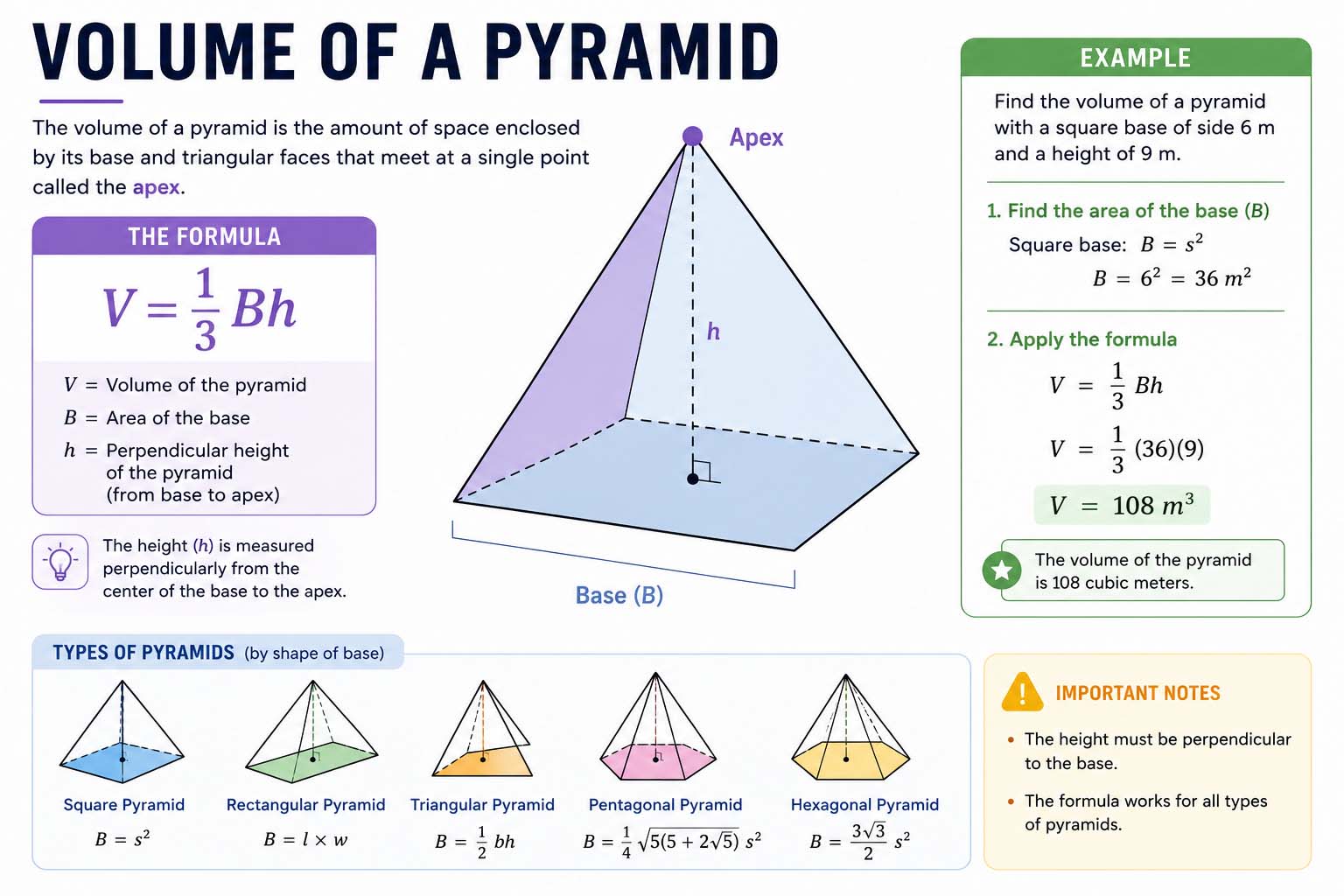
The concept of the volume of a pyramid is one of the most important topics in geometry. A pyramid is a three-dimensional shape that has a polygon base and triangular sides that meet at a single point called the apex. Learning how to calculate the volume of different types of pyramids helps students understand spatial measurements and practical applications in architecture, engineering, and design. These engineering principles are also connected to concepts like what is a simple machine, which introduces the basic mechanics used in construction and design. Whether you are studying basic geometry or preparing for advanced mathematics, understanding pyramid volume formulas is essential.
The general formula used to calculate the volume of any pyramid is:
This formula shows that the volume depends on the size of the base and the vertical height from the base to the apex. Even though different pyramids have different base shapes, the same principle applies to all of them. By understanding the structure of the base, you can solve many geometry problems with confidence.
Volume of a Triangular Pyramid
The volume of a triangular pyramid can be calculated by first finding the area of the triangular base and then multiplying it by the height of the . A triangular pyramid, also called a tetrahedron in some cases, has a triangle as its base and three triangular faces connected to the apex.
To calculate the base area of a triangle, you use the formula:
Base Area = 1/2 × base × height
After finding the triangular base area, substitute it into the pyramid volume formula. For example, if a triangular base has a base length of 8 cm and a height of 6 cm, the area of the triangle is:
1/2 × 8 × 6 = 24 square centimeters
If the pyramid height is 10 cm, then the becomes:
1/3 × 24 × 10 = 80 cubic centimeters
The volume of a triangular pyramid is commonly used in engineering and construction because triangular structures are naturally strong and stable. Similar triangular designs can also be seen in historical engineering devices such as what is a catapult, where structural stability was essential for performance. Ancient civilizations also used pyramid shapes in monuments and temples because of their durability.
Students often confuse the slant height with the vertical height when solving these problems. It is important to remember that the correct height is always the perpendicular distance from the apex to the base. Using the wrong measurement can lead to incorrect answers.
Volume of a Square Pyramid
The volume of a square is one of the easiest pyramid calculations because the base is a square. A square pyramid has four triangular sides connected to a square base, making the base area simple to calculate.
Base Area = side × side
If the square base side length is 12 cm, then the base area becomes:
If the pyramid height is 15 cm, the volume is:
1/3 × 144 × 15 = 720 cubic centimeters
The volume of a square pyramid is important in architecture and design. Famous structures such as the pyramids of Egypt are examples of square pyramids. Engineers also use square pyramid designs in modern buildings because the structure distributes weight efficiently.
Understanding this concept also helps students compare pyramids with prisms. A prism with the same base and height would have exactly three times the of the pyramid. This relationship is the reason why the formula includes the fraction one-third.
In mathematics classrooms, square pyramids are frequently used to explain how three-dimensional objects occupy space. Teachers often use models and diagrams to help students visualize how the shape narrows toward the apex.
How to Find the Volume of a Pyramid
Learning how to find the volume of a pyramid becomes easier when you follow a step-by-step method. First, determine the shape of the base. The base could be triangular, square, rectangular, or another polygon. Second, calculate the area of the base using the appropriate formula. Third, identify the perpendicular height of the pyramid. Finally, apply the formula.
For example, imagine a pyramid with a rectangular base measuring 10 cm by 6 cm and a height of 9 cm. First, calculate the base area:
10 × 6 = 60 square centimeters
Then multiply by the height:
60 × 9 = 540
Finally, divide by 3:
540 ÷ 3 = 180 cubic centimeters
This process demonstrates exactly how to find the volume of a pyramid in a simple and organized way.
Students should pay close attention to measurement units during calculations. If the dimensions are given in centimeters, the final answer should be written in cubic centimeters. Using consistent units prevents mistakes and ensures accurate results.
Pyramid volume calculations are useful in real life. Architects use them to estimate building space, while engineers use them for material calculations. Engineering students often study what is mechanical advantage alongside geometry because both subjects help explain how structures and machines work efficiently. Even in computer graphics and 3D modeling, pyramid geometry plays an important role.
Understanding geometric formulas also strengthens problem-solving skills. As students advance in mathematics, they also learn concepts like how to find expected value, which apply probability and statistics to real-world decision-making. Once students understand the logic behind the formula, they can apply it to many different shapes and mathematical challenges.
Volume of a Rectangular Pyramid
The volume of a rectangular pyramid is calculated using the same general formula, but the base is a rectangle instead of a square. The base area formula for a rectangle is:
Length × Width
Suppose a rectangular base has a length of 14 cm and a width of 9 cm. The base area becomes:
14 × 9 = 126 square centimeters
If the pyramid height is 12 cm, the volume calculation is:
1/3 × 126 × 12 = 504 cubic centimeters
The volume of a rectangular pyramid is commonly used in construction projects and storage design. Some roofs, monuments, and decorative structures are shaped like rectangular pyramids because they provide both stability and visual appeal.
In geometry, rectangular pyramids help students understand how base shapes affect volume calculations. Although the formula stays the same, the method for finding the base area changes depending on the shape.
Many students enjoy solving rectangular pyramid problems because they connect geometry with practical applications. Real-world examples make mathematical concepts easier to understand and remember.
It is also important to recognize the relationship between how to find surface area and volume. While volume measures the amount of space inside the pyramid, surface area measures the total outer covering. While volume measures the amount of space inside the pyramid, surface area measures the total outer covering. Both concepts are important in geometry and often appear together in mathematics lessons.
Conclusion
The study of the volume of a pyramid is an essential part of geometry that helps students understand three-dimensional measurement. Whether working with a triangular, square, or rectangular pyramid, the key formula remains the same: one-third multiplied by the base area and the height. By mastering these calculations, students improve their mathematical understanding and gain practical skills useful in science, engineering, and architecture.
From the volume of a triangular pyramid to the volume of a square pyramid, each shape teaches valuable geometric principles. Learning how to find the volume of a pyramid step by step makes complex problems easier to solve. Understanding the volume of a rectangular pyramid also shows how geometry applies to real-world structures and designs.
With regular practice, calculating becomes simple and enjoyable. Geometry is not only about numbers and formulas but also about understanding the shapes and structures that exist all around us every day.