Machines help humans perform tasks more efficiently by reducing the amount of force needed to move, lift, or manipulate objects. One of the most important concepts in physics, engineering, and technology is advantage.
Many students and technology enthusiasts ask, what is mechanical advantage? Understanding this concept helps explain how simple machines such as levers, pulleys, ramps, and gears make work easier.
What Is Mechanical Advantage?
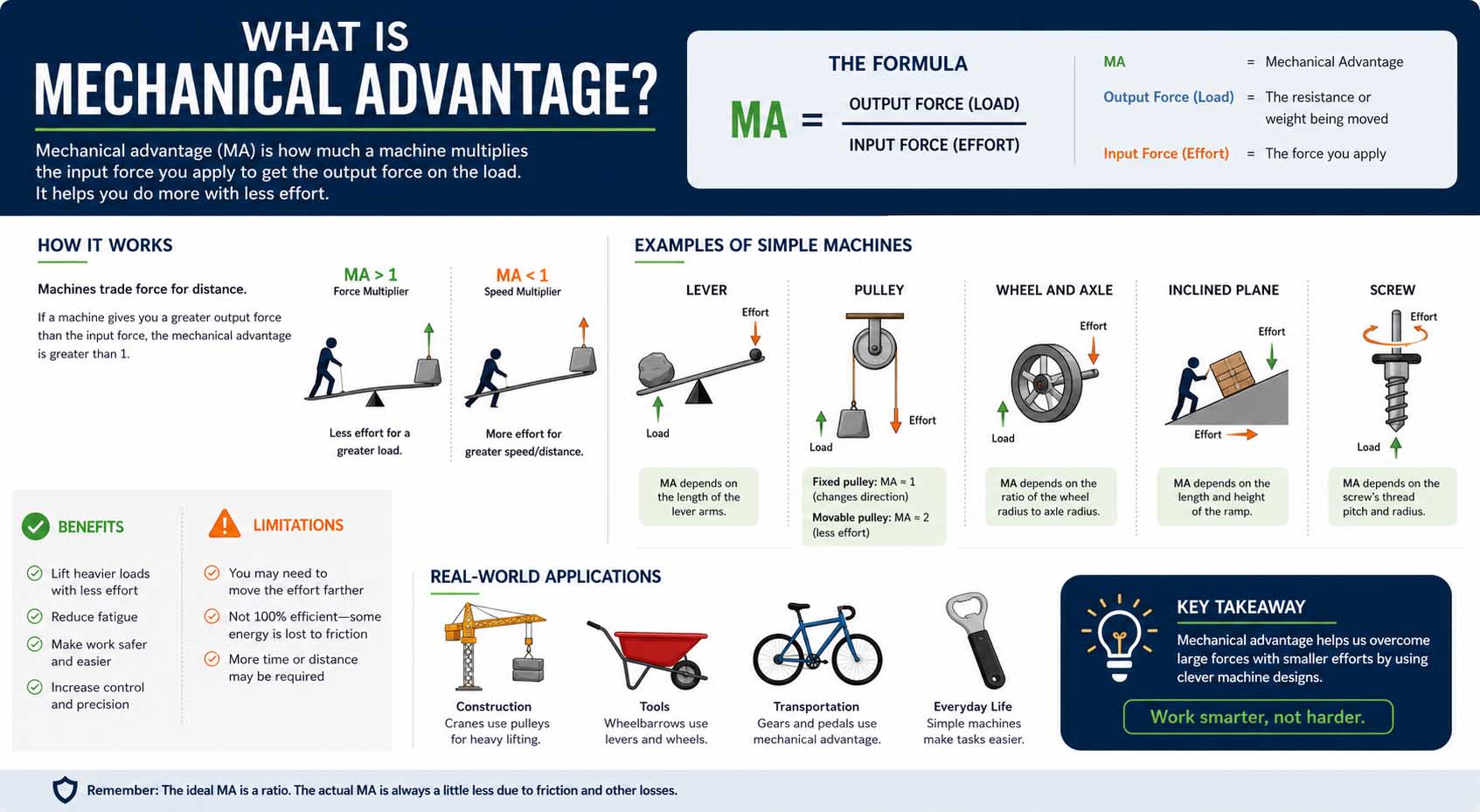
Mechanical refers to the factor by which a machine multiplies an input force.
In simple terms, it describes how much easier a machine makes a task.
A machine with a high allows a user to apply less effort while still moving a larger load.
For example:
- A crowbar helps lift heavy objects.
- A pulley system reduces lifting effort.
- A ramp makes moving heavy equipment easier.
These tools provide by changing how force is applied.
What Is a Mechanical Advantage?
Many learners search for what is a mechanical advantage because the term often appears in science and technology classes.
A is the ratio between the output force produced by a machine and the input force applied to it.
The greater the ratio, the more the machine amplifies force.
For instance, if a machine allows a person to lift a 100-pound object using only 25 pounds of effort, the machine provides a .
This principle forms the foundation of many engineering systems.
Explain What Is Meant by the Term Mechanical Advantage
To , it helps to think about everyday tools.
Imagine trying to lift a heavy rock using only your hands. The task may require significant effort.
Now imagine using a long lever.
The lever changes the force relationship, allowing you to move the same rock with much less effort.
The machine does not eliminate work entirely. Instead, it changes the way force is applied, making the task easier.
measures the effectiveness of that force multiplication.
Why Is Mechanical Advantage Important?
is essential because it helps people perform tasks that would otherwise be difficult or impossible.
Benefits include:
Reduced Effort
Machines allow users to move larger loads using less force.
Increased Efficiency
Tasks can be completed more quickly and safely.
Better Productivity
Industrial equipment relies on to handle heavy materials.
Engineering Innovation
Modern technologies often depend on optimizing advantage.
Without this principle, many machines would not function effectively.
What Is the Formula for Mechanical Advantage?
One of the most common questions is what is the formula for advantage.
The formula is:
Mechanical\ Advantage=\frac{Output\ Force}{Input\ Force}
This equation compares the force produced by a machine to the force applied by the user.
Example
Suppose:
- Output force = 200 Newtons
- Input force = 50 Newtons
This means the machine multiplies the applied force by four times.
Types of Mechanical Advantage
can be categorized into different forms.
Actual Advantage
This measures real-world machine performance.
It accounts for:
- Friction
- Energy loss
- Wear and tear
Ideal Mechanical
This assumes perfect machine efficiency without friction or losses.
Engineers often use ideal when designing systems.
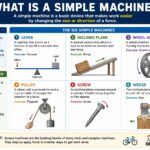
Mechanical Advantage in Simple Machines
Simple machines demonstrate clearly.
Levers
Levers use a pivot point called a fulcrum.
Longer effort arms generally produce greater .
Pulleys
Pulley systems distribute force across multiple ropes.
Additional pulleys can significantly reduce lifting effort.
Inclined Planes
Ramps reduce the force needed to raise objects by increasing the distance over which the force is applied.
Wheel and Axle
This machine converts rotational force into useful work.
Wedges
Wedges concentrate force to split or separate materials.
Screws
Real-World Examples of Mechanical Advantage
appears throughout modern technology.
Construction Equipment
Automobiles
Gears provide within transmissions.
Bicycles
Gear ratios help riders manage effort more effectively.
Manufacturing Machines
Industrial equipment relies on force multiplication to increase productivity.
Household Tools
Common tools include:
- Scissors
- Hammers
- Bottle openers
- Nutcrackers
These examples demonstrate how improves daily life.
Mechanical Advantage vs Efficiency
advantage and efficiency are related but different concepts.
| Mechanical Advantage | Efficiency |
|---|---|
| Measures force multiplication | Measures energy effectiveness |
| Focuses on input and output force | Focuses on energy losses |
| Can be high even with losses | Affected by friction and wear |
A machine may provide substantial while still losing energy due to friction.
Understanding both concepts helps engineers design better systems.
How to Increase Mechanical Advantage
Several methods can improve advantage.
Increase Lever Length
Longer levers often require less effort.
Add More Pulleys
Additional pulleys distribute force more effectively.
Optimize Gear Ratios
Proper gear design improves performance.
Reduce Friction
Lubrication and quality materials improve efficiency and effectiveness.
These strategies are widely used in engineering and technology.
Troubleshooting Mechanical Advantage Problems
Machines sometimes fail to deliver expected performance.
Excessive Friction
Friction reduces efficiency and force output.
Damaged Components
Worn gears, pulleys, or levers can lower advantage.
Incorrect Setup
Improper machine configuration may reduce effectiveness.
Overloading
Applying loads beyond design limits can create performance issues.
Regular maintenance helps preserve machine performance.
Mechanical Advantage in Modern Technology
Although the concept originated with simple machines, it remains highly relevant today.
Modern applications include:
Robotics
Robotic systems use gears and levers to perform tasks efficiently.
Aerospace Engineering
Aircraft systems rely on advantage for control surfaces.
Renewable Energy
Wind turbines use mechanical systems to transfer energy.
Medical Equipment
Many medical devices incorporate force-multiplying mechanisms.
advantage continues to drive innovation across industries.
FAQ
What is mechanical advantage?
is the ratio of output force to input force provided by a machine.
What is a mechanical advantage?
It is the amount by which a machine multiplies applied force.
What is the formula for mechanical advantage?
equals output force divided by input force.
Why is mechanical advantage important?
It reduces effort, increases efficiency, and enables machines to perform useful work.
Which machines use mechanical advantage?
Levers, pulleys, gears, ramps, screws, and many modern technologies use principles.
Conclusion
Understanding what is mechanical advantage provides valuable insight into how machines make work easier. From simple tools like levers and pulleys to advanced robotics and industrial equipment, allows humans to accomplish tasks more efficiently by multiplying force.