
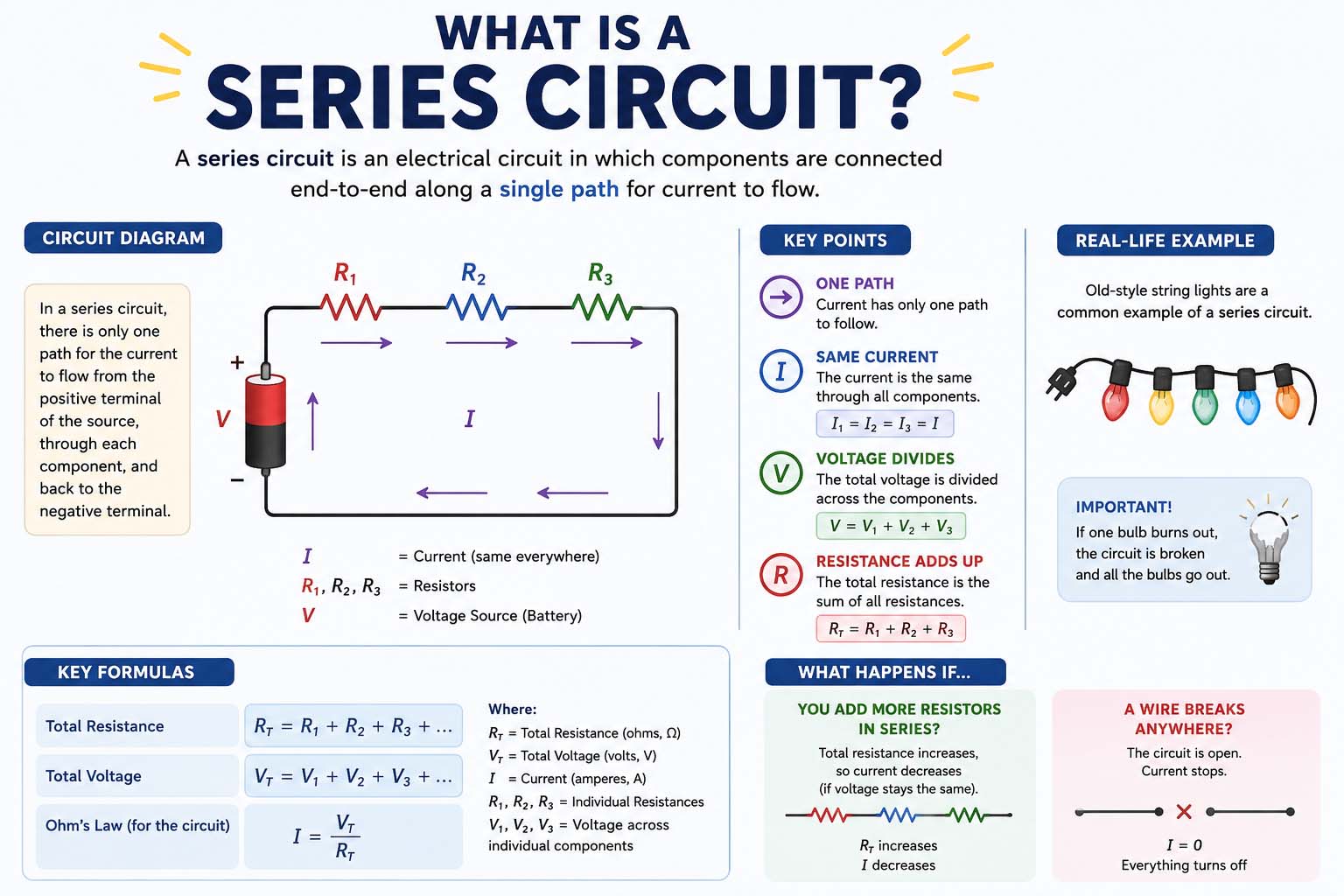
So, what is a series circuit? It is one of the most basic ideas in electronics, and it forms a key foundation of modern technology. From home gadgets to industrial systems, circuits power devices and control the flow of electricity.
Many students and beginners also ask what a parallel circuit is and how the two designs differ. For this reason, this guide covers both in simple words.
In fact, these ideas are essential for learning electronics, electrical engineering, robotics and basic technology.
Before you explore different designs, it helps to understand What Is a Circuit and how current travels through a complete electrical path.
What Is a Series Circuit?
It is an electrical setup where parts connect one after another in a single path. According to Britannica, the entire current flows through each component in this kind of pathway.
In other words, electricity passes through each part in order before it returns to the power source.
Because there is only one path, every part carries the same current.
For example, common parts include batteries, switches, light bulbs, resistors and small motors.
Teachers often explain this design first, since it is simple and easy to follow.
How Does a Series Circuit Work?
Electric current moves around in one continuous loop.
For instance, the current may flow from the battery, through a wire and a light bulb, then through a switch and back to the battery.
However, if any part of the path breaks, everything stops working.
In short, this is one of the most important features of single-path wiring.
Step-by-Step Example of a Series Circuit
Step 1: Connect the Power Source
First, a battery supplies the electrical energy.
Step 2: Add Components
Next, you connect parts like bulbs or resistors in a single line.
Step 3: Complete the Loop
Then, wires close the electrical path.
Step 4: Turn On the Circuit
Finally, electricity flows through every connected part.
As a result, if one bulb fails, all the bulbs on that path turn off.
What Is a Series Circuit? Simple Beginner Explanation
For beginners, imagine this setup as a single road.
Every car must follow the same route. So, if the road gets blocked, traffic stops completely.
Similarly, electricity has only one available route, and a break anywhere stops the flow.
Advantages of a Series Circuit
This design offers several benefits.
Easy to Build
It needs fewer wires and a simpler layout.
Beginner-Friendly
Because it is so simple, schools often use it for demonstrations.
Lower Cost
In addition, it usually needs fewer materials than complex systems.
Predictable Current Flow
The same current passes through every part.
Understanding Volts vs Amps also shows why the current stays the same everywhere while the voltage splits between parts.
Therefore, many basic electronics projects use this simple layout.
Disadvantages of a Series Circuit
On the other hand, this design has some limits.
One Failure Stops Everything
If one part breaks or burns out, the whole path opens and every device turns off.
Voltage Is Shared
Each part gets only a share of the total voltage.
Less Flexible
Also, devices cannot run on their own.
For these reasons, this design is less practical for large modern electrical systems.
What Is the Difference Between a Series and Parallel Circuit?
One of the most searched questions is how these two designs differ.
The biggest difference is the number of electrical paths.
| Feature | Series Circuit | Parallel Circuit |
|---|---|---|
| Current Path | Single path | Multiple paths |
| Component Independence | No | Yes |
| Failure Impact | Entire circuit stops | Other devices continue |
| Wiring Complexity | Simpler | More complex |
| Voltage Distribution | Shared | Equal across branches |
Homes mostly use parallel wiring, because each device can work on its own.
A more detailed look at Series vs Parallel wiring shows when each design is the better choice.
What Is a Series Circuit and a Parallel Circuit?
These are the two basic types of electrical connections.
Series Circuit
Parts connect one after another on a single path.
Parallel Circuit
In contrast, parts connect across several separate branches.
Often, modern systems combine both methods for better efficiency and flexibility.
What Is a Series Parallel Circuit?
A series-parallel circuit mixes both connection types in the same system.
As a result, engineers can balance power distribution, reliability, efficiency and device independence.
For example, cars, computers, factory machines and consumer electronics all use this mixed design.
Overall, large electrical systems usually rely on mixed layouts instead of only one type.
Real-World Examples of Series Circuits
This simple wiring appears in several everyday technologies.
For instance, you will find it in flashlights, basic string lights, battery toys and simple school science kits.
In the past, older holiday lights often used this wiring, so all the bulbs went out when one failed.
Real-World Examples of Parallel Circuits
Parallel wiring is more common in modern technology.
For example, it powers home wiring, office lighting, computer power systems and smartphones.
Thus, these systems stay reliable, because each device keeps working on its own.
Troubleshooting a Series Circuit
Single-path wiring is easier to troubleshoot, since there is only one route to check.
Problem: Entire Circuit Stops Working
A broken wire, a dead battery or a failed part usually causes this problem.
Problem: Dim Lights
A weak battery can cause dim lights. Likewise, too many parts sharing the voltage can make each bulb glow less.
Understanding How to Calculate Watts also helps you check whether the battery supplies enough power for every connected part.
Problem: Overheating
Too much resistance or parts with the wrong ratings can make things heat up.
In most cases, checking each connection one by one finds the issue quickly.
How to Build a Simple Series Circuit
Building a beginner version is easy.
Although circuits and simple machines are different topics, learning What Is Mechanical Advantage helps beginners see how engineering ideas work together in STEM projects.
Materials Needed
You only need a battery, some wires, a light bulb and a switch.
Process
First, connect the battery to the bulb. Next, place the switch in line with the wire. Then, turn on the switch to let the current flow.
Consequently, many schools use this small project to teach electrical basics.
Why Understanding Circuits Matters in Technology
Circuit knowledge supports many modern careers and technologies.
For example, it helps in robotics, engineering, computer hardware and renewable energy. Similarly, it supports smart devices and automation technology.
Even beginner ideas build a strong base for advanced technical learning.
Common Mistakes Beginners Make
New learners often make a few common mistakes.
Incorrect Connections
Loose wires stop the current from flowing.
Using Wrong Components
Parts with the wrong voltage rating can get damaged.
Confusing Series and Parallel Designs
Beginners sometimes create mixed layouts by accident.
Ignoring Polarity
Some electronic parts must face the correct direction.
Above all, careful assembly helps you avoid these problems.
Why Series Circuits Are Still Important in 2026
Even though modern systems often use parallel wiring, single-path designs still matter for education, basic electronics, testing and simple devices.
Moreover, they help students learn more advanced electrical ideas later.
FAQ About What Is a Series Circuit
What is a series circuit?
It is a setup where parts connect in one continuous electrical path.
What happens if one component fails?
Everything stops working, because the only path breaks.
What is the difference between a series and parallel circuit?
One design uses a single path, while the other uses several paths.
What is a series parallel circuit?
It combines both connection types in one system.
Are series circuits used in homes?
Most homes use parallel wiring, since devices need to work on their own.
Conclusion
To sum up, learning what is a series circuit is an important first step in electronics. It shows clearly how electricity flows, how voltage splits and how parts connect.
Although modern systems often rely on parallel designs, single-path wiring remains useful for education, troubleshooting and beginner projects. Ultimately, knowing both designs gives students a strong base for future technical skills.