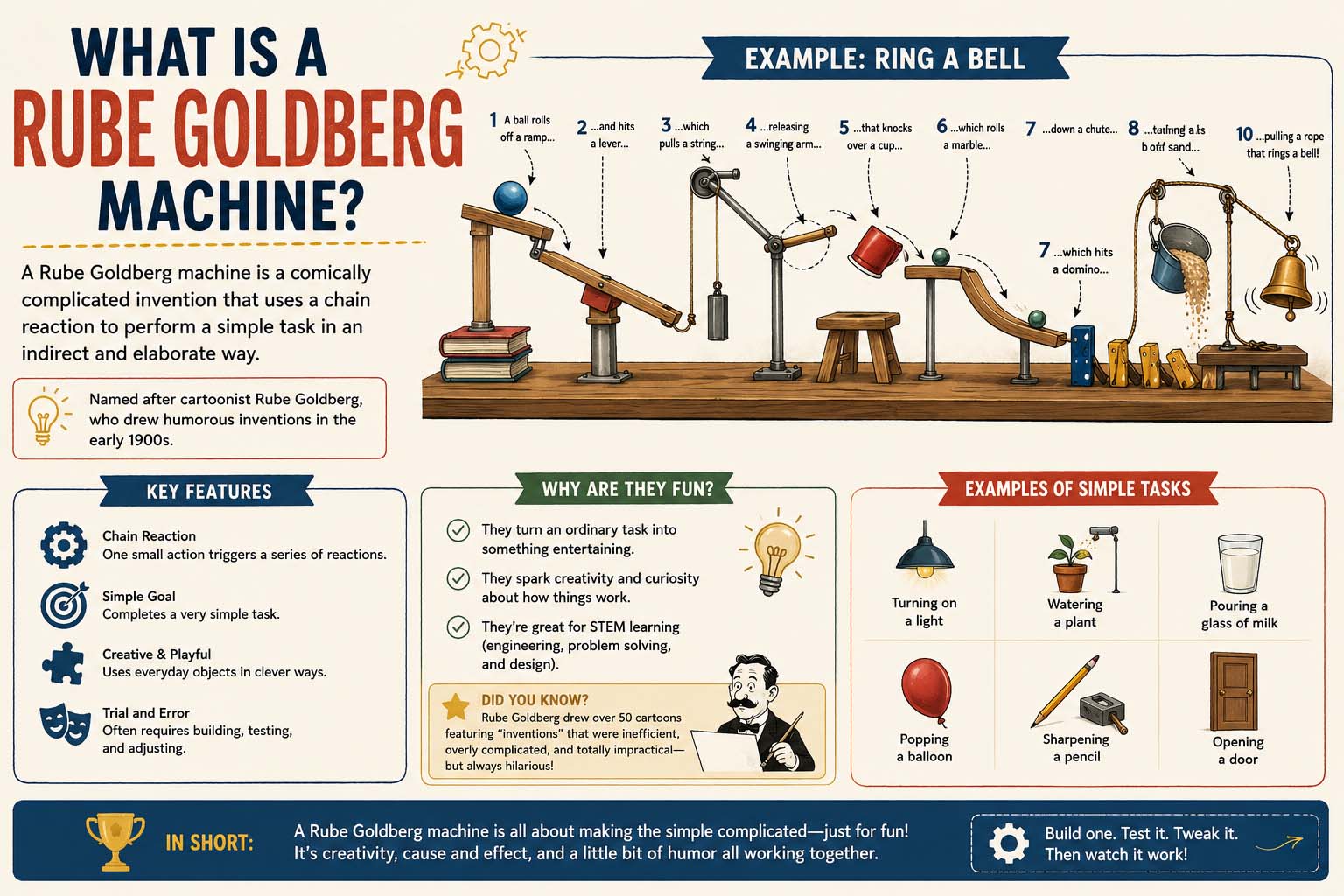
So, what is a Rube Goldberg machine? It is a complicated chain reaction that uses a series of simple actions to finish an easy task. It often uses balls, dominoes, ramps, pulleys, levers and other everyday items that work together in a creative order. People build these machines for fun, education and physics demos, because they show how one small action can trigger many others until the final result happens.
As a result, many students, teachers, engineers and hobbyists look up this idea, since these devices often appear in science projects, STEM classes and creative engineering challenges.
What Is a Rube Goldberg Machine?
The answer to what is a Rube Goldberg machine is quite simple.
It is a device that does a simple task through a long series of chain reactions. Instead of reaching the goal directly, the machine uses many linked steps that trigger one another until the last action happens.
For example, a machine built to turn off a light switch might use a rolling ball, a falling domino and a swinging lever. After that, a moving toy car and a pulley system could finish the job.
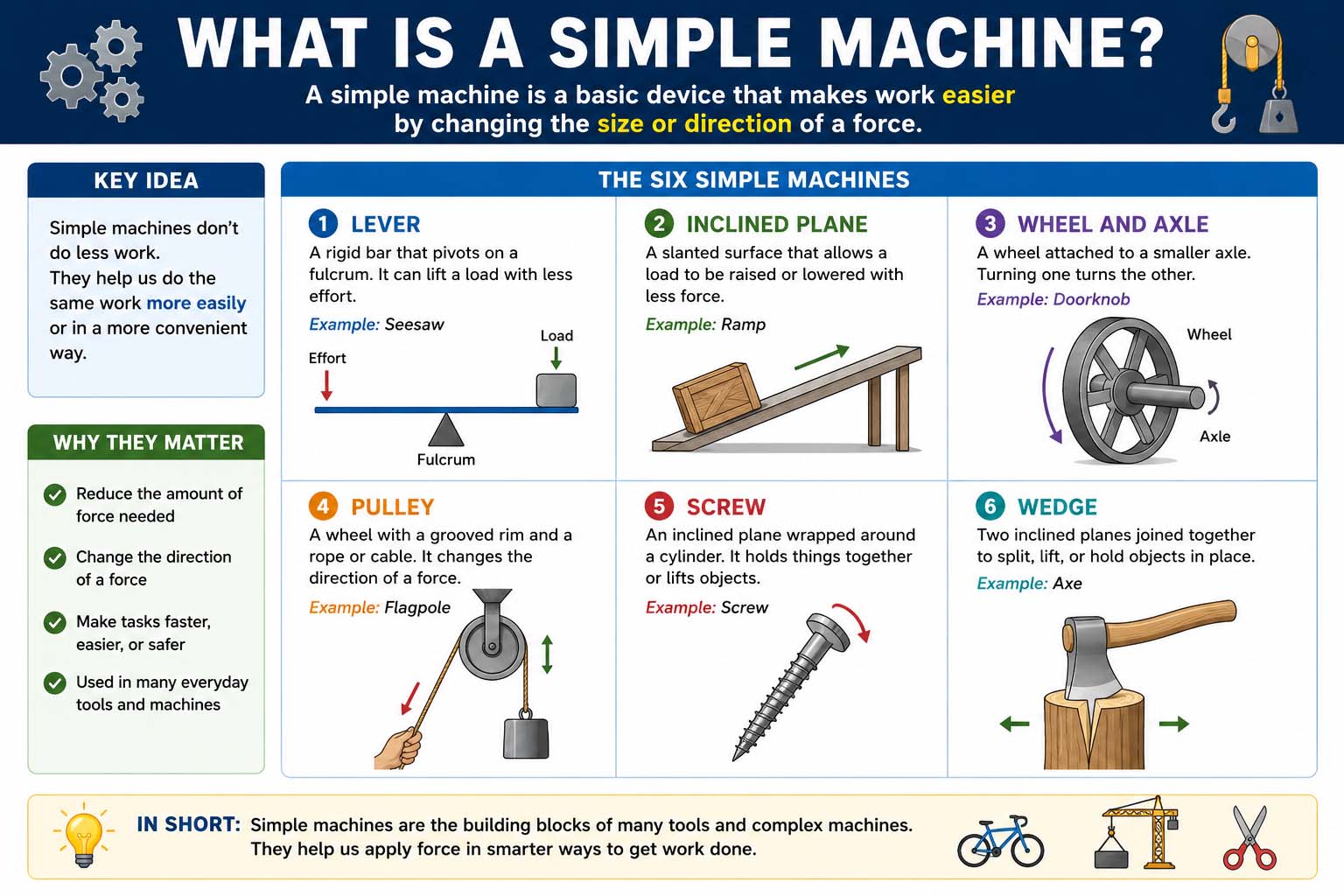
Levers and pulleys are classic examples covered in our guide on What Is a Simple Machine, so they are common building blocks in these designs.
In other words, each action causes the next one until the machine reaches its final goal.
Interestingly, the idea takes its name from Rube Goldberg, who became famous for his funny cartoons of overly complicated machines.
The History Behind Rube Goldberg Machines
Rube Goldberg was an American cartoonist who drew elaborate machines that did ordinary tasks in needlessly complicated ways. According to Britannica, his name became a byword for any simple process made outlandishly complicated.
His cartoons became very popular because they showed, with humor, how people sometimes overcomplicate simple problems.
Over time, people started using the term for any process or device that takes too many steps to reach a basic result.
Today, you will find these machines in STEM education, engineering competitions and science fairs. In addition, they show up in robotics projects and technology demos.
What Is the Purpose of a Rube Goldberg Machine?
A common question is what is the purpose of a Rube Goldberg machine.
Although these machines look inefficient, they serve several educational and practical purposes.
Teaching Engineering Concepts
Students learn how mechanical systems work together and affect one another.
Demonstrating Physics Principles
These builds show gravity, motion, momentum, energy transfer, friction and force in action.
Learning What Is Mechanical Advantage also explains how simple machines reduce effort while they pass force through different parts of the sequence.
Encouraging Creativity
Builders must think creatively to link many actions into one working system.
Improving Problem-Solving Skills
Every part must work correctly, otherwise the whole machine fails.
Therefore, these machines make great learning tools, even though their designs are complicated on purpose.
How Does a Rube Goldberg Machine Work?
This kind of machine relies on a chain reaction.
One action triggers another, which triggers another, until the final task is done.
For instance, a marble rolls down a ramp and hits a row of dominoes. Then, the dominoes knock over a lever, and the lever releases a toy car. Next, the toy car pulls a string. Finally, the string turns off a light switch.
The task itself is simple, whereas the path to finish it is complex on purpose.
Because of this mix of creativity and engineering, these machines are fun to build and watch.
What Is a Step in a Rube Goldberg Machine?
Many learners ask, what is a step in a Rube Goldberg machine?
A step is one single action inside the chain reaction. In fact, each step works like a link that connects one event to the next.
Common steps include rolling a ball, tipping over dominoes and moving a lever. Similarly, pulling a string, triggering a pulley and releasing a weight all count as steps.
A successful build usually has many carefully planned steps that work together without a break.
Above all, the more creative and reliable the sequence, the more impressive the machine becomes.
How to Build a Rube Goldberg Machine
Building one can be a fun technology project for any age.
Step 1: Choose a Simple Final Task
First, pick a basic goal, such as ringing a bell, turning off a light, opening a box or popping a balloon.
Step 2: Plan the Chain Reaction
Next, sketch how each action will trigger the next one.
Step 3: Gather Materials
Then, collect your materials. Balls, dominoes, toy cars, ramps, strings, cups and pulleys all work well.
Step 4: Build Individual Sections
After that, test each section on its own before you connect them.
Step 5: Connect the Entire System
Once every section works, join all the parts into one continuous sequence.
Step 6: Test and Improve
Lastly, expect to make changes, because most machines need adjustments before they run smoothly.
In short, patience and trial and error are important parts of the design process.
Rube Goldberg Machines and Technology Education
Schools use these machines a lot in modern technology education.
Teachers often assign these projects, because they combine several STEM subjects at once.
These mixed projects also introduce students to What Is Mechatronics, where mechanical systems, electronics, sensors and programming work together to solve real engineering problems.
Students learn engineering design, critical thinking and physics principles. Likewise, they learn about mechanical systems and how to work as a team.
Unlike traditional lectures, hands-on projects help students understand ideas through direct experience. Consequently, this practical approach stays very effective.
Comparison: Simple Machine vs Rube Goldberg Machine
It helps to understand the difference between a standard machine and a Rube Goldberg design.
| Feature | Simple Machine | Rube Goldberg Machine |
|---|---|---|
| Efficiency | High | Low |
| Number of Steps | Few | Many |
| Purpose | Practical | Educational/Creative |
| Design Complexity | Simple | Complex |
| Problem Solving | Direct | Indirect |
| Entertainment Value | Moderate | High |
Simple machines focus on efficiency, while these chain-reaction builds focus on creativity and demonstration.
Common Problems and Troubleshooting
Building a working machine often takes some troubleshooting.
Dominoes Fail to Fall
Keep the spacing even, and make sure each domino stands firmly.
Ball Stops Rolling
Check the ramp angles, and reduce friction where you can.
Lever Doesn’t Move
Look at how the weight sits on the lever and where you placed the pivot.
Chain Reaction Stops Midway
Test each section by itself to find the exact point of failure.
Timing Issues
Change the distances and speeds between steps until the timing feels right.
Overall, troubleshooting is a key part of engineering, and it helps builders grow strong problem-solving skills.
Popular Rube Goldberg Machine Examples
Many famous examples have appeared in ads, science fairs and viral videos.
Common projects include turning off a light, pouring a drink and feeding a pet. Besides these, builders often make machines that open a door or launch a toy.
Some advanced projects even add a What Is a Catapult mechanism to launch light objects as part of the chain reaction.
Meanwhile, large machines may have hundreds of steps and take months of planning and testing. Thus, these projects show both creativity and technical skill.
Why Rube Goldberg Machines Remain Popular
Even though they are inefficient on purpose, these machines keep drawing attention, because they mix science, technology, engineering, art and fun.
People enjoy watching chain reactions unfold, since each successful step builds excitement for the next one.
Moreover, the machines show how simple physical rules can create surprisingly complex results.
Some designs also use a What Is a Flywheel to store spinning energy and create smoother motion between stages.
As STEM education keeps growing, these projects stay valuable tools for sparking curiosity and new ideas.
Frequently Asked Questions
What is a Rube Goldberg machine?
It is a device that does a simple task through a complicated series of chain reactions.
What does Rube Goldberg machine mean?
The term describes a machine that is complex on purpose and uses many linked steps to finish a basic action.
What is the purpose of a Rube Goldberg machine?
Its purpose is often educational, since it helps students learn engineering, physics, creativity and problem solving.
What is a step in a Rube Goldberg machine?
A step is one action that triggers the next action in the chain reaction.
Are Rube Goldberg machines used in real engineering?
Real engineering puts efficiency first. However, schools and companies widely use these projects for education, demos and creative design challenges.
Conclusion
To sum up, understanding what is a Rube Goldberg machine gives you useful insight into engineering, physics and creative problem solving. These fun devices turn simple tasks into elaborate chain reactions, and they teach important STEM ideas along the way.