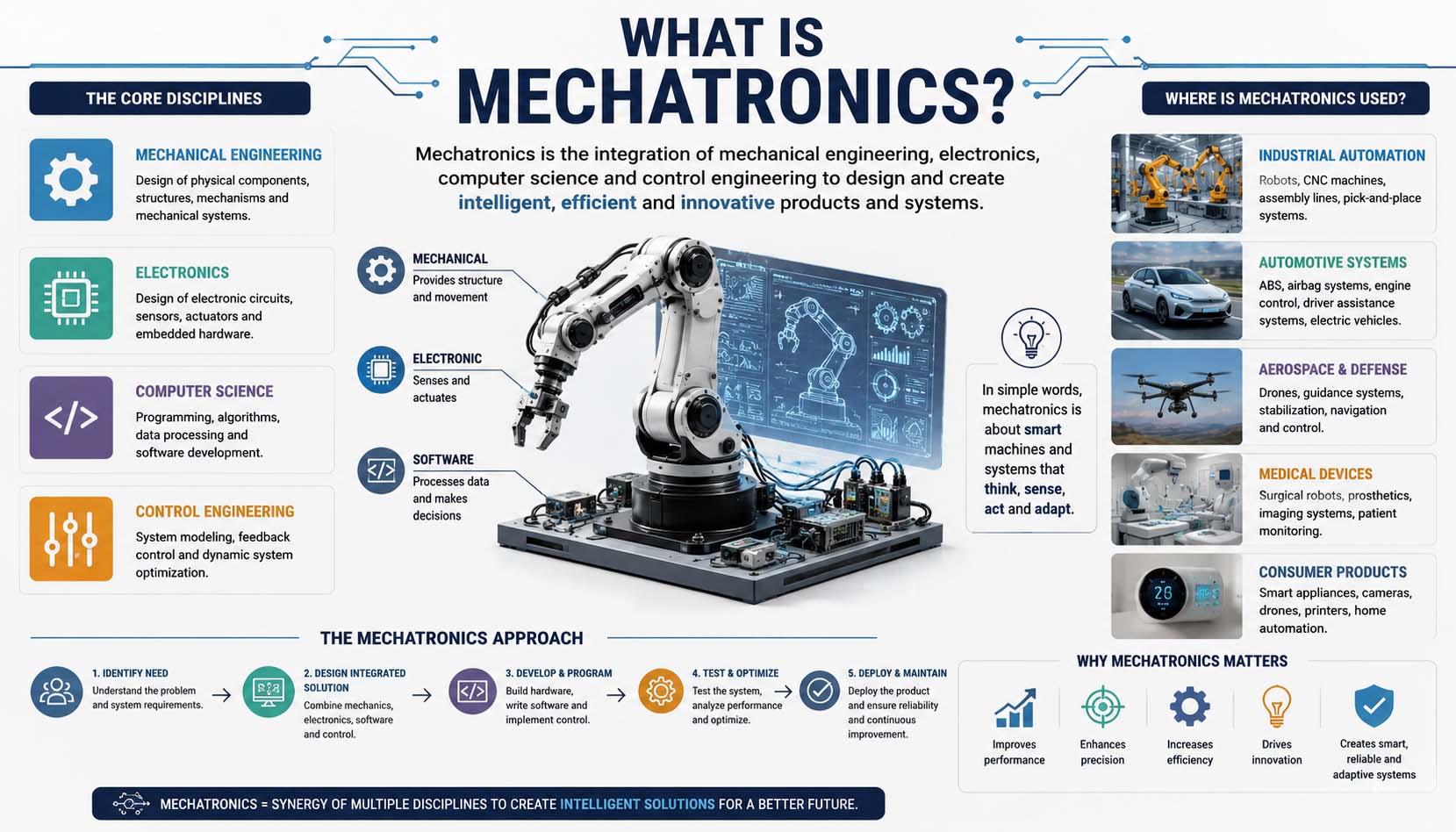
Many students and tech fans ask what is mechatronics, because this field blends several types of engineering into one smart system. In short, it combines mechanical engineering, electronics, computer programming, robotics and automation.
Today, industries rely on it for robotics, manufacturing, artificial intelligence, smart devices and factory automation. As a result, it remains one of the most important engineering fields, especially as technology keeps changing so fast.
What Is Mechatronics Engineering?
One of the most common questions is, “what is mechatronics engineering?” Simply put, engineers in this field combine knowledge of mechanical systems, electrical circuits, software, sensors, control systems and robotics.
Instead of working with just one type of technology, they build systems where hardware and software work together smoothly. For example, they create industrial robots, smart factory machines, self-driving vehicles, medical robots, drones and smart home devices.
Many of these systems use brushless motors. In fact, learning the brushless motor meaning helps explain why these motors suit automated equipment so well, since they offer high efficiency, precise control and low maintenance.
Therefore, this mix of skills makes it one of the most flexible engineering careers today.
How Mechatronics Works
These systems work by joining several technologies into one automated process. Generally, a basic system has four main parts.
Sensors
First, sensors collect information from the environment. For example, temperature, motion and pressure sensors all feed data into the system.
Controllers
Next, controllers process that information and make decisions. Usually, microcontrollers or computers handle this job.
In addition, many automated machines use open loop vs closed loop control to decide whether they need feedback to run accurately.
Actuators
Then, actuators create physical movement based on the controller’s commands. For instance, motors, hydraulic systems and pneumatic devices all act as actuators.
Software
Finally, software tells the system how to respond in different situations. Together, these four parts create intelligent automation.
Also, understanding what is impedance helps engineers design circuits, sensors and motors that work reliably inside these systems.
What Is a Mechatronics Engineer?
Another key question is, “what is a mechatronics engineer?” This engineer designs, builds and maintains automated systems and smart machines.
For example, their daily work may include programming robots, designing control systems and building automation equipment. They also troubleshoot machinery, test electronic systems and improve manufacturing processes.
Moreover, they work in many industries, such as automotive manufacturing, aerospace, robotics, healthcare technology, consumer electronics and renewable energy. Because automation keeps spreading worldwide, demand for these engineers stays strong.
What Is a Mechatronics Technician?
People also ask, “what is a mechatronics technician?” A technician focuses more on installing, maintaining, repairing and testing automated systems.
According to the U.S. Bureau of Labor Statistics, these technicians set up, repair and test machines that combine mechanical parts with electrical and computer controls, including robotic equipment.
For example, technicians work directly with robotic machines, automated production lines, industrial equipment, electrical systems, sensors and motors. While engineers usually design systems, technicians keep them running.
As a result, this role matters a lot in factories, warehouses and plants where automated machines must run efficiently.
Industries That Use Mechatronics
This technology now appears in many industries.
Manufacturing
Factories use automated robots to improve production speed and accuracy.
Automotive Industry
Modern vehicles also include advanced systems for safety and automation. For example, self-driving features, electronic braking and smart sensors all rely on it.
Healthcare
In hospitals, medical robots assist with surgery and patient care.
Consumer Electronics
Similarly, smartphones, smart appliances and wearable devices use the same ideas.
Aerospace
Aircraft systems also rely heavily on automation and control technology. Therefore, as smart technology grows, the field keeps getting more important worldwide.
Mechatronics vs Robotics
People often confuse the two fields. However, although they are connected, they are not identical.
| Mechatronics | Robotics |
|---|---|
| Broad engineering field | Specialized branch |
| Includes automation systems | Focuses mainly on robots |
| Combines multiple technologies | Robot-centered systems |
| Used across industries | Primarily robotics applications |
In fact, robotics is just one part of this broader field, which covers a much wider range of technologies.
Skills Needed for Mechatronics
Students interested in this field should build several important skills.
Programming Knowledge
Coding is essential for automation systems. For example, popular languages include Python, C++ and MATLAB.
Problem-Solving
In addition, engineers constantly troubleshoot mechanical and electronic issues.
Electronics Understanding
Basic circuit knowledge is also extremely important.
Mechanical Design
Likewise, understanding machine parts helps improve system performance.
Communication Skills
Finally, many projects need teamwork between engineers and technicians. As a result, these skills open up many more career opportunities.
Benefits of Mechatronics
This field offers many advantages for both industries and workers.
Improved Efficiency
First, automation speeds up production and reduces errors.
Better Precision
Second, machines perform tasks more accurately than manual systems.
Career Opportunities
Third, the field offers strong job demand and competitive pay.
Innovation Potential
Moreover, it supports new technologies like AI and robotics.
Cross-Industry Flexibility
Also, your skills can move between many industries. For these reasons, the field keeps growing quickly.
Common Mechatronics Problems and Troubleshooting
Automated systems sometimes run into technical issues. Fortunately, most have simple first steps.
Sensor Failures
Wrong sensor readings can hurt system accuracy. So inspect the sensor wiring and calibration settings first.
Software Errors
Programming bugs may disrupt automation. In that case, update or debug the control software.
Motor Malfunctions
Motors may overheat or lose efficiency. Therefore, check the electrical connections and cooling systems.
Communication Problems
Devices may fail to exchange data correctly. If that happens, inspect the network settings and hardware connections. Overall, strong troubleshooting skills are critical in this career.
How to Start Learning Mechatronics
Beginners can learn this field step by step.
Step 1: Learn Basic Electronics
First, understand circuits, voltage and electrical components.
Step 2: Study Programming
Next, learn beginner coding languages that automation uses.
Step 3: Explore Robotics Kits
Then, practice with Arduino and Raspberry Pi projects, because they are excellent for learning.
Step 4: Understand Mechanical Systems
After that, learn how motors, gears and actuators work. Also, studying what is mechanical advantage shows how gears, levers and other parts reduce effort.
Step 5: Build Small Projects
Finally, hands-on projects build real understanding. In addition, learning the reverse engineering meaning helps you see how existing machines work, so you can build and improve your own.
Future of Mechatronics Technology
The future of this field looks very promising. For example, artificial intelligence, smart robotics, self-driving vehicles and smart cities all depend on it. Factory automation and advanced healthcare machines also need it.
As industries keep modernizing, it will stay central to new technology. Moreover, many experts believe automation will create even more demand for skilled workers in the coming years.
FAQ About Mechatronics
What is mechatronics?
It is a technology field that combines mechanical engineering, electronics, software and automation systems.
What is mechatronics engineering?
This branch of engineering focuses on designing intelligent automated systems and machines.
What is a mechatronics engineer?
This engineer develops and improves robots, automation systems and smart technologies.
What is a mechatronics technician?
A technician installs, repairs and maintains automated machines and control systems.
Is mechatronics a good career?
Yes. It offers strong job opportunities, because the automation and robotics industries keep growing.
What industries use mechatronics?
Manufacturing, healthcare, automotive, aerospace, robotics and electronics all use these systems.
Conclusion
Understanding what is mechatronics helps explain how modern technology works in today’s automated world. By combining mechanical engineering, electronics, software and robotics, this field creates smart machines. As a result, it improves efficiency and productivity across countless industries.