
What is a parallel circuit? Electric circuits power nearly every device we use daily, from home lighting systems to computers and smartphones. Understanding how these circuits work is an important part of learning basic electronics and electrical technology.
Before learning about different circuit designs, it’s helpful to understand What Is a Circuit and how electrical current flows through a complete path.
One of the most common questions beginners ask is: what is a parallel circuit? Parallel circuits are widely used because they provide reliable power distribution and allow multiple devices to operate independently.
What Is a Parallel Circuit?
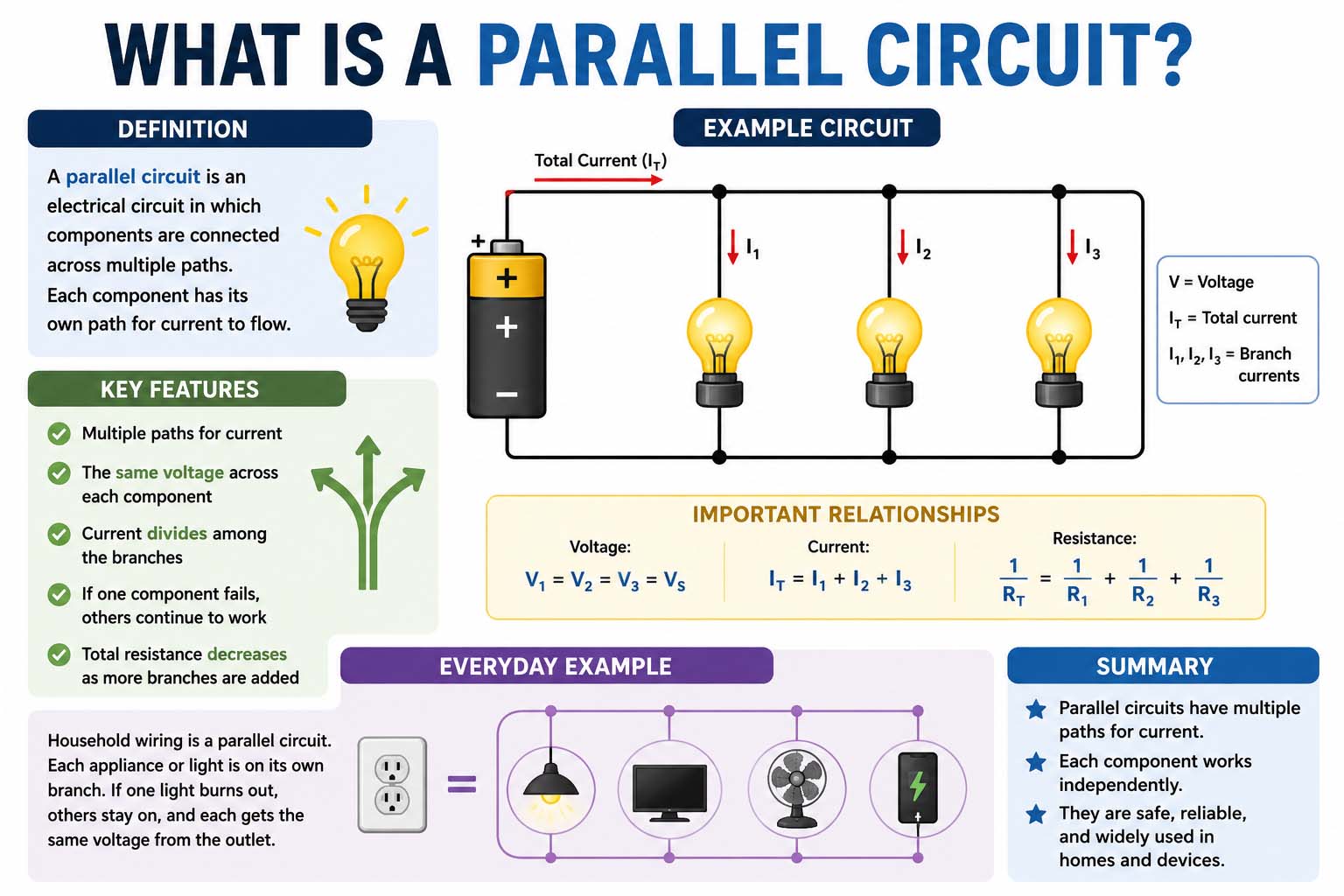
A parallel circuit is an electrical circuit in which components are connect across multiple paths.
Unlike a simple that provides only one path for electrical current, a circuit offers several paths through which electricity can flow.
In a parallel circuit:
- Each component receives the same voltage.
- Current is divided among different branches.
- One component can fail without stopping the others from working.
This design makes parallel circuits highly practical for homes, offices, vehicles, and electronic systems.
How Does a Parallel Circuit Work?
To understand how a circuit functions, imagine several roads leading to the same destination.
Instead of forcing all traffic through a single road, vehicles can travel along multiple routes.
Electricity behaves similarly.
When current reaches a junction in a , it splits and travels through separate branches. After passing through each component, the current rejoins before returning to the power source.
This allows devices connected to different branches to operate independently.
Basic Components of a Parallel Circuit
A typical includes:
Power Source
This may be a battery, power supply, or electrical outlet.
Conductors
Wires carry electrical current throughout the circuit.
Loads
Loads include devices such as:
- Light bulbs
- Motors
- Fans
- Electronic components
Switches
Switches control the flow of electricity through specific branches.
Real-World Examples of Parallel Circuits
Parallel circuits are extremely common because they offer flexibility and reliability.
Examples include:
Home Lighting Systems
Most residential lighting uses parallel wiring.
If one bulb burns out, the remaining lights continue working.
Electrical Outlets
Power outlets in homes are connected in parallel.
Each outlet can operate independently.
Automotive Electrical Systems
Modern vehicles rely on parallel circuits for lights, radios, sensors, and accessories.
Computer Systems
Many electronic components inside computers utilize parallel power distribution.
Advantages of a Parallel Circuit
Several benefits explain why parallel circuits are widely used.
Independent Operation
Each device functions separately from others.
Consistent Voltage
Every branch receives the same voltage from the power source.
Understanding Volts vs Amps also helps explain why voltage remains constant across each branch while the current is divided between them.
Increased Reliability
Failure in one branch usually does not affect the entire system.
Easier Expansion
Additional devices can often be added without redesigning the entire circuit.
Disadvantages of a Parallel Circuit
Although parallel circuits offer many benefits, they also have limitations.
More Wiring Required
Parallel circuits generally require additional wires compared to series circuits.
Increased Complexity
Larger systems can become more complicated to design and maintain.
Higher Current Demand
Total current consumption increases as more branches are added.
What Is the Difference Between a Series and Parallel Circuit?
Many beginners ask: what is the difference between a series and parallel circuit?
The primary difference involves how components are connected.
| Feature | Series Circuit | Parallel Circuit |
|---|---|---|
| Current Path | One path | Multiple paths |
| Voltage Distribution | Shared between components | Same across all branches |
| Component Failure | Entire circuit stops | Other branches continue working |
| Wiring Complexity | Simpler | More complex |
| Common Applications | Small electronic projects | Homes and buildings |
Because of their reliability, parallel circuits are generally preferred in modern electrical systems.
What Is a Series Circuit and a Parallel Circuit?
Understanding both circuit types helps build a stronger foundation in electronics.
Series Circuit
In a series circuit:
- Components are connected one after another.
- Current follows a single path.
- Failure of one component interrupts the entire circuit.
Learning What Is a Series Circuit makes it easier to understand why a single failed component can stop the entire circuit from operating.
Circuit
In a parallel circuit:
- Components are connected across multiple branches.
- Current divides between paths.
- Components operate independently.
Many educational electronics projects demonstrate both configurations to help students understand electrical principles.
What Is a Series Parallel Circuit?
Another common question is: what is a series parallel circuit?
A series-circuit combines elements of both circuit types.
In this design:
- Some components are connected in series.
- Other components are connected in parallel.
This hybrid approach is widely used in:
- Industrial equipment
- Consumer electronics
- Automotive systems
- Electrical control panels
Series-parallel circuits provide greater flexibility while maintaining efficient power distribution.
Step-by-Step Guide to Building a Simple Parallel Circuit
Building a basic can help beginners understand the concept.
Step 1: Gather Materials
You will need:
- Battery
- Two light bulbs
- Electrical wires
- Switch (optional)
Step 2: Connect the Battery
Attach wires to the positive and negative terminals.
Step 3: Create Multiple Branches
Connect each bulb on its own separate branch.
Step 4: Complete the Circuit
Ensure both branches reconnect to the power source.
Step 5: Test the Circuit
Both bulbs should illuminate simultaneously.
If one bulb is removed, the other should continue operating.
Troubleshooting Common Parallel Circuit Problems
Even simple circuits may experience issues.
One Device Not Working
Possible causes include:
- Loose wiring
- Damaged component
- Faulty connection
Inspect the affected branch carefully.
Uneven Performance
Check for:
- Incorrect wiring
- Power supply limitations
- Damaged conductors
Entire Circuit Not Functioning
Verify:
- Battery charge
- Main connections
- Power source integrity
Overheating Wires
Overheating may indicate excessive current draw or undersized wiring.
Always use appropriately rated components.
Applications of Parallel Circuits in Modern Technology
Parallel circuits remain essential in today’s technology landscape.
Smart Homes
Connected devices rely on parallel electrical systems.
Many smart home devices also rely on Open Loop vs Closed Loop control systems to automate lighting, heating, and other electrical functions.
Data Centers
Servers require reliable power distribution.
Renewable Energy Systems
Solar power installations frequently use parallel configurations.
When designing solar installations, knowing How to Calculate Watts helps determine the power requirements for panels, batteries, and connected electrical loads.
Consumer Electronics
Many modern devices contain internal designs.
These applications demonstrate the importance of understanding circuit fundamentals.
Why Parallel Circuits Are Important
Parallel circuits improve:
- Reliability
- Safety
- Device independence
- Power distribution efficiency
Without parallel circuits, many modern electrical systems would be far less practical and dependable.
Their widespread use makes them one of the most important concepts in electrical engineering and electronics.
FAQ
What is a parallel circuit?
A parallel circuit is an electrical circuit that provides multiple paths for current to flow.
Why are parallel circuits used in homes?
They allow lights and appliances to operate independently while receiving the same voltage.
What happens if one component fails?
Other branches usually continue functioning normally.
What is the difference between a series and parallel circuit?
A series circuit has one current path, while a parallel circuit has multiple paths.
What is a series parallel circuit?
It is a combination of both series and parallel connections within the same electrical system.
Conclusion
Understanding what is a parallel circuit is essential for anyone learning about electricity, electronics, or modern technology. Parallel circuits allow electrical current to travel through multiple paths, making systems more reliable, efficient, and flexible.