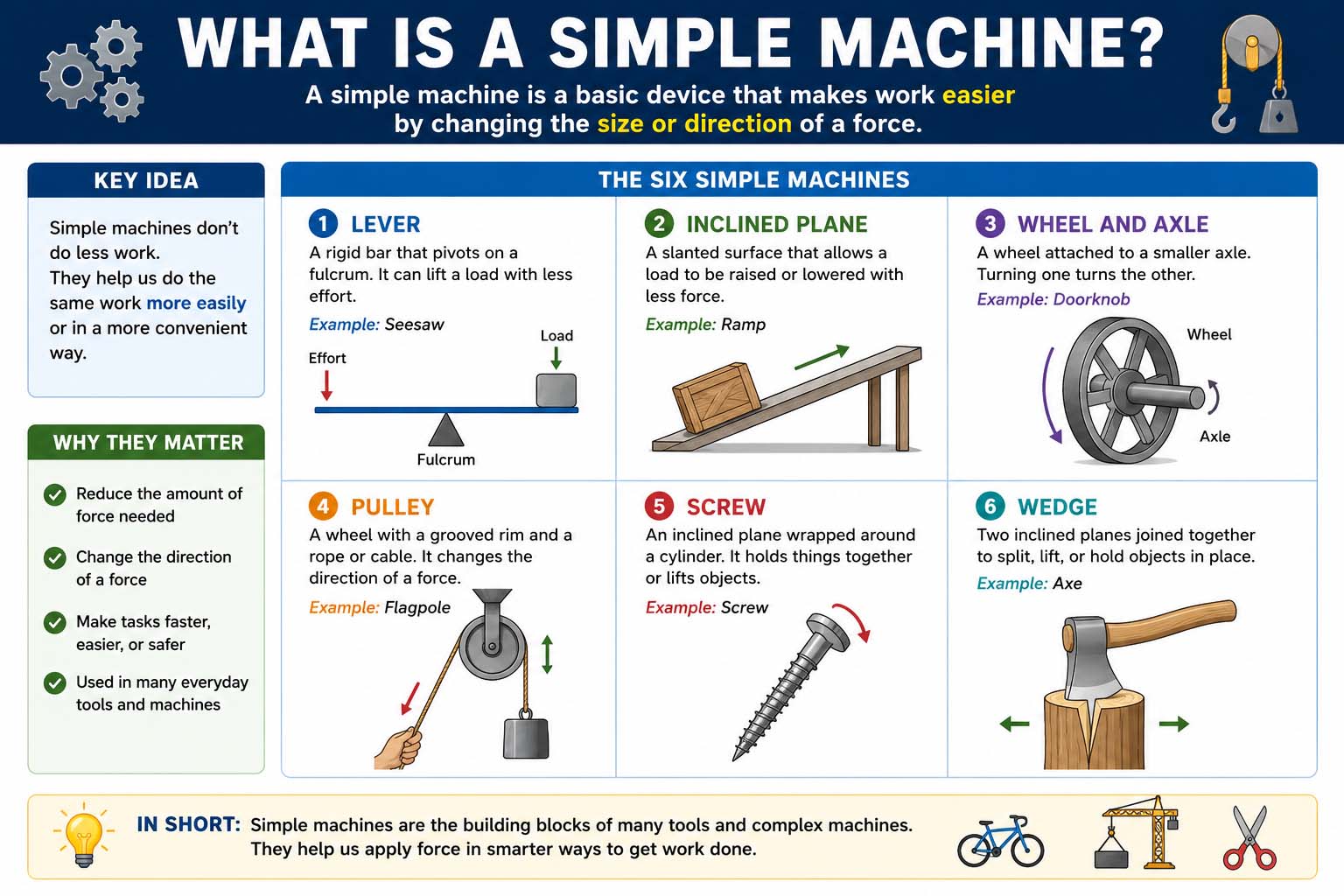
What is a simple machine? A simple machine is a basic mechanical device that makes work easier by changing the magnitude or direction of a force. Common examples include the lever, wheel and axle, pulley, inclined plane, wedge, and screw. Although simple machines do not create energy, they can make lifting, moving, cutting, fastening, and other physical tasks more practical.
For example, a ramp lets you move an object upward over a longer distance instead of lifting it vertically. Likewise, a pulley can change the direction of the force you apply. Therefore, understanding simple machines provides a foundation for learning about mechanics, engineering, and many technologies used every day.
What Is a Simple Machine and How Does It Work?
In simple terms, a simple machine is a mechanical device that changes how force acts on an object. Depending on its design, it can change the direction of a force or trade a smaller force over a greater distance for a larger force over a shorter distance.
In other words, simple machines do not eliminate work. Instead, they provide a mechanical advantage that can make a particular task easier to perform.
Specifically, the six basic simple machines are:
- Lever
- Wheel and axle
- Pulley
- Inclined plane
- Wedge
- Screw
These basic machines can operate individually or work together inside more complex devices. Understanding what is mechanical advantage also helps explain why simple machines can reduce the input force required for certain tasks.
What Are the Six Types of Simple Machines?
Traditionally, six devices are classified as simple machines. Although their designs differ, each changes how force and motion work in a mechanical system.
Lever Simple Machine
For example, a lever consists of a rigid bar that turns around a pivot point called a fulcrum.
Common examples include:
- Seesaws
- Crowbars
- Some bottle openers
- Scissors
For example, a crowbar can provide mechanical advantage by allowing a person to apply force farther from the fulcrum.
Wheel and Axle Simple Machine
Similarly, a wheel and axle consists of a larger wheel connected to a smaller shaft or axle so that they rotate together.
Examples include:
- Doorknobs
- Steering wheels
- Wheels attached to axles
- Some hand-operated mechanisms
As a result, applying force at the larger wheel can produce useful rotational force at the axle.
This basic rotational principle appears in many larger machines. For related technology, see what is a flywheel.
Pulley Simple Machine
A pulley uses a grooved wheel with a rope, belt, cable, or similar flexible element.
A fixed pulley can change the direction of an applied force. Meanwhile, combinations of movable pulleys can provide mechanical advantage.
Examples include:
- Flagpoles
- Cranes
- Hoisting systems
- Some elevators
Therefore, pulley systems are especially useful when loads need to move vertically.
Inclined Plane Simple Machine
An inclined plane is a sloped surface.
Instead of lifting an object vertically through a short distance, you can move it along the slope over a greater distance. Consequently, the required input force can be reduced, although friction also affects real-world performance.
Examples include:
- Loading ramps
- Wheelchair ramps
- Sloped roads
Wedge Simple Machine
Likewise, a wedge can be viewed as one or two inclined planes arranged to move through or between materials.
Examples include:
- Knives
- Axes
- Chisels
- Doorstops
For instance, an axe converts the force applied to it into forces that push material apart.
Screw Simple Machine
Finally, a screw is essentially an inclined plane wrapped around a cylinder.
When you rotate a screw, rotational motion produces linear movement. Therefore, screws can fasten materials, lift loads, or apply pressure.
Examples include:
- Bolts
- Jar lids with screw threads
- Vises
- Screw jacks
What Is a Simple Machine? Easy Explanation for Students
For students asking what is a simple machine, the easiest explanation is this:
A simple machine helps us use force in a more useful way.
For example, imagine moving a heavy box into a truck. Lifting the box directly requires a large upward force. However, placing a ramp between the ground and the truck allows you to push the box over a longer distance.
Similarly:
- A lever can help lift a load.
- A pulley can redirect force.
- A wheel and axle can make rotation easier.
- A wedge can cut or split material.
- A screw can convert turning motion into forward movement.
Therefore, simple machines help explain many everyday mechanical actions.
Simple Machine Examples and Their Uses
Your GSC data shows searches for simple machine examples, machine example, and simple machine and their uses. Here are some clear examples:
| Simple Machine | Everyday Example | Typical Use |
|---|---|---|
| Lever | Crowbar | Lifting or prying |
| Wheel and axle | Doorknob | Turning a shaft |
| Pulley | Flagpole | Changing force direction |
| Inclined plane | Ramp | Moving loads between heights |
| Wedge | Knife | Cutting |
| Screw | Bolt | Fastening materials |
However, many everyday objects are compound machines. They may combine two or more simple-machine principles rather than belonging exclusively to one category.
What Type of Simple Machine Is a Doorknob?
A doorknob is a wheel and axle, which directly answers one of the queries already appearing in your GSC data.
The round knob acts as the wheel, while the central spindle functions as the axle. When you turn the larger knob, it rotates the smaller spindle connected to the latch mechanism.
As a result, the wheel and axle arrangement makes the mechanism easier to operate than turning the small shaft directly.
Therefore, a doorknob is one of the clearest everyday examples of a wheel-and-axle simple machine.
What Type of Simple Machine Is a Catapult?
A basic catapult commonly uses a lever as an important part of its mechanism.
The throwing arm rotates around a pivot. However, catapults can also contain other mechanisms for storing and releasing energy, so the complete device is more complex than a single simple machine.
For a detailed explanation, read what is a catapult and how different catapult designs work.
How Does Mechanical Advantage Help a Simple Machine?
Mechanical advantage describes how a machine changes the relationship between input and output force.
For example, a long lever can allow a relatively small input force to produce a larger force on a load. Similarly, a pulley arrangement can distribute a load across multiple supporting rope sections.
However, there is a trade-off. A machine that reduces the required input force generally requires that force to act through a greater distance.
In real machines, friction also consumes some of the input energy. Therefore, no simple machine creates free energy.
For an authoritative educational overview of simple machines and mechanical advantage, see the Encyclopaedia Britannica guide to simple machines.
How Simple Machines Change Force and Motion
Simple machines can affect force and motion in several ways.
First, they can change the direction of force. A fixed pulley, for example, may allow you to pull downward to raise a load upward.
Second, they can change the magnitude of force. A lever or pulley arrangement may allow a smaller input force to move a heavier load.
Third, they can change the distance or speed of movement. The exact trade-off depends on the machine’s geometry.
Therefore, simple machines provide mechanical advantages by changing how force and motion interact rather than by creating additional energy.
Basic Machines vs Complex Machines
A simple machine uses one of the fundamental mechanical arrangements described above. A complex or compound machine combines multiple components and often incorporates several simple machines.
| Basic or Simple Machine | Complex Machine |
|---|---|
| Lever | Bicycle |
| Wheel and axle | Automobile |
| Pulley | Crane system |
| Inclined plane | Complex lifting equipment |
| Wedge | Mechanical cutting machine |
| Screw | Industrial assembly equipment |
For example, a bicycle combines wheel-and-axle systems with levers, gears, chains, and other mechanical components.
Therefore, learning about basic machines helps students understand more advanced mechanical systems later.
How Simple Machines Support Modern Technology
Although the six simple machines are ancient concepts, their mechanical principles remain relevant to modern technology.
For example, manufacturing equipment uses screws, levers, pulleys, wheels, and other mechanisms to move or control components.
Construction equipment also relies on basic mechanical principles when lifting, moving, cutting, and positioning materials.
Meanwhile, transportation systems use wheels, axles, levers, and related mechanisms extensively.
Furthermore, modern automated systems can combine these mechanical elements with electronics, sensors, motors, and software. Our guide to what is mechatronics explains how mechanical and electronic technologies work together.
Everyday Examples of Simple Machines
You probably use simple machines every day without thinking about them.
For instance:
- A doorknob uses a wheel-and-axle principle.
- A knife acts as a wedge.
- A ramp is an inclined plane.
- A bottle opener can function as a lever.
- A screw fastens materials using an inclined thread.
- A flagpole pulley changes the direction of the applied force.
Furthermore, many tools combine several simple-machine principles.
Scissors are a good example. Their handles and pivot form levers, while their cutting edges act as wedges. Therefore, scissors are better described as a compound machine rather than simply one basic mechanism.
How to Identify a Simple Machine
You can identify a simple machine by examining how an object changes force or movement.
Step 1: Observe the Movement
First, determine what the object does. Does it rotate, lift, cut, split, slide, or fasten something?
Step 2: Identify the Applied Force
Next, look at where the user applies force and where the machine delivers its output force.
Step 3: Match It to a Basic Machine
Then, compare the mechanism with the six simple machines:
- Lever
- Wheel and axle
- Pulley
- Inclined plane
- Wedge
- Screw
Step 4: Check for Multiple Simple Machines
Finally, determine whether the object combines multiple mechanisms.
For example, a pair of scissors incorporates both lever and wedge principles. Therefore, not every tool belongs to only one category.
What Makes a Simple Machine Useful?
A simple machine becomes useful because it can change how force is applied.
For example, an inclined plane allows a load to move through a longer distance while reducing the force required at any one moment. Similarly, a lever can multiply force depending on the positions of the effort, load, and fulcrum.
Moreover, a wheel and axle can provide rotational mechanical advantage, while a pulley can redirect force or contribute to force multiplication in a multi-pulley system.
Therefore, the usefulness of a simple machine depends on its design and the task being performed.
Simple Machine Efficiency and Friction
Real simple machines are not perfectly efficient because friction converts some mechanical energy into heat.
For instance, an axle rotating in a bearing experiences friction. Likewise, a box moving up a ramp encounters friction between its surface and the ramp.
Lubrication, appropriate materials, bearings, and proper alignment can reduce unwanted friction.
However, friction is not always undesirable. A wedge, screw, or braking mechanism may rely on friction to work effectively.
Consequently, engineers consider both mechanical advantage and efficiency when designing practical machines.
Common Problems With Simple Machines
Even basic machines can develop mechanical problems.
Friction and Wear
Moving surfaces can wear over time. Therefore, appropriate lubrication and maintenance may reduce unnecessary friction.
Rust and Corrosion
Metal components exposed to moisture or chemicals can corrode. As a result, their strength and movement may deteriorate.
Loose Connections
Bolts, screws, axles, and other connections can loosen after repeated use. Therefore, equipment may require periodic inspection.
Misalignment
Wheels, pulleys, axles, and other components may stop operating efficiently when they become misaligned.
Regular maintenance can help preserve both performance and safety.
How to Troubleshoot a Simple Machine
Troubleshooting depends on the particular machine, but several basic checks can help.
Check Moving Parts
First, inspect moving surfaces for wear, dirt, damage, or excessive friction.
Check Fasteners and Connections
Next, inspect screws, bolts, pins, and other connections. Tighten or replace them when appropriate for the equipment.
Check Alignment
Then, make sure wheels, pulleys, axles, and related components remain correctly positioned.
Clean the Mechanism
In addition, remove dirt or debris that interferes with movement.
Replace Damaged Components
Finally, damaged parts should be replaced according to the equipment manufacturer’s instructions.
For machinery that could cause injury, follow the manufacturer’s safety procedures rather than operating or repairing damaged equipment without appropriate knowledge.
Why Students Learn About Simple Machines
Simple machines introduce several fundamental ideas in physics and engineering.
Students can use them to understand:
- Force
- Motion
- Work
- Mechanical advantage
- Friction
- Energy
- Engineering design
- Compound machines
Moreover, these concepts create a foundation for studying robotics, machinery, manufacturing, and mechanical engineering.
Understanding simple machines can also make it easier to understand what is a Rube Goldberg machine, where multiple mechanisms work together through a deliberately complicated chain of actions.
Is a Simple Machine the Same as a Simple Mechanism?
Not exactly.
A simple machine traditionally refers to one of the six fundamental mechanical devices: lever, wheel and axle, pulley, inclined plane, wedge, and screw.
A mechanism, however, is a broader engineering term for an arrangement of components that produces or controls motion.
Therefore, a mechanism can contain a simple machine, multiple simple machines, or other mechanical components.
This distinction helps answer the GSC query for simple mechanism without confusing the two terms.
What Is a Virtual Machine in Simple Terms?
A virtual machine is not a simple machine in the mechanical sense.
Instead, a virtual machine is a software-based computing environment that behaves like a computer. It can run an operating system and applications while sharing physical hardware with other systems.
Therefore, the phrase “virtual machine” belongs to computing rather than the six classical simple machines.
Keeping these concepts separate prevents confusion for readers who encounter both terms in technology education.
Frequently Asked Questions About What Is a Simple Machine
What Is a Simple Machine?
A simple machine is a basic mechanical device that changes the magnitude or direction of force to make a task more practical. The six traditional types are the lever, wheel and axle, pulley, inclined plane, wedge, and screw.
What Are the Six Simple Machines?
The six simple machines are the lever, wheel and axle, pulley, inclined plane, wedge, and screw.
What Does a Simple Machine Do?
A simple machine changes how force is applied. For example, it may change the direction of a force or allow a smaller input force to act over a greater distance.
What Is an Example of a Simple Machine?
A ramp is a simple machine called an inclined plane. Other examples include a crowbar, doorknob, pulley, knife, and screw.
Is a Doorknob a Simple Machine?
Yes. A doorknob uses the wheel-and-axle principle. The knob functions as the wheel, while the central spindle acts as the axle.
What Are Simple Machines Used For?
Simple machines help people lift, move, cut, split, fasten, or position objects. In addition, their principles appear inside many complex machines.
Do Simple Machines Reduce Work?
In ideal physics, a simple machine does not reduce the total amount of work required. Instead, it can reduce the input force by increasing the distance over which that force acts or can change the direction of force.
Are Simple Machines Still Used Today?
Yes. Their principles appear throughout tools, vehicles, construction equipment, manufacturing systems, household devices, and other technologies.
What Is a Simple Machine? Key Takeaways
Understanding what is a simple machine helps explain how basic mechanical systems make physical tasks more practical.
The six traditional simple machines are the lever, wheel and axle, pulley, inclined plane, wedge, and screw. Each changes how force or movement acts, while complex machines can combine several of these principles.
Most importantly, simple machines do not create energy or provide free work. Instead, they trade force, distance, direction, or motion in useful ways.
Therefore, learning about simple machines provides a strong foundation for understanding mechanical advantage, engineering, machinery, and many technologies used in everyday life.