
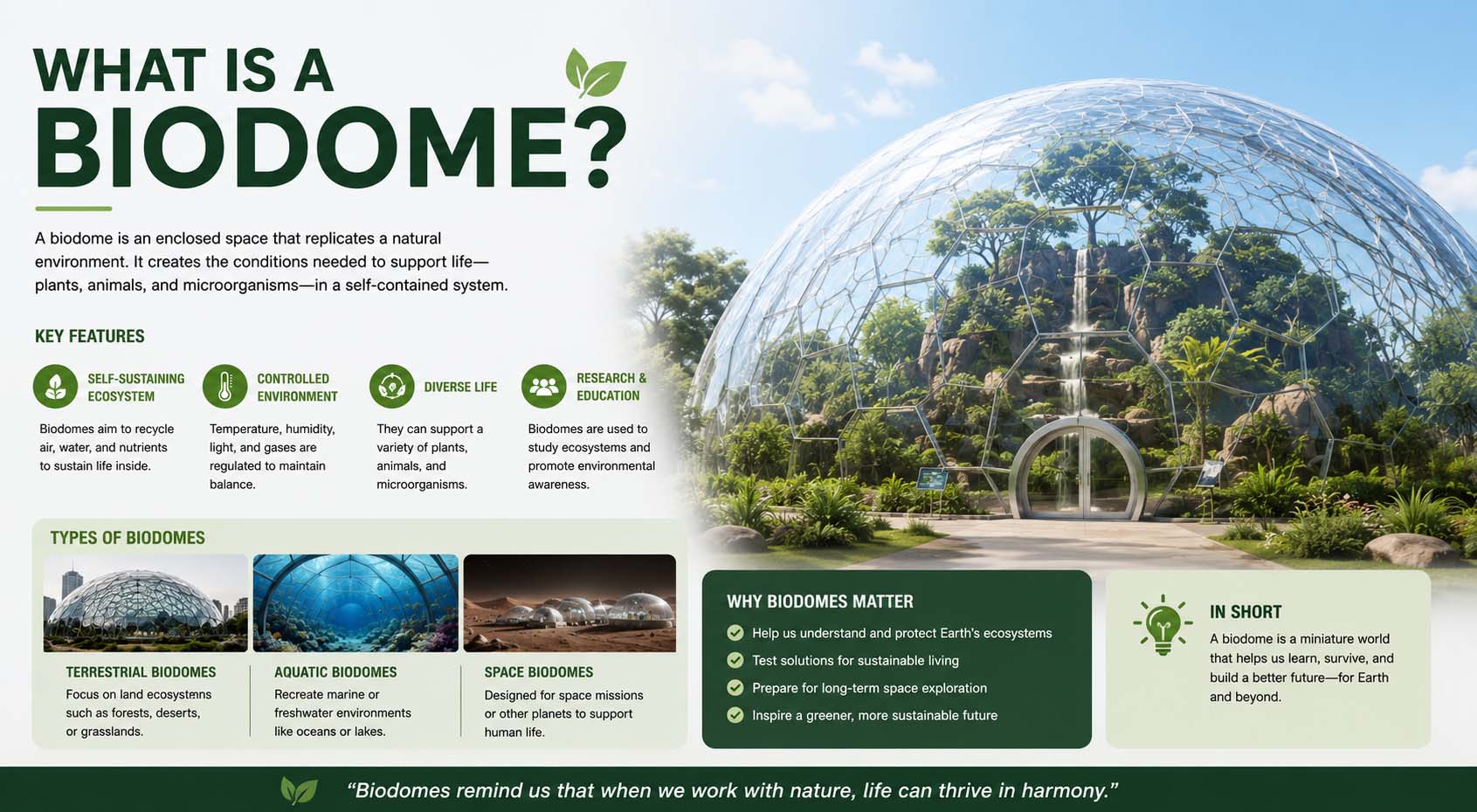
A biodome is a controlled environment designed to support living organisms such as plants, animals, and microorganisms. It recreates natural ecosystems inside a closed or semi-closed structure where conditions like temperature, humidity, air quality, and light can be carefully managed. Many people ask, “what is a biodome” because these unique structures are often used in science, education, environmental studies, and even futuristic living experiments.
Biodomes are important because they allow scientists and researchers to study ecosystems in a protected environment. They can simulate deserts, rainforests, oceans, or other habitats while keeping external influences limited. Biodomes also help researchers understand how life survives under controlled conditions and how ecosystems respond to environmental changes.
The concept of biodomes became especially popular through projects such as Biosphere 2 in Arizona, where scientists attempted to create a self-sustaining environment for human life and natural ecosystems. Today, biodomes are used in schools, research centers, zoos, and environmental conservation programs around the world.
What Is a Biodome?
When discussing what is a biodome?, it is important to understand that the structure is designed to imitate nature. A biodome creates a mini ecosystem inside a dome-shaped or enclosed building. Within this space, plants, animals, water, soil, and air interact similarly to how they do in the natural world.
The word “biodome” combines “bio,” meaning life, and “dome,” referring to the enclosed structure. Together, the term describes a place where life exists within a carefully controlled environment. Some biodomes are very small and used for educational purposes, while others are large enough to house entire ecosystems and research teams.
One major feature of a biodome is sustainability. Many biodomes recycle water, control oxygen levels, and regulate temperature naturally through technology. This allows scientists to test how ecosystems function without relying heavily on outside resources.
Biodomes are often used to grow plants in difficult climates. In cold or dry regions, biodomes can provide suitable conditions for agriculture and scientific experiments. Some researchers even study biodomes as a possible solution for future space colonization because they could help humans survive on planets with harsh environments.
What Is a Biodome in Science
The question of what is a biodome in science is closely connected to environmental research and ecosystem studies. In science, biodomes serve as living laboratories where researchers can observe interactions between organisms and their surroundings.
Because the environment inside a biodome is controlled, researchers can make precise changes and observe how plants and animals react. This provides valuable information about ecological balance and environmental protection.
Scientists can monitor how temperature changes affect plant growth or how different species interact with each other. These experiments help improve understanding of real-world ecosystems.
Educational institutions also use biodomes in science programs. Students can learn about biology, ecology, and environmental science by observing living ecosystems up close. Instead of reading only from textbooks, they can see natural processes happening in real time.
Biodomes are also valuable in agricultural science. Researchers test farming techniques, water conservation methods, and crop growth in controlled conditions. This can help develop more sustainable farming systems for the future.
The scientific importance of biodomes continues to grow as concerns about climate change and environmental sustainability increase around the world.
What Is the Purpose of a Biodome
Many people wonder what is the purpose of a biodome and why these structures are so important. Biodomes are created for several purposes, including scientific research, conservation, education, and environmental sustainability.
One major purpose is ecosystem preservation. Some species of plants and animals are endangered due to habitat destruction and climate change. Biodomes provide safe environments where these species can survive and reproduce. This helps conservationists protect biodiversity and prevent extinction.
Another important purpose of biodomes is scientific experimentation. Researchers can test how ecosystems function under different conditions without affecting natural habitats. They can study pollution, weather patterns, or plant growth in a safe and controlled setting.
Biodomes are also used to educate the public about nature and environmental responsibility. Visitors can experience different ecosystems such as tropical rainforests, deserts, or marine environments while learning about sustainability and conservation. Many science museums and botanical gardens include biodomes as interactive educational attractions.
In addition, biodomes may play a role in the future of human survival. Scientists are exploring how biodomes could support life in extreme environments such as deserts, Antarctica, or even outer space. A self-sustaining biodome could provide food, oxygen, and water recycling systems for astronauts during long-term space missions.
What Is a Biodome for Science
Understanding what is a biodome for science helps explain why these structures are so valuable to researchers worldwide. Biodomes are powerful scientific tools because they allow detailed observation of ecosystems in a controlled environment.
One key scientific use of biodomes is environmental simulation. Scientists can recreate ecosystems from different parts of the world and study them under changing conditions. This helps researchers predict how climate change may impact forests, oceans, deserts, and other natural habitats.
Biodomes also support biological research. Scientists study plant growth, animal behavior, nutrient cycles, and ecological relationships inside these enclosed systems. Since outside variables are minimized, researchers can focus on specific scientific questions more accurately.
Another important use is sustainability research. Biodomes help scientists test renewable energy systems, water recycling technology, and sustainable agriculture methods. These experiments may contribute to future eco-friendly living solutions for growing populations.
In medical and biological sciences, biodomes can help researchers study microorganisms and environmental health. Understanding how ecosystems maintain balance may provide insights into human health, disease prevention, and food production systems.
Conclusion
Learning what is a biodome reveals how important these structures are for science, education, and environmental sustainability. Biodomes create controlled ecosystems where plants, animals, and humans can exist together while researchers study natural processes in detail.