
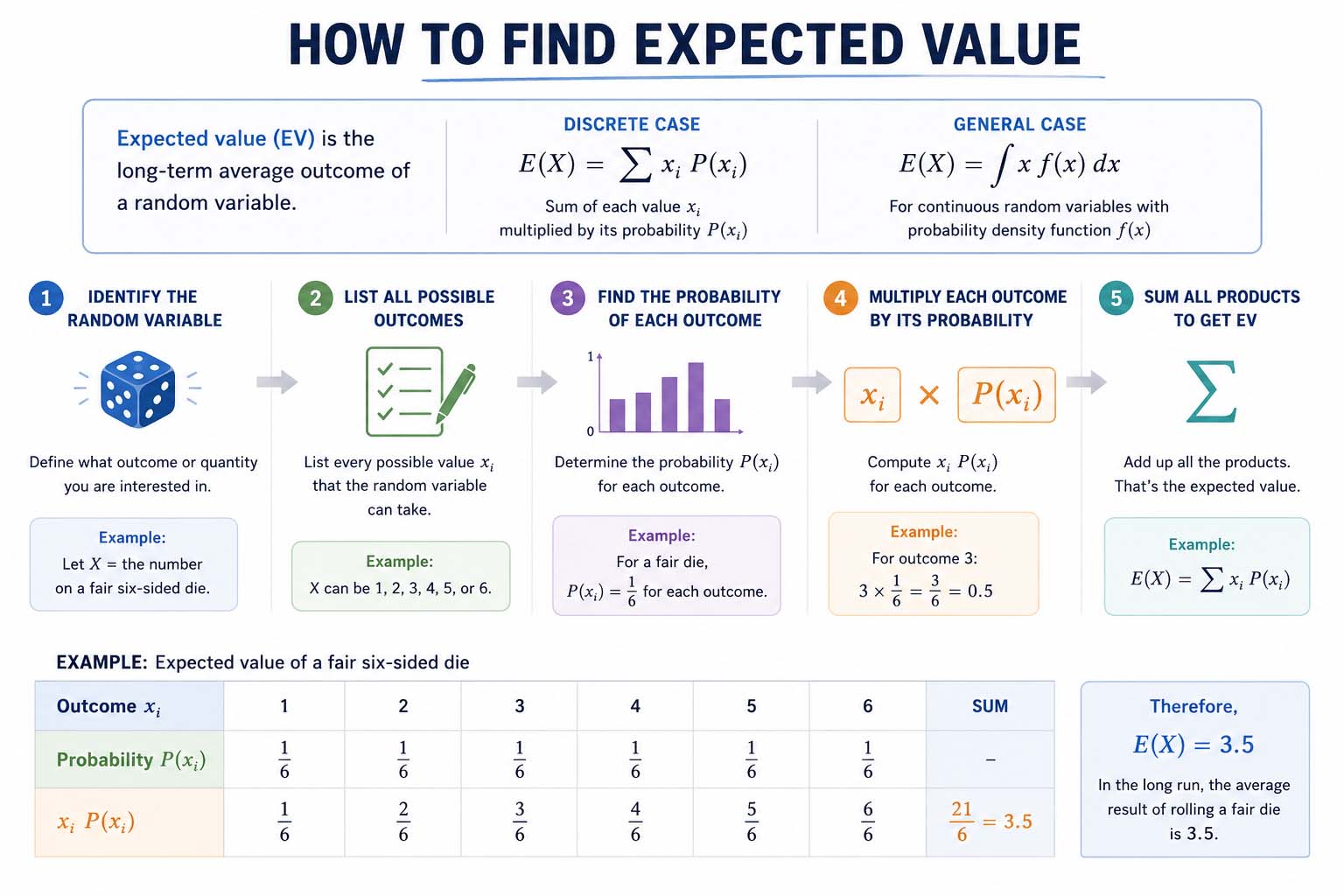
Expected value is one of the most important concepts in mathematics, probability, and statistics. It helps people understand the average outcome of a random event over time. Whether someone is analyzing financial investments, casino games, scientific experiments, or statistical data, understanding how to find expected value is essential for making informed decisions.
How to Find the Expected Value
Many students ask how to find the expected value when working with probability problems. The expected value is calculated by multiplying each possible outcome by its probability and then adding all the results together.
The formula for expected value is:
E(X)=∑xP(x)
In this formula, x represents each possible outcome, while P(x) represents the probability of that outcome occurring. The symbol E(X) means expected value.
To better understand the process, imagine rolling a fair six-sided die. Each side has an equal probability of occurring, which is 1/6. . To calculate the expected value, you multiply each number by its probability and then add the results together.
The calculation looks like this:(1×61)+(2×61)+(3×61)+(4×61)+(5×61)+(6×61)
The final expected value is 3.5. Even though a die cannot land on 3.5, this number represents the average result after many rolls.
Expected value is widely used in finance and economics. Investors use it to estimate average returns on investments, while insurance companies use it to calculate risk and pricing models. Casinos also rely heavily on expected value to ensure long-term profits.
How to Find Expected Value in Chi Square
Another important topic is how to find expected value in chi square tests. Chi-square analysis is commonly used in statistics to compare observed results with expected results. Researchers use chi-square tests in science, business, healthcare, and social studies to determine whether there is a significant relationship between variables.
In a chi-square test, expected values are calculated differently from regular probability problems. Instead of using probabilities directly, expected frequencies are found using row totals, column totals, and the grand total from a contingency table.
The formula used for expected value in chi-square is:
E=Grand Total(Row Total)(Column Total)
Suppose a researcher surveys people about their favorite type of entertainment and separates responses by age group. After collecting the observed data, the researcher calculates expected values to determine whether age influences entertainment preferences.
For example, if one row total is 50, one column total is 40, and the grand total is 200, the expected value would be:E=20050×40
The expected value equals 10.
This process is repeated for every cell in the contingency table. Once all expected values are calculated, researchers compare them to observed values using the chi-square formula. Large differences between observed and expected values may indicate a statistically significant relationship between variables.
Understanding how to find expected value in chi square tests is important because expected frequencies form the foundation of the entire analysis. Without accurate expected values, the chi-square test results would not be reliable.
How to Find Expected Value in Statistics
When learning how to find expected value in statistics, it is important to understand that expected value represents the center or average outcome of a probability distribution. Statistics uses expected value in both theoretical and practical applications.
In probability distributions, expected value is often called the mean of a random variable. The concept helps researchers summarize data and predict future outcomes. Different statistical models use expected value calculations in slightly different ways, but the overall principle remains the same.
For discrete random variables, the expected value formula involves multiplying outcomes by probabilities. For continuous random variables, integration may be used instead. In both cases, the goal is to calculate the average expected outcome over time.
Expected value plays a major role in hypothesis testing, data analysis, and predictive modeling. Economists use expected value to predict market trends, while engineers use it to evaluate system reliability. Scientists also apply expected value in experimental research and probability-based models.
One common example involves lotteries. Imagine a lottery ticket costs $5, and the probabilities of winning different prize amounts are known. By calculating the expected value, a person can determine whether the game is profitable or likely to result in losses over time.
How to Find the Expected Value in Chi Square
Many learners also search for how to find the expected value in chi square because chi-square analysis can initially seem confusing. However, once the formula is understood, the process becomes much simpler.
In chi-square testing, expected values represent the frequencies you would expect if there were no relationship between variables. Researchers compare these expected frequencies with actual observed frequencies to test hypotheses.
The calculation process involves organizing data into a table and then applying the expected value formula to every cell. After calculating expected values, the chi-square statistic measures the differences between expected and observed data.
The chi-square formula itself is:
χ2=∑E(O−E)2
In this equation, O represents observed values and E represents expected values.
. If they differ greatly, the statistic becomes larger, indicating a possible relationship between variables.
Researchers use this method in many fields. Healthcare studies use chi-square tests to compare treatment outcomes, while businesses use them to analyze customer preferences and demographics. Educational researchers also rely on chi-square analysis to study student performance and behavior patterns.
Conclusion
Understanding how to find expected value is an essential skill in mathematics, probability, and statistics. Expected value helps predict average outcomes and provides valuable insights for decision-making in finance, research, business, and everyday life. Whether calculating probabilities for games, analyzing statistical distributions, or conducting chi-square tests, expected value remains one of the most useful concepts in data analysis.