Computers rely on memory to run programs and process tasks efficiently. One important part of memory management is the swap file. Many users hear the term while working with Linux systems, virtual memory settings, or server optimization, but they may not fully understand its purpose. Learning what is a swap file can help users improve system performance and better manage computer resources.
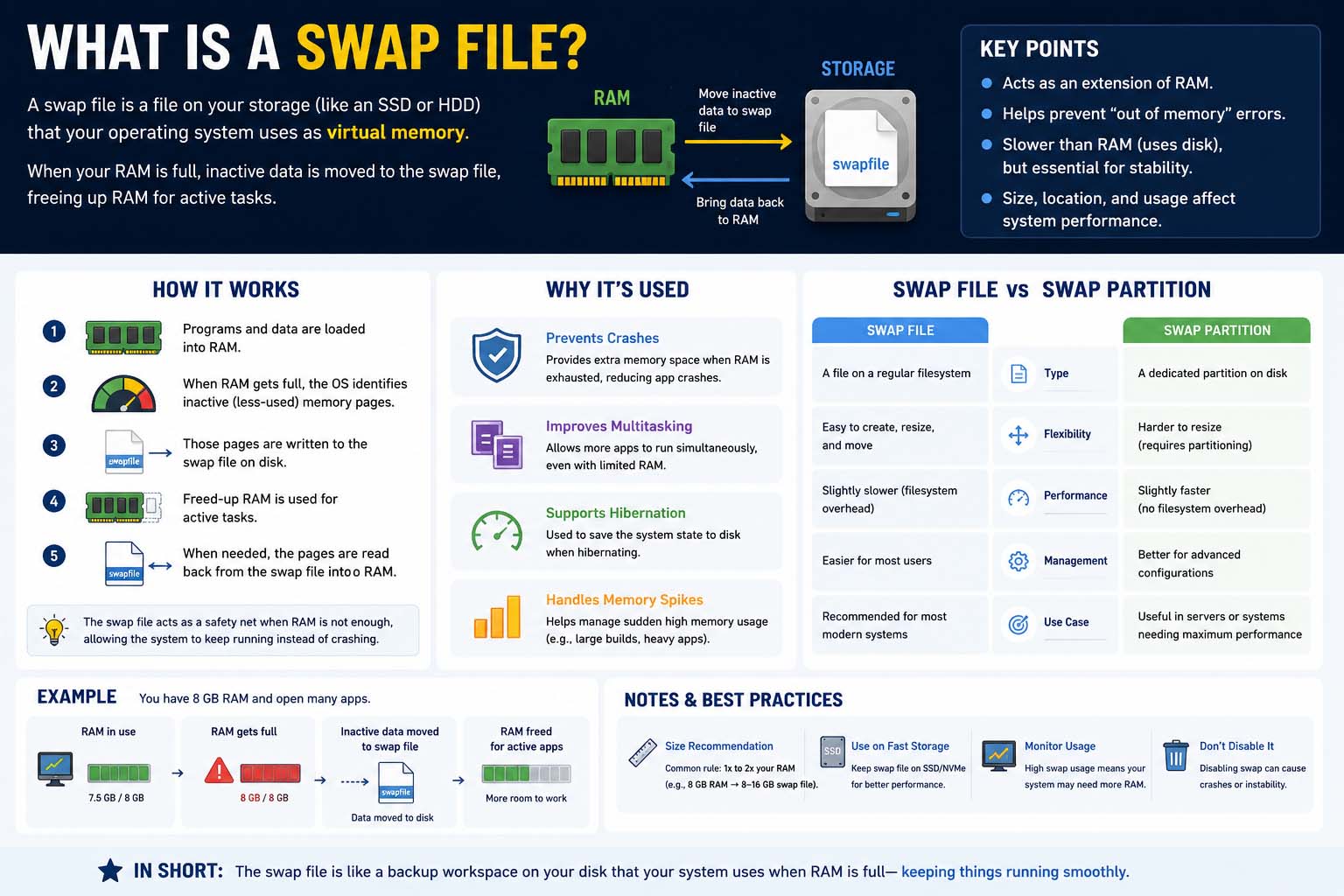
A swap file acts as additional virtual memory when the physical RAM of a computer becomes full. Instead of closing applications immediately when memory is exhausted, the operating system temporarily moves inactive data from RAM to storage space on the hard drive or SSD. This allows the system to continue running even under heavy workloads.
Modern operating systems such as Linux use swap files or swap partitions to increase flexibility and maintain stability. Although swap memory is slower than physical RAM, it still plays a valuable role in preventing crashes and improving multitasking capabilities.
What Is a Swap File or Swap Space?
One of the most common questions users ask is what is a swap file or swap space? Swap space refers to an area on a storage device that the operating system uses as virtual memory. This space can exist as a dedicated partition or as a regular file called a swap file.
When the system runs low on RAM, inactive memory pages are moved into swap space. This process frees physical memory for active programs and tasks. For example, if multiple applications are open at the same time, the operating system may move less frequently used data into swap space to keep the computer responsive.
Swap space helps prevent memory shortages that could otherwise cause applications to freeze or crash. Servers and workstations often use swap space to improve system reliability, especially when handling large workloads or multitasking environments.
Although swap space provides extra memory capacity, it is not as fast as physical RAM because storage devices have slower read and write speeds. However, modern SSDs have improved swap performance significantly compared to traditional hard drives.
How Swap Files Work
A swap file functions by storing inactive memory data on disk storage. When an application needs data that has been moved to swap, the operating system transfers it back into RAM.
Operating systems continuously monitor memory usage and decide which data should remain in RAM and which data can be temporarily moved into swap storage. The system usually prioritizes active applications while moving background processes into swap memory.
Computers with limited RAM benefit greatly from swap files because they allow more applications to run simultaneously. Systems with large amounts of RAM may use swap less frequently, but swap space still provides protection during memory spikes.
What Is a Swap File or Swap Space
The phrase what is a swap file or swap space often appears in technical courses, certification exams, and operating system tutorials. Understanding this concept is important for system administrators and Linux users because swap management directly affects performance.
Swap space serves as overflow memory for the operating system. heavy workloads.
In desktop environments, swap space helps when multiple browser tabs, applications, or editing programs consume large amounts of memory. On servers, swap can help maintain uptime during traffic spikes or resource-intensive processes.
Benefits of Using Swap Files
Swap files provide several advantages for both personal computers and servers. One major benefit is improved system stability. Even if RAM usage becomes extremely high, the system can continue functioning by using virtual memory.
Another advantage is flexibility. Swap files can usually be resized more easily than dedicated swap partitions. This makes them convenient for modern Linux systems where storage needs may change over time.
Swap files also support hibernation features in some operating systems. During hibernation, the contents of RAM are stored in swap space so the computer can restore its previous session after powering back on.
Question 6 What Is a Swap File or Swap Space?
The phrase question 6 what is a swap file or swap space? commonly appears in educational assignments, IT certification exams, and computer science quizzes. The correct explanation is that swap space acts as virtual memory used when physical RAM becomes insufficient.
In technical education, instructors often ask this question to test understanding of memory management concepts. Students are expected to explain how operating systems use swap storage to temporarily hold inactive data.
What Is a Swap File in Linux
The topic what is a swap file in Linux is especially important because Linux systems commonly use swap files and swap partitions for memory management. Linux provides flexible tools for creating, resizing, and managing swap storage.
A swap file in Linux is simply a dedicated file that the operating system uses as virtual memory. Unlike a swap partition, which occupies a separate disk partition, a swap file exists within the normal file system. This approach makes management easier because administrators can modify swap size without repartitioning drives.
Linux systems use commands such as swapon, swapoff, and free to manage and monitor swap usage. Administrators can also check active swap areas using terminal commands.
The Linux kernel uses a parameter called swappiness to determine how aggressively swap space should be used. Lower swappiness values prioritize physical RAM, while higher values encourage more swap usage.
Conclusion
Understanding what is a swap file is important for anyone interested in computers, Linux systems, or operating system performance. A swap file acts as virtual memory that helps systems continue running when physical RAM becomes full. Although swap space is slower than RAM, it provides stability, supports multitasking, and prevents crashes during heavy workloads.