
Electric circuits are one of the most important foundations of modern technology. From household electronics to industrial systems, circuits help power devices and control electrical flow. One of the most basic concepts in electronics is the series circuit.
Many students, beginners, and technology enthusiasts ask questions like what is a what is a and a parallel , and what is the difference between a and parallel circuit.
Understanding these concepts is essential for learning electronics, electrical engineering, robotics, and basic technology systems.
What Is a Series Circuit?
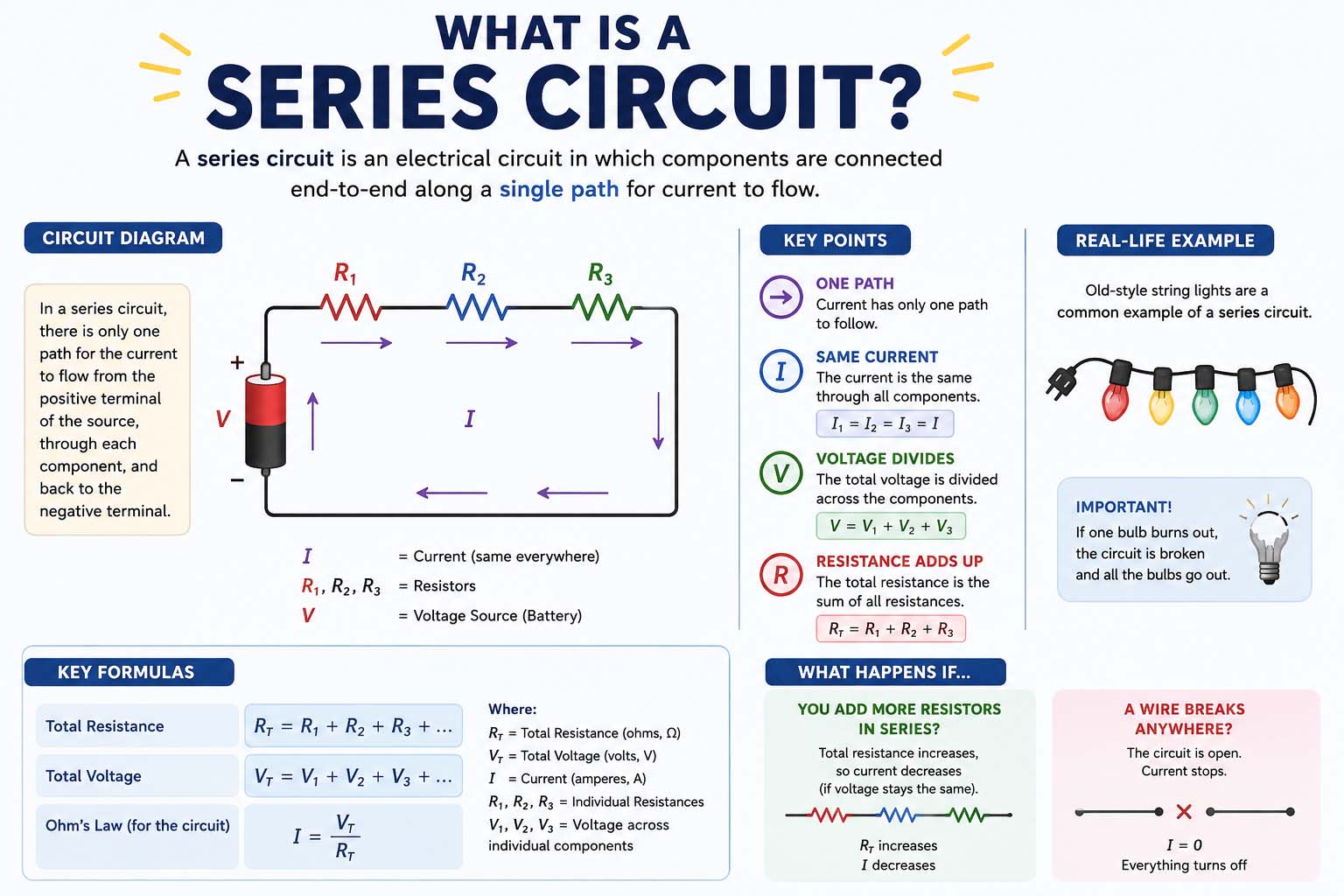
A series circuit is an electrical where components are connected one after another in a single path.
In a electricity flows through each component in sequence before returning to the power source.
Because there is only one path for current flow, every component shares the same electrical current.
Common components used in series circuits include:
Batteries.
Switches.
Light bulbs.
Resistors.
Motors.
Series circuits are often taught first because they are simple and easy to understand.
How Does a Series Circuit Work?
Electric current moves through the circuit in one continuous loop.
For example:
Battery → Wire → Light Bulb → Switch → Back to Battery
If any part of the path breaks, the entire circuit stops working.
This is one of the most important characteristics of series circuits.
Step-by-Step Example of a Series Circuit
Step 1: Connect the Power Source
A battery provides electrical energy.
Step 2: Add Components
Components like bulbs or resistors are connected in a single line.
Step 3: Complete the Loop
Wires create a closed electrical path.
Step 4: Turn On the Circuit
Electricity flows through every connected component.
If one bulb fails, all bulbs connected in the series path turn off.
What Is a Series Circuit? Simple Beginner Explanation
For beginners, imagine a like a single road.
Every car must follow the same route.
If the road becomes blocked, traffic stops completely.
Electricity behaves similarly inside a series circuit.
There is only one available path for electrical current.
Advantages of a Series Circuit
Series circuits offer several benefits.
Easy to Build
They require fewer wires and simpler layouts.
Beginner-Friendly
Series circuits are commonly used for educational demonstrations.
Lower Cost
Fewer materials are often needed compared to complex systems.
Predictable Current Flow
The same current passes through every component.
Because of their simplicity, series circuits are often used in basic electronics projects.
Disadvantages of a Series Circuit
Series circuits also have limitations.
One Failure Stops Everything
Voltage Is Shared
Each component receives only part of the total voltage.
Less Flexible
Devices cannot operate independently.
These limitations make series circuits less practical for large modern electrical systems.
What Is the Difference Between a Series and Parallel Circuit?
One of the most searched questions is what is the difference between a and parallel .
The biggest difference involves the number of electrical paths.
| Feature | Series Circuit | Parallel Circuit |
|---|---|---|
| Current Path | Single path | Multiple paths |
| Component Independence | No | Yes |
| Failure Impact | Entire circuit stops | Other devices continue |
| Wiring Complexity | Simpler | More complex |
| Voltage Distribution | Shared | Equal across branches |
Parallel circuits are commonly used in homes because devices can operate independently.
What Is a Series Circuit and a Parallel Circuit?
A and a parallel are two basic types of electrical connections.
Series Circuit
Components connect one after another.
Parallel Circuit
Components connect across multiple branches.
Modern electrical systems often combine both methods for better efficiency and flexibility.
What Is a Series Parallel Circuit?
A series parallel combines both and parallel connections in the same system.
This design allows engineers to balance:
Power distribution.
Reliability.
Efficiency.
Device independence.
Series parallel circuits are used in:
Automobiles.
Computers.
Industrial machines.
Consumer electronics.
Large electrical systems often rely on mixed circuit designs instead of only one type.
Real-World Examples of Series Circuits
Series circuits appear in several simple technologies.
Examples include:
Flashlights.
Basic string lights.
Battery-powered toys.
Simple school science kits.
Older holiday light systems often used series wiring, which caused all bulbs to go out if one failed.
Real-World Examples of Parallel Circuits
Parallel circuits are more common in modern technology.
Examples include:
Home electrical wiring.
Office lighting systems.
Computer power systems.
Smartphones.
Parallel systems improve reliability because devices continue operating independently.
Troubleshooting a Series Circuit
Series circuits are easier to troubleshoot because there is only one electrical path.
Problem: Entire Circuit Stops Working
Possible causes:
Broken wire.
Dead battery.
Failed component.
Problem: Dim Lights
Possible causes:
Weak battery.
Too many components sharing voltage.
Problem: Overheating
Possible causes:
Excessive resistance.
Incorrect component ratings.
Checking each connection step-by-step usually identifies the issue quickly.
How to Build a Simple Series Circuit
Creating a beginner series circuit is easy.
Materials Needed
Battery.
Wires.
Light bulb.
Switch.
Process
Connect the battery to the bulb.
Attach the switch in line with the wire.
Turn on the switch to allow current flow.
This basic project is often used in schools to teach electrical principles.
Why Understanding Circuits Matters in Technology
Circuit knowledge supports many modern careers and technologies.
Understanding circuits helps in:
Robotics.
Engineering.
Computer hardware.
Renewable energy systems.
Smart devices.
Automation technology.
Even beginner circuit concepts create a foundation for advanced technical learning.
Common Mistakes Beginners Make
New learners often make several mistakes.
Incorrect Connections
Loose wires prevent current flow.
Using Wrong Components
Improper voltage ratings can damage parts.
Confusing Series and Parallel Designs
Beginners sometimes accidentally create mixed circuits.
Ignoring Polarity
Some electronic components require correct direction alignment.
Careful assembly helps avoid these problems.
Why Series Circuits Are Still Important in 2026
Even though modern systems often use parallel wiring, series circuits remain important for:
Education.
Basic electronics.
Testing systems.
Simple devices.
Understanding series circuits also helps students learn more advanced electrical concepts later.
FAQ About What Is a Series Circuit
What is a series circuit?
A series circuit is a circuit where components are connected in one continuous electrical path.
What happens if one component fails?
The entire series circuit stops working because the path becomes broken.
What is the difference between a series and parallel circuit?
Series circuits use one path, while parallel circuits use multiple paths.
What is a series parallel circuit?
It combines both series and parallel connections in one system.
Are series circuits used in homes?
Most home systems use parallel circuits because devices work independently.
Conclusion
Understanding what is a series circuit is an important step for learning electronics and technology fundamentals. Series circuits provide a simple way to understand electrical flow, voltage distribution, and component connections.
Although modern systems often rely on parallel designs, series circuits remain valuable for education, troubleshooting, and beginner electronics projects. By learning the difference between series and parallel circuits, students and technology enthusiasts can build a stronger foundation for future technical skills in 2026 and beyond.