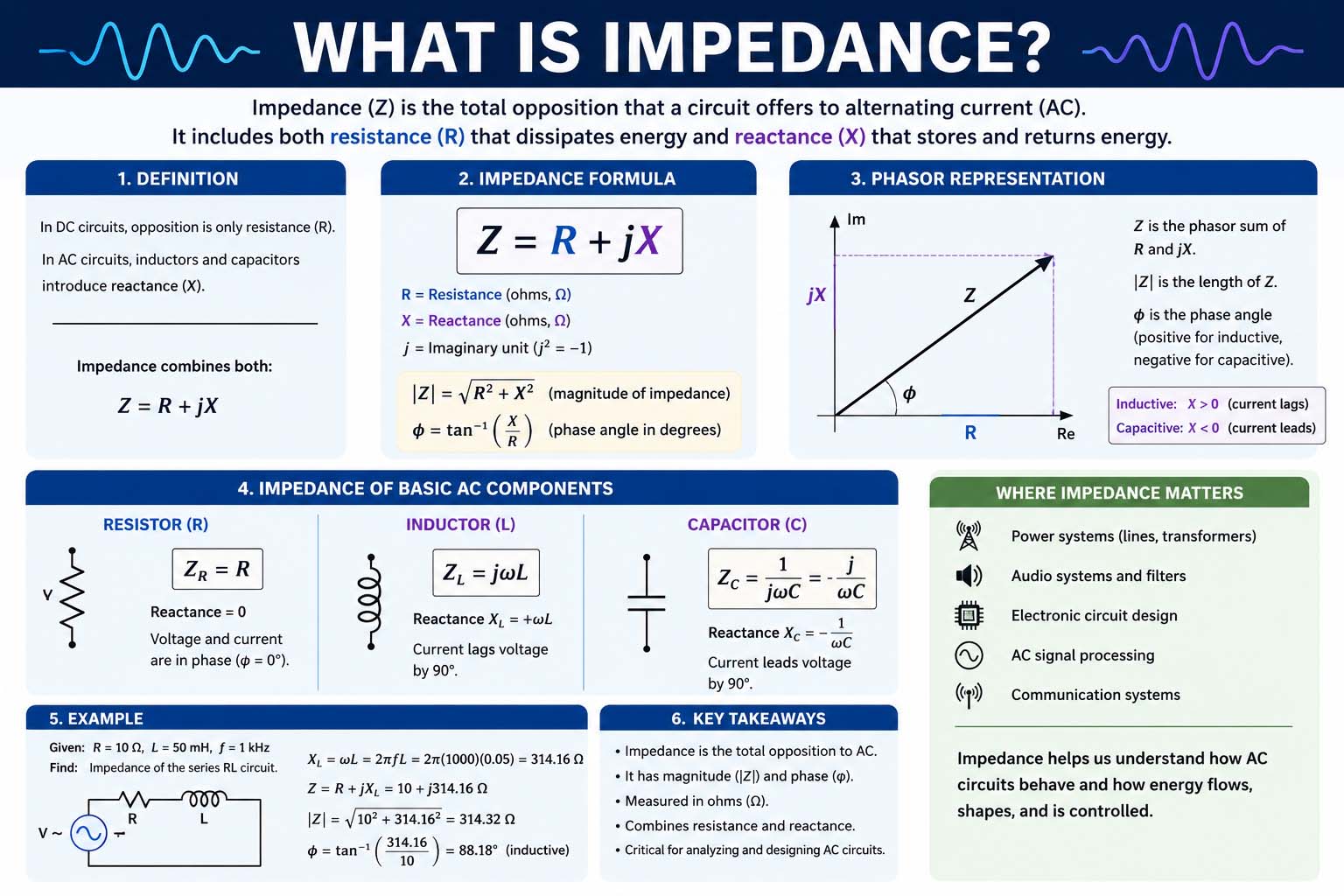
So, what is impedance? It is the total opposition that an electrical circuit gives to the flow of alternating current (AC). We measure it in ohms (Ω), and it includes both resistance and reactance. Resistance slows current down, while reactance comes from parts such as capacitors and inductors. Because it decides how much current flows and how energy behaves in a circuit, it matters a lot in electronics and electrical engineering.
In other words, it combines plain resistance with the extra effects that capacitance and inductance add when the current keeps changing direction.
Z = R + jXIn this formula, Z stands for impedance and R stands for resistance. Meanwhile, X stands for reactance, and j marks the imaginary part that engineers use to describe how reactance shifts the timing of current and voltage.
As a result, a clear grasp of this idea helps beginners troubleshoot electronics, improve audio quality and see how modern electrical systems work.
What Is Impedance in Electricity?
When people start learning electronics, they often notice that AC behaves differently from simple resistance.
Resistance is the only thing that opposes direct current (DC) in a basic circuit. However, AC faces extra opposition from reactance. Since most household power systems use AC, impedance becomes a key factor in real electrical systems.
It has two major parts, and each one works in its own way.
Resistance
Resistance turns some electrical energy into heat. It stays the same whether the current is AC or DC, so it is the easiest part to understand.
Reactance
Reactance comes from capacitors and inductors in a circuit. These parts store electrical energy for a short time, and then they release it, so they change how current moves through the system.
Many of these parts connect together inside a circuit. Our guide on What Is a Circuit makes it easier to see how it shapes the flow of alternating current through an electrical system.
For example, motors, transformers and wireless communication systems all depend on the right impedance to work correctly. Just like resistance, it uses ohms as its unit.
What Is Impedance in a Circuit?
Many beginners also ask about impedance in a circuit, because real circuits often hold more than just resistors.
A typical circuit may include resistors, capacitors, inductors, integrated circuits and audio parts. In AC circuits, all of these parts affect how electricity flows. Together, they set the current flow, voltage behavior, signal quality, energy efficiency and power delivery.
For example, if the impedance in a circuit is too high, less current flows. On the other hand, if it is too low, too much current may flow and damage parts.
Therefore, engineers choose impedance levels carefully to keep performance stable.
Example of Circuit Impedance
A speaker that connects to an amplifier has its own rating in ohms. If the two ratings do not match, sound quality may suffer, or the equipment may overheat.
For this reason, matching matters in many electronic systems.
What Is Impedance in Audio?
Audio technology depends heavily on this property. Many people ask about it because it affects sound quality, loudness and equipment compatibility.
Audio systems often combine analog vs digital technology, especially when microphones, amplifiers, speakers and recorders convert sound between electrical signals and digital data.
In audio gear, it controls how electrical audio signals move from one device to the next. For instance, speakers, amplifiers, microphones, headphones and mixing consoles all carry an impedance rating.
Low-impedance devices usually need less voltage, so they are easier to power. In contrast, high-impedance devices often need stronger amplification.
Low Impedance Audio Devices
Low ratings usually fall between 16 and 64 ohms. These devices play louder on phones and laptops, and they work with more gear. In addition, they need less power.
High Impedance Audio Devices
High ratings may range from 250 to 600 ohms. These devices give better studio-level accuracy, less distortion and more control over the signal.
However, they often need a dedicated amplifier.
Knowing volts vs amps also helps you see why different headphones and amplifiers need different amounts of electrical power to perform well.
What Is Impedance in Headphones?
Headphones are one of the most searched topics here, because their spec sheets usually list a rating in ohms.
This number affects volume levels, sound clarity and amplifier compatibility. Besides, it can change how fast a phone or player drains its battery.
Low-Impedance Headphones
Low-rated headphones work well with smartphones, tablets and laptops. They play louder with less power.
As a result, they suit casual listening, mobile devices, gaming and everyday music streaming.
High-Impedance Headphones
Professional audio engineers and musicians often choose high-rated headphones.
These models give cleaner audio, more detailed sound and better studio monitoring. However, they often sound quiet without a proper amplifier.
How to Choose the Right Headphone Impedance
Here is a simple guideline you can follow.
| Device Type | Recommended Headphone Impedance |
|---|---|
| Smartphones | 16–32 ohms |
| Laptops | 32–80 ohms |
| Gaming setups | 32–80 ohms |
| Studio equipment | 250+ ohms |
In short, the right rating helps you get the best sound and device performance.
Impedance vs Resistance
Understanding series vs parallel circuit layouts also explains why the total can change depending on how you connect the parts.
Many people mix up these two ideas, because both use ohms as their unit.
Still, they are not the same thing.
| Feature | Resistance | Impedance |
| Works with DC | Yes | Yes |
| Works with AC | Limited | Yes |
| Includes reactance | No | Yes |
| Frequency dependent | No | Yes |
Resistance is simpler, whereas impedance gives the full picture that AC systems need.
Why Impedance Matters in Technology
It plays a major role in modern technology systems.
It affects audio quality, signal transmission, wireless communication, electrical efficiency and device compatibility.
Without proper control, systems may suffer from signal loss, distortion, overheating, poor sound and wasted power. Consequently, manufacturers set these levels carefully to get stable and efficient performance.
Common Impedance Problems and Fixes
Furthermore, this knowledge helps you troubleshoot electronics and audio systems.
Low Volume Issues
If headphones sound too quiet, their rating may be too high for the device that powers them.
Fix
Use a headphone amplifier, or switch to lower-rated headphones.
Audio Distortion
A poor match between speakers and amplifiers can create distorted sound.
Fix
Check the ratings on both devices before you connect them.
Overheating Equipment
A very low load may force an amplifier to deliver too much current.
Fix
Use compatible speakers, and never go beyond the amplifier’s specifications.
Weak Signal Transmission
Communication systems can lose signal quality because of mismatches between parts.
Fix
Use proper cables, and choose components with matching ratings.
How to Measure Impedance
Engineers use special tools for this job. The most common ones are multimeters, LCR meters, oscilloscopes and audio analyzers.
The right method depends on the type of circuit and the signal frequency. In professional work, careful testing keeps devices reliable.
If you want an official definition, Merriam-Webster describes it as the apparent opposition in an electrical circuit to the flow of an alternating current.
Future Importance of Impedance
As technology grows, this concept stays essential in advanced systems.
Modern uses include 5G communication, smart devices, electric vehicles, audio engineering, wireless charging and robotics.
Many of these technologies also use what is a transducer devices to turn electrical energy into sound, motion or other forms of energy. In these cases, good matching improves overall performance.
Overall, knowing what is impedance gives students, technicians and tech fans a strong base in electronics and engineering.
FAQ About Impedance
What is impedance in simple words?
It is the total opposition to alternating current, and it combines resistance and reactance.
What is impedance measured in?
We measure it in ohms, just like resistance.
Why is impedance important in headphones?
It affects volume, sound quality and amplifier compatibility, so it decides which devices can drive them well.
Is higher impedance better?
Not always. A high rating can improve sound in professional setups, but a low rating works better for mobile devices.
Also, keep in mind that resistance only opposes current flow, while impedance also includes effects that change with frequency.
Can impedance damage electronics?
Yes. A wrong match can overheat amplifiers or reduce performance.
Conclusion
Finally, understanding what is impedance helps anyone interested in technology, electronics, audio systems or electrical engineering. It controls how alternating current behaves in circuits, and it directly affects device performance, signal quality and power efficiency.