Technology relies on devices that measure, convert, and transmit signals accurately. One important component in electronics, industrial systems, medical equipment, and marine devices is the transducer. Therefore, many beginners ask, what is a transducer, and why is it important in modern technology?
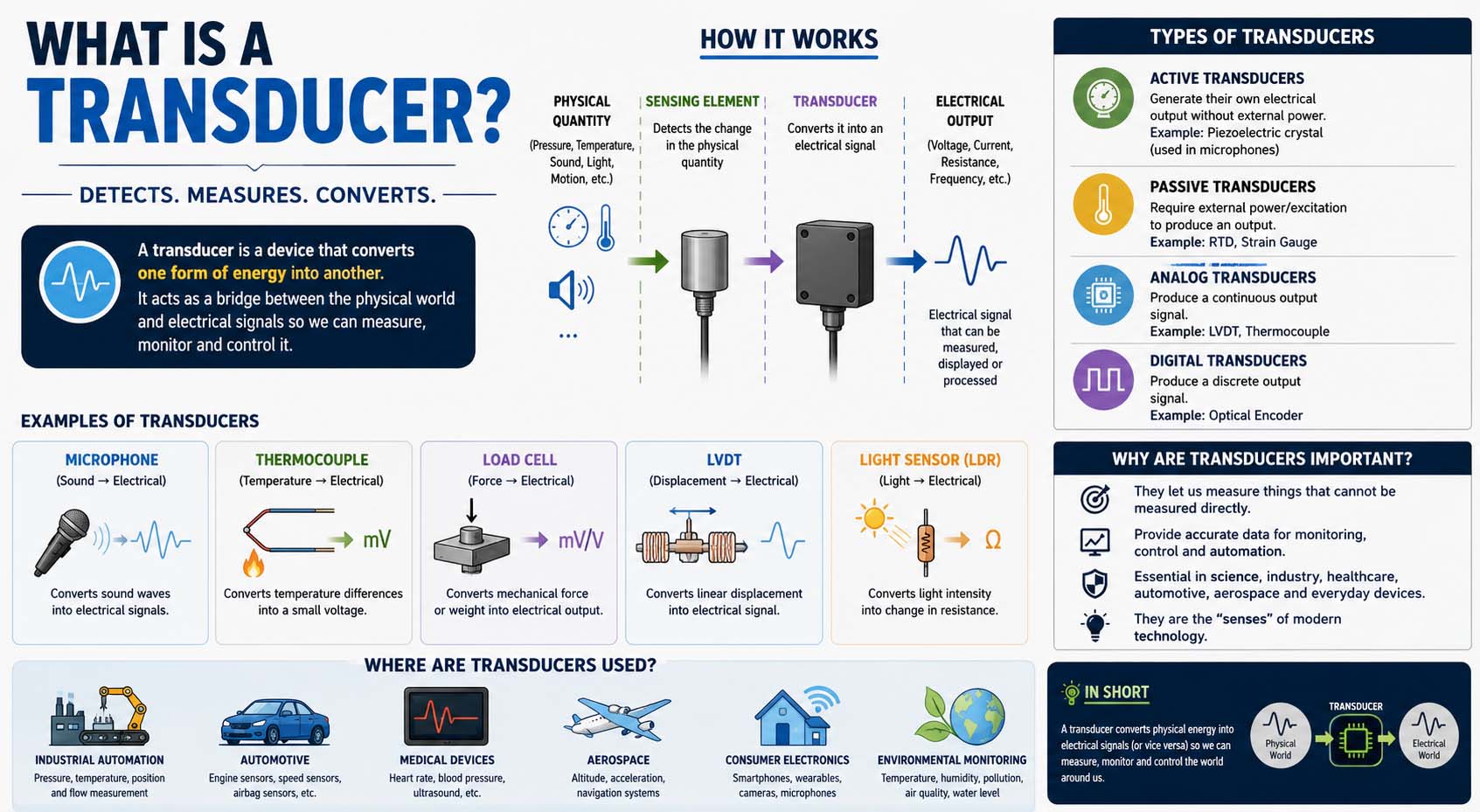
A transducer is a device that converts energy or information from one form into another. For example, measurement systems often use transducers to convert physical quantities such as pressure, sound, temperature, or motion into signals that electronic equipment can process.
Transducers appear in sensors, microphones, ultrasound equipment, boats, automation systems, and many other technologies. As a result, understanding their basic operation provides a useful foundation for learning about electronics, measurement, and control systems.
How Does a Transducer Work?
A transducer responds to an input and produces a corresponding output in another form. In measurement applications, for example, the input may be pressure, temperature, vibration, or sound. The device then produces an electrical or other usable signal that represents that input.
According to Britannica’s overview of transducers, the term now covers a wide range of sensors that respond to heat, sound, light and pressure. This helps explain why the terms sensor and transducer often overlap in measurement technology.
Many automated systems also rely on open loop vs closed loop control methods. In a closed-loop system, for instance, a controller can use measurement information from sensors or transducers to adjust system behavior.
A microphone provides a familiar example. It converts acoustic energy into an electrical signal. A speaker performs the reverse type of conversion by transforming an electrical signal into sound.
Types of Transducers
Engineers classify transducers in several ways. However, the categories often depend on how the device receives energy, what it measures, and what type of output it produces.
Active Transducers
Active or self-generating transducers produce an electrical output from the measured input without requiring an external excitation source for the transduction process. For example, thermocouples generate a voltage in response to a temperature difference.
Piezoelectric elements can also generate electrical charge when mechanical stress acts on them. Therefore, engineers often use them in applications involving vibration, force, or dynamic pressure.
Passive Transducers
Passive transducers require external electrical excitation and modify an electrical property in response to the measured quantity. For instance, the input may change resistance, capacitance, or inductance.
Understanding analog vs digital signals can also help when studying how measurement systems process a transducer’s output.
Input Transducers
Input transducers convert a physical quantity into another usable form, often an electrical signal. Microphones and many pressure-measurement devices provide common examples.
Output Transducers
Output transducers work in the opposite direction. They accept a signal and convert it into a physical effect such as sound, movement, or another form of energy.
Speakers and actuators are familiar examples. Therefore, transducers can support both measurement and output functions depending on the system.
What Is a Pressure Transducer?
A common related question is, what is a pressure transducer? This type of device responds to pressure and provides an output that represents the measured pressure.
Different pressure transducers use different sensing principles. For example, some systems rely on strain-gauge bridges, while others use capacitive or piezoelectric methods.
Industrial systems, hydraulic equipment, HVAC systems, automotive applications, and test equipment commonly require pressure measurements. Therefore, choosing an appropriate device depends on factors such as pressure range, environment, accuracy, and required output.
What Is a Pressure Transducer Used For?
Pressure transducers support applications in which equipment needs reliable pressure information for monitoring, control, or testing.
Common applications include:
- Industrial automation systems
- Water and fluid systems
- Oil and gas equipment
- Medical equipment
- Heating and cooling systems
- Automotive systems
- Aerospace applications
For example, an industrial controller can monitor a pressure signal and respond when operating conditions move outside an acceptable range.
In many engineering environments, teams also use measurement data during verification vs validation processes. As a result, reliable measurement can help engineers compare actual system behavior with specified requirements.
What Is a Transducer on a Boat?
Marine electronics provide another common application. When someone asks what is a transducer on a boat, they usually mean a device associated with sonar, depth measurement, or a fish finder.
A sonar transducer sends acoustic energy into the water and receives returning echoes. Objects, the bottom, and other underwater features can reflect part of the transmitted energy.
The system then processes the returning signal and uses information such as echo timing to help produce useful depth or sonar information. Therefore, the transducer acts as the interface between the electronic system and the underwater acoustic environment.
Its installation also matters. For example, poor positioning can affect sonar performance because water flow, bubbles, or mounting conditions may interfere with the signal.
Common Applications of Transducers
Transducers appear in many technologies that people use every day. However, their exact role varies greatly from one system to another.
Microphones convert sound into electrical signals for communication and recording. Speakers perform an output function by producing sound from electrical input.
Medical ultrasound equipment also relies on specialized transducers to transmit and receive acoustic energy. Meanwhile, industrial systems use different sensing technologies to monitor variables such as pressure, temperature, force, position, and vibration.
Robotics provides another important example. Robots need information about their physical environment and internal operation. Therefore, sensing and transduction technologies can help a control system monitor movement, force, position, and other variables.
Step-by-Step Guide to Choosing a Transducer
Selecting the correct device requires more than simply choosing the right measurement category. Instead, users should compare the operating requirements with the transducer’s specifications.
Step 1: Identify the Measurement Type
First, determine the physical quantity you need to measure or convert. This may include pressure, temperature, sound, force, displacement, acceleration, or vibration.
Choosing the correct measurement principle at this stage prevents many compatibility problems later.
Step 2: Check Environmental Conditions
Next, consider the operating environment. Temperature extremes, moisture, vibration, chemicals, pressure, and underwater use can affect which device will work reliably.
For example, marine equipment may require appropriate protection against water and corrosion.
Step 3: Verify Signal Compatibility
Then, check the output type and the requirements of the receiving equipment. A controller, data-acquisition system, or other electronic device must support the transducer’s output and required signal conditioning.
Engineers may also apply reverse engineering meaning techniques when they need to understand older equipment before selecting compatible replacement components.
Step 4: Compare Range, Accuracy, and Resolution
After that, review the required measurement range and performance specifications. A device must cover the intended range without sacrificing the accuracy required by the application.
However, higher precision is not automatically necessary for every system. The correct specification depends on the actual measurement requirements.
Step 5: Review Durability and Installation
Finally, consider mounting, connectors, wiring, mechanical dimensions, and environmental protection. Industrial and marine applications may require especially robust construction.
Proper selection and installation can improve measurement reliability and reduce avoidable problems.
Troubleshooting Common Transducer Problems
Like other technology components, transducers can produce unreliable results when installation, wiring, calibration, or environmental conditions are incorrect. Therefore, troubleshooting should follow a systematic process.
Weak Signal Output
First, inspect wiring, connectors, excitation requirements, and signal-conditioning equipment. Damaged connections or an incompatible measurement setup can reduce the usable output.
Inaccurate Readings
Calibration problems, incorrect setup, environmental conditions, or physical damage can affect measurement results. Therefore, compare the device with a known reference when the application allows it.
Water or Moisture Problems
Marine equipment operates in demanding conditions. As a result, damaged seals, connectors, cables, or mounting hardware can create problems.
Signal Interference
Electrical noise can interfere with low-level signals. Therefore, correct grounding, shielding, cable routing, and signal conditioning may become important in measurement systems.
Physical Damage
Finally, inspect the device for visible impact damage, corrosion, damaged cables, or loose connections. Mechanical damage can affect both reliability and measurement performance.
Regular inspection and correct installation can prevent many common issues.
Sensors vs. Transducers
Beginners often confuse sensors and transducers because engineers sometimes use the terms in closely related ways.
A transducer is the broader concept of converting energy or information from one form into another. A sensor, meanwhile, detects or measures a physical, chemical, or biological quantity and produces a corresponding output.
In many modern measurement devices, the sensing and transduction functions exist within the same component. Therefore, the terminology can overlap depending on the technical field and application.
For example, a temperature measurement device may respond to temperature and convert that response into an electrical quantity that another system can measure.
Transducers in Modern Smart Systems
Modern automation increasingly combines sensing, processing, communication, and control. Consequently, transducers often operate as one part of a much larger measurement system.
For example, a smart industrial system may collect a signal, condition it, convert it into digital data, analyze the result, and send information to a controller or monitoring platform.
Wireless communication can also reduce the need for direct signal cabling in some applications. However, designers still need to consider power, measurement accuracy, environmental conditions, communication reliability, and system compatibility.
Many modern systems also apply what is mechatronics principles. In these systems, mechanical components, electronics, sensors, control systems, and software work together.
As automation expands, reliable transduction and sensing will remain essential for connecting physical processes with electronic control and data systems.
FAQ About What Is a Transducer
What Is a Transducer in Simple Terms?
A transducer is a device that converts energy or information from one form into another. For example, a microphone converts acoustic energy into an electrical signal.
What Is a Pressure Transducer?
A pressure transducer responds to pressure and provides a corresponding output signal. Therefore, monitoring or control equipment can use that output to determine pressure conditions.
What Is a Transducer on a Boat Used For?
On boats, the term often refers to a sonar or fish-finder transducer. It sends acoustic energy into the water and receives returning echoes that the system can process.
Are Sensors and Transducers the Same?
The terms overlap, but they are not always identical. A sensor performs a sensing or measurement function, while transducer is a broader term for a device that converts one form of energy or information into another.
Where Are Transducers Commonly Used?
They appear in industrial measurement, medical equipment, marine electronics, automotive systems, consumer electronics, robotics, and many other technologies.
Conclusion
Understanding what is a transducer provides a useful foundation for learning about measurement, electronics, automation, and control systems. These devices connect physical phenomena with electronic or mechanical systems by converting energy or information from one form into another.
Pressure measurement, marine sonar, microphones, industrial automation, and robotics all provide practical examples of transduction. Therefore, learning how different types work, how engineers select them, and how to troubleshoot basic problems can help beginners better understand many modern technology systems.