The debate about motor vs engine has existed for decades. Many people use the terms interchangeably, especially when talking about cars, machinery, and modern technology. However, while motors and engines both produce movement, they are not exactly the same thing.
Understanding the difference between a motor and an engine is important for students, vehicle owners, technology enthusiasts, and anyone interested in mechanical systems.
This guide explains how motors and engines work, their key differences, common applications, and why the distinction still matters today.
What Is an Engine?
Most engines operate by burning fuel and using the resulting energy to create motion.
Common fuel sources include:
- Gasoline
- Diesel
- Natural gas
- Aviation fuel
Examples of engines include:
- Car engines
- Motorcycle engines
- Aircraft engines
- Marine engines
Engines typically rely on combustion processes to generate power.
What Is a Motor?
Instead of burning fuel directly, motors use electricity to generate movement.
Common examples include:
- Electric vehicle motors
- Household appliance motors
- Industrial electric motors
- Fan motors
- Robot motors
As electric technology continues to advance, motors are becoming increasingly important across many industries.
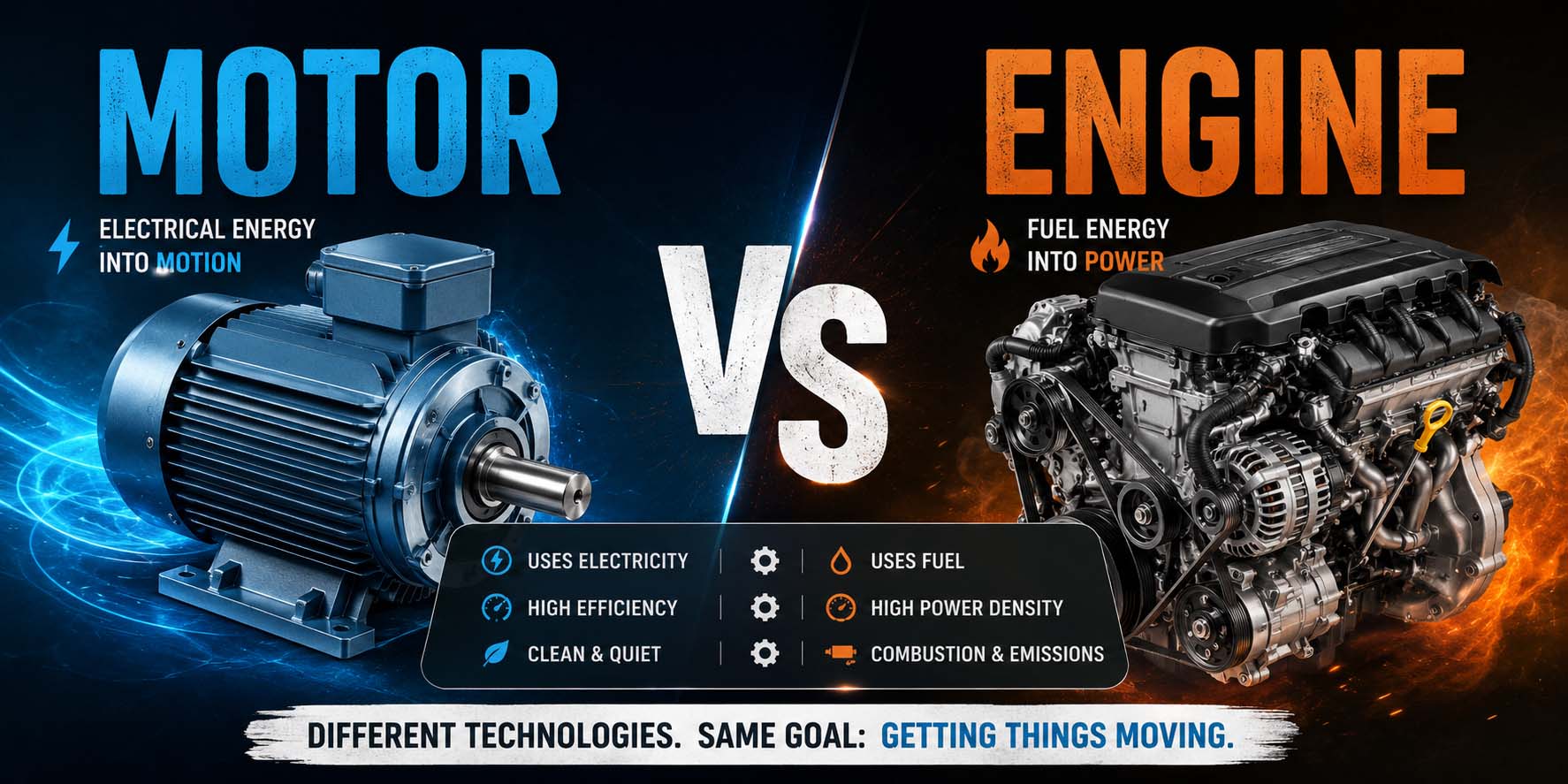
Motor vs Engine: Quick Comparison Table
| Feature | Motor | Engine |
|---|---|---|
| Energy Source | Electricity | Fuel combustion |
| Emissions | Usually lower | Produces exhaust gases |
| Noise Level | Generally quieter | Typically louder |
| Maintenance | Often lower | Usually higher |
| Efficiency | High efficiency | Varies by design |
| Common Uses | EVs, appliances, robotics | Cars, trucks, aircraft |
| Power Generation | Electrical conversion | Combustion process |
This comparison helps illustrate why the two technologies are often discussed separately.
Engine vs Motor: What Is the Main Difference?
The biggest distinction in the engine vs motor discussion is the energy source.
Engines Use Fuel
Engines generate power through combustion.
Fuel burns inside the system, creating energy that moves pistons or turbines.
Motors Use Electricity
Motors rely on electrical current.
Magnets and electromagnetic fields create rotational motion.
Although both systems perform similar tasks, the method of producing movement is fundamentally different.
Why Are the Terms Often Mixed Up?
Many people use “motor” and “engine” interchangeably because both generate movement.
For example:
- Motor vehicle
- Engine-powered car
Historically, language evolved in a way that blurred the distinction.
Today, even professionals sometimes use the terms loosely depending on industry conventions.
However, from a technical perspective, there is a meaningful difference.
How an Engine Works
To understand the comparison better, it helps to look at the process.
Step 1: Fuel Intake
The engine receives fuel and air.
Step 2: Combustion
Fuel ignites inside the combustion chamber.
Step 3: Energy Production
The explosion creates force.
Step 4: Mechanical Movement
The force moves pistons, crankshafts, or turbines.
Step 5: Power Output
Mechanical energy powers the vehicle or machine.
This process is the foundation of most internal combustion engines.
How a Motor Works
Electric motors operate differently.
Step 1: Electricity Supply
Electrical current enters the motor.
Step 2: Magnetic Field Creation
Electromagnetic forces are generated.
Step 3: Rotor Movement
Magnetic interactions create rotation.
Step 4: Mechanical Output
The rotating shaft powers equipment or vehicles.
The absence of fuel combustion is one reason electric motors are often more efficient.
Car Motor vs Engine
One common question involves car motor vs engine terminology.
Traditional Gasoline Vehicles
Most conventional vehicles contain engines.
Examples include:
- Sedans
- SUVs
- Pickup trucks
Electric Vehicles
Electric vehicles use motors rather than internal combustion engines.
Examples include many modern EVs.
Hybrid Vehicles
Hybrids may contain both:
- An engine
- One or more electric motors
This combination improves efficiency and performance.
As electric vehicles become more popular, understanding the difference becomes increasingly important.
Advantages of Motors
Electric motors offer several benefits.
High Efficiency
Motors convert a large percentage of energy into useful motion.
Reduced Maintenance
Fewer moving parts often mean fewer maintenance requirements.
Quiet Operation
Motors generally produce less noise than combustion engines.
Instant Torque
Electric motors can deliver power immediately.
These advantages help explain the growing popularity of electric vehicles and machinery.
Advantages of Engines
Despite the rise of electric technology, engines still offer important advantages.
Established Infrastructure
Fuel stations are widely available.
Long Range
Many vehicles can travel long distances without refueling.
High Power Output
Large engines remain important in heavy industries.
Proven Technology
Combustion engines have been refined over many decades.
For certain applications, engines remain highly practical.
Engine Oil vs Motor Oil
A common source of confusion involves engine oil vs motor oil.
The good news is that these terms usually refer to the same product.
What Is Engine Oil?
Engine oil lubricates internal engine components.
What Is Motor Oil?
Motor oil serves the same purpose.
Their functions include:
- Reducing friction
- Preventing wear
- Helping cooling
- Protecting components
Therefore, in most automotive contexts, there is little practical difference between the two terms.
Motor Oil vs Engine Oil: Is There Any Difference?
The question motor oil vs engine oil appears frequently online.
Manufacturers and retailers often use both names to describe the same lubricating product.
The important consideration is selecting the correct oil specification recommended by the vehicle manufacturer.
Troubleshooting Common Motor and Engine Problems
Understanding basic issues can help identify problems early.
Engine Problems
Common symptoms include:
- Rough idling
- Poor fuel economy
- Excessive smoke
- Hard starting
Motor Problems
Common symptoms include:
- Reduced performance
- Unusual noises
- Overheating
- Electrical faults
Regular maintenance helps reduce the likelihood of major failures.
Future Trends: Motors vs Engines
Technology continues to evolve rapidly.
Key trends include:
Electric Vehicle Growth
Electric motors are becoming more widespread.
Hybrid Systems
Many manufacturers combine engines and motors.
Improved Battery Technology
Better batteries support motor-based transportation.
Cleaner Engines
Engine manufacturers continue improving efficiency and emissions.
Both technologies are likely to coexist for many years.
FAQ
What is the difference between a motor and an engine?
A motor uses electricity to create motion, while an engine typically uses fuel combustion.
Traditional cars use engines, while electric vehicles use motors.
Why do people say motor when they mean engine?
The terms have been used interchangeably for many years in everyday language.
Is motor oil different from engine oil?
In most automotive situations, they are essentially the same product.
Which is more efficient, a motor or an engine?
Will motors replace engines completely?
Not necessarily. While electric motors are growing in popularity, engines still serve important roles in many industries.
Conclusion
The motor vs engine discussion is ultimately about understanding how machines create movement. While both perform similar functions, an engine typically generates power through fuel combustion, whereas a motor uses electricity. Understanding the difference between engine vs motor, knowing how car motor vs engine systems work, and recognizing that engine oil vs motor oil and motor oil vs engine oil are usually interchangeable terms can help consumers make better technology and vehicle decisions. As transportation and industry continue evolving, both motors and engines will remain important technologies shaping the future.