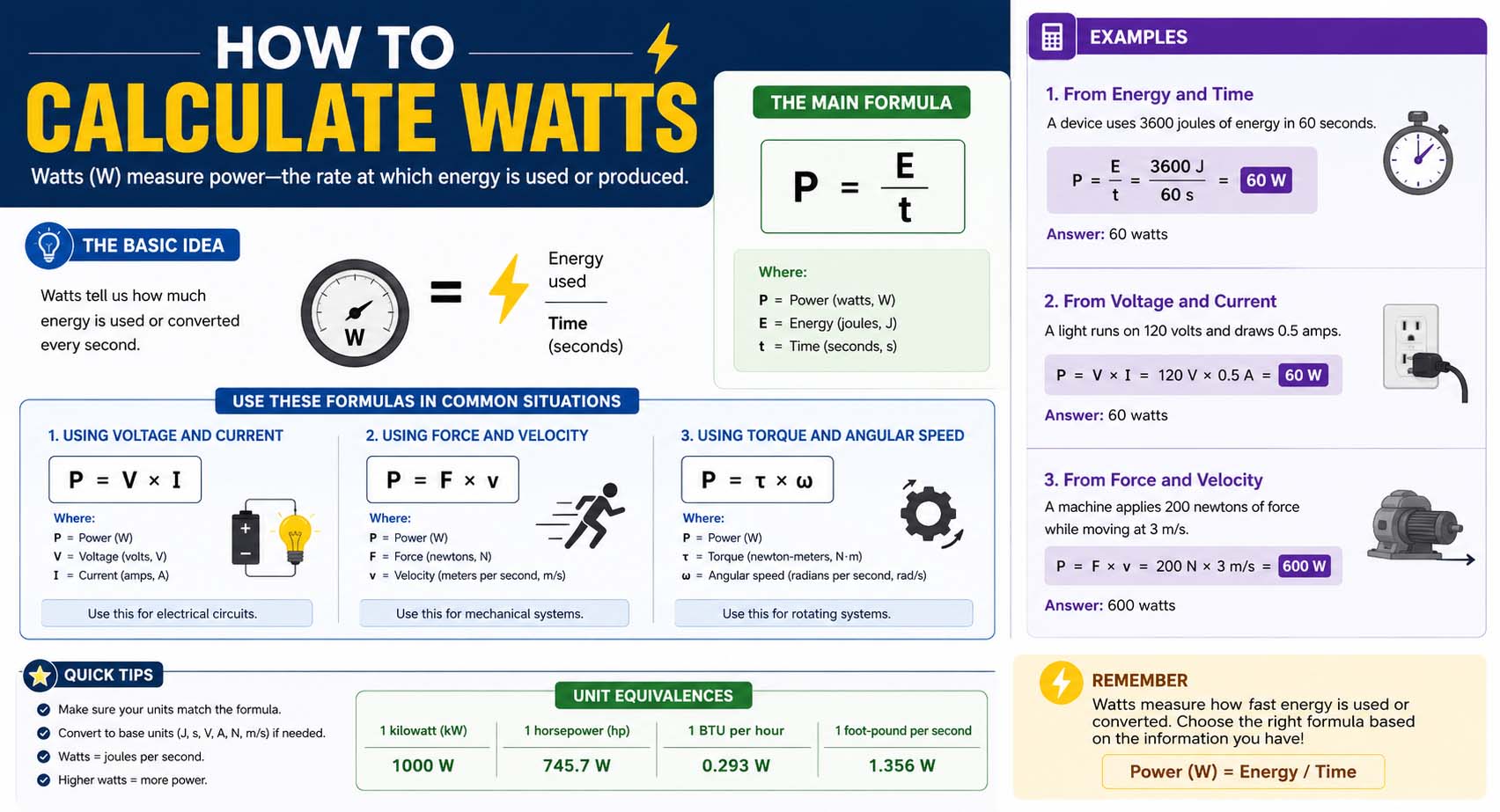
Understanding how to calculate watts is an important skill for anyone working with electronics, appliances, batteries, solar systems, or electrical equipment. Whether you want to estimate electricity usage, choose the right power supply, or understand your utility bill, knowing how watts are calculated can help.
Watts are the standard unit of power. They measure how much energy a device uses or produces at a given moment. From phone chargers and laptops to air conditioners and solar panels, wattage helps determine electrical performance and energy consumption.
What Are Watts?
A watt (W) is a unit of electrical power named after Scottish engineer James Watt.
Power represents the rate at which electrical energy is consumed or generated.
For example:
- LED light bulb: 10 watts
- Laptop charger: 65 watts
- Microwave oven: 1,000 watts
- Space heater: 1,500 watts
Basic Formula for Calculating Watts
The most common formula is:
Watts = Volts × Amps
Where:
- Watts (W) = Power
- Volts (V) = Electrical pressure
- Amps (A) = Electrical current
Understanding Volts vs Amps makes this formula much easier because power depends on both electrical pressure and current working together.
Example
If a device operates at:
- 120 volts
- 5 amps
Then:
Watts = 120 × 5
Watts = 600W
Step-by-Step Guide: How to Calculate Watts
Follow these simple steps:
Step 1: Find the Voltage
Check the device label, power adapter, or user manual.
Example:
Voltage = 230V
Step 2: Find the Current
Look for the amp rating.
Example:
Current = 3A
Step 3: Apply the Formula
The appliance uses 690 watts of power.
How to Calculate Watts From Amps and Volts
One of the most common electrical calculations involves converting voltage and current into power.
Formula
Watts = Amps × Volts
Example 1
- Voltage = 12V
- Current = 10A
Watts = 12 × 10
Watts = 120W
Example 2
- Voltage = 240V
- Current = 8A
Watts = 240 × 8
Watts = 1,920W
How to Calculate Amps From Watts
Sometimes you know the power rating but need to determine the current.
Formula
Amps = Watts ÷ Volts
Example
- Power = 1,200W
- Voltage = 120V
Amps = 1,200 ÷ 120
Amps = 10A
This method is useful when selecting circuit breakers, wires, or power supplies.
Knowing What Is a Circuit also helps you understand how electricity flows safely through the wiring and devices connected to these components.
How to Calculate kWh From Watts
Many people confuse watts with kilowatt-hours (kWh). Watts measure power, while kWh measures energy usage over time.
Electric utility companies bill customers using kilowatt-hours.
Formula
kWh = (Watts × Hours Used) ÷ 1,000
Example
kWh = (1,000 × 5) ÷ 1,000
kWh = 5 kWh
If electricity costs $0.15 per kWh:
Cost = 5 × $0.15
Cost = $0.75
This calculation helps estimate energy expenses.
If you prefer an automated calculation, a watt in kWh Rechner can quickly convert power usage into estimated energy consumption over time.
How to Calculate Watts Per Hour
The phrase “watts per hour” is often misunderstood.
Technically, watts already measure power at a specific moment. Most people asking how to calculate watts per hour actually want to know energy usage over time.
Example
A 500-watt appliance operating for 4 hours uses:
500 × 4 = 2,000 watt-hours
Or:
2,000 ÷ 1,000 = 2 kWh
When discussing electricity bills, kilowatt-hours are generally more useful than watts per hour.
Common Wattage Calculations for Household Devices
Here are some examples of typical power consumption:
Learning Why Is the Light Bulb Important also helps explain how improvements in lighting efficiency have reduced electricity consumption in homes and businesses.
| Device | Voltage | Current | Watts |
|---|---|---|---|
| Laptop Charger | 20V | 3.25A | 65W |
| LED TV | 120V | 1A | 120W |
| Refrigerator | 120V | 6A | 720W |
| Microwave | 120V | 10A | 1,200W |
| Hair Dryer | 120V | 12.5A | 1,500W |
AC vs DC Watt Calculations
Not all electrical systems work the same way.
DC Systems
Watts = Volts × Amps
AC Systems
For household electricity, power factor may affect calculations.
More advanced formula:
Watts = Volts × Amps × Power Factor
This formula is commonly used for AC electrical systems where the power factor affects actual power consumption.
Why Watt Calculations Matter
Learning how to calculate watts offers several benefits:
Energy Savings
Solar System Planning
Solar panel and battery sizing depends heavily on watt calculations.
Understanding What Is a Battery Charge also helps when estimating battery capacity and runtime for solar systems and portable power stations.
Electrical Safety
Proper watt calculations help prevent overloaded circuits and damaged equipment.
Device Compatibility
You can verify whether power supplies, generators, or batteries can handle connected devices.
Troubleshooting Incorrect Watt Calculations
Sometimes calculations do not match device labels. Here are common reasons.
Incorrect Voltage Reading
Verify the voltage rating listed on the appliance.
Wrong Amp Measurement
Check the actual operating current rather than the maximum current rating.
Power Factor Issues
Some AC appliances draw reactive power that affects watt calculations.
Unit Conversion Errors
Avoid confusing:
- Watts (W)
- Kilowatts (kW)
- Watt-hours (Wh)
- Kilowatt-hours (kWh)
Using the wrong unit can produce inaccurate results.
Watts vs Kilowatts Comparison
| Unit | Value |
| 1 Watt | Basic power unit |
| 1 Kilowatt | 1,000 Watts |
| 2 Kilowatts | 2,000 Watts |
| 5 Kilowatts | 5,000 Watts |
Large appliances and solar systems are often rated in kilowatts rather than watts.
Frequently Asked Questions
How do I calculate watts?
Multiply voltage by current.
Watts = Volts × Amps
Example:
120V × 5A = 600W
How do I calculate amps from watts?
Divide watts by volts.
Amps = Watts ÷ Volts
Example:
600W ÷ 120V = 5A
How do I calculate kWh from watts?
Multiply watts by hours used and divide by 1,000.
kWh = (Watts × Hours) ÷ 1,000
What is the difference between watts and kWh?
Watts measure power, while kilowatt-hours measure energy consumed over time.
Can I calculate wattage without amps?
If you know voltage and resistance, you can use alternative electrical formulas. However, voltage and amps are the most common values used for watt calculations.
Conclusion
Knowing how to calculate watts is a valuable skill for understanding electrical devices, managing energy consumption, and improving efficiency. The basic formula—Watts = Volts × Amps—makes it easy to determine power usage for most appliances and electronics.