
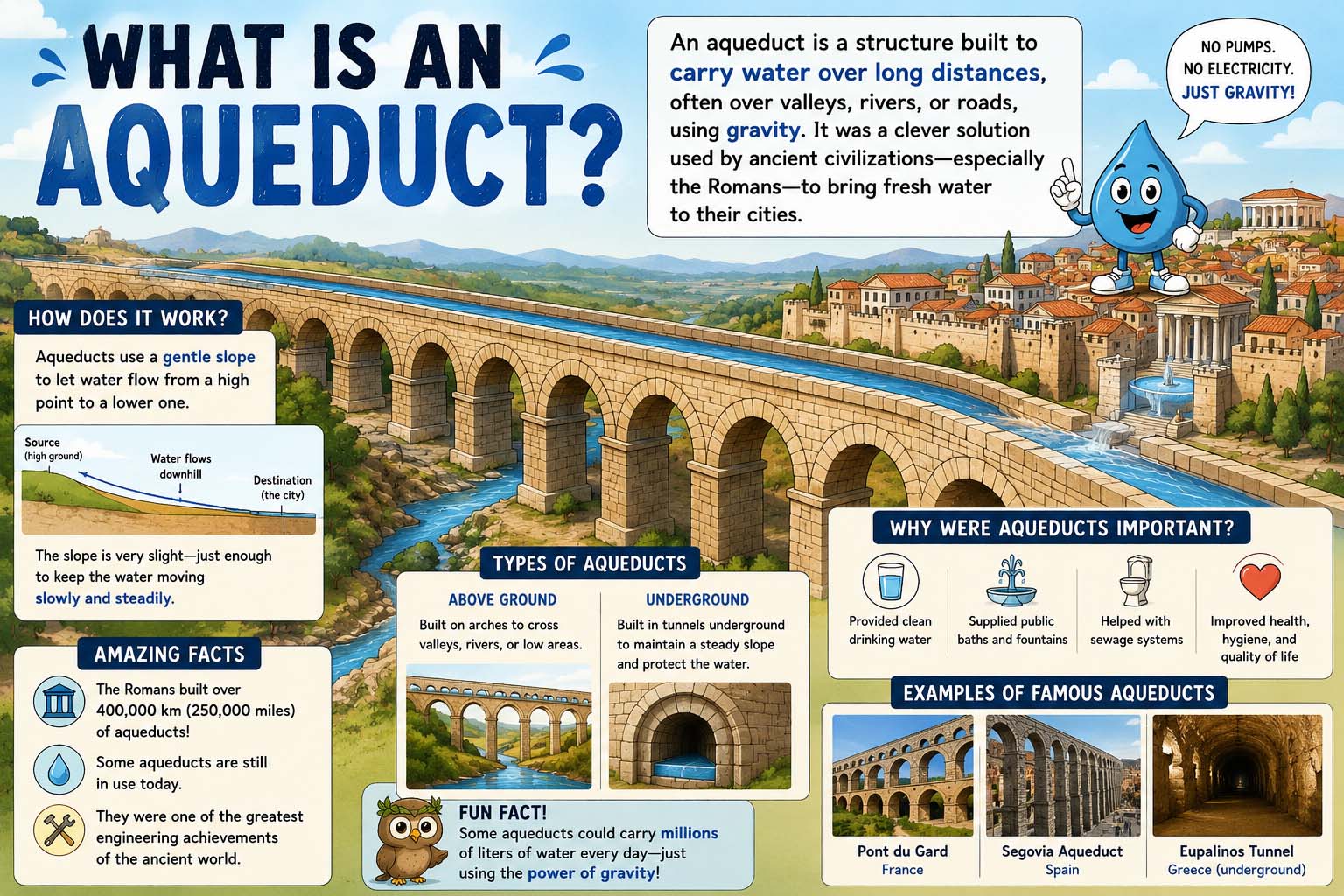
Many people ask, “what is an aqueduct?” An aqueduct is a structure or system designed to transport water from one location to another. Although people often associate aqueducts with ancient civilizations, especially Rome, engineers still use the same basic water-conveyance principle in modern infrastructure.
Aqueducts can move water across valleys, through mountains, into cities, and over long distances. Depending on the system, engineers may use canals, tunnels, pipelines, bridges, reservoirs, and pumping facilities to transport water.
In ancient times, aqueducts helped cities grow by supplying water for drinking, farming, baths, fountains, and other public needs. Today, large water-conveyance systems support agriculture, urban infrastructure, industry, and water management.
Therefore, understanding aqueducts helps explain how water engineering has shaped civilization for thousands of years.
Many large infrastructure projects also depend on understanding what is mechanical advantage, since construction equipment uses simple machines to move massive amounts of material efficiently.
What Is the Purpose of an Aqueduct?
The primary purpose of an aqueduct is to move water from an available source to a location where people need it. For example, a city or agricultural area may lie far from a dependable freshwater source.
Aqueduct systems can help provide water for:
- Drinking water supplies
- Irrigation systems
- Industrial uses
- Hydroelectric facilities
- Public water infrastructure
- Urban development
However, the exact purpose depends on the design of the system and the region it serves. Some aqueducts primarily support agriculture, while others form part of large municipal water networks.
As a result, these water systems can help communities use resources located many kilometers away.
How Does an Aqueduct Work?
Aqueduct systems can contain many structures, but their fundamental purpose remains straightforward: move water efficiently from its source to its destination.
Many traditional aqueducts rely heavily on gravity. Therefore, engineers carefully control the gradient so water continues flowing along the intended route.
Modern systems may also use pumps where gravity alone cannot provide the required movement.
Step 1: Collecting Water
First, the system obtains water from an appropriate source, such as a river, reservoir, spring, or other managed supply.
Step 2: Transporting Water
Next, water travels through structures such as canals, tunnels, pipelines, or elevated channels. The exact route depends on terrain, distance, elevation, and engineering requirements.
Step 3: Distributing Water
Finally, the system delivers water to its intended destination. Depending on the project, that destination may include a city, agricultural region, storage facility, treatment plant, or another water network.
Modern distribution networks may also use open loop vs closed loop control concepts to regulate pumps, valves, flow, and other equipment.
Roman Aqueduct Engineering
Roman aqueducts remain among the best-known examples of ancient water engineering. However, the Romans did not invent the general concept of transporting water through engineered channels. Earlier civilizations also developed water-conveyance systems.
The Romans expanded the technology on a remarkable scale. They constructed networks of channels, tunnels, pipes, reservoirs, and bridges to supply settlements throughout their territories.
Why Roman Aqueducts Were Important
Roman engineers carefully managed gradients so water could travel long distances by gravity. In addition, they adapted routes to hills, valleys, and other difficult terrain.
These water networks supplied water for purposes such as:
- Public fountains
- Baths
- Households in some circumstances
- Sanitation
- Gardens
- Agriculture and other uses
As a result, reliable water infrastructure supported many aspects of Roman urban life.
The famous rows of arches that people often associate with Roman aqueducts represented only part of these systems. In fact, much of an aqueduct route could run underground or close to ground level.
What Are Aqueducts Used for Today?
Modern aqueducts continue to transport large quantities of water. However, today’s systems can combine traditional gravity-based engineering with pumps, pipelines, reservoirs, monitoring equipment, and control systems.
Modern applications can include:
- Municipal water supplies
- Agricultural irrigation
- Regional water transfers
- Industrial water supplies
- Reservoir connections
- Hydroelectric-related water conveyance
For example, the U.S. Bureau of Reclamation’s water-resource projects include infrastructure related to water management and delivery in the United States.
Therefore, aqueduct technology is not simply a historical subject. Large water-conveyance projects remain important parts of modern infrastructure.
Ancient Aqueducts vs. Modern Aqueduct Systems
Aqueduct engineering has changed significantly over time. Nevertheless, both ancient and modern systems share the same broad objective of moving water reliably between locations.
| Feature | Ancient Aqueducts | Modern Aqueducts |
|---|---|---|
| Common Materials | Stone, masonry, concrete | Concrete, steel, pipelines, and other materials |
| Water Movement | Primarily gravity | Gravity and pumps |
| Monitoring | Human inspection | Sensors and digital monitoring |
| Water Management | Relatively simple controls | Advanced control systems |
| Maintenance | Manual labor | Machinery and modern inspection tools |
For example, modern engineers can monitor pressure, flow, structural conditions, and equipment performance electronically. Ancient engineers, on the other hand, relied on physical inspection and manual maintenance.
Technology Behind Modern Aqueduct Systems
Modern aqueduct infrastructure can incorporate sensors, communications equipment, automated controls, pumps, and water-quality monitoring.
Smart Aqueduct Monitoring
Sensors can track conditions such as flow, pressure, equipment status, and other system variables. As a result, operators can identify unusual conditions more quickly.
Automated Water Control Systems
Digital controllers can operate pumps, gates, and valves according to system requirements. Therefore, operators can manage complex water networks more efficiently.
Engineers also apply verification vs validation processes when developing monitoring and control systems for critical infrastructure.
Predictive Maintenance
Modern monitoring can help engineers detect changes in equipment performance. Consequently, maintenance teams may identify developing problems before they cause larger disruptions.
Environmental Engineering
Water infrastructure must also account for environmental conditions and resource management. Therefore, engineers may evaluate factors such as ecosystems, water availability, energy use, and long-term operating requirements.
Common Aqueduct Problems
Like other major infrastructure, aqueducts can develop problems as components age or environmental conditions change.
Water Leaks
Cracks, damaged joints, aging pipes, or structural problems can cause water loss. Therefore, operators need effective inspection and maintenance programs.
Sediment Build-Up
Sediment and debris can interfere with water movement in certain channels and structures. As a result, maintenance crews may need to remove accumulated material.
In pumping systems, engineers may also monitor what is cavitation, since cavitation can damage pumps and reduce their performance.
Structural Damage
Erosion, ground movement, earthquakes, weather, and material deterioration can affect infrastructure over time. Therefore, engineers inspect vulnerable structures and repair damage when necessary.
Water Quality Problems
Contamination can create serious concerns in water systems. Consequently, operators must monitor and manage water quality according to the purpose of the supply and applicable requirements.
Aqueduct Maintenance and Inspection
Maintenance helps water infrastructure continue operating safely and reliably. However, the exact maintenance program depends on the design, age, location, and purpose of each system.
Aqueduct Inspection
First, engineers and maintenance teams inspect accessible channels, tunnels, pipelines, structures, and mechanical equipment. Modern systems may also use remote monitoring technologies.
Cleaning Water Channels
Next, crews may remove sediment, vegetation, debris, or other material that interferes with operation.
Structural Repairs
Engineers repair or reinforce damaged sections when inspections reveal deterioration. In addition, they may replace components that have reached the end of their service life.
Technology Upgrades
Finally, operators can upgrade older systems with sensors, communications equipment, automated controls, and other modern technologies.
Regular maintenance can reduce the risk of unexpected disruptions and help extend the useful life of infrastructure.
Famous Aqueducts Around the World
Several aqueducts have become famous because of their engineering, history, scale, or preservation.
Pont du Gard Aqueduct – France
The Pont du Gard is a famous Roman aqueduct bridge in southern France. Its surviving arches demonstrate the engineering skill involved in carrying a water channel across difficult terrain.
Aqueduct of Segovia – Spain
The Aqueduct of Segovia is known for its monumental stone arches. In addition, it remains one of the most recognizable examples of Roman engineering in Spain.
California Aqueduct – United States
The California Aqueduct forms part of a large modern water-conveyance network. Unlike ancient masonry systems, it uses modern canals and infrastructure to transport water over long distances.
Aqua Claudia – Ancient Rome
Aqua Claudia was one of the major aqueducts that supplied ancient Rome. Today, surviving sections help illustrate the scale of Roman water engineering.
Together, these examples show how different societies solved the challenge of transporting water across difficult landscapes.
Why Aqueduct Technology Still Matters
Water does not always exist where cities, farms, and industries need it. Therefore, large water-conveyance systems remain important in regions where supplies and demand are geographically separated.
Modern water planning may combine aqueducts with:
- Reservoirs
- Water-treatment facilities
- Irrigation networks
- Pumping stations
- Water recycling
- Desalination in suitable regions
- Digital monitoring
However, moving water over long distances also creates engineering, environmental, economic, and energy challenges. As a result, planners must consider more than simply constructing a channel between two locations.
Aqueducts and Smart Infrastructure
Digital technology can help operators monitor and control modern water infrastructure. For example, sensors can provide information about flow conditions and equipment performance.
Engineers can also use:
- Automated pressure and flow controls
- Remote monitoring
- Real-time operational data
- Pump-control systems
- Equipment condition monitoring
These technologies relate closely to what is mechatronics, where mechanical equipment, electronics, sensors, control systems, and software work together.
As a result, modern aqueduct operation can combine traditional civil engineering with electrical, mechanical, and digital technologies.
Beginner Guide to Aqueduct Engineering
For beginners, aqueduct engineering may appear highly technical. However, the core idea is simple: engineers need to move water from one place to another while controlling its route and flow.
The main challenges can include:
- Distance
- Changes in elevation
- Flow requirements
- Water pressure
- Structural durability
- Terrain
- Environmental conditions
- Maintenance access
For example, mountainous terrain may require tunnels, while valleys may require bridges, pipelines, or other structures. Therefore, engineers select solutions according to local geography and project requirements.
FAQ About Aqueducts
What Is an Aqueduct?
An aqueduct is a structure or system that conveys water from one location to another. Depending on the design, it may include canals, tunnels, pipelines, bridges, and other infrastructure.
What Is the Purpose of an Aqueduct?
Its main purpose is to transport water to places where people, agriculture, industry, or infrastructure need it.
How Do Roman Aqueducts Work?
Roman engineers primarily used carefully graded channels to move water by gravity. However, they also constructed tunnels, bridges, settling structures, and other components where the route required them.
What Are Modern Aqueducts Used For?
Modern systems transport water for municipal supplies, agriculture, industry, and other infrastructure needs. In addition, some large water projects integrate reservoirs, pumps, monitoring systems, and control equipment.
Are Aqueducts Still Important in 2026?
Yes. Large water-conveyance systems remain important in many regions where water sources lie far from the communities or agricultural areas that need them.
Conclusion
Understanding aqueducts reveals how engineers have solved the challenge of moving water across long distances for thousands of years. Ancient civilizations developed sophisticated gravity-fed systems, while modern engineers combine similar fundamental principles with pumps, pipelines, sensors, and automated controls.
Aqueducts are therefore more than historical landmarks. They remain important infrastructure for cities, agriculture, industry, and regional water management. As water systems continue to evolve, engineers can combine proven water-conveyance principles with modern monitoring and control technologies.