
Technology professionals, cybersecurity experts, software developers and engineers often use the term reverse engineering. However, many beginners still wonder about the reverse engineering meaning and why it matters in today’s digital world.
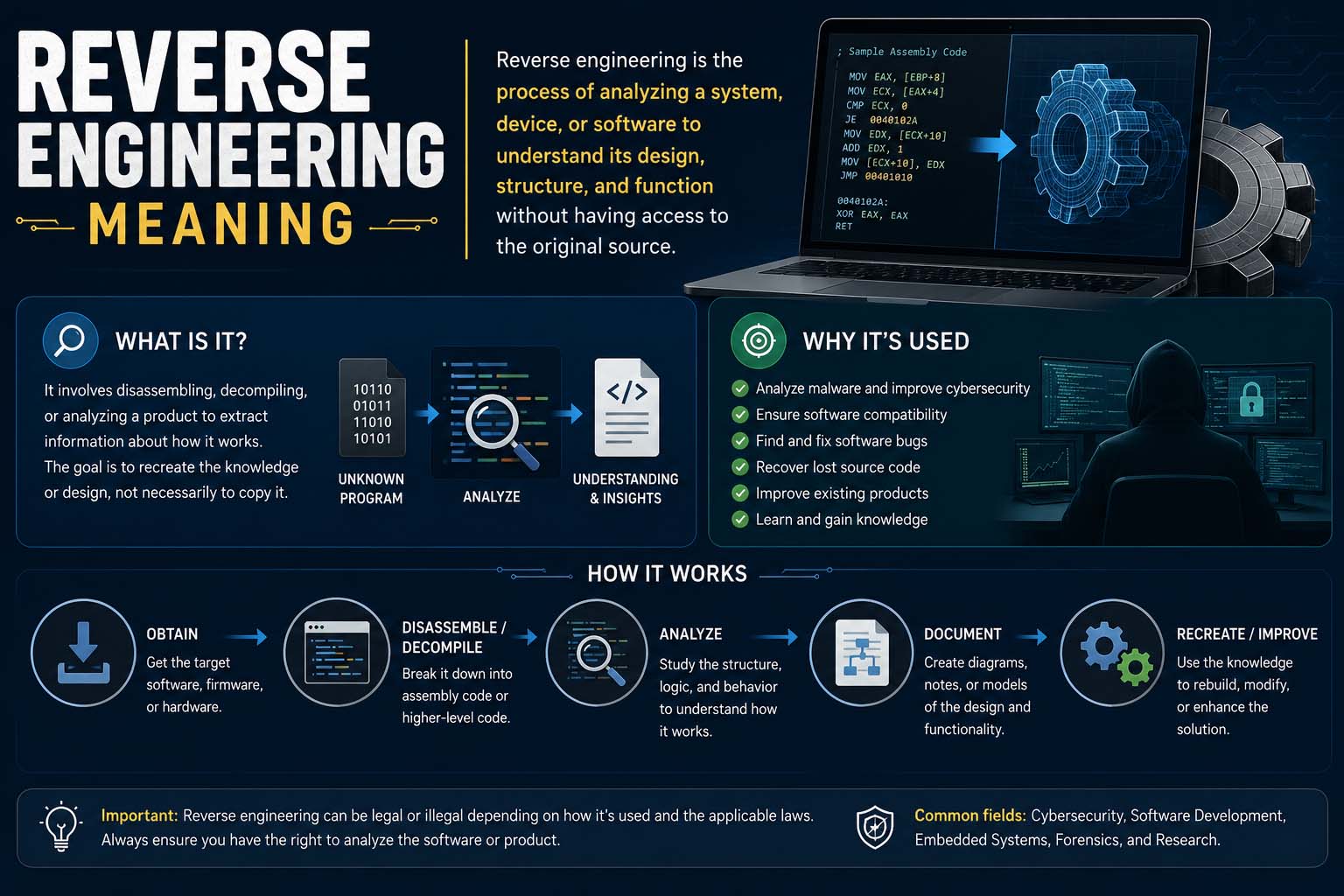
Reverse engineering is the process of studying a product, system, software application or device to understand how it works. Instead of creating something from scratch, engineers examine an existing product and then work backward to uncover its design, structure, parts or function.
What Is Reverse Engineering?
The simplest reverse engineering meaning is taking apart or studying an existing system to understand how it works inside. According to Merriam-Webster, to reverse engineer is to disassemble and examine or analyze a product or device in detail.
In other words, instead of starting with a design and building a product, reverse engineering starts with the finished product and looks at how someone made it.
People do this for many reasons. For example, they may want to learn how a system works, improve existing technology or fix compatibility issues. In addition, they may want to find security weaknesses, document old systems or create replacement parts.
Also, reverse engineering does not always mean copying a product. In fact, people often use it for research, education, maintenance and security.
Meaning of Reverse Engineering in Technology
The meaning of reverse engineering changes slightly from one industry to another.
Software Development
Developers study software programs to understand their architecture, code behavior, algorithms and the way they interact with other systems.
Hardware Engineering
Engineers inspect physical devices to understand their circuit design, how the parts are arranged and how the maker built them. For this reason, knowing what is a circuit makes hardware analysis much easier.
Cybersecurity
Security professionals use reverse engineering to examine malware, viruses, ransomware and exploits.
Therefore, in every case, the goal is to understand how something works on the inside.
How Reverse Engineering Works
Reverse engineering follows a clear process from start to finish.
Step 1: Collect Information
First, engineers gather data about the product, software or system. This data may include documentation, hardware specifications, program files and network activity.
Step 2: Analyze Components
Next, they break the product into smaller parts. For instance, they may look at software modules, electronic components or mechanical assemblies one at a time.
Step 3: Understand Functionality
Then, they study each part to see what role it plays in the larger system.
Step 4: Reconstruct Design Logic
After that, engineers create diagrams, documents or models that explain how the system operates.
Step 5: Apply Findings
Finally, they put the results to use. For example, they may use them for security analysis, product improvement, compatibility work or educational research.
As a result, this step-by-step approach helps uncover hidden design details.
What Does Reverse Engineering Meaning Include in Software?
Many beginners ask what does reverse engineering meaning involve in software development.
In software, it means examining an application without access to the original source code. Common methods include disassembling code, decompiling applications, watching how the system behaves and studying file structures.
Because of this, software reverse engineering helps developers understand old programs and recover lost documentation. Similarly, it helps them find weak spots and make different programs work together.
Overall, it plays a big role across the technology industry.
Common Uses of Reverse Engineering
Reverse engineering serves many practical purposes.
Security Research
Cybersecurity experts study malware to understand threats, so they can build better defenses.
Product Improvement
Manufacturers study existing products because it helps them improve future designs.
Legacy System Support
Organizations often reverse engineer old systems when the original documentation no longer exists.
Educational Purposes
Students and researchers also use reverse engineering to understand technology concepts.
Compatibility Development
Software developers use it to build products that work with existing systems.
Clearly, these uses show how flexible reverse engineering can be.
Reverse Engineering vs Forward Engineering
Understanding the difference also helps make the idea clearer.
| Feature | Reverse Engineering | Forward Engineering |
|---|---|---|
| Starting Point | Finished product | Initial concept |
| Goal | Understand design | Create design |
| Process Direction | Backward analysis | Forward development |
| Main Purpose | Learning and analysis | Building and production |
| Common Users | Analysts, researchers | Engineers, developers |
In short, both approaches play important roles in technology development.
Reverse Social Engineering Meaning
A special cybersecurity idea is the reverse social engineering meaning.
Traditional social engineering happens when attackers trick victims into giving away information. Reverse social engineering, on the other hand, works differently.
In this case, the attacker sets up a situation where the victim comes to the attacker for help.
Example
First, the attacker causes a problem. Then, the victim notices the issue. Next, the attacker shows up as a trusted expert, and the victim asks for help. Finally, the attacker gains access or information.
Since the victim makes the first contact, reverse social engineering can work very well for attackers.
For this reason, organizations often train staff to spot these tricks.
Reverse Prompt Engineering Meaning
Artificial intelligence has brought another related idea known as the reverse prompt engineering meaning.
Reverse prompt engineering means studying AI-generated content to work out which prompt likely produced it. Moreover, this practice keeps growing in importance in AI development.
Why It Is Used
People use it to improve prompt design and understand how AI behaves. Likewise, it helps them improve outputs, study language models and repeat successful results.
For example, an AI researcher may look at a generated article and guess the instructions that produced it.
As AI use grows, reverse prompt engineering also becomes more relevant.
Benefits of Reverse Engineering
Reverse engineering offers many advantages.
Better System Understanding
Engineers gain a clear view of how products function.
Enhanced Security
Security teams find weak spots before attackers can exploit them.
Cost Savings
Organizations can keep older systems running instead of rebuilding them completely.
Innovation Opportunities
Studying existing technology often sparks new ideas.
Improved Documentation
Reverse engineering helps recreate missing technical information. Thus, it becomes a valuable tool across many industries.
Common Challenges in Reverse Engineering
Despite its advantages, reverse engineering can be hard.
Complex Systems
Modern software and hardware often contain millions of parts.
Limited Documentation
Some products come with very little technical information.
Time Requirements
A thorough analysis can also take a lot of effort.
Obfuscation Techniques
Developers sometimes hide their code structure on purpose.
Legal Considerations
Any reverse engineering work must follow local laws and licensing agreements. Still, good planning helps you get past many of these challenges.
Troubleshooting Reverse Engineering Projects
When a project gets difficult, try these simple strategies.
Break Systems into Smaller Parts
Study each part on its own rather than examining everything at once.
Use Specialized Tools
Software and hardware analysis tools make the work easier. For instance, it helps to understand what is a transducer when you study sensors inside a device.
Create Documentation
Write down your findings throughout the process.
Validate Assumptions
Test your ideas before you accept any conclusion.
Collaborate with Experts
Ask experienced people for help whenever you get stuck. Altogether, these habits improve both speed and accuracy.
Industries That Use Reverse Engineering
Many industries depend on reverse engineering.
Software Development
Software teams use it for application analysis and compatibility testing.
Cybersecurity
Security teams use it for threat detection and malware analysis.
Automotive Engineering
Car makers use it to study vehicle systems and design new components.
Aerospace
Aerospace companies use it for maintenance and to support old systems.
Manufacturing
Factories use it to evaluate products and improve designs. Similarly, the analog vs digital shift pushes many companies to study older equipment before they upgrade it.
Overall, this wide use shows how important reverse engineering is in modern technology.
Frequently Asked Questions
What is reverse engineering?
It is the process of studying an existing product or system to understand how it works.
What is the meaning of reverse engineering?
Basically, the term means studying a finished product to uncover its design, function or internal structure.
What does reverse engineering meaning involve in software?
Software reverse engineering involves examining software behavior, code structure and function without the original design documents.
What is reverse social engineering meaning?
It is a cybersecurity trick where attackers push victims into asking the attacker for help.
What is reverse prompt engineering meaning?
This term means studying AI outputs to figure out the prompts that likely created them.
Is reverse engineering legal?
Legality depends on local laws, licensing agreements and the purpose of the analysis.
Conclusion
In conclusion, understanding the reverse engineering meaning shows how technology professionals study and understand complex systems. Whether you explore it in software, cybersecurity, social engineering or AI prompts, the core idea stays the same: you work backward to uncover how something functions.