Technology and engineering often focus on solving problems efficiently. However, some inventions are famous for doing the exact opposite. If you’ve ever seen a chain reaction where a ball rolls down a ramp, knocks over dominoes, and eventually performs a simple task, you’ve already encountered the concept.
Many students, teachers, engineers, and hobbyists search for what is a Rube Goldberg machine because these devices are commonly used in science projects, STEM education, and creative engineering challenges.
What Is a Rube Goldberg Machine?
The answer to what is a Rube Goldberg machine? is relatively simple.
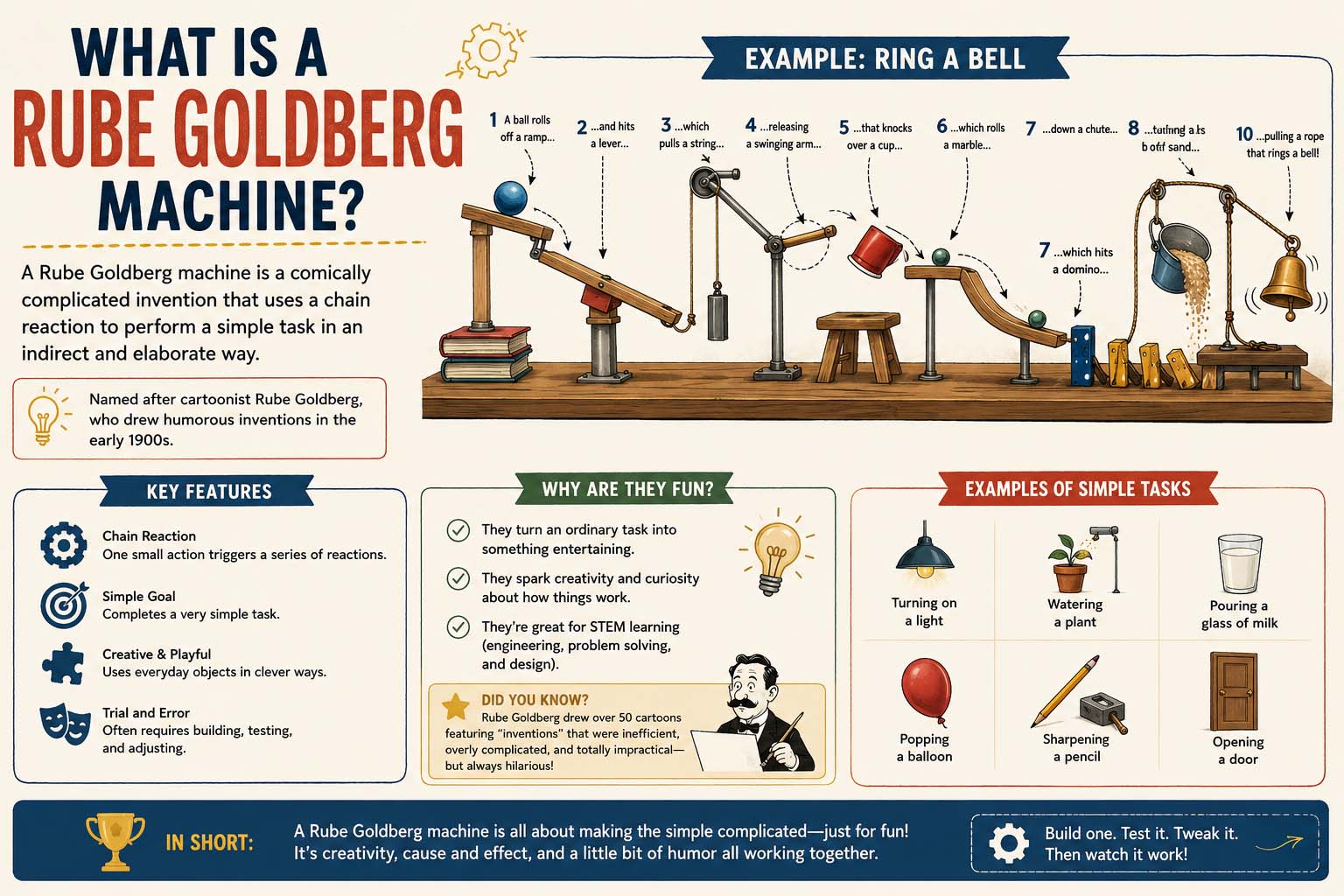
A is a device that performs a simple task through a complex series of chain reactions. Instead of accomplishing a goal directly, the machine uses multiple interconnected steps that trigger one another until the final action is completed.
For example, a machine designed to turn off a light switch might include:
- A rolling ball
- A falling domino
- A swinging lever
- A moving toy car
- A pulley system
Each action causes the next action until the final objective is achieved.
The concept is named after Rube Goldberg, who became famous for creating humorous cartoons depicting overly complicated machines.
The History Behind Rube Goldberg Machines
Rube Goldberg was an American cartoonist who created illustrations of elaborate machines that performed ordinary tasks in unnecessarily complicated ways.
His cartoons became extremely popular because they humorously highlighted how people sometimes overcomplicate simple problems.
Over time, the term “Rube Goldberg machine” became widely used to describe any process or device that uses excessive steps to achieve a basic result.
Today, these machines are commonly featured in:
- STEM education
- Engineering competitions
- Science fairs
- Robotics projects
- Technology demonstrations
What Is the Purpose of a Rube Goldberg Machine?
A common question is what is the purpose of a Rube Goldberg machine?
Although the machines appear inefficient, they serve several educational and practical purposes.
Teaching Engineering Concepts
Students learn how mechanical systems interact with one another.
Demonstrating Physics Principles
Rube Goldberg machines illustrate:
- Gravity
- Motion
- Momentum
- Energy transfer
- Friction
- Force
Encouraging Creativity
Builders must think creatively to connect multiple actions into one working system.
Improving Problem-Solving Skills
Each component must function correctly for the machine to succeed.
These benefits make Rube Goldberg machines valuable learning tools despite their intentionally complicated designs.
How Does a Rube Goldberg Machine Work?
A relies on a chain reaction.
One action triggers another, which triggers another, and so on until the final task is completed.
For example:
A marble rolls down a ramp.
The marble hits dominoes.
The dominoes knock over a lever.
The lever releases a toy car.
The toy car pulls a string.
The string turns off a light switch.
While the task itself is simple, the journey to complete it is intentionally complex.
This combination of creativity and engineering makes these machines fascinating to build and watch.
What Is a Step in a Rube Goldberg Machine?
Many learners ask, what is a step in a Rube Goldberg machine?
A step refers to an individual action within the chain reaction.
Each step serves as a link connecting one event to the next.
Examples of common steps include:
- Rolling a ball
- Tipping over dominoes
- Activating a lever
- Pulling a string
- Triggering a pulley
- Releasing a weight
A successful typically contains multiple carefully planned steps that work together without interruption.
The more creative and reliable the sequence, the more impressive the machine becomes.
Creating a Rube Goldberg machine can be a fun technology project.
Step 1: Choose a Simple Final Task
Select a basic goal such as:
- Ringing a bell
- Turning off a light
- Opening a box
- Popping a balloon
Step 2: Plan the Chain Reaction
Sketch how one action will trigger the next.
Step 3: Gather Materials
Common materials include:
- Balls
- Dominoes
- Toy cars
- Ramps
- Strings
- Cups
- Pulleys
Step 4: Build Individual Sections
Test each section separately before connecting them together.
Step 5: Connect the Entire System
Combine all components into one continuous sequence.
Step 6: Test and Improve
Most machines require adjustments before operating successfully.
Patience and experimentation are important parts of the design process.
Rube Goldberg Machines and Technology Education
Rube Goldberg machines are widely used in modern technology education.
Teachers often assign these projects because they combine multiple STEM disciplines.
Students learn:
- Engineering design
- Critical thinking
- Physics principles
- Mechanical systems
- Team collaboration
Unlike traditional lectures, hands-on projects help students understand concepts through direct experience.
This practical learning approach remains highly effective.
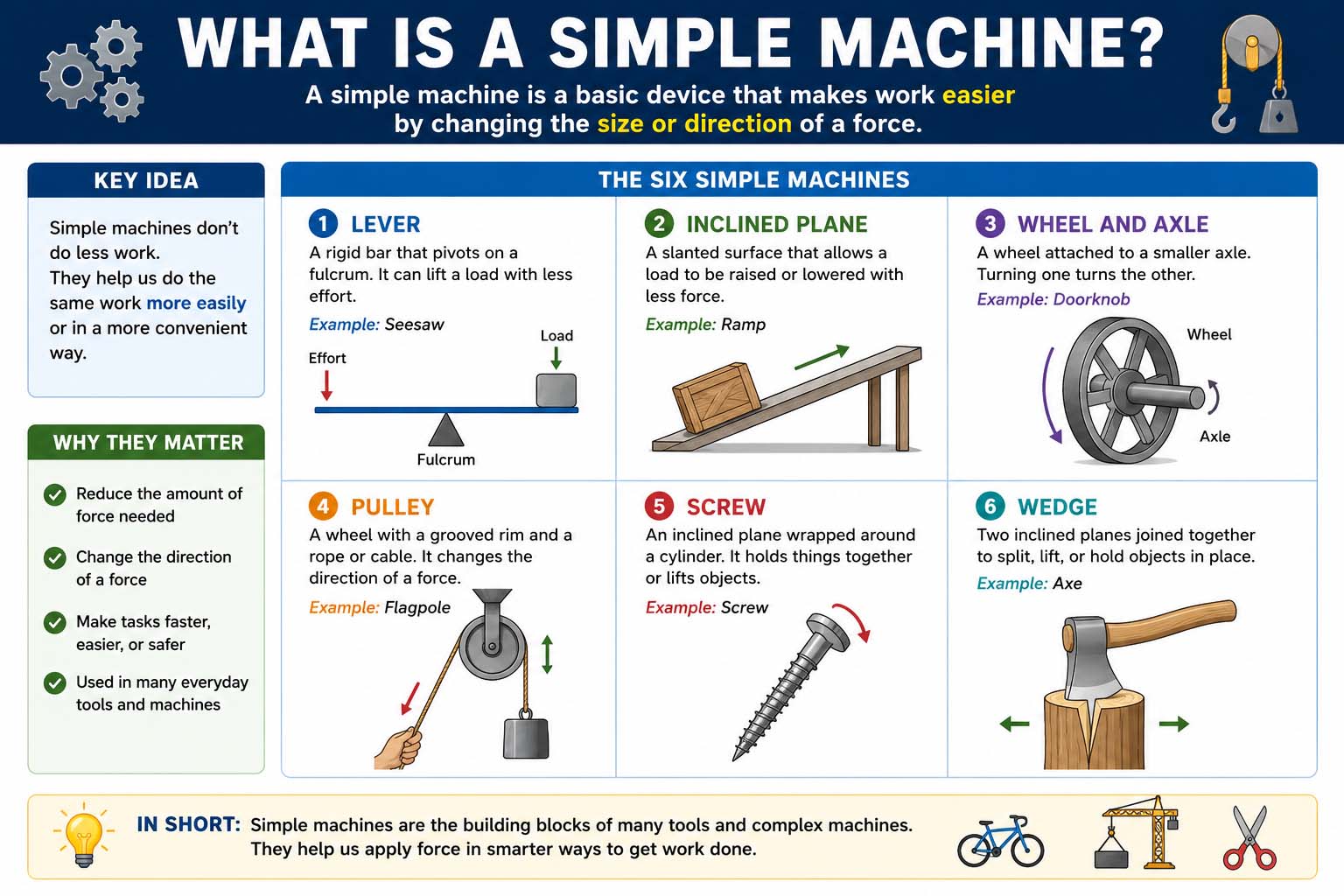
Comparison: Simple Machine vs Rube Goldberg Machine
Understanding the difference between a standard machine and a Rube Goldberg machine can be helpful.
| Feature | Simple Machine | Rube Goldberg Machine |
|---|---|---|
| Efficiency | High | Low |
| Number of Steps | Few | Many |
| Purpose | Practical | Educational/Creative |
| Design Complexity | Simple | Complex |
| Problem Solving | Direct | Indirect |
| Entertainment Value | Moderate | High |
While simple machines prioritize efficiency, Rube Goldberg machines emphasize creativity and demonstration.
Common Problems and Troubleshooting
Building a successful machine often requires troubleshooting.
Dominoes Fail to Fall
Ensure spacing is consistent and stable.
Ball Stops Rolling
Check ramp angles and reduce friction.
Lever Doesn’t Move
Verify weight distribution and pivot placement.
Chain Reaction Stops Midway
Test each section individually to identify the failure point.
Timing Issues
Adjust distances and speeds between steps.
Troubleshooting is an important part of the engineering process and helps builders develop valuable problem-solving skills.
Popular Rube Goldberg Machine Examples
Many famous examples have appeared in advertisements, science fairs, and viral videos.
Common projects include:
- Turning off a light
- Pouring a drink
- Feeding a pet
- Opening a door
- Launching a toy
Large-scale machines may contain hundreds of steps and require months of planning and testing.
These projects showcase both creativity and technical skill.
Why Rube Goldberg Machines Remain Popular
Despite being intentionally inefficient, Rube Goldberg machines continue to attract attention because they combine science, technology, engineering, art, and entertainment.
People enjoy watching chain reactions unfold because each successful step creates anticipation for the next.
The machines also demonstrate how simple physical principles can produce surprisingly complex outcomes.
As STEM education continues to grow, Rube Goldberg projects remain valuable tools for inspiring curiosity and innovation.
Frequently Asked Questions
What is a Rube Goldberg machine?
A Rube Goldberg machine is a device that performs a simple task through a complicated series of chain reactions.
What is a Rube Goldberg machine?
The term refers to an intentionally complex machine designed to complete a basic action using many interconnected steps.
What is the purpose of a Rube Goldberg machine?
Its purpose is often educational, helping students learn engineering, physics, creativity, and problem-solving skills.
What is a step in a Rube Goldberg machine?
A step is an individual action that triggers the next action within the chain reaction sequence.
Are Rube Goldberg machines used in real engineering?
While real-world engineering prioritizes efficiency, Rube Goldberg projects are widely used for education, demonstrations, and creative design challenges.
Conclusion
Understanding what is a Rube Goldberg machine provides valuable insight into engineering, physics, and creative problem-solving. These fascinating devices transform simple tasks into elaborate chain reactions that capture attention while teaching important STEM concepts.