Cavitation is a fascinating phenomenon that plays an important role in engineering, fluid mechanics, industrial systems, and modern technology. While cavitation can be beneficial in certain applications, it is often associated with equipment damage and performance issues in pumps, turbines, and marine systems.
Understanding what is cavitation helps engineers, technicians, students, and technology enthusiasts better manage fluid-based systems and prevent costly failures.
What Is Cavitation?
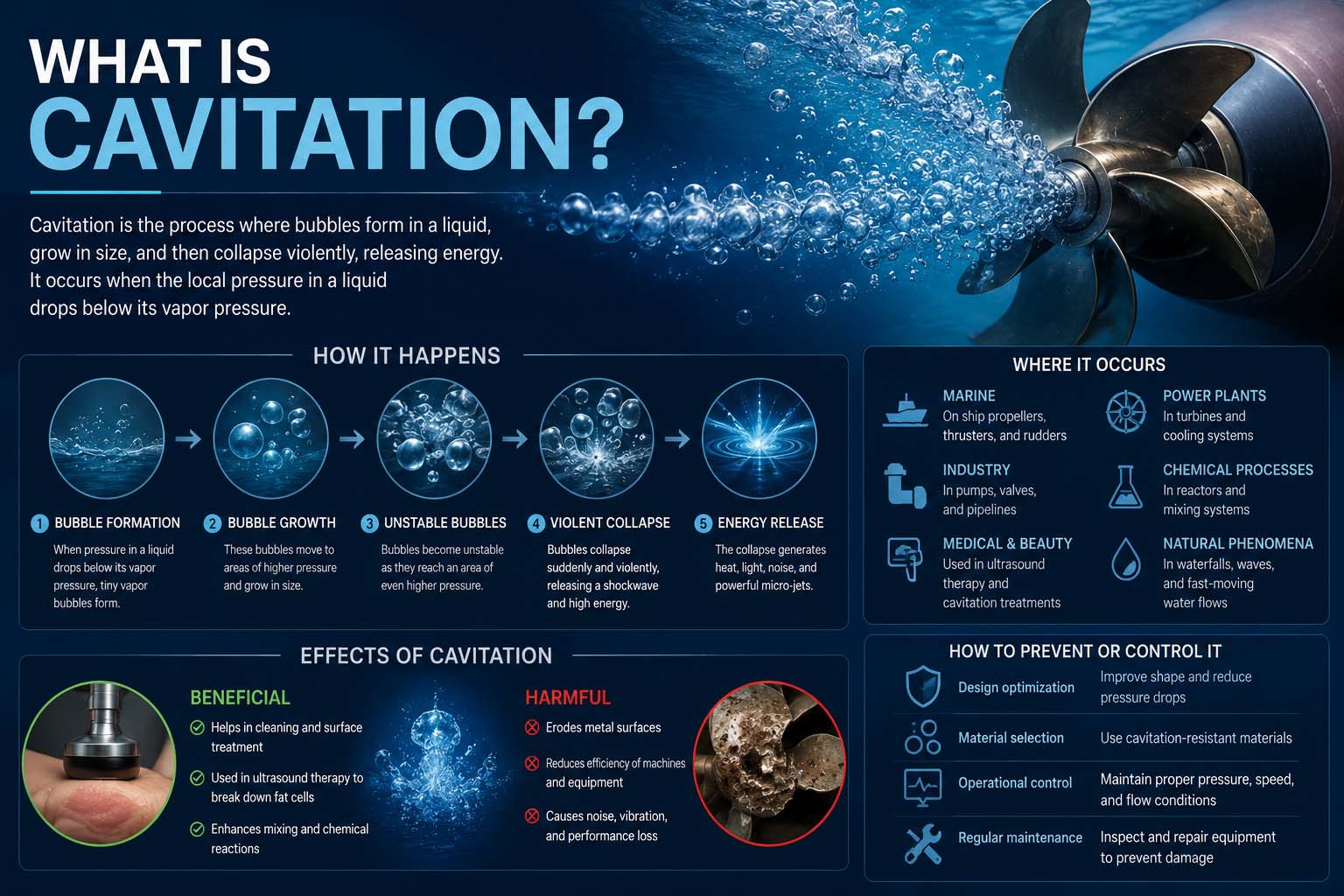
occurs when the pressure of a liquid drops below its vapor pressure, causing tiny vapor bubbles to form.
As the liquid moves into a higher-pressure area, these bubbles rapidly collapse.
The collapse creates:
- Shock waves
- Noise
- Vibration
- Surface damage
Although the bubbles are microscopic, their implosion generates significant energy.
This is why can become a serious issue in industrial equipment.
How Does Cavitation Work?
The process happens in several stages.
Step 1: Pressure Drops
Liquid pressure decreases below the liquid’s vapor pressure.
Step 2: Bubble Formation
Small vapor-filled bubbles appear within the fluid.
Step 3: Pressure Recovery
The liquid enters an area of higher pressure.
Step 4: Bubble Collapse
The vapor bubbles implode rapidly.
Step 5: Energy Release
Shock waves and localized pressure spikes occur.
Repeated can gradually damage nearby surfaces.
Common Causes of Cavitation
Several conditions can increase the likelihood of .
Low Inlet Pressure
Insufficient pressure often causes vapor bubbles to form.
High Fluid Velocity
Fast-moving liquids may create pressure drops.
Elevated Temperatures
Higher temperatures increase vapor pressure.
Improper Equipment Design
Poor system layouts can encourage .
Flow Restrictions
Blocked pipes or filters may reduce pressure and contribute to .
Understanding these causes helps engineers prevent equipment problems.
Why Is Cavitation a Problem?
In many industrial systems, can have serious consequences.
Equipment Damage
Reduced Efficiency
Pumps and turbines may lose performance.
Increased Noise
often produces unusual sounds.
Higher Maintenance Costs
Damaged components require repair or replacement.
System Instability
Fluid flow may become less predictable.
Because of these effects, preventing is a major engineering priority.
What Is Cavitation in Pumps?
One of the most common searches is what is cavitation in pumps.
Pump occurs when pressure at the pump inlet falls below the liquid’s vapor pressure.
This leads to vapor bubble formation inside the pump.
Signs of Pump Cavitation
Common symptoms include:
- Rattling sounds
- Excessive vibration
- Reduced flow rate
- Lower pressure output
- Impeller damage
If left unresolved, can significantly shorten pump lifespan.
Industries Affected
Pump is frequently encountered in:
- Water treatment facilities
- Manufacturing plants
- Chemical processing
- Power generation
- Agricultural irrigation systems
Proper pump design and maintenance are essential for prevention.
Real-World Examples of Cavitation
appears in many technologies.
Marine Propellers
Ship propellers can experience at high speeds.
Hydraulic Turbines
Power plants must manage to protect turbine components.
Fuel Systems
Certain fuel pumps may be vulnerable to .
Industrial Pumps
Many fluid-handling systems face risks.
These examples demonstrate how widespread the phenomenon is across industries.
What Is a Cavitation Machine?
Another common question is what is a cavitation machine.
In consumer technology and wellness industries, a machine typically refers to an ultrasonic device that uses sound waves to create microscopic pressure changes within liquids or tissues.
How Cavitation Machines Work
The device generates ultrasonic frequencies that create tiny bubbles.
These bubbles expand and collapse rapidly.
Applications may include:
- Industrial cleaning
- Material processing
- Specialized therapeutic equipment
- Ultrasonic technologies
The underlying scientific principle remains the same: bubble formation and collapse caused by pressure variations.
What Is Cavitation Treatment?
Many people also ask what is cavitation treatment.
The term usually refers to treatments that use ultrasonic technology.
These systems rely on high-frequency sound waves that generate microscopic bubbles.
Potential applications may include:
- Industrial cleaning processes
- Material surface treatment
- Certain non-invasive technology applications
Because usage varies by industry, the exact purpose depends on the specific equipment involved.
What Is Cavitation Therapy?
The term what is cavitation therapy is commonly associated with devices that use ultrasonic energy.
In technology-focused discussions, therapy refers to systems that utilize controlled effects through sound waves.
These devices are designed to generate targeted pressure changes while minimizing unwanted effects.
Advancements in ultrasonic engineering continue expanding potential applications for controlled technologies.
Beneficial Uses of Cavitation
Ultrasonic Cleaning
bubbles help remove contaminants from surfaces.
Medical Technology
Certain medical devices utilize controlled principles.
Industrial Processing
Some manufacturing processes rely on effects.
Scientific Research
Researchers study to improve engineering systems.
Controlled can provide valuable technological benefits.
Cavitation vs Aeration
People sometimes confuse with aeration.
| Feature | Cavitation | Aeration |
|---|---|---|
| Bubble Source | Vapor bubbles | Air bubbles |
| Cause | Pressure reduction | Air introduction |
| Potential Damage | High | Low |
| Industrial Concern | Significant | Usually beneficial |
| Energy Release | Very high | Minimal |
Understanding the difference helps identify system issues accurately.
How to Prevent Cavitation
Preventing often involves improving system design.
Maintain Adequate Inlet Pressure
Ensure sufficient fluid pressure reaches equipment.
Reduce Flow Restrictions
Clean filters and remove obstructions.
Use Proper Equipment Sizing
Correct sizing improves fluid dynamics.
Lower Fluid Temperature
In some systems, temperature control helps reduce risk.
Monitor Performance Regularly
Early detection prevents extensive damage.
Preventive maintenance remains one of the most effective solutions.
Troubleshooting Cavitation Problems
If is suspected, follow a systematic approach.
Check Noise Levels
Unusual sounds may indicate bubble collapse.
Inspect Components
Look for pitting or erosion.
Measure Pressure
Verify adequate inlet pressure.
Evaluate Flow Rates
Excessive flow velocity may contribute to .
Review System Design
Identify restrictions or improper configurations.
These steps help pinpoint underlying causes.
Future of Cavitation Technology
Researchers continue developing new applications for .
Emerging areas include:
- Advanced manufacturing
- Precision cleaning
- Renewable energy systems
- Medical engineering
- Fluid optimization technologies
As technology evolves, controlled may play an even larger role across industries.
FAQ
What is cavitation?
Why is cavitation harmful?
Bubble collapse generates shock waves that can damage equipment surfaces.
What is cavitation in pumps?
It occurs when pressure inside a pump drops below the liquid’s vapor pressure, causing vapor bubbles to form and collapse.
What is a cavitation machine?
A machine is typically a device that uses ultrasonic energy to create controlled effects.
What is cavitation treatment?
treatment generally refers to technologies that utilize ultrasonic for specific industrial or technical applications.
What is cavitation therapy?
therapy uses controlled ultrasonic principles in specialized equipment and treatment systems.
Conclusion
Understanding what is cavitation is essential for anyone working with fluid systems, pumps, turbines, or ultrasonic technologies. Whether learning what is in pumps, exploring what is a machine, researching what is treatment, or understanding what is therapy, the core principle remains the same: vapor bubbles form and collapse due to pressure changes. While uncontrolled can damage equipment and reduce efficiency, controlled continues to support innovation in cleaning, manufacturing, research, and advanced technological applications. As engineering technology advances, will remain an important concept in both industrial and scientific fields.