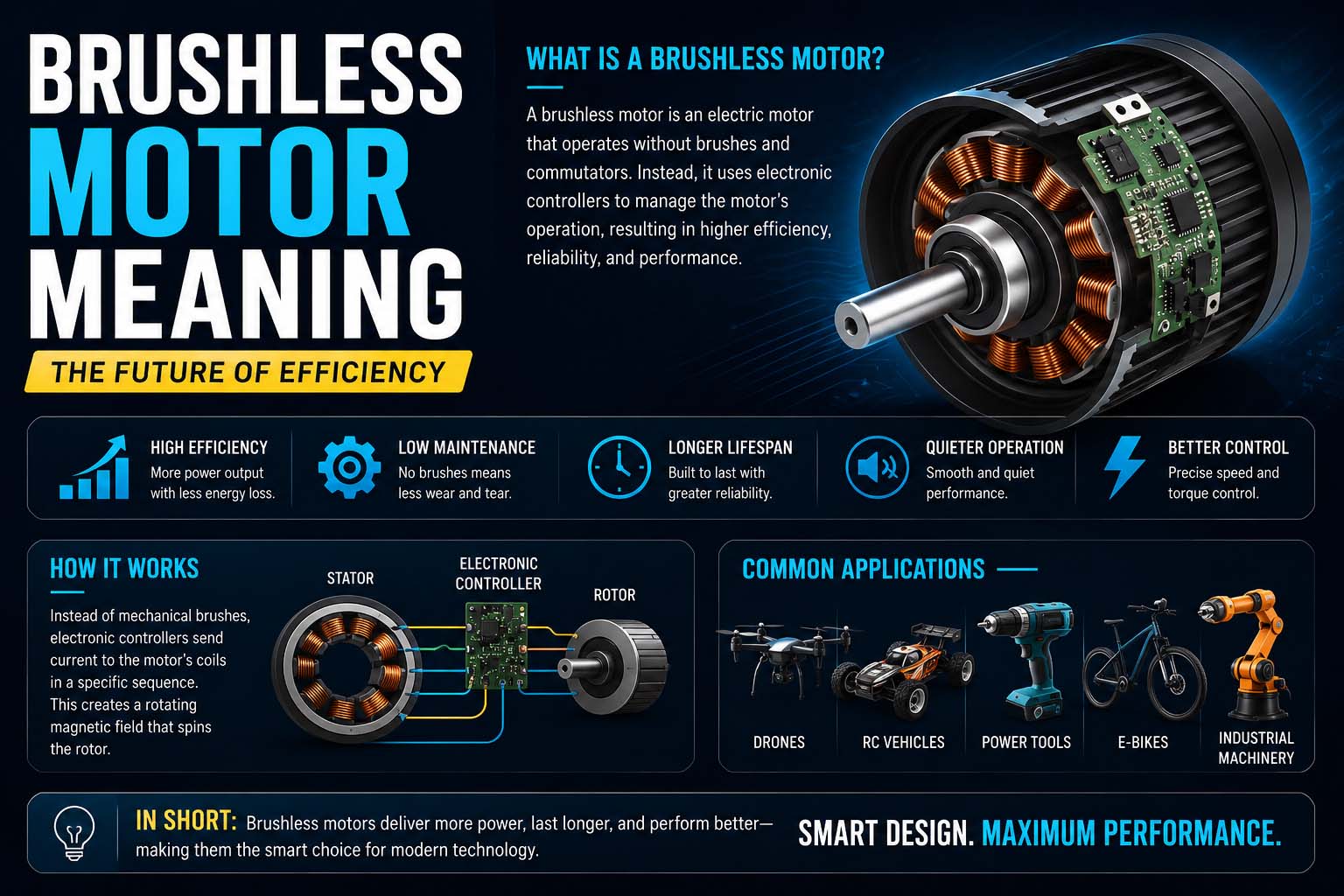
The brushless motor meaning is simple: it is an electric motor that runs without traditional brushes or a mechanical commutator. Instead, it uses electronic controls to manage the flow of electricity and create rotation. As a result, brushless motors are efficient, durable, low-maintenance and quieter than brushed motors. For example, you will find them in electric vehicles, drones, power tools, fans, robots and many other modern devices.
Many people look up this term, because it often appears in product descriptions, technical specs and equipment manuals.
This guide explains what a brushless motor is, how it works, its main advantages and why it has become the top choice for so many modern uses.
What Is a Brushless Motor?
To understand the idea, it helps to start with the basics.
A brushless motor is an electric motor that works without physical brushes. According to Britannica, an electric motor is any of a class of devices that convert electrical energy to mechanical energy.
Traditional motors use brushes and a commutator to send electricity to the spinning parts. In contrast, brushless motors remove these parts and use an electronic controller instead.
Consequently, this design improves efficiency, durability and performance.
What Is the Meaning of Brushless Motor?
Many beginners ask what is the meaning of brushless motor.
In other words, it is an electronically controlled motor that does not use carbon brushes.
The word “brushless” refers to the missing mechanical brushes that traditional DC motors use.
Because it has fewer parts that rub together, a brushless motor usually suffers less wear and tear.
How a Brushless Motor Works: The Meaning in Practice
Brushless motors use electronic controllers instead of physical brushes. Here is how the process works.
Electrical input: First, power flows into the motor from a battery or other power source.
Controller activation: Next, a controller decides how electricity should flow through the motor windings.
Magnetic field: Then, the current creates electromagnetic fields inside the motor.
Rotor movement: After that, permanent magnets on the rotor react to these changing fields.
Continuous rotation: Finally, the controller keeps adjusting the current, so the motor spins smoothly.
In short, this electronic system replaces the mechanical switching found in brushed motors.
Meaning of Brushless Motor in Everyday Technology
The meaning of brushless motor becomes clearer when you look at real products.
For instance, you can find these motors in drones, electric vehicles, e-bikes and power tools. Similarly, computer cooling fans, RC cars and industrial machines use them.
Manufacturers often choose them because they offer better reliability and efficiency.
It also helps to understand Motor vs Engine, since brushless motors are electric machines that work very differently from fuel engines.
Brushless Motor vs Brushed Motor
One of the most common comparisons is between brushless and brushed motors.
| Feature | Brushless Motor | Brushed Motor |
|---|---|---|
| Brushes | No | Yes |
| Efficiency | Higher | Lower |
| Maintenance | Low | Higher |
| Lifespan | Longer | Shorter |
| Noise | Lower | Higher |
| Cost | Higher | Lower |
| Performance | Better | Basic |
Clearly, this table shows why brushless technology keeps growing in popularity.
Advantages of Brushless Motors
Several benefits explain why these motors are so widely used.
Higher efficiency: They turn more electrical energy into useful motion.
Longer lifespan: Since there are no brushes to wear down, the motor often lasts longer.
Lower maintenance: In addition, fewer mechanical parts mean less upkeep.
Better performance: They usually deliver higher speeds, better torque control and quicker response.
Reduced noise: Also, electronic control often makes them run more quietly.
Together, these benefits make brushless motors attractive for both home and industrial use.
Common Uses of Brushless Motors
Brushless motors have become standard in many modern technologies.
Drones: Most drones rely on them for high efficiency, precise control and light weight.
Electric vehicles: Likewise, EV makers often use brushless systems because they are efficient and durable.
Power tools: Cordless drills and saws also use them for longer battery life.
Industrial equipment: Moreover, factories use them in automated machines and robots.
Brushless motors are also a key part of What Is Mechatronics, where electronics, sensors, software and mechanical systems work together to automate tasks.
Overall, the range of uses for this technology keeps growing.
Brushless Motor KV Meaning
One of the most confusing specs for beginners is the brushless motor KV meaning.
The KV rating does not mean kilovolts. Instead, it means RPM per volt.
For example, a 1000KV motor should, in theory, spin at 1000 revolutions per minute (RPM) for every volt it receives.
So, if you power it with 10 volts, it spins at about 1000KV × 10V = 10,000 RPM.
Therefore, this rating helps you estimate how fast a motor will spin.
KV Brushless Motor Meaning Explained
The KV brushless motor meaning matters most to drone and RC fans.
Higher KV motors spin faster but usually produce less torque. On the other hand, lower KV motors spin slower and usually give more torque.
High KV motors: These suit racing drones and high-speed RC vehicles.
Low KV motors: In contrast, these suit heavy-lift drones, electric bicycles and other jobs that need more torque.
In some machines, our guide What Is a Flywheel also explains how stored spinning energy can work alongside motors for smoother operation.
How to Choose the Right Brushless Motor
Picking the right motor means checking a few key factors.
Determine your application: First, ask whether speed or torque matters more for your project.
Check voltage requirements: Next, match the motor’s ratings to your power source. Understanding What Is a Battery Charge also helps you estimate runtime in battery-powered setups.
Consider the KV rating: Then, choose a higher KV for speed or a lower KV for torque.
Review efficiency ratings: More efficient motors usually use less power. For example, learning How to Calculate Watts makes it easier to estimate the power each setup needs.
Verify compatibility: Finally, make sure the motor works with your controller and battery.
In the end, careful planning prevents performance problems later.
Troubleshooting Common Brushless Motor Problems
Although they are reliable, brushless motors can sometimes have issues.
Motor not spinning: A failed controller, wiring problems or battery issues can stop the motor.
Overheating: Similarly, too much load, poor cooling or the wrong voltage can make it overheat.
Vibration: Damaged bearings, an unbalanced rotor or loose mounting screws often cause shaking.
Reduced performance: In this case, check the battery condition, speed controller settings and wiring connections.
Above all, regular inspection keeps performance at its best.
Future of Brushless Motor Technology
Brushless motors keep evolving.
For example, electric mobility is growing fast, so more EVs and e-bikes will use them. Likewise, robotics benefits from their precise control.
In addition, they play important roles in renewable energy systems, and smarter controllers keep improving their efficiency.
As technology advances, brushless motors will likely become even more common.
FAQ
What is a brushless motor?
It is an electric motor that uses an electronic controller instead of mechanical brushes.
What is the meaning of brushless motor?
The term describes a motor that runs without physical brushes, which improves efficiency and durability.
What is brushless motor KV meaning?
KV stands for RPM per volt, and it shows how fast a motor can spin.
Are brushless motors better than brushed motors?
In many uses, yes. They are usually more efficient and durable, and they need less maintenance.
Why are brushless motors used in drones?
Drone makers choose them because they offer high efficiency, precise control and excellent performance.
What does KV brushless motor meaning tell you?
The KV number helps you estimate motor speed and decide whether a motor suits speed-focused or torque-focused jobs.
Conclusion
In conclusion, understanding the brushless motor meaning is essential for anyone interested in modern technology, electronics, drones or electric vehicles. Whether you are learning about KV ratings or comparing motor types, the key advantage stays the same: efficient, reliable and high-performance operation. As industries move toward electric and automated systems, brushless motors will remain a vital part of future technology.