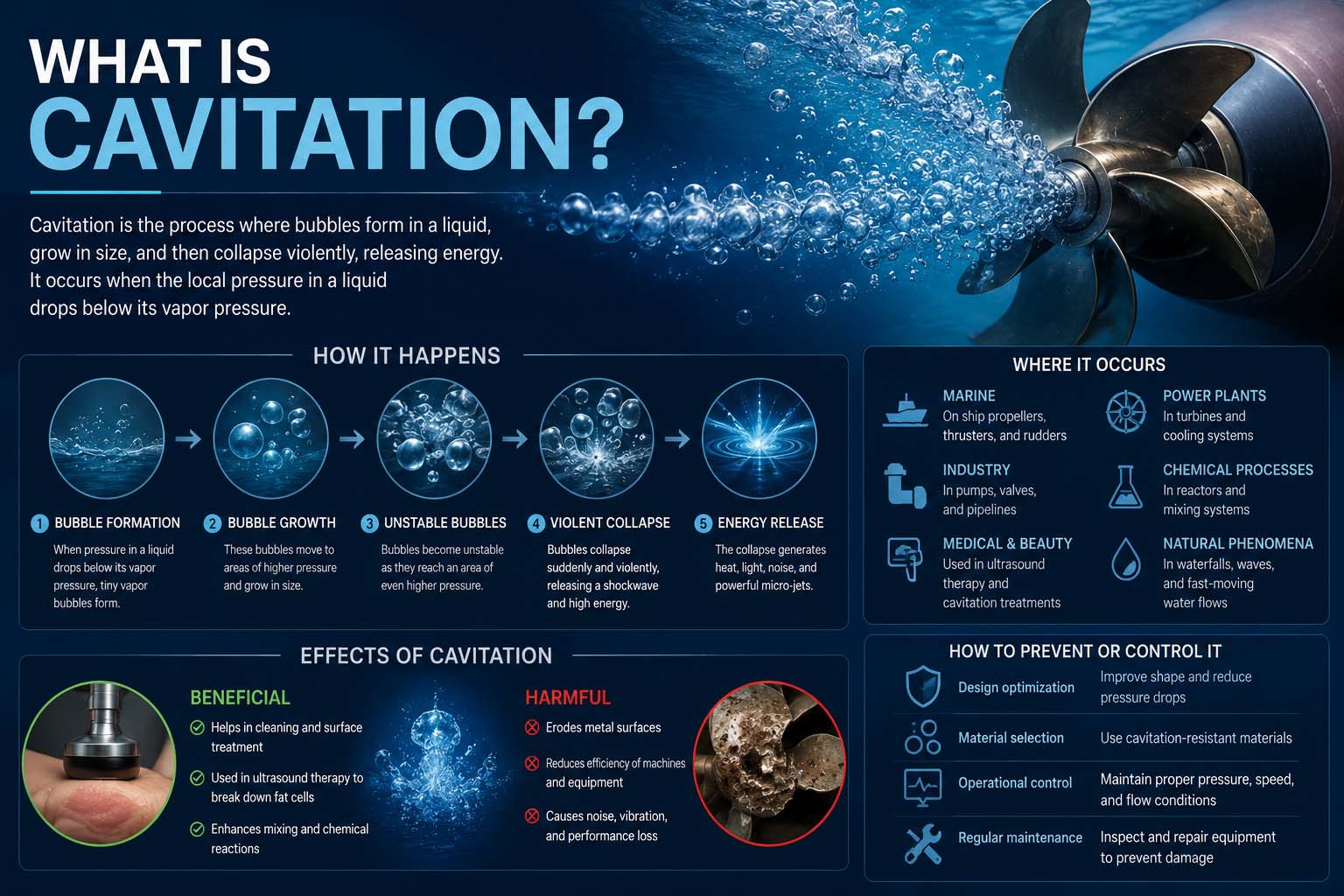
So, what is cavitation? It is a process in which vapor bubbles form and then collapse in a liquid because the pressure changes. It often happens in pumps, turbines and propellers, and it can cause noise, vibration and damage to equipment.
As a result, engineers, technicians, students and tech fans who understand it can manage fluid systems better and avoid costly failures.
What Is Cavitation?
It happens when the pressure of a liquid drops below its vapor pressure, so tiny vapor bubbles start to form. According to Britannica, it is the formation of vapour bubbles within a liquid at low-pressure regions.
Then, as the liquid moves into a higher-pressure area, these bubbles collapse very fast. Consequently, the collapse creates shock waves, noise, vibration and surface damage.
Engineers also study what is impedance, because pressure waves and vibration can affect how energy travels through mechanical and fluid systems.
Although the bubbles are tiny, their collapse releases a lot of energy. For this reason, the effect can become a serious issue in industrial equipment.
How Does Cavitation Work?
The process happens in several stages, one after another.
Step 1: Pressure Drops
First, the liquid pressure falls below the liquid’s vapor pressure.
Step 2: Bubble Formation
Next, small vapor-filled bubbles appear inside the fluid.
Step 3: Pressure Recovery
Then, the liquid flows into an area of higher pressure.
Step 4: Bubble Collapse
After that, the vapor bubbles implode very quickly.
Step 5: Energy Release
Finally, shock waves and sharp local pressure spikes hit nearby surfaces. Over time, these repeated hits slowly wear the metal away.
Common Causes of Cavitation
Several conditions make this problem more likely.
Low Inlet Pressure
When the inlet pressure is too low, vapor bubbles form easily.
High Fluid Velocity
Fast-moving liquids can create sudden pressure drops.
Elevated Temperatures
Higher temperatures raise the vapor pressure, so bubbles form at a higher pressure than usual.
Improper Equipment Design
Poor system layouts can also encourage bubble formation.
Flow Restrictions
Blocked pipes or filters can lower the pressure and add to the problem.
Therefore, knowing these causes helps engineers prevent equipment trouble.
Why Is Cavitation a Problem?
In many industrial systems, the effects can be serious.
Equipment Damage
The collapsing bubbles cause pitting and erosion on impellers, blades and pipe walls.
Reduced Efficiency
In addition, pumps and turbines may lose performance.
Increased Noise
The bubble collapse often makes unusual rattling or crackling sounds.
Higher Maintenance Costs
Damaged parts need repair or replacement, which raises costs.
System Instability
The fluid flow may also become less predictable.
Because of these effects, prevention is a major engineering priority.
What Is Cavitation in Pumps?
One of the most common searches is what is cavitation in pumps.
Pump problems of this kind start when the pressure at the pump inlet falls below the liquid’s vapor pressure. As a result, vapor bubbles form inside the pump.
Signs of Pump Cavitation
Common signs include rattling sounds and heavy vibration. Likewise, you may notice a lower flow rate, weaker pressure output or a damaged impeller.
If you leave it unfixed, the damage can greatly shorten the pump’s life.
Industries Affected
This issue often shows up in water treatment plants, factories and chemical processing. Similarly, power stations and farm irrigation systems face it too.
Above all, good pump design and regular maintenance are key to prevention.
In many fluid systems, understanding what is a manifold also helps improve flow distribution and reduce the conditions that lead to bubble damage.
Real-World Examples of Cavitation
This effect appears in many technologies.
Marine Propellers
Ship propellers can suffer from it at high speeds, because the fast-spinning blades create low-pressure zones.
Hydraulic Turbines
Power plants must control it so that turbine parts stay protected.
Fuel Systems
Likewise, certain fuel pumps can be vulnerable to vapor bubbles.
Industrial Pumps
Many fluid-handling systems face the same risk.
In some cases, pump makers use light, strong materials in selected parts to improve durability.
Clearly, these examples show how widespread the problem is across industries.
What Is a Cavitation Machine?
Another common question is what is a cavitation machine.
In consumer technology and wellness, this kind of machine usually means an ultrasonic device. It uses sound waves to create tiny pressure changes in liquids or tissues.
How Cavitation Machines Work
The device produces ultrasonic frequencies that create tiny bubbles. Then, these bubbles grow and collapse very quickly.
For example, people use these devices for industrial cleaning, material processing, special therapy equipment and other ultrasonic technologies.
Still, the basic science stays the same: bubbles form and collapse because of pressure changes.
What Is Cavitation Treatment?
Many people also ask what is cavitation treatment.
The term usually refers to treatments that use ultrasonic technology. These systems rely on high-frequency sound waves that create tiny bubbles.
For instance, uses include industrial cleaning, surface treatment of materials and certain non-invasive technology uses.
Since usage differs by industry, the exact purpose depends on the equipment involved.
What Is Cavitation Therapy?
The phrase what is cavitation therapy usually links to devices that use ultrasonic energy.
In tech discussions, the therapy refers to systems that use controlled bubble effects through sound waves. In particular, makers design these devices to create targeted pressure changes while they limit unwanted effects.
Meanwhile, progress in ultrasonic engineering keeps opening up new uses for this controlled technology.
Beneficial Uses of Cavitation
However, this effect is not always harmful.
Ultrasonic Cleaning
Collapsing bubbles help remove dirt and grime from surfaces.
Medical Technology
Certain medical devices use controlled bubble collapse.
Industrial Processing
Some manufacturing processes also rely on these bubble effects.
Scientific Research
Researchers study the effect to improve engineering systems.
In short, when people control it carefully, it can offer real technical benefits.
Cavitation vs Aeration
People sometimes mix it up with aeration.
| Feature | Cavitation | Aeration |
|---|---|---|
| Bubble Source | Vapor bubbles | Air bubbles |
| Cause | Pressure reduction | Air introduction |
| Potential Damage | High | Low |
| Industrial Concern | Significant | Usually beneficial |
| Energy Release | Very high | Minimal |
Thus, knowing the difference helps you identify system issues correctly.
How to Prevent Cavitation
Prevention often starts with better system design.
Maintain Adequate Inlet Pressure
Make sure enough fluid pressure reaches the equipment.
Reduce Flow Restrictions
Clean the filters, and remove any blockages.
Use Proper Equipment Sizing
Correct sizing improves how the fluid moves.
Lower Fluid Temperature
In some systems, temperature control also lowers the risk.
Monitor Performance Regularly
Early detection stops small problems from turning into big damage.
Many industrial monitoring systems use open loop vs closed loop control to spot abnormal conditions before the damage becomes severe.
Overall, preventive maintenance remains one of the best solutions.
Troubleshooting Cavitation Problems
If you suspect this problem, follow a step-by-step approach.
Check Noise Levels
Unusual sounds may point to collapsing bubbles.
Inspect Components
Look closely for pitting or erosion on metal parts.
Measure Pressure
Check that the inlet pressure is high enough. Many monitoring systems use what is a transducer devices to measure pressure and catch the problem before serious damage occurs.
Evaluate Flow Rates
Too much flow speed may also add to the problem.
Review System Design
Look for restrictions or poor layouts.
Together, these steps help you find the real cause.
Future of Cavitation Technology
Researchers keep developing new uses for controlled bubble collapse.
For example, new areas include advanced manufacturing, precision cleaning and renewable energy systems. Besides these, medical engineering and fluid optimization are growing fields.
As technology evolves, this effect may play an even bigger role across industries.
FAQ
What is cavitation?
It is the formation and collapse of vapor bubbles in a liquid when pressure drops and then rises again.
Why is cavitation harmful?
Bubble collapse creates shock waves that can damage equipment surfaces.
What is cavitation in pumps?
This happens when the pressure inside a pump drops below the liquid’s vapor pressure, so vapor bubbles form and collapse.
What is a cavitation machine?
Such a machine is usually a device that uses ultrasonic energy to create controlled bubble effects.
What is cavitation treatment?
The treatment generally refers to technologies that use ultrasonic bubbles for specific industrial or technical tasks.
What is cavitation therapy?
The therapy uses controlled ultrasonic principles in special equipment and treatment systems.
Conclusion
In conclusion, knowing what is cavitation matters for anyone who works with fluid systems, pumps, turbines or ultrasonic technology. The core idea stays the same: vapor bubbles form and collapse because of pressure changes. While uncontrolled bubbles can damage equipment and cut efficiency, controlled bubbles support new ideas in cleaning, manufacturing and research.