One of the most important concepts in engineering and technology is understanding open loop vs closed loop control.
These two approaches determine how a system responds to commands and whether it uses feedback to adjust its operation. Understanding the differences can help students, engineers, technicians, and technology enthusiasts better understand how modern systems function.
In this guide, we’ll explore what open loop and closed loop systems are, how they work, their advantages and disadvantages, and where they are commonly used.
What Is an Open Loop System?
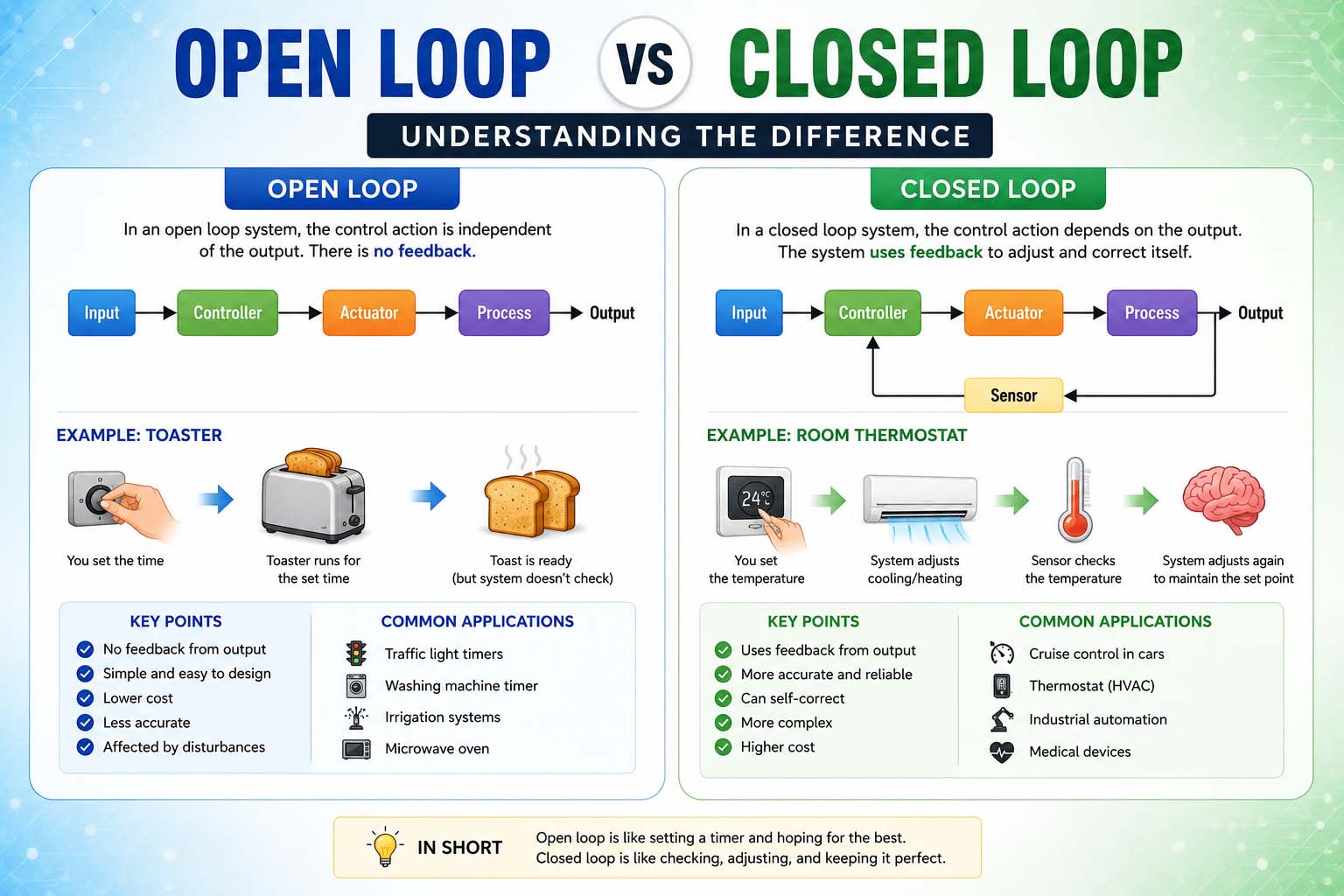
An open loop system operates without feedback.
The system receives an input and performs a predefined action without checking whether the desired result was achieved.
Simple Example
A basic microwave timer is often considered an open loop system.
You set:
- Time
- Power level
The microwave runs for the selected duration regardless of whether the food is fully heated.
The system does not monitor the actual temperature of the food.
Characteristics of Open Loop Systems
- No feedback mechanism
- Simple design
- Lower cost
- Faster operation
- Less accurate under changing conditions
Open loop systems work best when operating conditions remain predictable.
What Is a Closed Loop System?
A closed loop system uses feedback to continuously monitor output and make adjustments.
The system compares actual results with desired results and automatically corrects deviations.
Simple Example
A home thermostat is a common closed loop system.
The thermostat:
- Measures room temperature
- Compares it with the target temperature
- Turns heating or cooling on and off as needed
This feedback process helps maintain consistent performance.
Characteristics of Closed Loop Systems
- Uses feedback sensors
- More accurate
- Self-correcting
- Better adaptability
- More complex design
Closed loop systems are commonly used when precision is important.
Open Loop vs Closed Loop Comparison Table
| Feature | Open Loop | Closed Loop |
|---|---|---|
| Feedback | No | Yes |
| Accuracy | Lower | Higher |
| Complexity | Simple | More Complex |
| Cost | Lower | Higher |
| Error Correction | No | Automatic |
| Reliability Under Changing Conditions | Limited | Strong |
| Maintenance | Easier | More Involved |
This comparison helps explain why different industries choose different control methods.
How Open Loop Systems Work
Understanding the process is easier when viewed step by step.
Step 1: Input Is Given
A command is entered into the system.
Step 2: System Executes Action
The system performs its programmed function.
Step 3: Process Ends
No measurement or verification occurs after the action is completed.
Because feedback is absent, any errors remain uncorrected.
How Closed Loop Systems Work
Closed loop systems follow a different process.
Step 1: Desired Output Is Set
A target value or condition is established.
Step 2: Sensors Measure Actual Output
Feedback devices collect performance data.
Step 3: Comparison Occurs
The controller compares actual output with desired output.
Step 4: Corrections Are Made
Adjustments occur automatically until the target is achieved.
This continuous monitoring improves accuracy and efficiency.
Closed Loop vs Open Loop Control
The discussion of closed loop vs open loop control is central to automation and engineering.
Open Loop Control
Control actions depend only on the initial command.
Examples:
- Basic washing machine timers
- Simple irrigation timers
- Traffic signal timers
Closed Loop Control
Control actions depend on both input and feedback.
Examples:
- Cruise control systems
- Industrial robotics
- Smart climate control systems
Closed loop control is generally preferred when accuracy and consistency are critical.
Closed Loop vs Open Loop System in Everyday Technology
Many technologies use these concepts daily.
Open Loop Examples
- Electric hand dryers
- Toaster timers
- Basic sprinklers
- Manual washing cycles
Closed Loop Examples
- Air conditioners
- Modern vehicles
- Drones
- Automated manufacturing equipment
As technology advances, more devices are incorporating closed loop feedback systems.
Advantages of Open Loop Systems
Lower Cost
Fewer components reduce manufacturing expenses.
Simple Design
Implementation and maintenance are often easier.
Faster Response
No time is required for feedback processing.
Easy Installation
Many applications require minimal setup.
These benefits make open loop systems practical for straightforward tasks.
Advantages of Closed Loop Systems
Higher Accuracy
Continuous feedback improves performance.
Automatic Error Correction
Greater Stability
Performance remains consistent under varying environments.
Better Efficiency
Resources are often used more effectively.
For complex operations, these advantages often justify the additional cost.
Disadvantages of Open Loop Systems
While useful, open loop systems have limitations.
Sensitive to Disturbances
Unexpected changes may affect results.
Lower Precision
Outputs may vary without correction mechanisms.
No Self-Adjustment
Manual intervention may be required.
These limitations become significant in demanding environments.
Disadvantages of Closed Loop Systems
Closed loop systems also have challenges.
Higher Cost
Additional sensors and controllers increase expenses.
Greater Complexity
Design and maintenance are more demanding.
Sensor Dependency
Faulty sensors can affect performance.
Despite these drawbacks, many industries prefer closed loop systems for critical applications.
Geothermal Open Loop vs Closed Loop
A common question involves geothermal open loop vs closed loop heating and cooling systems.
Open Loop Geothermal Systems
Use groundwater directly.
Advantages:
- High efficiency
- Lower initial installation costs
Challenges:
- Water quality concerns
- Regulatory requirements
- Potential maintenance issues
Closed Loop Geothermal Systems
Circulate fluid through sealed underground pipes.
Advantages:
- Reduced contamination risk
- Consistent operation
- Lower environmental impact
Challenges:
- Higher installation cost
- More extensive excavation
The best choice depends on local conditions and project requirements.
Troubleshooting Open Loop and Closed Loop Systems
Open Loop Troubleshooting
Common issues:
- Incorrect timing
- Component wear
- Calibration errors
Solutions:
- Check settings
- Inspect hardware
- Verify operating conditions
Closed Loop Troubleshooting
Common issues:
- Sensor failures
- Feedback delays
- Controller configuration errors
Solutions:
- Test sensors
- Review calibration
- Inspect control software
Regular maintenance improves reliability for both system types.
Which System Is Better?
The answer depends on the application.
Choose open loop systems when:
- Cost is important
- Conditions are predictable
- Precision is less critical
Choose closed loop systems when:
- Accuracy matters
- Conditions frequently change
- Automation is required
Many modern technologies favor closed loop designs because they offer greater adaptability and performance.
FAQ
What is the difference between open loop and closed loop systems?
Open loop systems operate without feedback, while closed loop systems continuously monitor output and make corrections using feedback.
Which system is more accurate?
Closed loop systems are generally more accurate because they automatically correct errors.
Are open loop systems cheaper?
Yes. Open loop systems typically require fewer components and lower installation costs.
What is an example of a closed loop system?
What is closed loop vs open loop control?
Closed loop control uses feedback to adjust performance, while open loop control performs actions without feedback.
Which geothermal system is better?
The best option depends on water availability, budget, environmental conditions, and maintenance preferences.
Conclusion
Understanding open loop vs closed loop systems is essential for anyone studying technology, engineering, automation, or industrial control. Open loop systems offer simplicity and affordability, while closed loop systems provide greater accuracy, adaptability, and performance through continuous feedback.