One of the most important concepts in engineering and technology is open loop vs closed loop control. These two approaches determine how a system responds to commands and whether it uses feedback to adjust its performance.
Understanding the difference helps students, engineers, technicians, and technology enthusiasts learn how automated systems work. In this guide, you’ll discover how each system operates, its advantages and disadvantages, and where engineers use these control methods in everyday technology.
What Is an Open Loop System?
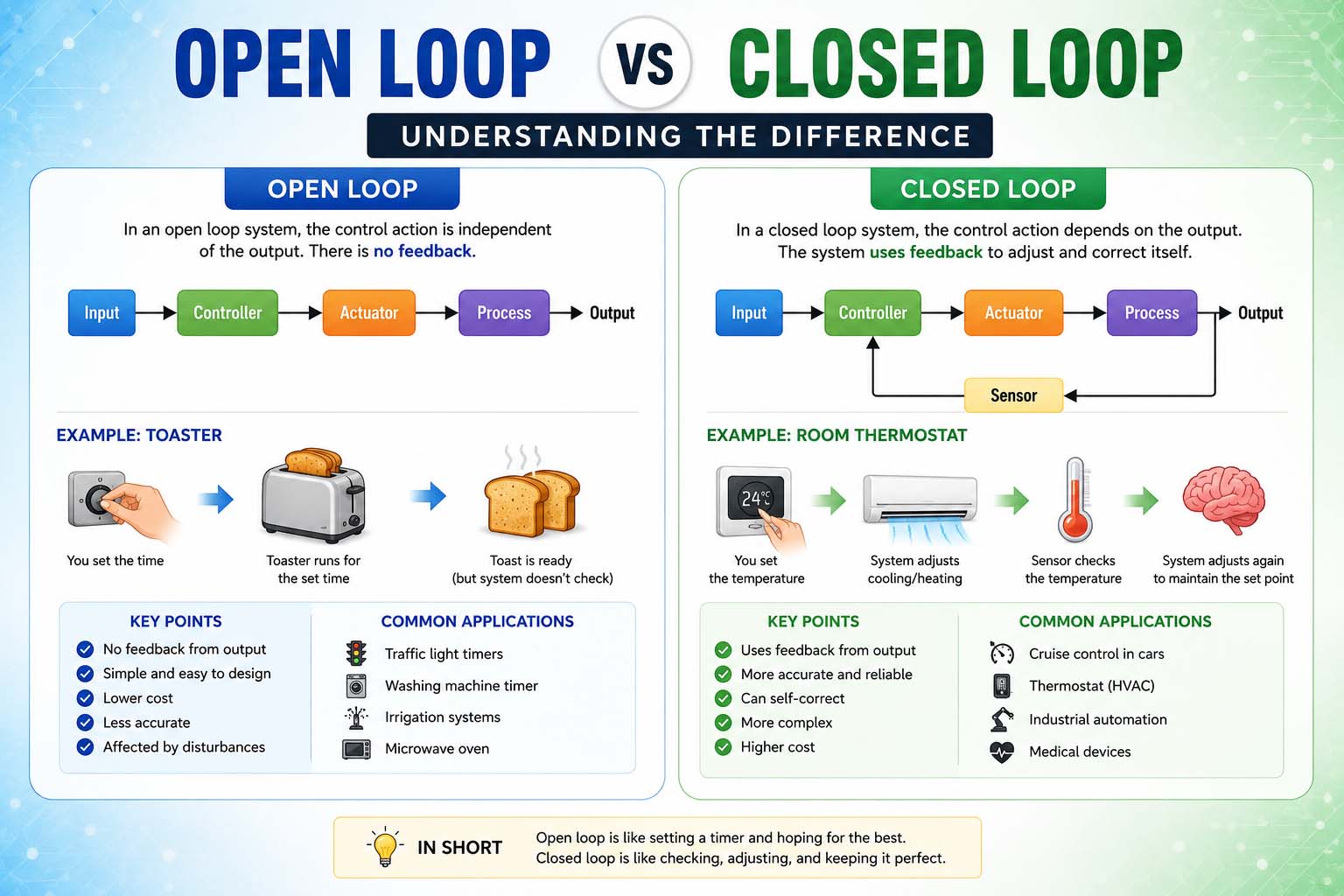
An open loop system operates without feedback from its output. It receives an input and performs a predefined action without checking whether the result matches the desired outcome.
Example: A basic microwave timer illustrates this principle. You select a cooking time and power level, and the microwave runs according to those settings. However, it does not measure the food’s internal temperature to determine whether the food has reached the desired level of heating.
Open loop systems have several defining characteristics:
- Simple design: They generally require fewer components.
- Lower cost: They often need less hardware and simpler control logic.
- Quick operation: They follow predetermined commands without output-feedback calculations.
- Limited correction: They cannot automatically correct output errors caused by changing conditions.
Therefore, this approach works well when tasks are predictable and precise output control is unnecessary.
What Is a Closed Loop System?
A closed loop system uses feedback to monitor its output and adjust its operation. It compares the actual result with a desired target and uses the difference, called the error, to determine the necessary correction.
Example: A home heating system with a thermostat demonstrates closed loop control. First, the thermostat measures room temperature. Next, it compares that measurement with the selected temperature. The controller then switches the heating system on or off according to the temperature difference.
As a result, the system can maintain a more consistent room temperature than a basic timer-controlled system.
Its main characteristics include:
- Feedback monitoring: Sensors measure relevant operating conditions.
- Automatic correction: The controller responds to detected errors.
- Improved accuracy: Feedback helps the system maintain its target.
- Greater complexity: Additional sensors, control logic, and components may increase costs.
Engineers often choose this approach when changing conditions or accurate output control make feedback valuable.
Open Loop vs Closed Loop: Key Differences
According to Encyclopaedia Britannica’s explanation of control systems, control systems manage or regulate the behavior of a process. Open loop and closed loop designs differ primarily in how they use information about the output.
| Feature | Open Loop | Closed Loop |
|---|---|---|
| Feedback | Not used to regulate the output | Used to regulate the output |
| Accuracy | Depends on predictable conditions | Can improve through error correction |
| Complexity | Generally simpler | Generally more complex |
| Cost | Often lower | Often higher |
| Error correction | No automatic output-based correction | Can correct detected errors |
| Changing conditions | Less adaptable | Can respond to disturbances |
| Maintenance | Often simpler | May require sensor and controller checks |
The better choice depends on the task. A simple timer may be sufficient for a predictable process, whereas an industrial control application may require continuous feedback.
How Open Loop Control Works
An open loop controller follows a predefined sequence without using output measurements to adjust its action.
The process usually follows three steps:
- Input: An operator or program provides a command.
- Action: The controller activates the equipment according to its settings.
- Completion: The system finishes the programmed task without checking the final output.
For example, a basic irrigation timer may run a sprinkler for a set number of minutes. It does not automatically determine whether the soil has received enough water.
Because the controller does not use output feedback, disturbances can affect the final result. Users may need to adjust the settings manually when operating conditions change.
How Closed Loop Control Works
Closed loop control uses measurements to compare actual performance with a target. The controller then adjusts its output to reduce the difference.
The typical process involves these steps:
- Set a target: The operator specifies a desired temperature, speed, position, or other value.
- Measure the output: Sensors collect information about the system’s current condition.
- Compare the values: The controller calculates the difference between the target and the measured result.
- Adjust the operation: The controller changes its output to reduce the error.
- Repeat the process: The system continues monitoring and correcting as needed.
In many applications, sensors use transducers to convert physical quantities into signals that a controller can interpret. Learn more in this guide to What Is a Transducer.
Similarly, understanding What Is Impedance can help explain electrical relationships that affect signals in sensor and control circuits.
However, feedback does not guarantee perfect performance. Sensor errors, excessive delays, and poor controller settings can reduce accuracy or cause instability.
Open Loop Control vs Closed Loop Control
Both methods direct a system toward a particular task, but they use different information when making control decisions.
Open loop control relies on the initial command and predefined settings. It does not adjust its action based on measurements of the resulting output.
Examples include a basic timer-controlled appliance, a fixed-duration irrigation system, and a simple traffic signal operating on a preset schedule.
Closed loop control uses output feedback to guide control actions. The controller changes its response when measurements indicate a difference between the target and actual performance.
Examples include vehicle cruise control, temperature regulation, and industrial robot position control.
During product development, engineers also use Verification vs Validation to check whether a system meets its specifications and satisfies its intended purpose.
Ultimately, engineers select the control method according to the required accuracy, operating conditions, safety needs, and available budget.
Examples in Everyday Technology
Control systems appear in homes, vehicles, factories, and other environments. However, a device’s classification depends on how it operates, not simply on its name.
Examples of open loop operation:
- A microwave running for a preset time without measuring food temperature.
- A basic sprinkler operating for a scheduled duration.
- A toaster using a fixed timer rather than sensing the toast’s actual condition.
- A washing machine running a timed stage without adjusting it based on output measurements.
Examples of closed loop operation:
- A thermostat adjusting heating or cooling based on room temperature.
- Vehicle cruise control adjusting engine power to maintain a target speed.
- An industrial robot using position sensors to correct movement.
- A drone using sensor feedback to stabilize its flight.
Some appliances combine both methods. For instance, a washing machine may follow a programmed sequence while using sensors to adjust water levels or other operating conditions.
Likewise, modern controllers often combine Analog vs Digital technologies. They may receive analog sensor signals and process measurements digitally before issuing control commands.
Advantages of Open Loop Systems
Open loop designs remain useful because they offer practical benefits for straightforward tasks.
Lower cost: Fewer components can reduce manufacturing and installation expenses.
Simple design: Developers can often build and configure these systems with less complicated control logic.
Easy maintenance: With fewer sensors and feedback components, troubleshooting may require less effort.
Predictable operation: A fixed sequence can provide consistent timing when operating conditions remain stable.
For these reasons, open loop systems suit applications where the desired result does not require continuous output measurement.
Advantages of Closed Loop Systems
Closed loop control offers several benefits when an application requires accurate or adaptable performance.
Improved accuracy: Feedback helps the controller reduce differences between actual and desired outputs.
Automatic error correction: The system can respond to disturbances without requiring constant manual adjustments.
Better adaptability: Measurements allow the controller to respond when operating conditions change.
Consistent performance: Properly designed feedback can help maintain a target value despite external disturbances.
These advantages often justify the additional cost in applications that demand reliable, precise control. Nevertheless, engineers must select and configure the feedback components carefully.
Disadvantages of Open Loop Systems
Despite their simplicity, open loop systems have limitations.
Limited response to disturbances: Changes in temperature, load, pressure, or other conditions can affect the result.
Lower accuracy in variable conditions: A predefined command may not produce the same outcome every time.
No automatic output correction: The controller cannot compensate for output errors using feedback it does not receive.
Dependence on settings: Incorrect timing or configuration can lead to an unsuitable result.
Consequently, engineers may need to choose another control method when operating conditions change frequently or output accuracy is essential.
Disadvantages of Closed Loop Systems
Closed loop systems can provide better control, but their additional components introduce challenges.
Higher initial cost: Sensors, controllers, and related hardware can increase expenses.
Greater design complexity: Engineers must account for feedback signals, controller behavior, and system response.
Sensor problems: Incorrect measurements can lead to inappropriate control actions.
Maintenance requirements: Technicians may need to inspect sensors, wiring, calibration, and software settings.
Furthermore, poorly designed feedback can cause oscillation or instability. Engineers must therefore test the system and tune its controller to achieve suitable performance.
Geothermal Open Loop vs Closed Loop Systems
The terms open loop and closed loop also describe geothermal heating and cooling systems. In this context, the distinction concerns how the system exchanges heat with the ground and handles the circulating fluid.
Open Loop Geothermal Systems
An open loop geothermal system uses groundwater as part of its heat-exchange process. The system draws water from a suitable source, passes it through the equipment, and discharges or returns it according to the design and local requirements.
Potential advantages include efficient heat transfer and relatively simple underground arrangements where suitable water supplies exist.
However, water quality, supply availability, discharge requirements, and local regulations can affect feasibility. Proper assessment is essential before installation.
Closed Loop Geothermal Systems
A closed loop geothermal system circulates fluid through sealed underground pipes. The fluid transfers heat between the building and the surrounding ground without routinely exchanging the circulating fluid with groundwater.
These systems can work well where groundwater use is unsuitable. However, installation requires appropriate pipe layouts, ground preparation, and careful system design.
The best option depends on site conditions, installation costs, local requirements, and long-term operating needs.
Troubleshooting Common Control Problems
When a system does not perform as expected, identifying whether it uses feedback can help narrow down possible causes.
Open Loop System Problems
Common problems include incorrect timer settings, worn components, unsuitable operating conditions, and inconsistent inputs.
Start by checking the programmed settings and inspecting the equipment. Next, confirm that the system receives the correct input and follows its intended operating sequence.
If the result remains inconsistent, the task may require more frequent manual adjustments or a different control approach.
Closed Loop System Problems
Closed loop systems may experience sensor faults, incorrect calibration, feedback delays, wiring problems, or controller configuration errors.
First, check the sensor readings against a reliable reference where appropriate. Then, inspect connections and review the controller settings. Finally, check whether the system responds correctly when its measured output changes.
Regular maintenance can help identify these issues before they significantly affect performance.
Which Control System Should You Choose?
The right choice depends on what the application needs to achieve.
Choose an open loop system when the process is predictable, the budget is limited, and output accuracy does not require automatic correction.
Choose a closed loop system when changing conditions affect performance, accurate output control matters, or automatic adjustments provide a clear benefit.
For more advanced automation applications, What Is Mechatronics explains how mechanical systems, electronics, sensors, and software work together.
Before choosing either method, consider the operating environment, cost, maintenance needs, response time, and consequences of an error. In some applications, a combination of programmed control and feedback provides the most practical solution.
Frequently Asked Questions
What is the main difference between open loop and closed loop systems?
An open loop system operates without using output feedback to adjust its action. In contrast, a closed loop system measures its output and uses that information to guide corrections.
Which system is more accurate?
Closed loop systems can achieve greater accuracy because they respond to measured errors. However, their performance depends on sensor quality, controller design, and operating conditions.
Are open loop systems cheaper?
Generally, yes. Open loop systems often require fewer components and simpler control logic, which can reduce initial costs and maintenance requirements.
What is an example of a closed loop system?
A thermostat-controlled heating system is a common example. It measures room temperature, compares it with the selected target, and adjusts heating operation accordingly.
Can a system use both open loop and closed loop control?
Yes. Some systems combine programmed commands with feedback-based adjustments. This approach allows the controller to follow a planned sequence while responding to measured conditions when necessary.
Which geothermal system is better?
Neither option is best for every property. Open loop geothermal systems depend on suitable groundwater and applicable discharge requirements, while closed loop systems use sealed underground piping. Site conditions, cost, and local regulations determine the appropriate choice.
Conclusion
Understanding open loop vs closed loop control helps explain how engineering systems respond to commands and maintain their intended performance. Open loop designs offer simplicity and lower costs for predictable tasks, while closed loop systems use feedback to correct errors and adapt to changing conditions.
By comparing accuracy, complexity, cost, and operating requirements, engineers can select the control method that best fits the application. Both approaches remain valuable across everyday technology, industrial automation, and modern engineering.