
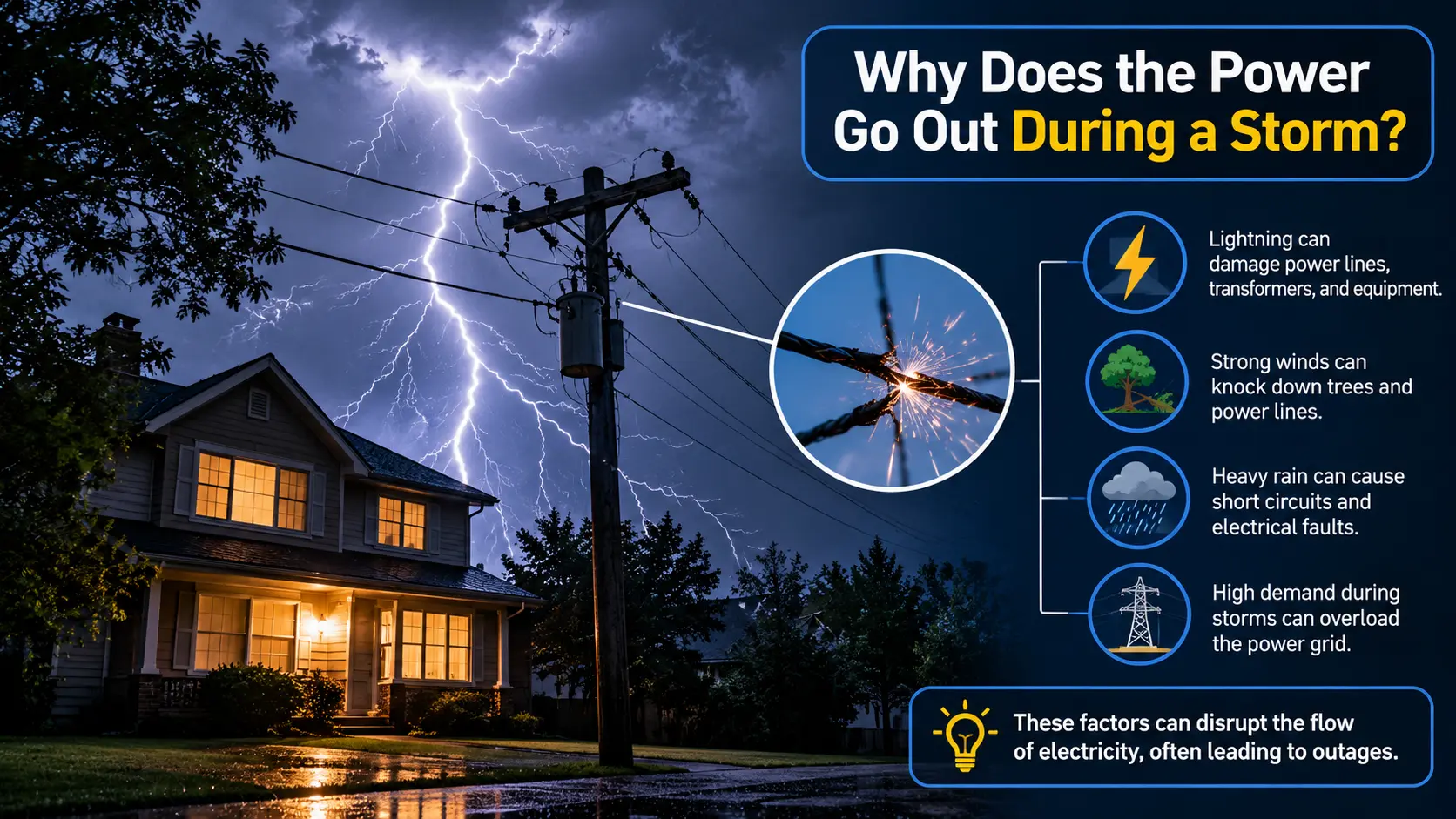
The wind picks up, the lights flicker twice and then everything goes dark. Naturally, the first thing many people wonder is: why does the power go out during a storm when the lines seemed fine an hour ago? In short, storms damage the equipment that carries electricity to your home, and the grid sometimes shuts itself off on purpose to stay safe.
Below, you’ll learn the main causes, why lights flicker first, how long repairs take and how to get ready for the next big storm.
Why Does the Power Go Out During a Storm? The Short Answer
Basically, electricity travels a long way to reach you. First, power plants create it. Then, high-voltage transmission lines carry it to substations. After that, smaller distribution lines bring it down your street, and a transformer lowers the voltage before it enters your home.
So if a storm damages any part of that chain, power stops flowing to everyone further down the line. Most often, the trouble happens on local distribution lines, since they sit close to trees and are exposed to the weather.
Top Reasons Power Can Go Out During a Storm
Now let’s look at the most common culprits.
1. Falling Trees and Branches
By far, trees cause a huge share of storm outages. For example, strong winds can snap branches or uproot whole trees, which then fall onto power lines. Even a small branch touching two wires can create a short circuit.
2. High Winds
Meanwhile, wind alone can do plenty of damage. In fact, it can make lines swing into each other, knock over utility poles or toss debris into equipment. As a result, wide areas can lose power at once.
3. Lightning Strikes
Next, lightning carries a massive electrical charge. When it hits a line, pole or transformer, it can cause a power surge that damages equipment. Often, protective devices shut off the circuit to prevent bigger problems.
4. Ice and Heavy Snow
In winter, ice builds up on lines and branches. Because ice is heavy, it can snap wires or bring down tree limbs. Similarly, wet, heavy snow can bend lines and topple poles.
5. Flooding and Planned Shutoffs
Also, floodwater can damage substations and underground equipment. On top of that, some utilities shut off power on purpose during extreme wind events to reduce wildfire risk or protect equipment.
Why Lights Flicker Before an Outage
Have you ever noticed the lights blink a few times before going out completely? Interestingly, that’s usually the grid trying to fix itself.
Basically, utilities use devices called reclosers on many lines. When something like a branch briefly touches a wire, the recloser cuts power for a moment. Then, it tries to turn the power back on automatically. If the problem clears, the lights stay on. However, if the fault is still there after a few tries, the recloser locks out and the power stays off until a crew arrives.
Behind this system, protective relays sense faults and signal breakers to open. If you’re curious about how those switching parts operate, our explainer on how does a relay work breaks it down simply.
Did the Power Go Out From the Storm or Your House?
Sometimes, the outage isn’t the grid at all. So before you call the utility, check these quick signs:
| What You Notice | Likely Cause |
|---|---|
| Neighbors’ lights are also out | Grid or neighborhood outage |
| Only part of your house is dark | Tripped breaker or blown fuse |
| Your whole house is out, but neighbors have power | Your service line, meter or main breaker |
| Lights dim or flicker often | Grid issues or a loose connection |
If only a few rooms lost power, check your breaker panel first. For more help, our guide on why does a breaker trip explains the common causes and safe fixes.
How Long Will the Power Be Out After a Storm?
Honestly, it depends on how much damage the storm caused. Small outages might be fixed in an hour or two. On the other hand, big storms can leave people without power for days.
Generally, utilities restore power in a set order:
- First, they repair major transmission lines and substations.
- Next, they fix lines that serve hospitals, emergency services and water plants.
- Then, they restore main lines that serve the most customers.
- Finally, they work on smaller neighborhood lines and individual homes.
So if your street is restored last, it’s usually because fewer homes share that line, not because you were forgotten.
Storm Prep: Get Ready Before the Power Can Go Out
Thankfully, a little planning makes outages much easier to handle. Before storm season, gather these basics:
- Flashlights and extra batteries
- Portable phone chargers or power banks
- Bottled water and nonperishable food
- A battery-powered or hand-crank radio
- Coolers and ice packs for food
- A first aid kit and needed medicines
According to Ready.gov, you should also have a plan for anyone who depends on electric medical devices.
Also, if outages are common in your area, a portable generator can keep essentials running. For quiet, clean power for electronics, our roundup of the best inverter generator models is a good place to start.
Protect Your Electronics
Unfortunately, storms don’t just cut power. They can also send surges through your wiring when power drops or returns. So protect your devices with these steps:
- Use surge protectors for computers, TVs and gaming systems.
- Unplug sensitive electronics when a big storm is coming.
- Wait a few minutes after power returns before plugging things back in.
Of course, hardware can be replaced, but lost photos and files often can’t. For peace of mind, look at our guide to the best photo backup solutions so your memories stay safe even if a device gets damaged.
Backup Power and Safety Tips
If you use a generator, safety comes first. Always run it outdoors, far from windows and doors, because exhaust contains deadly carbon monoxide. Also, never plug a generator into a wall outlet, since this can send power back into the lines and endanger repair crews.
Instead, use heavy-duty extension cords or have an electrician install a generator transfer switch, which safely connects backup power to selected circuits in your home.
Also, stay far away from downed power lines. Always assume they’re live, and call your utility or 911 to report them.
FAQs
Why does the power go out during a storm with little wind?
Usually, lightning, flooding or problems further up the grid are to blame. Also, damage miles away can still affect your area.
Should I unplug things when the power could go out in a storm?
Yes, for sensitive electronics. That way, you lower the risk of surge damage when power drops or comes back.
Why does my power go out but my neighbor’s doesn’t?
Often, homes on the same street connect to different lines or transformers. So one side can lose power while the other stays on.
Key Takeaways
To sum up, storms knock out power mostly by damaging lines, poles and transformers. Meanwhile, flickering lights are the grid’s way of trying to fix small problems on its own.
So prepare before storm season, protect your electronics and stay away from downed lines. That way, the next outage feels like an inconvenience instead of an emergency.