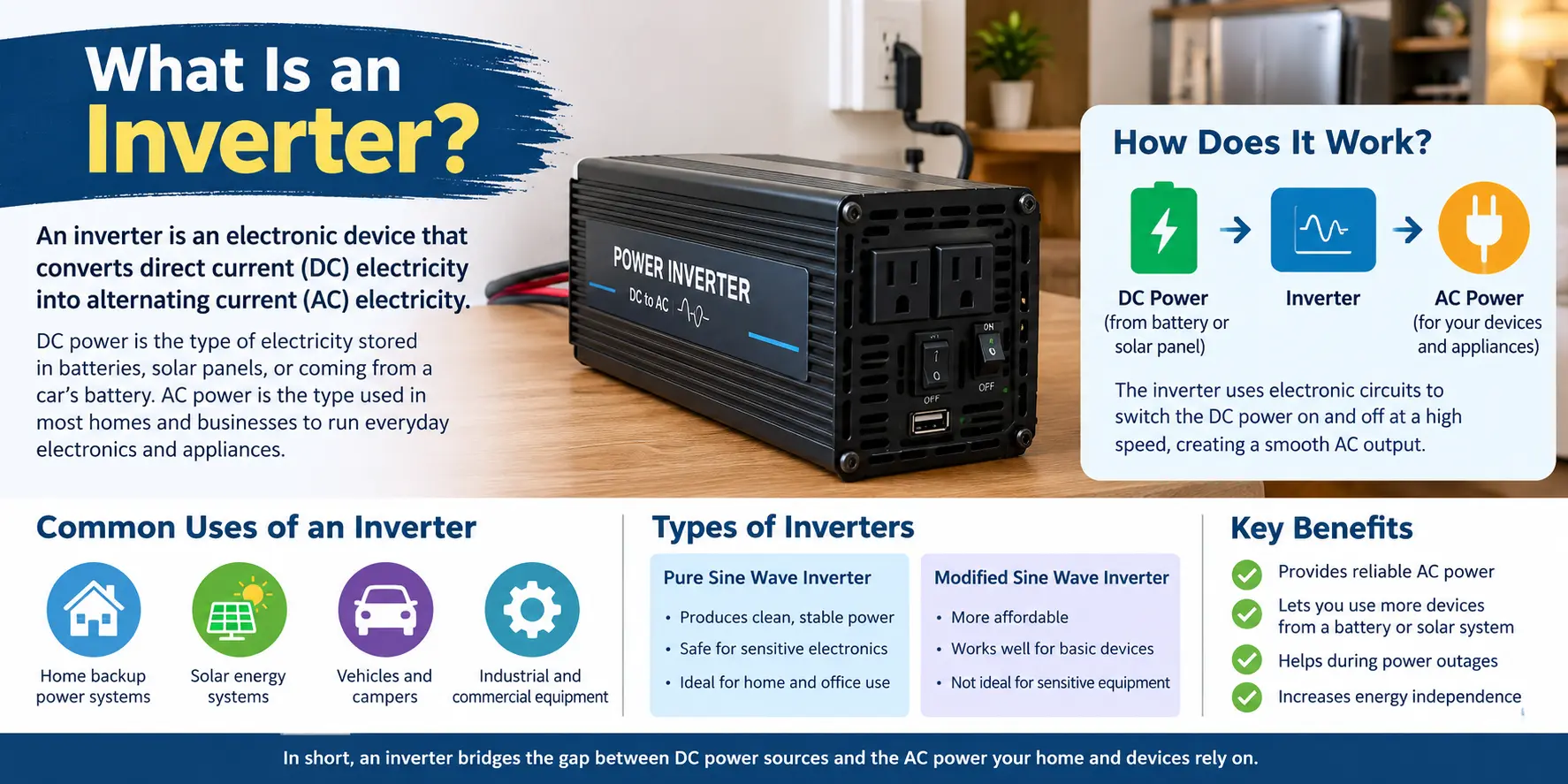
Your car battery, a solar panel and a home battery bank all store or produce one kind of electricity, yet your TV, laptop charger and fridge run on another. So, what is an inverter, and why does it matter? Simply put, an inverter is a device that changes direct current (DC) into alternating current (AC), so battery or solar power can run everyday household devices.
In this guide, you will learn how inverters work, the main types, what “inverter technology” means on appliances and how to choose the right size. Also, everything is explained in plain English, so no engineering degree is needed.
What Is an Inverter in Simple Terms?
Electricity comes in two main forms. First, there is DC, which flows in one direction, just like the power stored in batteries and produced by solar panels. Then, there is AC, which switches direction many times per second, and that is what comes out of your wall outlets.
Most homes and appliances are built for AC. However, batteries and solar panels only give you DC. Therefore, an inverter acts as the translator between the two, turning DC into usable AC power.
For a more technical background, the power inverter entry explains the history and engineering behind these devices.
How an Inverter Works
An inverter does not create energy. Instead, it reshapes the energy it receives. Here is the basic process, step by step:
- First, DC power comes in. This usually comes from a battery (often 12V, 24V or 48V) or solar panels.
- Next, electronic switches flip the current. Fast switching parts, such as transistors, turn the current on and off and reverse its direction many times per second.
- Then, the voltage changes. A transformer or boost circuit raises the low battery voltage to household levels, such as 120V or 230V depending on your country.
- Finally, filters smooth the output. As a result, the power becomes a cleaner wave that devices can use safely.
If terms like voltage and current still feel confusing, our guide on volts vs amps breaks them down in simple language. Once those basics click, inverter specs become much easier to read.
Inverter Waveforms: Pure Sine vs Modified Sine
Not all inverters produce the same quality of power. In fact, the output “wave” shape makes a big difference for sensitive electronics.
Pure Sine Wave Inverter
A pure sine wave inverter produces smooth power that closely matches your utility grid. So, it works well with laptops, medical devices, refrigerators, motors and audio equipment. On the downside, it usually costs more.
Modified Sine Wave Inverter
A modified sine wave inverter creates power in rough steps rather than a smooth curve. Because of that, it is cheaper and works fine for simple devices like basic lights and some power tools. However, motors may run hotter, and some electronics may buzz or fail to work properly.
The difference between a smooth wave and a stepped one is a bit like the idea behind analog vs digital signals, where one flows continuously and the other moves in jumps.
Square Wave Inverter
Square wave inverters are the most basic type. Today, however, they are rare, since most modern devices do not run well on them.
Main Types of Inverters
Inverters come in several designs, and each one fits a different job. Here are the most common:
- Off-grid (standalone) inverters: These run from batteries and power homes, cabins or RVs that are not connected to the grid.
- Grid-tie inverters: These connect solar panels directly to the utility grid, so you can use solar power and often send extra energy back.
- Hybrid inverters: These combine solar, batteries and grid power in one unit, which makes them popular for backup systems.
- Microinverters: These attach to individual solar panels, so shading on one panel affects the rest of the system less.
- Car or portable inverters: These plug into a vehicle’s 12V socket or battery, so you can charge laptops and small devices on the road.
- Home backup inverters (UPS-style): These charge batteries while grid power is on and then switch to battery power during outages.
For solar setups in particular, the U.S. Department of Energy has a helpful overview of how solar inverters work with the grid.
Inverter Technology in Everyday Appliances
You have probably seen “inverter” printed on air conditioners, fridges and microwaves. In these cases, the word means something slightly different. Rather than turning battery power into AC, the appliance uses inverter electronics to control motor speed or power output smoothly.
What Is an Inverter Air Conditioner?
A regular air conditioner runs its compressor at full speed and then shuts off when the room cools. Then, it turns back on when the temperature rises again. An inverter model, on the other hand, adjusts the compressor speed up and down as needed.
As a result, it keeps the temperature steadier and often uses less energy over time. So, if you are asking what is an inverter AC, the short answer is an air conditioner with a variable-speed compressor. This works through a variable-frequency drive, which changes the motor’s speed by adjusting the power frequency.
What Is an Inverter Microwave?
A standard microwave usually simulates lower power settings by cycling full power on and off. In contrast, an inverter microwave delivers a steady, lower level of power. Therefore, foods defrost more evenly, and delicate dishes are less likely to overcook at the edges.
What Is an Inverter Generator?
A traditional generator’s engine must run at a fixed speed to produce the right AC frequency. An inverter generator, however, first produces AC, then converts it to DC, and finally inverts it back to clean AC.
Because of this extra step, the engine can speed up or slow down based on demand. Consequently, inverter generators are usually quieter, more fuel-efficient and safer for sensitive electronics. If you are shopping for one, our guide to the best inverter generator compares popular models for camping and home backup.
How to Choose the Right Inverter Size
Picking the right size keeps your devices running and prevents overloads. So, start by adding up the power your devices need.
First, list every device you plan to run at the same time. Next, find each one’s wattage on its label or manual. If a label only shows volts and amps, our guide on how to calculate watts shows the simple math.
Then, check two numbers on any inverter:
- Continuous power: This is the steady wattage the inverter can supply for long periods.
- Surge (peak) power: This is the short burst it can handle when motors start, since fridges and pumps often need two to three times their running watts for a moment.
As a rule of thumb, choose an inverter with about 20–25% more continuous capacity than your total load. That way, you leave a safety margin for surges and future devices. Also, make sure the inverter’s input voltage matches your battery bank, such as 12V, 24V or 48V.
Advantages and Disadvantages of Inverters
Benefits
- They let you run household devices from batteries and solar panels.
- They provide backup power during outages, especially when paired with batteries.
- In appliances, inverter technology often improves comfort and efficiency.
- Plus, portable models make road trips and camping more convenient.
Drawbacks
- Some energy is lost as heat during conversion, so efficiency is never 100%.
- Pure sine wave models usually cost more upfront.
- Larger systems need proper wiring, fuses and ventilation.
- Also, inverter appliances may cost more to repair because of their electronic boards.
Safety Tips for Using an Inverter
Inverters handle a lot of power, so safe setup matters. First, keep the unit in a dry, ventilated spot, since heat shortens its life. Next, use the cable size and fuses the manufacturer recommends, because undersized cables can overheat.
Also, never connect a backup system straight into your home’s wiring without the right equipment. For home backup, an electrician can install a generator transfer switch or similar device, which keeps power from feeding back into utility lines and protects line workers.
Finally, avoid running an inverter from a car battery for long periods with the engine off. Otherwise, you may drain the battery and be unable to start the car.
Common Inverter Problems and Quick Fixes
- Inverter shuts off suddenly: Usually, this points to overload or low battery voltage, so reduce the load or recharge the battery.
- Beeping alarm: Often, it warns about low voltage or overheating, so check connections and airflow.
- Devices humming or not working: In many cases, a modified sine inverter is the cause, so consider a pure sine model.
- Unit feels very hot: Then, move it to a cooler spot and make sure the fan is working.
Frequently Asked Questions About Inverters
What is an inverter used for at home?
Mostly, home inverters provide backup power from batteries during outages or convert solar energy into usable AC power.
Is an inverter the same as a converter?
No, it is not. An inverter changes DC to AC, whereas a converter usually changes AC to DC or adjusts DC voltage levels.
Can an inverter run a refrigerator?
Yes, as long as it has enough surge capacity and ideally a pure sine wave output.
Do inverter air conditioners really save energy?
Generally, they can use less energy than fixed-speed models, especially when they run for long hours. Still, actual savings depend on climate, usage and the specific unit.
Key Takeaways
To sum up, an inverter turns DC power from batteries or solar panels into the AC power your devices need. Meanwhile, “inverter” on appliances like ACs, microwaves and generators means smarter, variable power control.
So, before you buy, match the inverter type to your goal, choose pure sine for sensitive electronics and size it with room to spare. Above all, follow the manual’s safety advice, and call a licensed electrician for any setup that connects to your home’s wiring.