Have you ever wondered how does a relay work when you press a car’s ignition, switch on industrial equipment, or automate a home device? A relay is an electrically operated switch that allows a small electrical signal to safely control a much larger electrical load. Instead of carrying high current through a manual switch or microcontroller, the relay acts as a bridge between a low-power control circuit and a high-power device.
Although relays come in several designs, they all perform the same basic job: opening or closing an electrical circuit in response to a control signal. Understanding how they work makes it much easier to grasp modern electrical systems used in vehicles, appliances, factories, and automation.
What Is a Relay?
A relay is a switching device that uses electricity to control another electrical circuit.
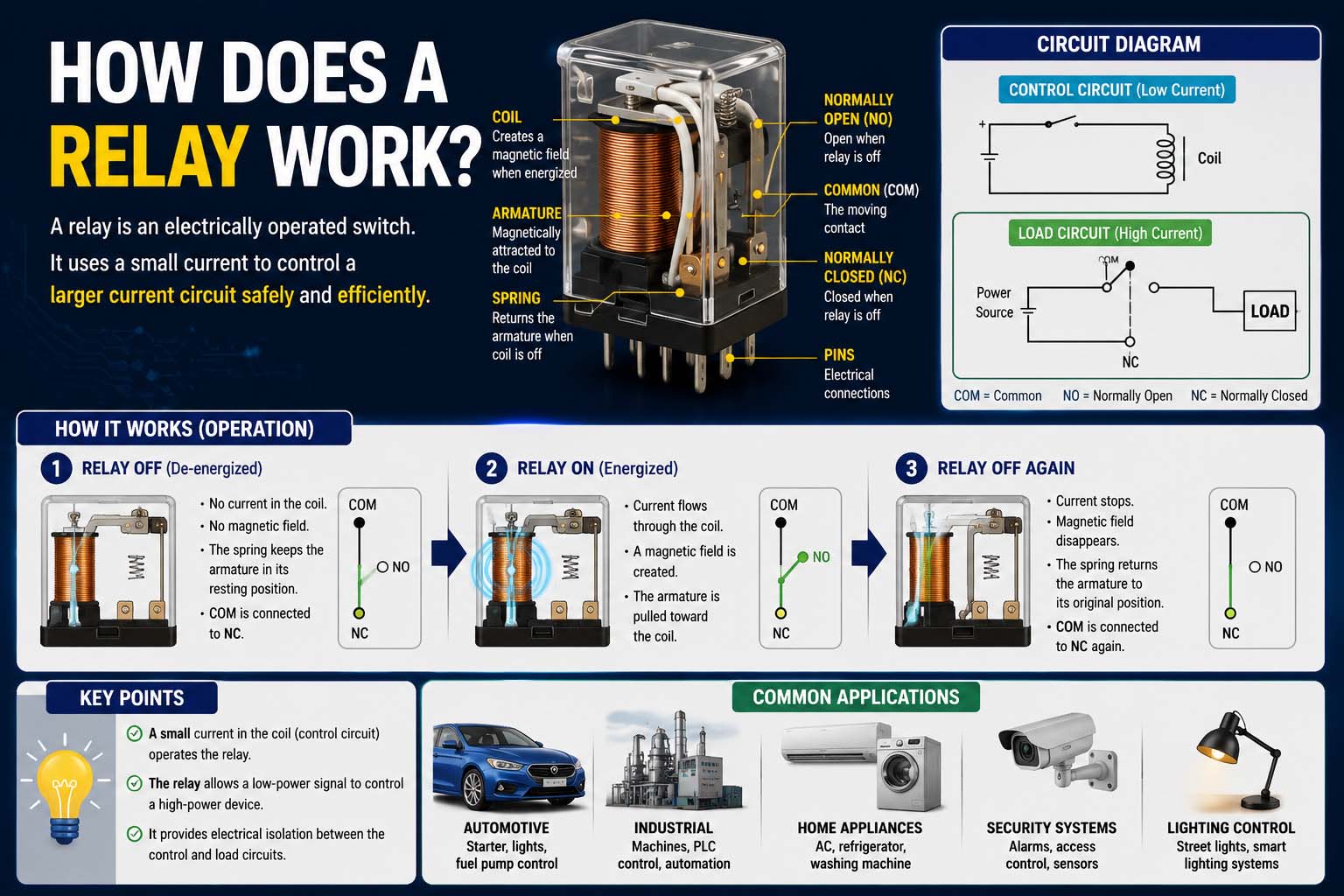
Most traditional relays rely on electromagnetism. When electricity flows through a coil, it creates a magnetic field that moves a mechanical switch. Once the current stops, the switch returns to its original position.
Relays provide electrical isolation between the control side and the power side, making systems safer and easier to design.
If you’re new to electrical systems, learning What Is a Circuit first can make relay operation even easier to understand.
How Does a Relay Work? Step by Step
The easiest way to answer how does a relay work is by following the switching process from start to finish.
Step 1: A Control Signal Reaches the Coil
When voltage is applied to the relay coil, electrical current begins flowing through the wire wrapped around an iron core.
This creates an electromagnetic field.
Step 2: The Electromagnet Pulls the Armature
The magnetic field attracts a small metal lever called the armature.
As the armature moves, it changes the position of the relay contacts.
Step 3: The Contacts Open or Close
Depending on the relay’s design, the contacts either:
- Close a previously open circuit
- Open a previously closed circuit
- Switch power between two different circuits
This allows a low-current signal to control equipment that requires much higher current.
Step 4: Power Reaches the Load
Once the contacts close, electricity flows to the connected device.
The relay itself does not increase voltage or current. It simply controls whether electricity can pass through the main circuit.
Main Parts of a Relay
Every electromagnetic relay contains several important components.
| Component | Purpose |
|---|---|
| Coil | Creates the magnetic field |
| Iron core | Strengthens the magnetic field |
| Armature | Moves when attracted by the magnet |
| Spring | Returns the armature to its resting position |
| Contacts | Open or close the electrical circuit |
| Housing | Protects internal components |
Each part plays an essential role in reliable switching.
Why Are Relays Used?
Relays solve several common electrical challenges.
They allow:
- Small switches to control large devices
- Low-voltage electronics to control high-voltage equipment
- Electrical isolation between circuits
- Automatic switching
- Remote operation
- Improved safety
Because of these advantages, relays appear in thousands of electronic and industrial products.
Common Types of Relays
Different applications require different relay designs.
Electromagnetic Relay
This is the classic relay design using a coil and moving armature.
Advantages include:
- Simple operation
- Affordable cost
- Reliable switching
- Electrical isolation
Solid-State Relay
Many people ask, how does a solid state relay work because these devices contain no moving mechanical parts.
Instead of using an electromagnet, a solid-state relay uses semiconductor components such as transistors or thyristors to switch electrical power electronically.
Benefits include:
- Faster switching
- Silent operation
- Longer service life
- Less mechanical wear
However, solid-state relays usually generate more heat than mechanical relays and may require heat sinks for high-power applications.
Latching Relay
Another common question is how does a latching relay work.
Unlike standard relays, a latching relay stays in its last switched position even after power is removed.
It only changes state when another control pulse arrives.
This design reduces energy consumption because the coil doesn’t need continuous power.
How Does a 5 Pin Relay Work?
Automotive systems commonly use five-pin relays.
If you’ve wondered how does a 5 pin relay work, here’s a simplified explanation.
The five terminals typically include:
- Two coil terminals
- One common terminal
- One normally open contact
- One normally closed contact
When the coil receives power, the common terminal switches from the normally closed contact to the normally open contact.
This arrangement allows one relay to control different circuit paths depending on whether it’s energized.
How Does a Starter Relay Work?
Vehicles rely heavily on relays.
A frequent question among car owners is how does a starter relay work.
- A small electrical current activates the relay.
- The relay closes its contacts.
- Battery power flows to the starter motor.
- The engine begins turning.
Without the starter relay, the ignition switch would need to carry much higher current, reducing its lifespan.
Normally Open vs. Normally Closed Contacts
Relay contacts come in two primary configurations.
Normally Open (NO)
The circuit remains disconnected until the relay activates.
These contacts are commonly used for lighting, motors, and appliances.
Normally Closed (NC)
The circuit remains connected until the relay receives power.
These are often used in safety systems or alarm circuits.
Many relay models include both contact types within a single device.
Where Are Relays Used?
Relays appear almost everywhere modern electrical control is needed.
Common applications include:
- Cars
- Industrial machinery
- HVAC systems
- Home automation
- Elevators
- Medical equipment
- Telecommunications
- Robotics
- Security systems
- Power distribution
Factories often rely on hundreds or even thousands of relays to automate complex manufacturing processes.
Advantages of Using Relays
Relays offer several practical benefits.
Electrical Isolation
The control circuit remains separated from the high-power circuit, improving safety.
Low-Power Control
Small electronic devices can safely control large electrical loads.
Flexible System Design
One controller can operate multiple devices using separate relays.
Reliable Automation
Relays can switch automatically without manual intervention.
Limitations of Mechanical Relays
Despite their usefulness, traditional relays also have drawbacks.
These include:
- Mechanical wear over time
- Audible clicking noise
- Slower switching than semiconductor devices
- Contact arcing under heavy loads
Applications requiring extremely rapid switching often use solid-state relays instead.
Relay vs. Circuit Breaker
People sometimes confuse relays with circuit breakers.
Although both interact with electrical circuits, they perform different jobs.
A relay controls when electricity flows.
A circuit breaker protects wiring by disconnecting power during overloads or short circuits.
If you’re curious about electrical protection systems, our guide explaining why does a breaker trip covers common causes and how breakers help prevent damage.
Relays in Control Systems
Relays often form part of automated control systems.
For example, a temperature sensor may activate a relay that switches on a cooling fan.
Many industrial machines also combine relays with controllers using either manual logic or programmable automation. If you’d like to understand these approaches better, our comparison of open loop vs closed loop control explains how automated systems respond to changing conditions.
Troubleshooting Common Relay Problems
If a relay isn’t working correctly, several issues may be responsible.
| Problem | Possible Cause |
| Relay won’t activate | No coil voltage |
| Contacts stay open | Damaged coil or armature |
| Clicking but no output | Worn contacts |
| Relay overheats | Incorrect voltage or overload |
| Intermittent operation | Loose wiring or poor connections |
Testing usually involves measuring coil voltage, checking continuity, and inspecting the contacts for wear.
Does Relay Performance Depend on Impedance?
In some electronic circuits, relay coils interact with components that resist changes in electrical current.
Understanding what is impedance becomes especially useful when working with alternating current (AC) circuits, where resistance and reactance both influence overall electrical behavior.
For many simple DC relay applications, basic resistance measurements are often sufficient.
Relay Wiring Tips
Whether you’re building a hobby project or repairing equipment, a few good habits improve safety.
- Match the relay voltage to the power supply.
- Never exceed the relay’s current rating.
- Use correctly sized wiring.
- Protect circuits with appropriate fuses.
- Double-check terminal labels before connecting wires.
- Disconnect power before making wiring changes.
Careful wiring reduces equipment damage and improves long-term reliability.
How Relays Fit into Larger Electrical Systems
Relays often work alongside switches, sensors, motors, timers, and controllers.
Some circuits place relays in combination with other wiring layouts. If you’re learning electrical fundamentals, our guide to what is a series circuit explains one of the basic circuit arrangements you’ll frequently encounter.
Frequently Asked Questions
How does a relay work?
A relay uses an electromagnetic coil or semiconductor components to control whether electrical contacts open or close, allowing a low-power signal to switch a higher-power circuit.
Why are relays used instead of regular switches?
Relays allow small electrical signals to safely control large electrical loads while keeping the control circuit electrically isolated from the power circuit.
What’s the difference between a relay and a contactor?
Both are electrically operated switches, but contactors are generally designed for higher current applications such as industrial motors.
How long do relays last?
Mechanical relays often last hundreds of thousands or even millions of switching cycles, depending on operating conditions. Solid-state relays can last even longer because they have no moving parts.
Can a relay fail?
Yes. Common failures include worn contacts, damaged coils, overheating, contamination, and incorrect wiring.
Key Takeaways
Relays are among the most useful components in electrical engineering because they allow small control signals to operate much larger electrical devices safely and efficiently. Whether you’re studying electronics, troubleshooting automotive systems, or working with industrial automation, understanding how does a relay work provides a strong foundation for learning more advanced electrical concepts.
From traditional electromagnetic relays to modern solid-state designs, the core principle remains the same: using one circuit to safely control another. Once you understand that simple idea, many electrical systems become much easier to understand.