
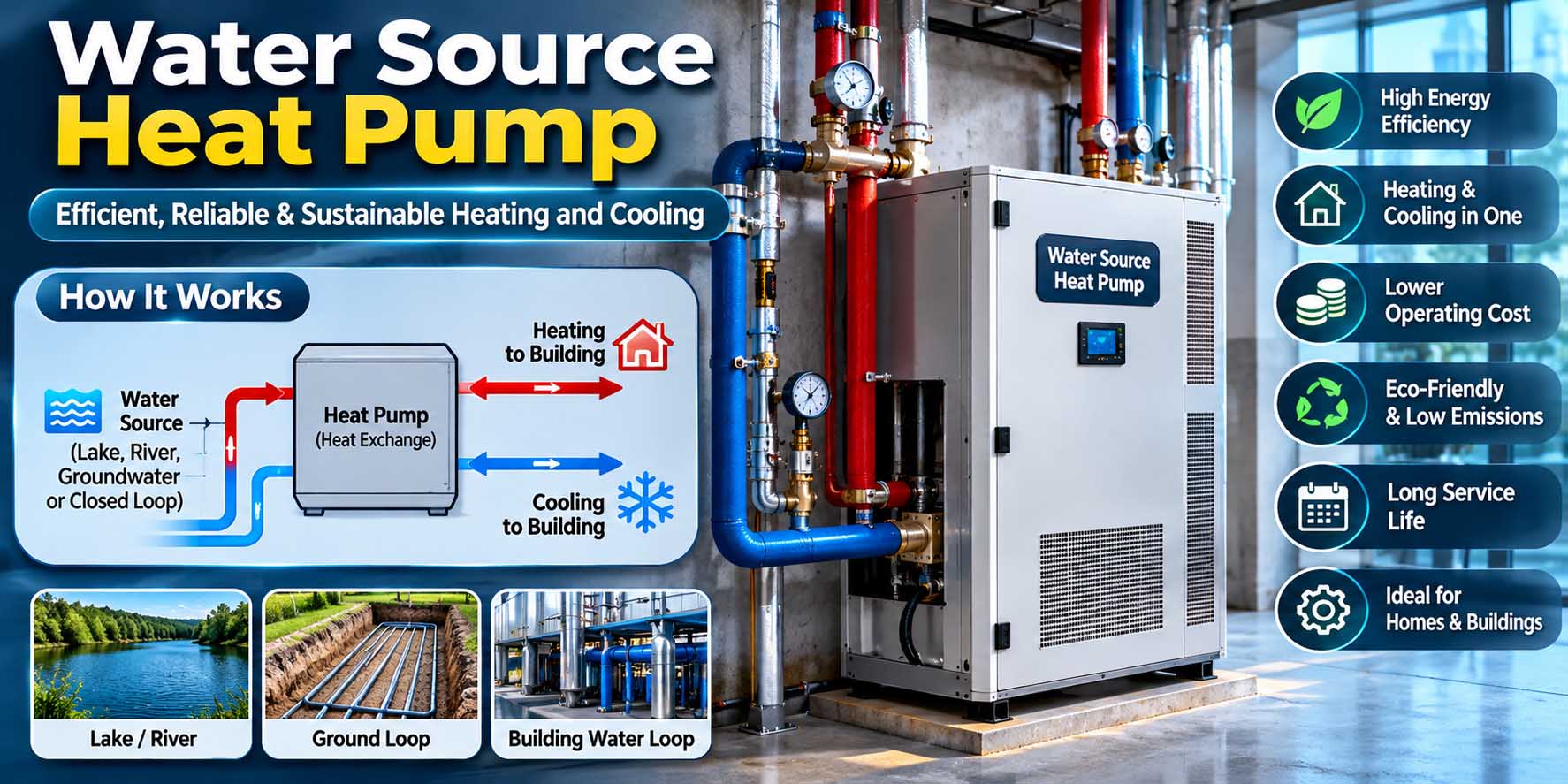
Imagine heating and cooling a building by borrowing warmth from a nearby lake, a well or a loop of pipes running through the walls. That is exactly what a water source heat pump does. Instead of trading heat with outdoor air, it moves heat to and from water, which stays at a much steadier temperature all year.
In this guide, you will learn how these systems work, the main types, how they compare to other options and what installation, service and repair involve. So, whether you own a home or manage a building, you will know what to expect.
What Is a Water Source Heat Pump?
A heat pump does not burn fuel to make heat. Instead, it moves heat from one place to another using refrigerant, a compressor and a couple of heat exchangers. Then, a water source model uses water as the place it pulls heat from in winter and dumps heat into in summer.
That water might come from a well, a pond or a lake. In many apartments, hotels and offices, however, it comes from a shared water loop that runs through the whole building. Because water temperature changes far less than air temperature, these systems often run efficiently in both hot and cold weather.
How a Water Source Heat Pump Works
The basic idea is the same refrigeration cycle found in your fridge or air conditioner. If you want a refresher on that cycle, our guide on how does an air conditioner work explains each step in plain English. The big difference here is that one side of the system trades heat with water instead of outdoor air.
Heating Mode
In winter, the refrigerant absorbs heat from the water as it passes through a water-to-refrigerant heat exchanger. Next, the compressor squeezes the refrigerant, which raises its temperature. Then, a blower pushes indoor air across a hot coil, so warm air flows into your rooms. Finally, the slightly cooler water returns to its source.
Cooling Mode
In summer, the system simply runs in reverse. A reversing valve flips the refrigerant flow, so the indoor coil now absorbs heat from your rooms. After that, the system releases that heat into the water, which carries it away.
Water Source Heat Pump Diagram Explained
If you picture a simple water source heat pump diagram, it usually shows these parts in a loop:
- Water loop or source: First, water flows in from a well, lake or building loop.
- Water-to-refrigerant heat exchanger: Here, heat moves between the water and the refrigerant.
- Compressor: Next, it raises the refrigerant’s pressure and temperature.
- Reversing valve: This switches the system between heating and cooling.
- Air coil and blower: Then, these move heat into or out of the indoor air.
- Expansion valve: Finally, it drops the refrigerant pressure so the cycle can start again.
Most units are compact boxes that sit indoors, often in a closet, ceiling space or mechanical room. As a result, you do not need a noisy outdoor unit.
Main Types of Water Source Systems
Not every system gets its water the same way. Here are the three most common setups.
Open-Loop Systems
An open-loop system pumps water from a well or surface source, runs it through the heat pump and then sends it back to the ground or a second well. Because it uses fresh water each time, it can be very efficient. However, it needs enough clean water, and local rules may limit how you discharge it.
Closed-Loop Lake or Pond Systems
Here, sealed pipes sit at the bottom of a pond or lake. Meanwhile, a water and antifreeze mix circulates inside those pipes, so lake water never enters the unit. This setup avoids water quality problems, although you need a large enough and deep enough body of water.
Building Water Loop Systems
In commercial buildings, each apartment or office often has its own small heat pump connected to one shared water loop. Then, a boiler adds heat to the loop when needed, while a cooling tower or fluid cooler removes extra heat. Interestingly, one unit cooling a sunny office can send heat into the loop that another unit uses to warm a shaded room.
Water Source Heat Pump vs Other Options
So, how does a water-based system stack up? Here is a quick comparison:
- Air source heat pump: It trades heat with outdoor air, so it is cheaper to install but usually loses some efficiency in very cold or very hot weather.
- Water source heat pump: In contrast, it uses steady water temperatures for strong year-round efficiency, but it needs a reliable water source or loop.
- Ground source system: Similarly, this option uses buried pipes and the earth’s stable temperature. If you want the full picture, our guide to the geothermal heat pump explains how ground loops work.
Also, the U.S. Department of Energy notes that geothermal and water-source heat pumps take advantage of relatively constant ground or water temperatures, which helps them keep operating costs low.
Pros and Cons
Like any HVAC choice, these systems have strengths and trade-offs.
Advantages
- Steady efficiency, since water temperatures change slowly.
- Quiet operation, because there is no large outdoor fan unit.
- Both heating and cooling come from one system.
- In buildings, units can share heat through the loop, which saves energy.
- Plus, indoor units are protected from weather, so they often last longer.
Disadvantages
- You need a suitable water source or a building loop.
- Installation usually costs more than a standard air source system.
- Water quality problems can cause scaling or clogging.
- Also, open-loop systems may need permits for wells and water discharge.
If you are still deciding between cooling-only equipment and a system that heats too, our breakdown of heat pump vs ac shows the key differences. Likewise, if you are replacing an older gas system, it helps to understand how does a furnace work so you can compare running costs fairly.
Water Source Heat Pump Installation: What to Expect
A proper water source heat pump installation starts long before anyone moves equipment. Here is the usual process:
- Site check: First, a contractor looks at your water source, its temperature, flow and quality.
- Load calculation: Next, they size the system based on your building’s heating and cooling needs.
- Permits: Then, they handle local approvals, especially for wells or lake loops.
- Loop or piping work: After that, crews install wells, pond loops or connections to the building loop.
- Unit and ductwork setup: Meanwhile, they place the indoor unit and connect ducts, wiring and drains.
- Flushing and startup: Finally, they flush the water lines, check flow and test both heating and cooling.
Costs vary widely depending on the water source, building size, local labor rates and permits. So, get several quotes from licensed installers with water source experience.
Water Source Heat Pump Service and Maintenance
Regular water source heat pump service keeps the system efficient and helps prevent breakdowns. Usually, a technician visits once or twice a year.
During a service visit, they typically:
- Replace or clean air filters.
- Clear the condensate drain so water does not back up.
- Clean water strainers and check water flow.
- Inspect the water coil for scale or buildup.
- Check refrigerant pressures and electrical parts.
- Test antifreeze levels in closed loops.
Technicians also measure the temperature difference across the water and air coils. If that number drifts from the manufacturer’s range, it can point to flow, airflow or refrigerant problems. For a simple explanation of this measurement, see our guide on what is delta t.
Between visits, you can help by changing filters on schedule and keeping the area around the unit clear.
Water Source Heat Pump Repair: Common Problems
Even well-kept systems sometimes act up. Here are common issues and what they usually mean:
- Unit locks out on high pressure: In cooling mode, this often means low water flow, a clogged strainer or a pump problem.
- Unit locks out on low pressure or freeze protection: In heating mode, the water may be too cold or flow too low.
- Weak heating or cooling: Typically, dirty filters, a scaled water coil or low refrigerant cause this.
- Water leaking indoors: Usually, a blocked condensate drain is the culprit.
- System will not switch modes: Then, the reversing valve or thermostat may need attention.
- Unusual noises: These can come from the compressor, blower or a struggling water pump.
Simple fixes, like changing a filter or resetting a lockout once, are fine for most owners. However, refrigerant work, electrical repairs and coil cleaning should go to a licensed HVAC technician. After all, repeated lockouts usually signal a deeper problem that needs proper water source heat pump repair.
Frequently Asked Questions
How long does a water source heat pump last?
With good maintenance, many units last around 15–20 years. Meanwhile, wells and buried or submerged loops often last much longer.
Can I use pool water as a source?
Generally, no. Pool water is usually too small a source, and chemicals can damage the heat exchanger, although some systems are made specifically for pool heating.
Does it work in cold climates?
Yes, as long as the water source stays warm enough. In fact, steady water temperatures help these systems perform well when air source units struggle.
Is it the same as a geothermal system?
They are closely related. However, water source systems use water directly or a building loop, while ground source systems rely on pipes buried in the earth.
Is a Water Source System Right for You?
To sum up, these heat pumps shine when you have a reliable water source or a building with a shared water loop. They offer quiet, efficient heating and cooling, but they need careful planning, proper installation and regular service.
So, start by having a qualified contractor check your water source and building needs. Then, compare quotes, ask about maintenance plans and make sure your installer has real experience with water-based systems.