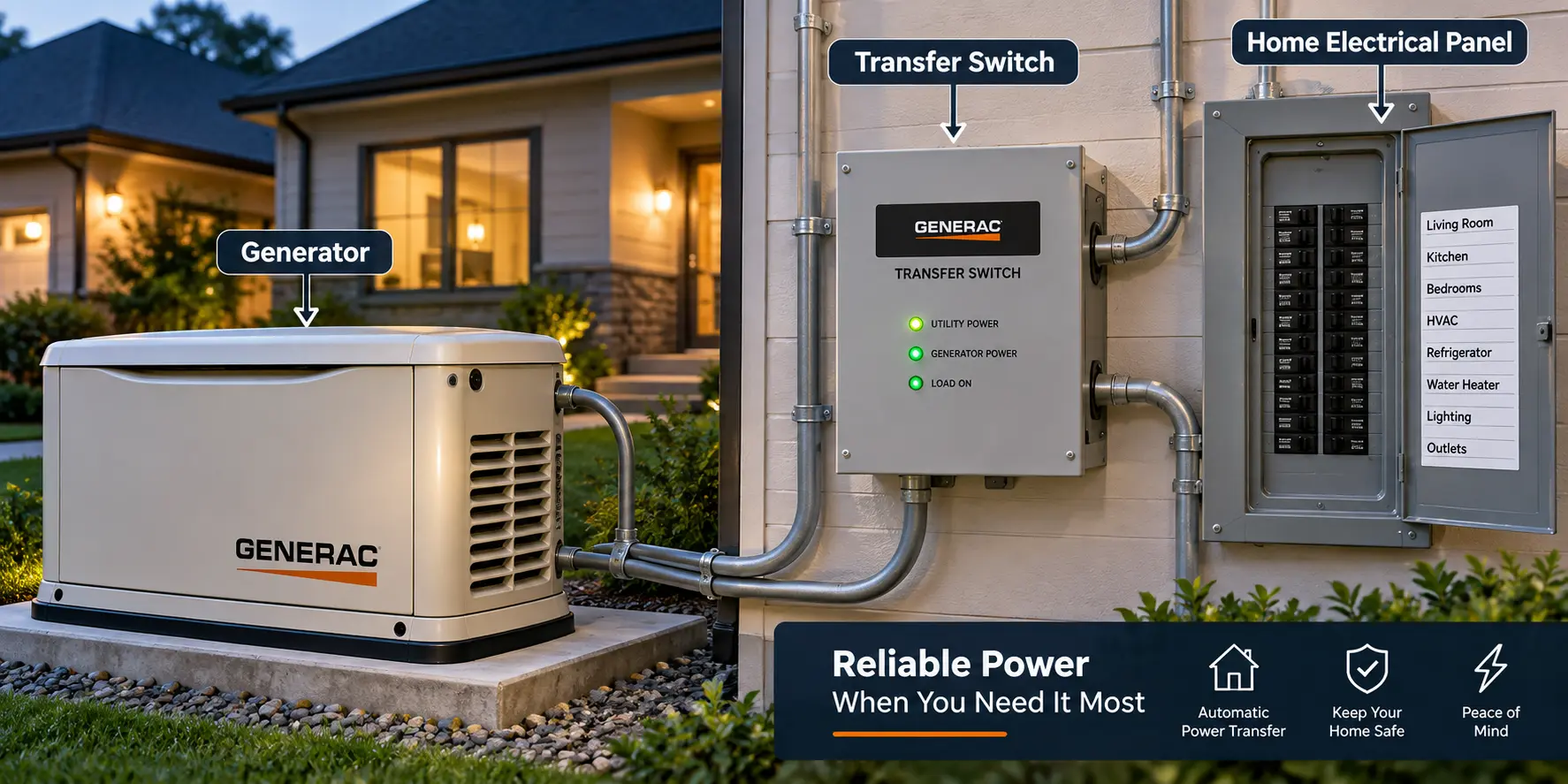
When the power goes out, a portable or standby generator can keep essential equipment running. However, safely supplying generator electricity to a home’s electrical system requires more than plugging in the generator. A generator transfer switch provides a controlled way to select between utility electricity and generator power while preventing the two sources from feeding the home at the same time.
Transfer switches are available in manual and automatic designs, while their electrical ratings and supported circuits vary widely. Therefore, choosing the right setup depends on your generator, electrical service, desired backup loads, and local electrical requirements.
Here is how generator transfer switches work, why they matter, and what homeowners should know before choosing one.
What Is a Generator Transfer Switch?
A generator transfer switch is an electrical switching device that changes a building’s power source from normal utility electricity to generator electricity.
Under normal conditions, the utility supplies the home’s electrical panel. However, during an outage, an appropriately installed transfer system isolates the utility source before connecting generator power to the selected loads or electrical panel.
That isolation is one of the switch’s most significant functions. Without it, an improperly connected generator could energize wiring that should be disconnected from the generator source.
If you are learning the basics of household electrical systems, What Is a Circuit is useful background because a transfer switch changes which power source supplies one or more electrical circuits.
Transfer switches can serve a few selected circuits or, when properly designed and sized, a larger portion of the electrical system.
How Does a Generator Transfer Switch Work?
Although designs differ, the basic operating sequence is straightforward.
During normal operation, the electrical system receives power from the utility. When an outage occurs, generator power becomes available either after someone starts a portable generator or after a standby generator starts automatically.
The transfer equipment then changes the connected source.
Utility power → transfer equipment → electrical loads
or, during generator operation:
Generator → transfer equipment → electrical loads
The switching arrangement prevents the generator and utility source from being connected to the protected loads simultaneously under normal transfer operation.
Because transfer equipment is part of a broader family of electrical switching devices, understanding the types of switches can also help explain why different mechanisms suit manual control, automatic operation, isolation, and other electrical jobs.
Why Is a Transfer Switch for Generator Systems Used?
The main purpose of a transfer switch for generator installations is safe source selection.
A generator cannot necessarily supply every electrical load in a house. Therefore, a transfer system can also help homeowners control which circuits receive backup power.
For example, a smaller portable generator might supply:
- Refrigerator and freezer
- Selected lights
- Internet equipment
- Heating system controls
- Sump or water pump, if properly sized
- Selected outlets
Meanwhile, a larger standby generator may be designed to support many more loads or potentially the whole home, depending on generator capacity and system design.
The transfer equipment must match the electrical configuration. As a result, generator output, voltage, current, service arrangement, neutral configuration, load requirements, and applicable electrical codes all matter.
Manual Transfer Switch for Generator Systems
A manual transfer switch for generator setups requires a person to perform the changeover.
When utility power fails, the user typically starts the generator according to its instructions. Then, after generator output is stable, the user operates the transfer equipment to supply the intended circuits.
Because the process is manual, this arrangement is commonly paired with portable generators.
Advantages of Manual Transfer
Manual equipment is generally simpler than a fully automatic standby system. Consequently, it can be practical for homeowners who only need backup electricity occasionally.
The user also controls when generator power reaches the connected loads. Therefore, loads can be managed according to generator capacity.
Limitations of Manual Systems
Someone normally needs to be present to start the generator and transfer the load. As a result, the system does not automatically restore backup power when nobody is home.
Portable generators also require safe operating practices. For example, combustion-engine generators must never operate inside a home, garage, basement, or other enclosed area because carbon monoxide can be deadly.
Automatic Transfer Switch for Generator Systems
An automatic transfer switch for generator systems, often called an ATS, can change sources automatically when it detects a loss of normal utility power.
These switches are commonly paired with permanently installed standby generators.
A typical sequence works like this:
- Utility electricity fails.
- The control system detects the outage.
- The standby generator receives a start command.
- The generator starts and reaches suitable operating conditions.
- The transfer switch connects the designated loads to generator power.
- Utility power eventually returns.
- After suitable verification or delay, the switch transfers the load back to utility power.
- The generator completes its programmed cooldown and stops.
Because several electrical and mechanical actions happen in sequence, automatic transfer systems use control circuitry. If you want a broader explanation of electrically controlled switching, how does a relay work provides useful context for understanding how low-power control signals can operate switching functions.
Manual vs Automatic Generator Transfer Switch
Neither design fits every situation. Instead, the right choice depends on the generator and the level of automation required.
| Feature | Manual Transfer Switch | Automatic Transfer Switch |
|---|---|---|
| Common generator type | Portable generator | Standby generator |
| User action required | Yes | Usually no during an outage |
| Automatic outage response | No | Yes |
| Typical complexity | Lower | Higher |
| Best suited to | Occasional backup power | Automatic backup power |
| Generator start | Usually manual | Usually automatic |
| Installation | Professional installation recommended | Professional installation expected |
A manual system may make sense when occasional outages are manageable and someone can operate the generator. In contrast, an automatic setup can be useful when uninterrupted automatic backup is a priority.
Choosing the Correct Transfer Switch Size
Transfer equipment must have suitable electrical ratings for the system in which it operates. Therefore, you should not select a switch only because its connector physically fits your generator.
Generator output is often specified in watts, while electrical equipment also uses volts and amps. If those units are unfamiliar, volts vs amps can help explain the relationship between electrical potential and current.
For a simplified single-phase load calculation:
Watts = Volts × Amps
For example, 7,200 watts divided by 240 volts equals 30 amps. However, real generator sizing requires more than this basic calculation because motor starting loads, continuous loads, generator ratings, load management, and electrical-code requirements can affect the final design.
Check Generator Capacity
First, identify the generator’s rated output and electrical configuration.
Next, determine which loads need backup power. Large appliances such as air conditioners, electric water heaters, pumps, and some heating equipment can require significant power.
Meanwhile, motors may briefly draw substantially more current while starting than while running.
Check the Electrical Service
Whole-home transfer equipment must also be appropriate for the electrical service and installation design.
For instance, a home may have a 100-amp, 150-amp, or 200-amp service. However, that does not automatically mean the generator itself must supply the full service rating. Load management may allow a smaller generator to serve prioritized loads, depending on the system.
An electrician can calculate the required loads and select compatible equipment.
How to Connect a Generator to Your House Without Transfer Switch Equipment
People sometimes search for how to connect a generator to your house without transfer switch because they want a cheaper or faster solution during an outage. However, connecting a portable generator directly to household wiring without approved transfer or interlock equipment can create serious electrical hazards.
In particular, never use a homemade double-male power cord or another method that can energize household wiring improperly.
Instead, use a properly designed connection method that complies with the electrical rules applicable to your location. Depending on the installation and jurisdiction, an approved panel interlock arrangement may sometimes be an alternative to a separate transfer switch.
However, compatibility and code requirements vary. Therefore, a qualified electrician should determine whether an interlock, transfer switch, transfer panel, or another approved solution fits the installation.
For temporary power without connecting into house wiring, appliances may sometimes be powered directly from suitable generator receptacles with correctly rated cords, provided the generator manufacturer and applicable safety guidance allow it.
Breakers, Overloads, and Generator Power
A transfer switch does not make an undersized generator capable of running unlimited loads.
Suppose several high-demand appliances start simultaneously. In that case, their combined demand may exceed the generator’s capacity, causing protective equipment to operate.
Understanding why does a breaker trip can help homeowners recognize how overloads, short circuits, and other electrical faults cause protective devices to disconnect a circuit.
Therefore, load planning matters.
For example, a portable generator might comfortably support a refrigerator, lights, internet equipment, and a few outlets but struggle if a large air conditioner or electric heating load starts simultaneously.
Instead of guessing, calculate the expected loads and account for equipment starting requirements.
Common Generator Transfer Switch Problems
Transfer systems are generally dependable when correctly installed and maintained. Still, several symptoms can indicate a problem.
Generator Runs but the House Has No Power
First, verify that the generator is operating normally and follow the manufacturer’s operating procedure.
Then, check whether the appropriate transfer position or generator-side breaker is set correctly. A tripped generator breaker or incorrectly operated manual transfer device may prevent power from reaching the intended circuits.
If the cause is unclear, stop troubleshooting beyond basic user-level checks and contact a qualified technician.
Some Circuits Work but Others Do Not
This may be normal with a selected-circuit transfer system because only designated circuits receive backup power.
However, an unexpected loss of a normally backed-up circuit could also indicate a tripped breaker, wiring problem, equipment fault, or transfer-system issue.
Automatic Transfer Does Not Occur
With an automatic system, the problem may involve outage sensing, generator starting, controls, batteries, wiring, or the transfer equipment itself.
Because an ATS interacts with both utility and generator power, internal electrical troubleshooting should be left to qualified service personnel.
Generator Transfer Switch Safety Tips
Treat generator power with the same care as utility electricity.
Always operate portable generators outdoors and well away from occupied spaces, following the manufacturer’s instructions for safe placement. Carbon monoxide can accumulate rapidly when an engine runs in an enclosed or poorly ventilated location.
Likewise, keep generators protected from unsafe exposure to rain or standing water while still maintaining the ventilation and clearance required by the manufacturer.
Never modify plugs, bypass protective equipment, or improvise a connection to a home’s wiring.
Also, avoid assuming that every generator and transfer switch combination is compatible. Electrical ratings, grounding and bonding arrangements, neutral switching, connectors, and system configuration all need to work together correctly.
Finally, test and maintain standby systems according to their manufacturer’s schedule so that they are ready before the next outage.
Frequently Asked Questions
Do I need a transfer switch for a portable generator?
If a portable generator will supply a home’s fixed wiring, an approved transfer or interlock arrangement is generally needed to isolate power sources safely, subject to local electrical rules. However, requirements and permitted equipment vary by jurisdiction.
Can I install a generator transfer switch myself?
Transfer equipment connects to high-energy electrical systems and may involve the service equipment or main panel. Therefore, installation is generally a job for a qualified electrician who can select compatible equipment and meet applicable codes and permit requirements.
Is an automatic transfer switch worth it?
An automatic switch can be useful when a permanently installed standby generator must restore backup power without manual intervention. However, a manual system may be sufficient for occasional portable-generator use.
Can a transfer switch power the whole house?
Yes, some transfer systems support whole-home applications. However, the generator still needs enough capacity, or the system needs appropriate load management, to handle the loads that may operate during an outage.
What happens when utility power comes back?
With a manual system, the user follows the proper procedure to transfer back to utility power. With an automatic system, the controls normally detect stable utility power, transfer the loads back, and then allow the generator to shut down according to its programmed sequence.
Building a Safer Backup Power Setup
A generator transfer switch creates a controlled boundary between utility electricity and generator electricity. Therefore, it is one of the central components in a properly designed home backup-power system.
Manual transfer equipment works well for many portable-generator setups, while automatic transfer equipment provides hands-off operation with compatible standby generators. In either case, correct sizing, compatible equipment, sensible load management, and professional installation help the system operate as intended.
Most of all, avoid improvised connections to household wiring. A properly designed transfer or interlock system costs more than a shortcut, yet it provides the isolation and control that safe generator operation requires.