Have you ever turned on an appliance only to lose power a few seconds later? If so, you’ve probably wondered why does a breaker trip and whether it’s a sign of a serious electrical problem. In many cases, a tripped breaker is actually doing its job. It disconnects power before excessive current can damage wiring, overheat equipment, or create a fire hazard.
While an occasional trip isn’t unusual, repeated breaker trips should never be ignored. They often point to overloaded circuits, faulty appliances, damaged wiring, or electrical faults that require attention. Understanding what causes a breaker to trip makes it easier to identify the problem and restore power safely.
Why Does a Breaker Trip? Understanding the Basics
A circuit breaker is an automatic electrical safety switch installed inside your electrical panel. Its job is to monitor the amount of current flowing through a circuit.
When the current exceeds the breaker’s safe limit or a fault occurs, the breaker immediately opens the circuit and stops electricity from flowing.
Unlike a fuse, which must be replaced after it blows, a breaker can usually be reset once the problem has been corrected.
If you’re new to electrical systems, learning how electricity moves through sensors and monitoring equipment can also help. For example, understanding what is a transducer explains how electrical signals are measured and converted in many industrial and automation systems.
How a Circuit Breaker Detects Problems
Inside every breaker is a protective mechanism that responds to abnormal electrical conditions.
Depending on the breaker type, it may use:
- A thermal element that reacts to heat from excessive current
- A magnetic element that responds almost instantly to short circuits
- Electronic sensors in modern smart breakers
Once the protection mechanism activates, the internal switch disconnects the circuit to prevent further damage.
The Most Common Reasons a Breaker Trips
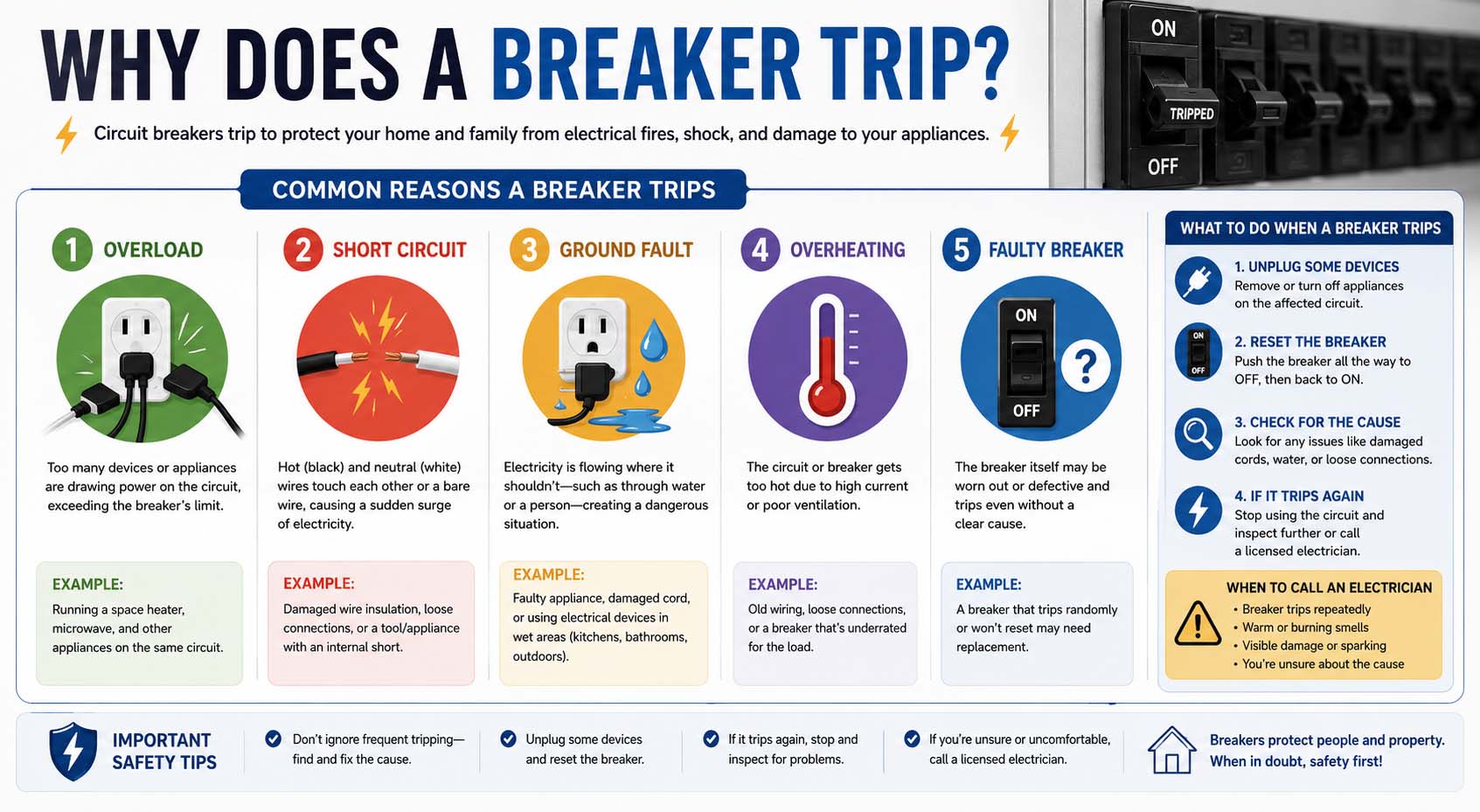
There isn’t just one answer to why does a circuit breaker trip. Several different conditions can activate the protection system.
Circuit Overload
The most common cause is an overloaded circuit.
Every breaker is rated to carry a maximum amount of current. When too many devices run on the same circuit at the same time, the total electrical demand exceeds that limit.
For example, plugging a portable heater, microwave, coffee maker, and toaster into outlets served by the same breaker can easily overload the circuit.
Common overload symptoms include:
- Breaker trips after several minutes
- Lights dim before power shuts off
- Warm outlets or extension cords
- Breaker resets normally after reducing the electrical load
Short Circuit
A short circuit happens when electricity follows an unintended path with very little resistance.
Instead of flowing through the appliance, current bypasses the normal load and increases dramatically within a fraction of a second.
Because this creates dangerous heat almost instantly, breakers disconnect power immediately.
Signs of a short circuit include:
- Breaker trips instantly
- Burn marks near outlets
- Burning smell
- Sparking
- Melted insulation
Short circuits should always be investigated before resetting the breaker repeatedly.
Ground Fault
Ground faults occur when electricity escapes the intended circuit and flows directly to ground.
This often happens when damaged insulation allows a live wire to contact a grounded metal surface or when moisture creates an unintended path for electrical current.
Ground faults can be dangerous because they increase the risk of electric shock.
Why Does a GFCI Breaker Trip?
Many kitchens, bathrooms, garages, outdoor outlets, and unfinished basements use Ground Fault Circuit Interrupter (GFCI) breakers for extra protection.
If you’ve asked why does a GFCI breaker trip, the answer usually involves current leaking somewhere outside the intended electrical path.
Unlike standard breakers that mainly monitor current levels, GFCI breakers compare the current leaving and returning through the circuit.
Even a small difference may indicate electricity is escaping through water, damaged insulation, or even a person. When that happens, the breaker disconnects power almost instantly.
Common causes include:
- Wet outlets
- Water-damaged appliances
- Outdoor extension cords
- Damaged wiring
- Faulty electrical tools
Although GFCI trips can seem inconvenient, they provide valuable protection against electrical shock.
Why Does a Ground Fault Breaker Trip?
People often use the terms “ground fault breaker” and “GFCI breaker” interchangeably because both are designed to detect ground faults and quickly shut off power to help prevent electrical shock.
So, why does a ground fault breaker trip?
The breaker detects an imbalance between the outgoing and returning electrical current. Even a difference of just a few milliamps is enough to trigger the safety mechanism.
Unlike overload protection, which allows temporary high current, ground fault protection reacts very quickly because human safety is the priority.
Why Does a Breaker Trip When It Rains?
One of the more confusing problems homeowners experience is why does a breaker trip when it rains.
Rain itself doesn’t overload electrical circuits. Instead, moisture creates conditions that increase the chance of electrical leakage or short circuits.
Possible causes include:
- Water entering outdoor outlets
- Damaged exterior wiring
- Wet junction boxes
- Moisture inside landscape lighting
- Cracked conduit allowing water intrusion
If your breaker only trips during or shortly after rain, the issue is often outside rather than inside your home.
An electrician can inspect outdoor electrical equipment to locate the source of moisture.
How to Troubleshoot a Tripping Breaker Safely
Before resetting the breaker, try identifying what caused it to trip.
Follow these steps carefully.
Step 1: Unplug Connected Devices
Disconnect appliances connected to the affected circuit.
Large appliances, portable heaters, and power tools are common causes of overloads.
Step 2: Reset the Breaker
Move the breaker fully to the OFF position before switching it back to ON.
Many people miss this step because the handle often sits midway after tripping.
Step 3: Restore Devices One at a Time
Reconnect appliances individually.
If the breaker trips after plugging in one specific device, that appliance may have an internal electrical fault.
Step 4: Watch for Repeat Trips
If the breaker trips again with little or no electrical load, avoid resetting it repeatedly.
Frequent trips often indicate wiring problems that require professional diagnosis.
Understanding Electrical Load
Every appliance draws electrical power based on its wattage.
Knowing how to calculate watts helps estimate whether a circuit is approaching its maximum capacity. For example, several high-power appliances operating simultaneously can exceed the breaker’s rating even though each device works normally on its own.
Learning to estimate electrical load can prevent overloads before they happen and helps homeowners distribute appliances more evenly across available circuits.
Could the Breaker Itself Be Faulty?
Although breakers are designed to last for many years, they don’t last forever. Heat, age, repeated tripping, and electrical wear can eventually reduce their reliability.
A faulty breaker may show signs such as:
- Tripping with little or no electrical load
- Refusing to reset
- Feeling unusually hot
- Visible cracks or burn marks
- Loose connection in the electrical panel
If you suspect the breaker itself has failed, avoid replacing it unless you’re qualified to work inside an electrical panel. Contact a licensed electrician to inspect the circuit and confirm whether the breaker or another component is causing the problem.
How Faulty Appliances Cause Breaker Trips
Sometimes the wiring is perfectly fine, and the real problem is an appliance.
As electrical components wear out, damaged insulation, failing motors, or internal short circuits can draw excessive current. When that happens, the breaker disconnects power before the appliance overheats.
Common household items that may trip a breaker include:
- Portable space heaters
- Air conditioners
- Refrigerators
- Washing machines
- Microwaves
- Hair dryers
- Electric kettles
A simple way to narrow down the cause is to unplug every device on the affected circuit, reset the breaker, and reconnect each appliance one at a time.
Can a Weak Battery Cause Electrical Problems?
People occasionally wonder whether batteries contribute to breaker trips.
In most residential electrical systems, the answer is no. Standard household breakers protect AC wiring supplied by the utility, while batteries usually power low-voltage or backup systems.
If you’re interested in how stored electrical energy works, our guide on what is a battery charge explains how batteries store and deliver power in different electrical applications.
Preventing Future Breaker Trips
Many breaker trips can be avoided with a few simple habits.
Spread Out High-Power Appliances
Avoid running multiple high-wattage appliances on the same circuit at the same time.
For example, operating a space heater, vacuum cleaner, and portable air conditioner together can quickly overload a typical household circuit.
Inspect Power Cords
Damaged extension cords and worn power cables increase the risk of short circuits.
Replace cords that have:
- Cracked insulation
- Loose plugs
- Exposed wiring
- Burn marks
Keep Outdoor Electrical Equipment Dry
If breaker trips occur only during wet weather, inspect outdoor outlets and extension cords for moisture.
Weatherproof covers help reduce water intrusion and improve long-term reliability.
Schedule Periodic Electrical Inspections
Older homes often contain aging wiring that may no longer meet today’s electrical demands.
An inspection can identify overloaded circuits, loose connections, or outdated components before they become safety hazards.
Troubleshooting Checklist
Use this quick checklist to help identify the cause when a breaker trips unexpectedly.
| Check | Action |
|---|---|
| Too many appliances running? | Unplug some devices and reset the breaker. |
| Breaker trips immediately? | Look for a short circuit or damaged appliance. |
| Breaker trips only when it rains? | Inspect outdoor outlets and wiring for moisture. |
| Breaker feels hot? | Stop using the circuit and arrange an inspection. |
| Breaker won’t reset? | Leave it off and contact a licensed electrician. |
| Burn marks or unusual odors? | Turn off power and avoid using the circuit until it has been inspected. |
Working through these steps helps eliminate simple causes before assuming a major electrical fault.
Smart Breakers and Modern Electrical Protection
Newer homes may include smart circuit breakers that provide more than basic overload protection.
These devices can monitor electrical usage, detect abnormal current patterns, and even send alerts through a mobile app. Some models record trip history, making troubleshooting much easier.
Many smart electrical systems rely on electronic monitoring rather than purely mechanical operation. If you’d like to learn how electronic signals differ from traditional electrical methods, our article on analog vs digital provides a helpful introduction.
When to Call an Electrician
Some breaker trips are easy to resolve, while others require professional attention.
Call a qualified electrician if:
- The breaker trips repeatedly after resetting.
- You notice sparks or burning smells.
- The electrical panel feels unusually hot.
- Water has entered electrical equipment.
- Breakers trip without any appliances connected.
- Lights flicker throughout the house.
Ignoring these warning signs could allow a small electrical issue to become a much larger safety problem.
Frequently Asked Questions
Is it normal for a breaker to trip occasionally?
Yes. An occasional trip during an overload is normal because the breaker is protecting the circuit from excessive current.
Should I keep resetting a breaker?
No. If the breaker continues to trip, resetting it repeatedly won’t solve the underlying problem. Find the cause before restoring power again.
Can a breaker trip without an overload?
Yes. Short circuits, ground faults, damaged wiring, faulty appliances, and worn breakers can all cause trips without exceeding the normal electrical load for very long.
Can weather affect circuit breakers?
Yes. Rain, humidity, and water intrusion can create ground faults or short circuits, especially in outdoor electrical equipment.
How long do circuit breakers last?
Many breakers operate reliably for 25 to 40 years, although heavy use, repeated overloads, and environmental conditions can shorten their lifespan.
Understanding Heat and Electrical Protection
Heat plays a major role in how many circuit breakers operate. Traditional thermal breakers use a bimetallic strip that bends as it warms, eventually opening the circuit when excessive current generates too much heat.
The same relationship between temperature and electrical systems appears in many industrial devices. For example, how does a thermocouple work explains how temperature changes can be measured accurately using two different metals, although thermocouples serve a measurement role rather than providing circuit protection.
Keep Your Electrical System Safe
Knowing why does a breaker trip helps you respond calmly when the power suddenly goes out. In many situations, the breaker has detected an overload, short circuit, or ground fault exactly as it was designed to do.
Start by reducing the electrical load, checking connected appliances, and inspecting for obvious signs of damage. If the breaker continues to trip or you notice burning smells, scorch marks, or water around electrical equipment, stop using the affected circuit and arrange a professional inspection.
A circuit breaker is one of the most valuable safety devices in your home. Treat every unexpected trip as a warning worth investigating, and you’ll reduce the risk of damaged equipment, electrical fires, and costly repairs in the future.