
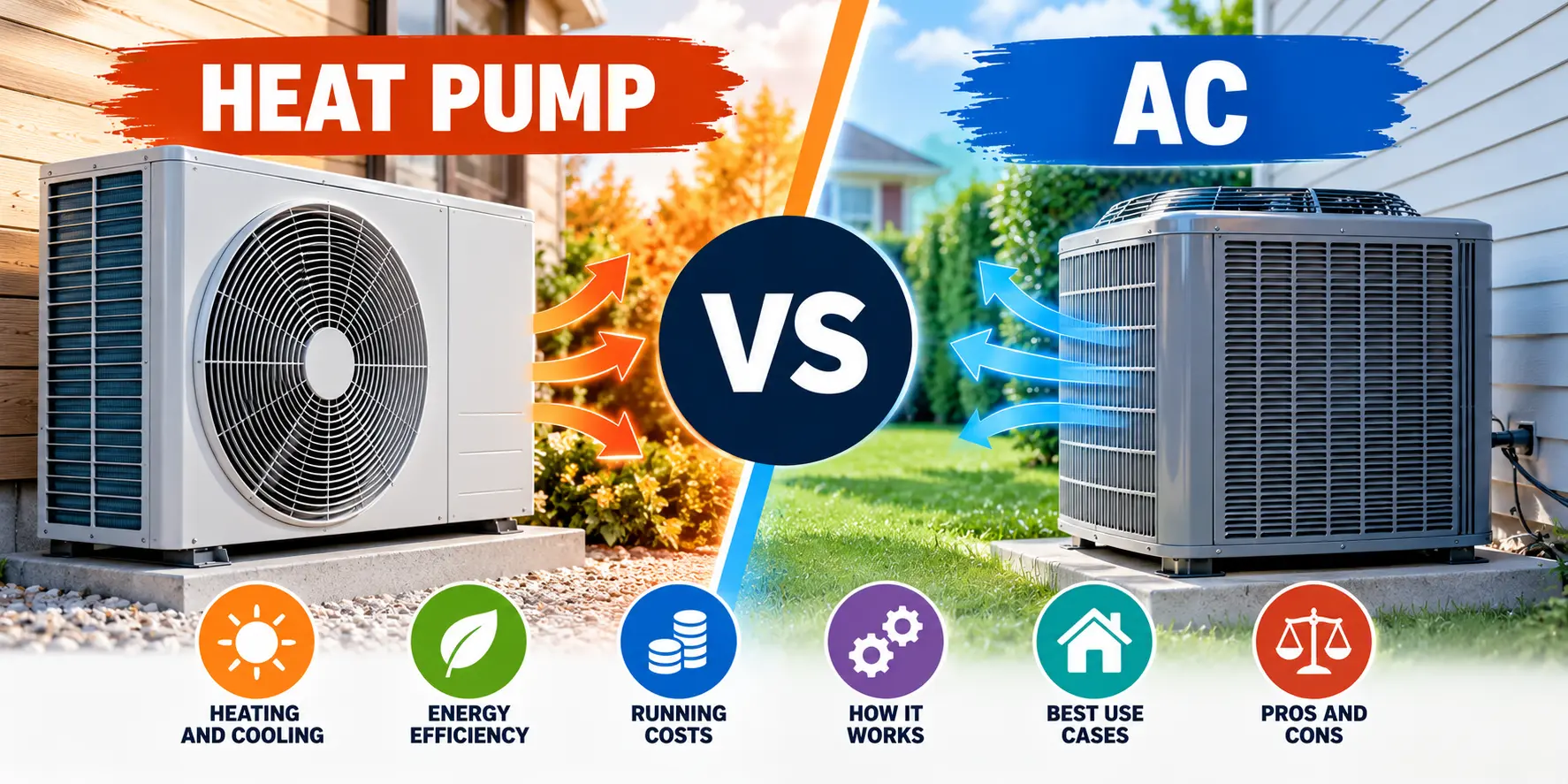
Choosing between a heat pump vs AC system can feel confusing, especially when both appliances look almost identical from the outside. While both systems cool your home, their biggest difference is what happens when temperatures drop.
A standard central air conditioner provides cooling only. In contrast, a heat pump can cool your home during summer and provide heating during colder months.
However, that doesn’t automatically make a heat pump the best option for every household.
Your climate, existing heating equipment, electricity rates, installation budget, and home insulation all influence which system makes more sense.
For example, a homeowner in a mild climate may benefit from a heat pump’s year-round functionality. Meanwhile, someone with a reliable furnace may prefer replacing only their air conditioner.
This guide explains how both technologies work, compares their efficiency and costs, and helps you choose the right heating and cooling system for your home.
Heat Pump vs AC: What’s the Main Difference?
The main difference between a heat pump and an air conditioner is their ability to provide heating.
Both systems use refrigerant, a compressor, and heat exchangers to move heat between indoor and outdoor environments.
However, a heat pump includes components that allow the refrigeration cycle to reverse.
As a result, it can transfer heat outdoors during summer and bring heat indoors during winter.
A conventional air conditioner only operates in cooling mode.
Here’s a quick comparison:
| Feature | Heat Pump | Air Conditioner |
|---|---|---|
| Cooling | Yes | Yes |
| Heating | Yes | No |
| Refrigeration cycle | Reversible | Cooling only |
| Summer efficiency | Depends on model | Depends on model |
| Winter operation | Provides heating | Requires separate heater |
| Installation cost | Often higher than comparable AC alone | Often lower than comparable heat pump |
| Best suited for | Combined heating and cooling | Cooling with separate heating |
| Maintenance | Heating and cooling components | Cooling components |
Therefore, the better choice depends on whether you need cooling alone or a complete heating and cooling solution.
How Does an AC Work Compared to a Heat Pump?
An air conditioner removes heat from indoor air and releases it outside.
First, warm indoor air passes over a cold evaporator coil.
The refrigerant inside the coil absorbs heat, while moisture may condense from the air.
Next, the compressor raises the refrigerant’s pressure and temperature.
The outdoor condenser then releases the collected heat into the surrounding air.
Finally, the refrigerant passes through an expansion device before repeating the cycle.
If you’re wondering how does an air conditioner work, understanding this refrigeration process explains why an AC cools indoor spaces without producing cold air directly.
However, conventional central air conditioners cannot reverse the cycle to provide heating.
Therefore, homes with standard AC systems typically need a furnace or another separate heating source.
How Does a Heat Pump Work Compared to AC?
A heat pump uses nearly the same refrigeration technology as an air conditioner.
However, it includes a reversing valve that changes the direction of refrigerant flow.
The U.S. Department of Energy’s guide to air-source heat pumps explains how these systems transfer heat and provide both heating and cooling.
Heat Pump Cooling Mode
During summer, the heat pump absorbs heat from indoor air and transfers it outside.
Consequently, it performs much like a conventional air conditioner.
Heat Pump Heating Mode
During winter, the refrigeration cycle reverses.
The outdoor heat exchanger absorbs thermal energy from the surrounding air.
Next, the compressor raises the refrigerant temperature, allowing heat to transfer indoors.
Even cold outdoor air can contain usable thermal energy.
However, heating capacity and efficiency generally decrease as outdoor temperatures fall.
Some systems also use electric resistance backup heating during particularly cold conditions.
Heat Pump vs AC Cost: Which Is More Expensive?
When comparing heat pump vs ac cost, consider both the initial installation expense and long-term operating costs.
Although heat pumps often cost more upfront than comparable cooling-only units, they may reduce the need for separate heating equipment.
Heat Pump vs AC Installation Costs
A conventional central air conditioner generally costs less than a comparable air-source heat pump when comparing the cooling equipment alone.
However, installation prices vary depending on:
- Equipment capacity
- Efficiency rating
- Brand and model
- Ductwork condition
- Electrical requirements
- Local labor costs
- Existing heating equipment
For example, replacing an AC while keeping an existing furnace may be relatively straightforward.
Meanwhile, switching to a heat pump could require electrical upgrades, control changes, or backup heating modifications.
Therefore, compare complete installation quotes rather than equipment prices alone.
Heat Pump and AC Long-Term Ownership Costs
Heat pumps can offer lower heating costs than electric resistance systems because they transfer heat rather than generating it directly.
However, savings compared with natural gas furnaces depend on local electricity and fuel prices.
Similarly, cooling expenses depend on the efficiency of the specific models being compared.
A high-efficiency AC may outperform a less efficient heat pump during summer.
Heat Pump vs AC Monthly Cost: What Affects Your Bill?
The heat pump vs ac monthly cost comparison depends heavily on how much heating and cooling your home requires.
For example, during summer, two systems with similar cooling efficiency ratings may use comparable amounts of electricity.
However, winter costs differ because a heat pump provides heating while an AC requires another heating system.
Consider this simplified cooling example:
Suppose one system consumes 2 kW of electricity while operating.
If it runs for six hours daily, electricity consumption equals:
2 kW × 6 hours = 12 kWh per day
Over 30 days:
12 × 30 = 360 kWh
At $0.20 per kWh, the estimated monthly cost would be:
360 × $0.20 = $72
However, actual systems cycle on and off or adjust compressor speed, so real consumption varies.
Also, remember that this example covers cooling electricity only, not heating or other household energy use.
Heat Pump vs Air Conditioner Efficiency
Neither technology automatically wins every efficiency comparison.
Instead, efficiency depends on equipment design, operating conditions, and the relevant performance rating.
Cooling Efficiency and SEER2 Ratings
In the United States, central cooling systems commonly use SEER2 ratings.
A higher SEER2 rating generally indicates better seasonal cooling efficiency under standardized test conditions.
Therefore, compare actual model ratings rather than assuming one technology is always superior.
Heating Efficiency and HSPF2 Ratings
Heat pumps commonly use HSPF2 ratings to describe seasonal heating performance.
Higher HSPF2 values generally indicate better heating efficiency under the relevant test conditions.
However, local climate still affects real-world performance.
Temperature Differences
HVAC technicians often measure temperature differences to assess system operation.
For example, understanding what is delta t helps explain how technicians compare supply and return air temperatures during heating or cooling checks.
Nevertheless, temperature differences alone cannot establish a system’s overall efficiency or diagnose every problem.
Heat Pump vs AC Unit: Installation and Equipment Differences
When comparing a heat pump vs ac unit, you’ll notice that their outdoor cabinets often look similar.
Both usually contain a compressor, fan, and outdoor heat exchanger.
However, heat pumps require extra components to support reversible operation.
Reversing Valve
A reversing valve changes refrigerant flow direction.
Consequently, the system can switch between heating and cooling.
Defrost System
During cold, humid weather, frost may accumulate on a heat pump’s outdoor coil.
Therefore, many systems periodically enter a defrost cycle to remove ice.
Temporary steam or changes in operating sound can be normal during this process.
Thermostat Compatibility
Heat pumps need controls that support heating, cooling, and potentially auxiliary heating.
If you’re curious about what is a temperature controller, understanding thermostat operation can help you recognize how HVAC systems maintain indoor comfort.
However, not every conventional AC thermostat supports all heat pump functions.
Heat Pumps in Cold Climates
A common misconception is that heat pumps stop working whenever outdoor temperatures fall below freezing.
In reality, many modern cold-climate air-source heat pumps can provide heating at temperatures well below 0°C.
However, performance varies significantly between models.
Therefore, homeowners in colder regions should compare manufacturer heating capacity at low outdoor temperatures.
Some installations also include backup heating for extreme weather or peak demand.
What About Geothermal Systems?
A geothermal heat pump transfers heat between a building and the ground or a ground-connected water loop.
Because underground temperatures are relatively stable, these systems can provide efficient heating and cooling across different seasons.
However, installation usually requires ground loops, suitable property conditions, and a higher initial investment.
For most homeowners comparing conventional AC systems, air-source heat pumps are the more direct alternative.
Heat Pump vs Furnace and AC Combination
Many homes use a central air conditioner for summer cooling and a furnace for winter heating.
This arrangement can work well, particularly when the furnace is already efficient and reliable.
However, installing a heat pump may provide an alternative heating source.
Traditional Furnace and AC
A furnace produces heat using natural gas, propane, oil, or electricity, depending on the model.
Meanwhile, the air conditioner handles cooling separately.
If you’re unfamiliar with furnace operation, learning how does a furnace work can clarify why its heating process differs from a heat pump’s heat-transfer cycle.
Dual-Fuel Systems
Some homes combine a heat pump with a gas furnace.
During moderate weather, the heat pump handles heating.
However, the system can switch to furnace heating when outdoor conditions or operating costs make that preferable.
As a result, dual-fuel setups may offer flexibility in colder climates.
Advantages and Disadvantages of Heat Pumps
Heat pumps offer several benefits, but they also have limitations.
Advantages
- Provide both heating and cooling
- Can reduce heating electricity consumption compared with resistance heaters
- Support efficient year-round temperature control
- May eliminate the need for a separate heating system
- Available with variable-speed technology
- Can reduce on-site combustion when replacing fuel-burning heating
Disadvantages
- Often have higher upfront costs than cooling-only AC equipment
- Heating performance varies with outdoor temperature
- May require backup heating in some climates
- Can need electrical or thermostat upgrades
- Require professional installation and maintenance
Therefore, evaluate your complete heating and cooling needs before purchasing.
When Is an Air Conditioner the Better Choice?
A conventional AC may be the better option when your existing heating system already meets your needs.
For example, replacing only the cooling equipment may be more affordable than changing the entire HVAC arrangement.
An air conditioner may also make sense when:
- Your home rarely requires heating
- You already own a reliable furnace
- Installation costs strongly favor AC replacement
- Local fuel prices make your current heating system economical
- You prefer maintaining separate heating and cooling equipment
However, always compare available equipment efficiency ratings and installation quotes.
Common Heat Pump and AC Problems
Both technologies require regular maintenance to operate effectively.
Fortunately, several common issues can be identified through basic checks.
Weak Cooling
Dirty filters, restricted airflow, or incorrect thermostat settings may reduce cooling performance.
First, inspect accessible filters and thermostat settings.
If the problem continues, contact an HVAC technician.
Unexpectedly High Electricity Bills
Higher energy consumption may result from extreme weather, poor insulation, dirty coils, or equipment problems.
For heat pumps, frequent auxiliary resistance heating can also increase electricity use.
Therefore, review thermostat settings and schedule professional maintenance when necessary.
Outdoor Unit Freezing
Some frost on a heat pump during heating operation can be normal.
However, heavy ice that remains after defrost cycles may indicate an airflow, control, or refrigeration problem.
Avoid manually breaking ice or opening sealed refrigeration components.
Frequent Cycling
Short operating cycles can result from thermostat issues, equipment sizing problems, or other faults.
Consequently, repeated cycling deserves professional inspection.
Frequently Asked Questions
Is a Heat Pump Better Than an AC?
A heat pump may be better if you need both heating and cooling. However, a conventional AC can be a practical choice when you already have an effective heating system.
Does a Heat Pump Cool as Well as an Air Conditioner?
Yes. A properly sized heat pump can provide cooling comparable to an AC with similar performance specifications.
Are Heat Pumps More Expensive to Repair?
Repair costs depend on the failed component, equipment model, warranty, and labor rates. Because heat pumps contain additional heating-related components, some repairs may be more involved.
Can I Replace My AC With a Heat Pump?
Often, yes. However, a qualified HVAC contractor should assess ductwork, electrical capacity, indoor equipment compatibility, and heating requirements.
Do Heat Pumps Last as Long as Air Conditioners?
Service life varies with climate, usage, maintenance, and equipment quality. Because heat pumps may operate during both heating and cooling seasons, they can accumulate more annual operating hours than cooling-only equipment.
Which HVAC System Should You Choose?
The best choice depends on your home’s heating requirements, climate, and long-term energy costs.
If you want one system for heating and cooling, a properly selected heat pump may offer convenience and efficient operation.
However, if your existing furnace works well and you only need cooling, replacing the AC may be more economical.
Before deciding, request comparable installation quotes, check efficiency ratings, and ask contractors to calculate your home’s heating and cooling loads.
That way, you can choose equipment based on actual performance and ownership costs rather than assumptions.