
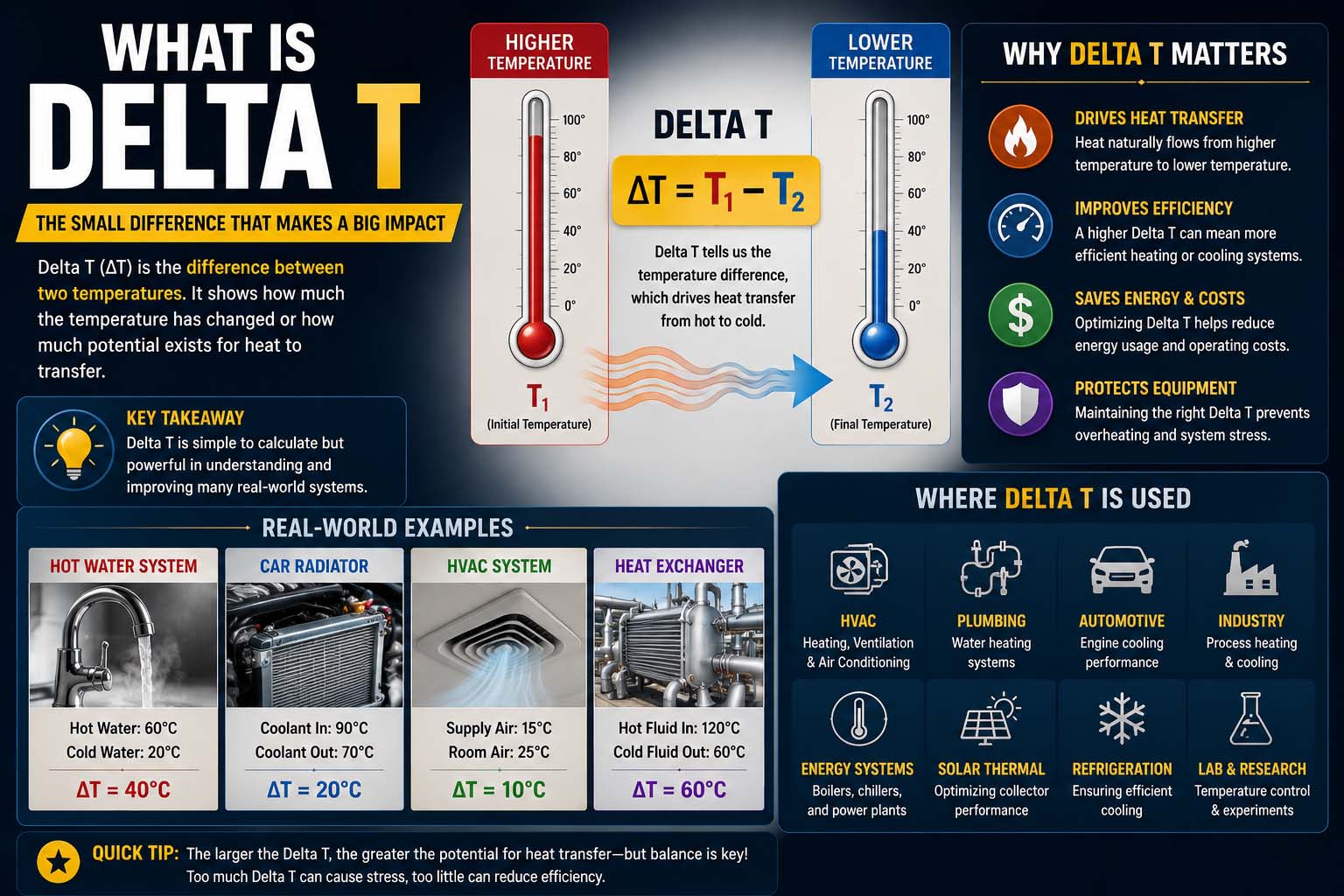
What is Delta T? Delta T (ΔT) represents the difference between two temperatures. It shows how much temperature increases or decreases between measurements. Therefore, it is an essential concept in HVAC systems, physics, refrigeration, and engineering.
Although the Greek letter delta may look complicated, its meaning is straightforward. The symbol Δ represents a change or difference, while T stands for temperature.
For example, if a room warms from 60°F to 75°F, its temperature increases by 15°F. Engineers and technicians use this information to study heat transfer, evaluate equipment performance, and investigate potential operating problems.
However, a temperature difference alone does not determine whether equipment is operating efficiently. Other factors, including airflow, humidity, and system design, also matter.
This guide explains the formula, practical calculations, HVAC applications, and common measurement mistakes.
Delta T Meaning: Quick Reference
| Term | Meaning |
|---|---|
| Delta (Δ) | Change or difference |
| T | Temperature |
| Delta T (ΔT) | Difference between two temperature readings |
| Formula | ΔT = Final Temperature − Initial Temperature |
| Positive result | Temperature increased |
| Negative result | Temperature decreased |
| Applications | HVAC, physics, refrigeration, and engineering |
Temperature difference is often one part of a larger engineering calculation. For example, understanding How to Calculate Watts helps explain how engineers evaluate electrical power alongside thermal-system performance.
Similarly, learning what is a KW provides useful context for comparing power measurements with energy consumption in heating and cooling equipment.
What Does Delta T Mean?
Delta T describes a temperature change or the difference between two measurement points.
In mathematics and physics, the symbol Δ indicates a change in a quantity. Therefore, ΔT specifically represents a change in temperature.
For example, consider these readings:
- Starting temperature: 60°F
- Ending temperature: 75°F
- Temperature change: +15°F
The calculation is:
ΔT = 75°F − 60°F = +15°F
The positive result shows that the temperature increased.
However, the same formula also works when temperature decreases.
Suppose water cools from 35°C to 20°C.
ΔT = 20°C − 35°C = −15°C
In this case, the negative sign indicates cooling. Meanwhile, the magnitude of the temperature difference is 15°C.
Therefore, it is useful to distinguish a signed temperature change from an absolute difference.
Why Is Temperature Difference Important?
Temperature difference helps technicians and engineers understand how heat moves through a system.
For instance, an air conditioner removes heat from indoor air, while a furnace adds heat to it. Comparing temperatures before and after the equipment provides useful performance information.
Engineers also use these measurements to evaluate:
- Air conditioning performance.
- Furnace temperature rise.
- Heat exchanger operation.
- Refrigeration systems.
- Engine cooling.
- Industrial temperature control.
However, a larger temperature difference does not automatically mean greater efficiency.
Airflow, fluid flow, humidity, equipment capacity, and operating conditions also affect performance. As a result, technicians combine temperature measurements with other diagnostic information.
How to Calculate Delta T
The basic calculation requires two temperature readings.
ΔT = Final Temperature − Initial Temperature
To calculate the result, subtract the starting temperature from the ending temperature.
Example 1: Temperature Increase
Suppose a laboratory sample warms from 22°C to 32°C.
- Initial temperature: 22°C
- Final temperature: 32°C
ΔT = 32°C − 22°C = +10°C
Therefore, the sample experienced a temperature increase of 10°C.
Example 2: Temperature Decrease
Now imagine that water cools from 40°C to 25°C.
ΔT = 25°C − 40°C = −15°C
The negative result indicates a temperature decrease. Meanwhile, the absolute difference between the readings is 15°C.
Example 3: Air Conditioning Temperature Difference
An air conditioner receives return air at 75°F and delivers supply air at 55°F.
The signed change from return air to supply air is:
ΔT = 55°F − 75°F = −20°F
However, HVAC technicians commonly report the cooling temperature split as a positive magnitude.
Cooling temperature split = 75°F − 55°F = 20°F
Both calculations describe the same temperature difference. The distinction depends on whether you want the signed change or its magnitude.
What Is Delta T in HVAC?
In heating, ventilation, and air conditioning, Delta T commonly refers to the temperature difference between air entering and leaving equipment.
Technicians use this measurement during installation, maintenance, and troubleshooting.
For example, an air conditioner should deliver cooler air than it receives. Similarly, a furnace should deliver warmer air than the return air entering its heat exchanger.
However, the expected temperature difference depends on the system’s design and operating conditions.
Cooling System Temperature Split
In a typical central air conditioning system, technicians compare return-air and supply-air temperatures.
For example:
- Return air: 76°F
- Supply air: 57°F
Cooling temperature split = 76°F − 57°F = 19°F
Therefore, the supply air is 19°F cooler than the return air.
This measurement can help assess cooling performance. Nevertheless, it cannot establish the system’s overall efficiency or identify a refrigerant problem by itself.
Heating System Temperature Rise
For a furnace, technicians measure the air temperature before and after heating.
For example:
- Return air: 68°F
- Supply air: 112°F
Temperature rise = 112°F − 68°F = 44°F
The furnace raises the air temperature by 44°F.
However, technicians should compare this result with the manufacturer’s specified temperature-rise range rather than relying on a universal target.
Temperature Sensors in HVAC Equipment
Modern HVAC equipment often uses temperature sensors to monitor operating conditions.
These sensors convert temperature changes into electrical signals that control systems can interpret.
For example, understanding What Is a Transducer helps explain how measurement devices convert physical quantities into signals for monitoring and control.
Likewise, learning what is instrumentation provides a broader understanding of how sensors, transmitters, and controllers work together in industrial systems.
As a result, automated equipment can respond to changing temperatures and maintain suitable operating conditions.
What Is a Good Delta T in HVAC?
A good temperature difference depends on the type of HVAC equipment, airflow, humidity, and manufacturer specifications.
For many conventional residential air conditioning systems, technicians often use approximately 16°F to 22°F as an initial cooling temperature-split reference under typical conditions.
However, this range is not a universal pass-or-fail standard.
For example, high indoor humidity can change the temperature split because the cooling coil removes both sensible heat and moisture.
Likewise, airflow problems can alter supply-air temperatures.
Factors That Affect Normal HVAC Readings
Several conditions influence the expected result:
- Equipment type and capacity.
- Indoor humidity.
- Return-air temperature.
- Airflow across the coil.
- Refrigerant system operation.
- Duct leakage and insulation.
- Manufacturer operating specifications.
Therefore, technicians should evaluate the complete system before deciding whether a reading indicates a fault.
For heating equipment, the acceptable temperature-rise range may appear on the manufacturer’s data plate or in its service documentation.
Why HVAC Technicians Measure Temperature Difference
Temperature measurements offer a quick way to identify unusual system behavior.
For instance, a technician may notice that an air conditioner produces only a small difference between return and supply air.
That observation could justify further checks of airflow, coil condition, refrigerant operation, or compressor performance.
On the other hand, an unusually large temperature split may suggest restricted airflow in some systems.
Common issues that deserve inspection include:
- Dirty air filters.
- Restricted ducts.
- Dirty evaporator coils.
- Blower problems.
- Refrigerant system faults.
- Incorrect equipment settings.
The U.S. Department of Energy’s air conditioner maintenance guidance explains why clean filters, coils, and proper airflow matter for cooling-system performance.
However, temperature difference alone cannot confirm the cause of a problem.
What Is Delta T in Physics?
In physics, ΔT represents a change in temperature when T denotes temperature.
Scientists use this quantity in thermodynamics, calorimetry, and heat transfer calculations.
For example, a common equation is:
Q = mcΔT
Where:
- Q = Heat transferred.
- m = Mass of the substance.
- c = Specific heat capacity.
- ΔT = Change in temperature.
This equation describes sensible heat transfer when the material’s specific heat capacity remains approximately constant and no phase change occurs.
Example: Heating Water
Suppose water warms from 25°C to 40°C.
ΔT = 40°C − 25°C = 15°C
Therefore, the temperature increases by 15°C.
If you know the water’s mass and specific heat capacity, you can calculate the approximate heat energy transferred.
Celsius, Fahrenheit, and Kelvin Differences
Temperature differences do not require the same conversion rules as absolute temperatures.
For example:
- A change of 1°C equals a change of 1 K.
- A change of 1°C equals a change of 1.8°F.
- A change of 10°C equals a change of 18°F.
Therefore, a 15°C temperature difference also equals 15 K or 27°F.
However, this relationship applies to temperature intervals, not absolute temperature readings.
Delta T and Other Engineering Measurements
Temperature calculations often appear alongside electrical and mechanical measurements.
For example, understanding What Is Impedance can help engineering students distinguish thermal quantities from electrical opposition in AC circuits.
Although the measurements describe different physical properties, both play important roles in engineering analysis.
Delta T in Heat Transfer
Heat naturally flows from warmer regions toward cooler regions when a temperature difference exists.
Therefore, the difference between temperatures helps determine the driving force for heat transfer.
For example, a hot radiator transfers heat to cooler surrounding air.
Similarly, a refrigerator removes heat from its interior and releases that energy into the surrounding environment.
How Temperature Difference Affects Heat Flow
Under otherwise identical conditions, a larger temperature difference generally increases the rate of heat transfer.
However, other factors also matter.
These include:
- Surface area.
- Material thermal conductivity.
- Insulation thickness.
- Air or fluid movement.
- Heat exchanger design.
For example, adding insulation reduces heat transfer even when the temperature difference remains unchanged.
As a result, engineers consider both temperature and thermal resistance when designing equipment.
Common Applications of Temperature Difference
Many industries rely on temperature measurements to control equipment and maintain operating conditions.
HVAC Systems
Heating and cooling technicians compare supply and return temperatures.
For example, they may use these readings to investigate unusual heating or cooling performance.
Refrigeration
Refrigeration systems use temperature measurements to evaluate evaporator and condenser operation.
However, technicians also need pressure, airflow, and refrigerant information for reliable diagnosis.
Manufacturing
Manufacturers monitor temperature changes during production.
For instance, heating and cooling stages can influence material properties and product quality.
Power Plants
Power plants use temperature measurements to assess heat exchangers and cooling systems.
Consequently, engineers can monitor thermal conditions and identify performance changes.
Automotive Cooling Systems
Vehicle cooling systems transfer engine heat into coolant and surrounding air.
Therefore, technicians may compare coolant temperatures at different points when evaluating heat transfer.
For example, understanding what a radiator does in a car can help explain how coolant and surrounding air exchange heat.
Electric vehicles also require careful battery temperature management. Understanding What Is a Battery Charge provides useful context for how charging and operating conditions relate to battery performance.
Food Processing
Food processing facilities monitor heating and cooling temperatures.
For example, controlled temperature changes help operators manage cooking, chilling, and other production processes.
Delta T vs Actual Temperature
Actual temperature and temperature difference describe different quantities.
| Actual Temperature | Delta T |
|---|---|
| Describes a temperature at one point | Compares two temperature readings |
| Requires one measurement | Requires two measurements |
| Example: 72°F | Example: 18°F difference |
| Indicates a thermal condition | Indicates a change or separation |
For example, a room may have an actual temperature of 72°F while its cooling system produces an 18°F supply-to-return temperature difference.
Therefore, the two values describe different aspects of the same environment.
Step-by-Step Guide to Measuring Delta T
Accurate measurements require suitable instruments and consistent procedures.
Step 1: Select the Measurement Points
First, identify the two locations you want to compare.
For HVAC equipment, these may be return-air and supply-air locations.
However, choose locations that represent the equipment’s actual inlet and outlet conditions.
Step 2: Measure the First Temperature
Next, use a suitable thermometer or temperature probe.
Record the reading and its unit.
Step 3: Measure the Second Temperature
Then, take the second reading with the same temperature unit.
Whenever possible, measure both points under stable operating conditions.
Step 4: Calculate the Difference
Subtract the first temperature from the second.
ΔT = T₂ − T₁
If you only need the magnitude, use the absolute value of the result.
Step 5: Interpret the Reading
Finally, compare the result with the expected operating conditions.
For example, HVAC technicians should consider manufacturer specifications, airflow, and humidity.
A single reading may not provide enough information for a complete diagnosis.
What Can Affect Delta T?
Several factors influence temperature differences in real systems.
Airflow and Fluid Flow
Airflow changes how much heat a system transfers to or from moving air.
For example, restricted airflow can produce an unusually large temperature rise across some heating systems.
However, the relationship depends on equipment type and operating conditions.
Ambient Temperature
Outdoor and surrounding temperatures influence many heating and cooling systems.
Therefore, equipment may behave differently during extreme weather.
Humidity
Humidity affects air conditioning performance because cooling systems may remove moisture as well as sensible heat.
As a result, temperature readings alone cannot describe the full cooling load.
Insulation and Heat Loss
Insulation limits unwanted heat transfer.
For example, poorly insulated ducts can gain or lose heat before air reaches a measurement point.
Equipment Condition
Dirty coils, blocked filters, and mechanical faults can affect system operation.
Consequently, regular maintenance helps keep measurements more consistent.
Troubleshooting Low or High Delta T
Unexpected readings can indicate an operating problem. However, the correct interpretation depends on the system.
Low Cooling Temperature Difference
A lower-than-expected cooling split may occur because of:
- Excessive airflow.
- Refrigerant system problems.
- Compressor performance issues.
- High latent cooling load.
- Measurement errors.
For example, an air conditioner operating in a humid environment may devote substantial capacity to moisture removal.
Therefore, a lower sensible temperature split does not automatically indicate a mechanical fault.
High Cooling Temperature Difference
A higher-than-expected cooling split may occur with:
- Restricted airflow.
- Dirty air filters.
- Blocked return-air paths.
- Incorrect blower settings.
- Certain operating or humidity conditions.
However, an unusually high split does not necessarily mean the system provides better cooling.
Instead, technicians should examine airflow and other operating measurements.
When to Request Professional Inspection
If the system repeatedly produces unexpected readings, a qualified technician can perform additional tests.
These may include checking airflow, electrical operation, refrigerant conditions, and equipment controls.
As a result, the diagnosis will rely on more than one temperature measurement.
Best Practices for Accurate Temperature Measurements
Reliable results depend on consistent measurement methods.
Follow these practices:
- Use suitable, calibrated thermometers.
- Measure at consistent locations.
- Allow equipment to reach stable operation.
- Record temperature units clearly.
- Check airflow conditions.
- Compare readings with manufacturer specifications.
- Keep maintenance records.
- Repeat questionable measurements.
For example, measuring supply air too far from the equipment may introduce temperature changes caused by duct heat gain or loss.
Therefore, proper measurement placement matters.
Common Delta T Mistakes to Avoid
Beginners sometimes misinterpret temperature differences or overlook important conditions.
Common mistakes include:
- Confusing temperature difference with actual temperature.
- Ignoring negative signs in cooling calculations.
- Mixing Fahrenheit and Celsius readings.
- Measuring before equipment stabilizes.
- Assuming every HVAC system has the same target range.
- Ignoring humidity and airflow.
- Using inaccurate instruments.
- Treating one reading as a complete diagnosis.
For example, a 20°F cooling split may be reasonable in one system but unsuitable for another.
Therefore, context matters as much as the calculation itself.
Frequently Asked Questions
What Is Delta T?
It represents the difference between two temperatures. For example, if a surface warms from 20°C to 30°C, its temperature change is +10°C.
What Does Delta T Mean in HVAC?
In HVAC, it commonly describes the temperature difference between supply and return air.
For example, technicians use it to evaluate cooling or heating performance. However, they also consider airflow and equipment specifications.
What Is a Good Delta T in HVAC?
Many conventional residential cooling systems use approximately 16°F to 22°F as an initial reference range.
However, the expected value varies with equipment design, humidity, airflow, and operating conditions.
How Is Delta T Used in Physics?
Physics uses temperature change in heat transfer calculations.
For example, the equation Q = mcΔT relates heat energy to mass, specific heat capacity, and temperature change.
How Do You Calculate Temperature Difference?
Subtract the initial temperature from the final temperature.
ΔT = Final Temperature − Initial Temperature
A positive result indicates warming, while a negative result indicates cooling.
Can Delta T Be Negative?
Yes. A negative result means the final temperature is lower than the initial temperature.
For example, cooling from 30°C to 20°C produces a temperature change of −10°C.
Is Delta T the Same in Celsius and Kelvin?
For temperature differences, one degree Celsius equals one kelvin.
Therefore, a temperature change of 10°C is also a change of 10 K.
Does a Higher Delta T Mean Better HVAC Performance?
Not necessarily. A higher reading may reflect restricted airflow or other operating conditions.
Therefore, technicians must interpret the result alongside additional measurements.
Final Thoughts
Understanding what is Delta T gives you a practical way to interpret temperature changes in HVAC systems, physics, and engineering.
The basic calculation is straightforward: subtract the initial temperature from the final temperature. However, interpreting the result requires understanding the equipment and measurement conditions.
For example, HVAC technicians use temperature differences to evaluate heating and cooling operation, while scientists use them in thermal energy calculations.
By measuring temperatures accurately and considering the surrounding conditions, you can better understand heat transfer and recognize when equipment may need further inspection.