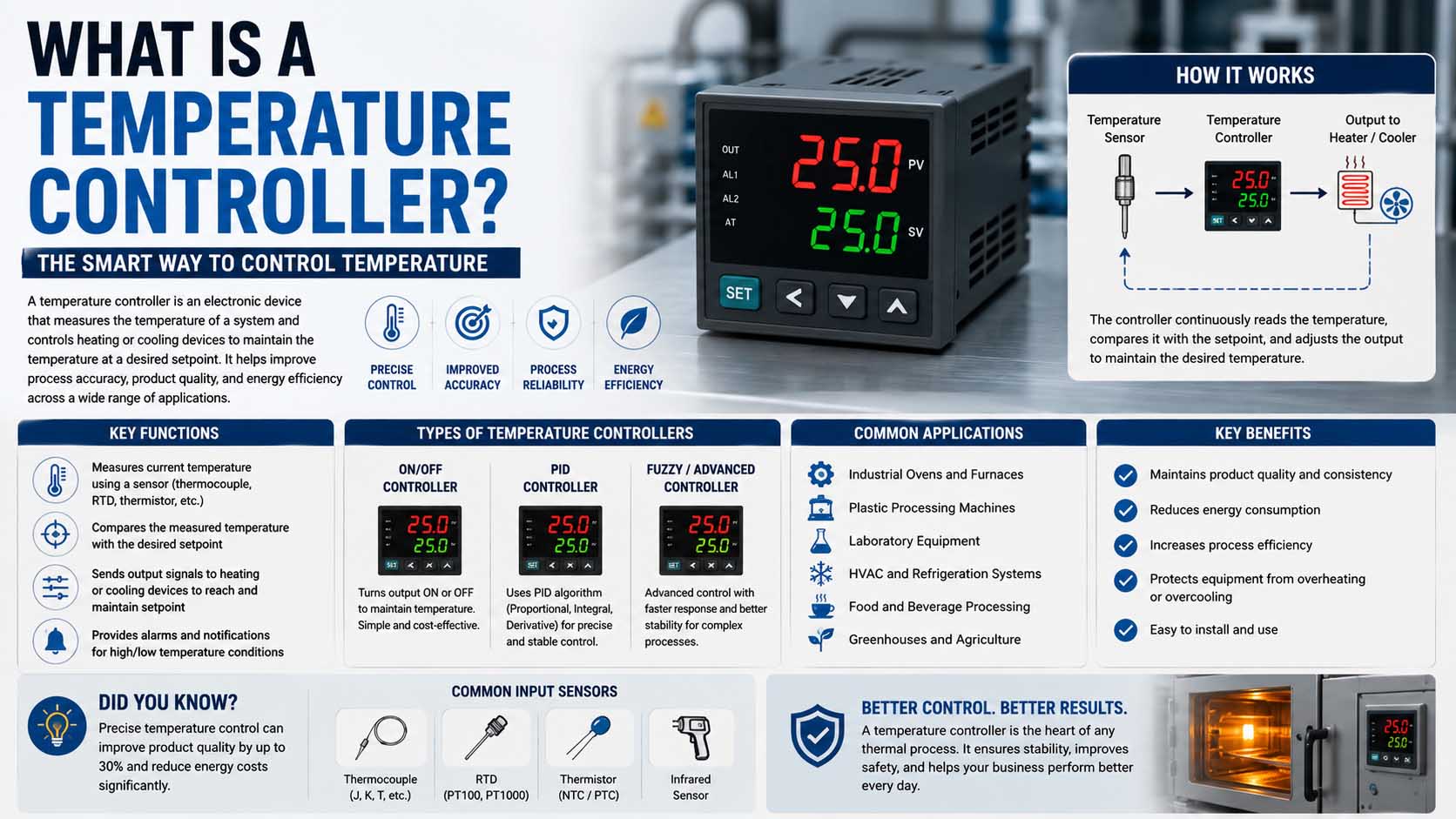
If you have ever wondered what is a temperature controller, the simplest answer is that it is a device that measures temperature and controls heating or cooling equipment to keep a process near a desired temperature. You can find temperature controllers in industrial ovens, refrigerators, laboratory equipment, manufacturing machines, HVAC systems, food-processing equipment, and many other applications.
Although the basic idea is simple, temperature controllers range from basic on/off units to advanced PID controllers capable of making small, continuous adjustments. Therefore, understanding the differences can help you select the right controller for a machine, project, or process.
What Is a Temperature Controller and What Does It Do?
A temperature controller is an electronic or electromechanical control device that receives information from a temperature sensor, compares the measured value with a target value, and then controls equipment that changes the temperature.
The target temperature is usually called the setpoint. Meanwhile, the temperature currently measured by the sensor is often called the process value, or PV.
For example, imagine an industrial oven with a setpoint of 180°C. If the sensor detects only 170°C, the controller can activate the heater. Then, as the temperature approaches 180°C, the controller changes or stops the heating command according to its control method.
As a result, the system can maintain a much more consistent temperature than equipment that simply runs continuously.
Temperature controllers are especially useful whenever excessive heating or cooling could affect product quality, energy use, equipment operation, or process consistency.
How Does a Temperature Controller Work?
Most temperature-control systems involve four basic parts: a sensor, controller, output device, and heating or cooling equipment.
First, the sensor measures the process temperature. Next, it sends a signal to the controller. The controller then compares that measurement with the selected setpoint and decides what output is needed.
Finally, the output controls another device, such as a heater, compressor, valve, fan, contactor, or solid-state relay.
Temperature sensor → Controller → Output → Heating/Cooling equipment → Process temperature
The cycle repeats continuously while the system operates.
Temperature sensors provide the measurement
A controller cannot regulate temperature accurately without knowing the current temperature. Therefore, the sensor is one of the most significant components in the system.
Common sensor types include thermocouples, resistance temperature detectors (RTDs), and thermistors.
Thermocouples are especially common in industrial applications because various thermocouple types can operate across different temperature ranges. If you want to understand the sensing side in more detail, learning how does a thermocouple work helps explain how temperature can be converted into an electrical signal.
However, the sensor and controller must be compatible. For instance, a controller configured for one sensor type may produce an incorrect reading when connected to another type.
The controller makes the decision
After receiving the sensor signal, the controller calculates the difference between the measured temperature and the setpoint. This difference is commonly known as the error.
Then, depending on its design, the controller decides whether to turn an output on or off or vary its output more gradually.
Consequently, the control method has a major effect on temperature stability.
Main Types of Temperature Controllers
Not every application needs sophisticated control. In fact, a simple thermostat-style controller can work perfectly well for some equipment. However, processes requiring tighter temperature regulation often benefit from more advanced control.
On/off temperature controllers
An on/off controller is one of the simplest options.
Suppose a heater needs to maintain approximately 100°C. When the temperature drops below a defined level, the controller switches the heater on. Once the temperature reaches or passes another threshold, it switches the heater off.
Usually, the controller uses a small differential or hysteresis range to prevent rapid switching.
This approach is affordable and straightforward. However, the process temperature normally moves somewhat above and below the desired value rather than remaining precisely at the setpoint.
Therefore, on/off control often works well when small temperature fluctuations are acceptable.
Proportional controllers
A proportional controller adjusts its output according to how far the process temperature is from the target.
For example, the controller may apply stronger heating when the measured temperature sits well below the setpoint. Then, as the process gets closer to the target, it reduces the control action.
As a result, proportional control can provide smoother operation than basic on/off control. Still, depending on the system, a small offset from the desired temperature can remain.
What Is a PID Temperature Controller?
If you’re researching industrial temperature control, you will probably encounter the question, what is a PID temperature controller?
PID stands for Proportional, Integral, and Derivative. Each part of the control algorithm responds to temperature error in a different way.
The proportional component responds to the current error. Meanwhile, the integral component considers accumulated error over time. Finally, the derivative component responds to how quickly the error is changing.
Working together, these three actions can provide stable and accurate temperature regulation when the controller is properly configured.
PID control is widely used for processes where large temperature swings are undesirable. Examples can include industrial ovens, laboratory systems, plastic-processing machinery, packaging equipment, and manufacturing processes.
Open-Loop vs Closed-Loop Temperature Control
Temperature controllers make the most sense when viewed as part of a control system.
In an open-loop system, equipment receives a command without continuously using feedback to determine whether the target condition has actually been achieved.
A closed-loop system, by comparison, measures the result and feeds that information back into the controller. Therefore, a typical sensor-based temperature controller operates as part of a closed-loop system.
Understanding open loop vs closed loop control makes this distinction easier to see because feedback is the key feature separating the two approaches.
For example, running a heater at a fixed power level for ten minutes does not necessarily guarantee a specific final temperature. However, measuring the temperature continuously allows a controller to adjust the heater according to what is actually happening.
What Is a Temperature Indicator Controller?
Another common question is, what is a temperature indicator controller?
Generally, the term describes equipment that combines temperature indication with control functions. In other words, the unit displays the measured temperature while also controlling an output according to the configured setpoint.
Many modern digital temperature controllers work this way.
For instance, the front panel may show the process value and setpoint at the same time. Meanwhile, buttons allow an operator to change settings, alarms, control modes, or PID parameters.
Still, a temperature indicator by itself may only display temperature. Therefore, when buying equipment, check whether the product actually includes control outputs rather than assuming every temperature display can operate a heater or cooling device.
Analog vs Digital Temperature Controllers
Temperature controllers are also available with different interfaces and internal designs.
Traditional analog controllers may use knobs, scales, or simpler circuitry. In contrast, digital controllers usually offer numerical displays, push-button configuration, alarms, programmable settings, and more precise parameter adjustment.
The broader analog vs digital distinction helps explain why digital controllers are now common in applications that require flexible configuration.
However, digital does not automatically mean better for every task. A simple application may only require basic temperature adjustment, while a complex process could benefit from programmable PID settings, communication interfaces, multiple alarms, and data monitoring.
Therefore, choose features according to the actual application rather than the number of options on the specification sheet.
Temperature Controller Inputs and Outputs
When selecting a controller, input compatibility should be one of the first specifications you check.
Some models accept only a specific thermocouple type. Others support multiple thermocouples, RTDs, or standardized electrical signals.
This is where understanding what is a transducer can also be useful. Sensors and transducers allow physical conditions such as temperature to become signals that electronic control equipment can process.
Outputs vary as well.
A controller might provide a mechanical relay output, voltage pulse output for a solid-state relay, or an analog control signal such as 4–20 mA.
The correct output depends on the equipment being controlled. Therefore, you should never choose a controller based only on temperature range and display style.
Relays and Temperature Control
Many temperature-control systems use a relay somewhere between the controller and the load.
For example, a controller may determine that heating is required and energize a relay output. That action can then switch the heater circuit or control another power device.
Understanding how does a relay work is particularly helpful when dealing with controllers that cannot directly handle the current required by the heating equipment.
Mechanical relays are simple and widely used. However, frequent switching can cause mechanical wear over time.
Solid-state relays, or SSRs, have no moving contacts and can switch rapidly. Therefore, they are commonly paired with PID temperature controllers using time-proportional control.
Still, the output device must be correctly rated for the electrical load and operating conditions.
Where Are Temperature Controllers Used?
Temperature controllers appear in far more equipment than many people realize.
In manufacturing, they may regulate heaters in molding machines, sealing equipment, ovens, furnaces, and process tanks. Meanwhile, laboratories use them for incubators, environmental chambers, heating equipment, and testing systems.
Food-processing equipment can also depend on temperature control for repeatable processes. Likewise, refrigeration and HVAC applications use temperature feedback to manage cooling and heating.
Other applications include 3D printing, semiconductor processing, packaging machinery, aquariums, brewing equipment, agricultural systems, and electronics testing.
However, each application has different requirements. A controller suitable for a hobby heating project may not meet the accuracy, environmental, electrical, or reliability requirements of industrial machinery.
Key Features to Check Before Choosing a Controller
Before buying or specifying a temperature controller, start with the sensor. Make sure the controller supports the exact thermocouple, RTD, thermistor, or signal type used by the system.
Next, check the required temperature range and desired control method. Basic on/off control may be enough for a tolerant process, whereas PID control makes more sense when stable regulation is needed.
Then, review the output type. A relay, SSR drive, and analog output are not interchangeable in every application.
You should also consider display readability, panel size, power supply requirements, alarm outputs, communication capabilities, environmental ratings, and configuration options.
For PID models, an auto-tuning function can be useful. Auto-tuning helps calculate suitable PID parameters based on the behavior of the process, although manual adjustment may still be useful for demanding systems.
Common Temperature Controller Problems
A temperature controller that displays an unexpected value does not necessarily have a failed controller.
First, check the sensor type configured in the settings. A mismatched thermocouple or RTD configuration can produce inaccurate readings.
Next, inspect sensor wiring and connections. Loose terminals, damaged cables, reversed thermocouple polarity, or electrical interference can all affect measurements.
If the display appears correct but the heater does not operate, inspect the output configuration and switching device. The controller may be sending a command while a relay, SSR, contactor, fuse, or downstream circuit prevents the load from operating.
Temperature overshoot can have several causes as well. For instance, aggressive PID parameters, poor sensor placement, excessive heater capacity, or thermal delay can cause the process to continue warming after the controller reduces its output.
Therefore, troubleshoot the entire control loop instead of immediately replacing the controller.
FAQs About Temperature Controllers
What is a temperature controller used for?
A temperature controller maintains a process near a selected temperature by reading a sensor and controlling heating or cooling equipment. Common applications include ovens, manufacturing machines, laboratory equipment, HVAC systems, refrigeration, and process equipment.
Does a temperature controller measure temperature?
Yes, although it normally relies on an external temperature sensor. The controller receives the sensor signal, interprets the measurement, and displays or uses that information for control.
Is a thermostat a temperature controller?
A thermostat is a form of temperature control device. However, industrial temperature controllers often provide more configuration options, sensor choices, output types, alarms, and control methods than a basic thermostat.
Is PID always better than on/off control?
No. PID control can provide tighter and smoother regulation, but some applications do not require that level of control. Therefore, a simple on/off controller may be cheaper, easier to configure, and entirely adequate.
Can one temperature controller handle heating and cooling?
Some models can. Controllers with suitable dual outputs may manage both heating and cooling, although capabilities vary by model. Therefore, check the output configuration before purchasing one.
Choosing the Right Temperature Controller
So, what is a temperature controller in practical terms? It is the decision-making part of a temperature-control system. The sensor tells it what the temperature is, the setpoint tells it what the temperature should be, and the controller determines how the heating or cooling equipment should respond.
For a basic application, an on/off model may provide everything you need. However, when temperature stability matters more, a PID controller can offer much finer control.
Before choosing one, match the sensor input, temperature range, control method, output type, power requirements, and physical installation needs. Also consider alarms and communication features only when they add real value to the application.
With those specifications matched correctly, you can choose a controller based on the actual process instead of simply buying the model with the longest feature list.