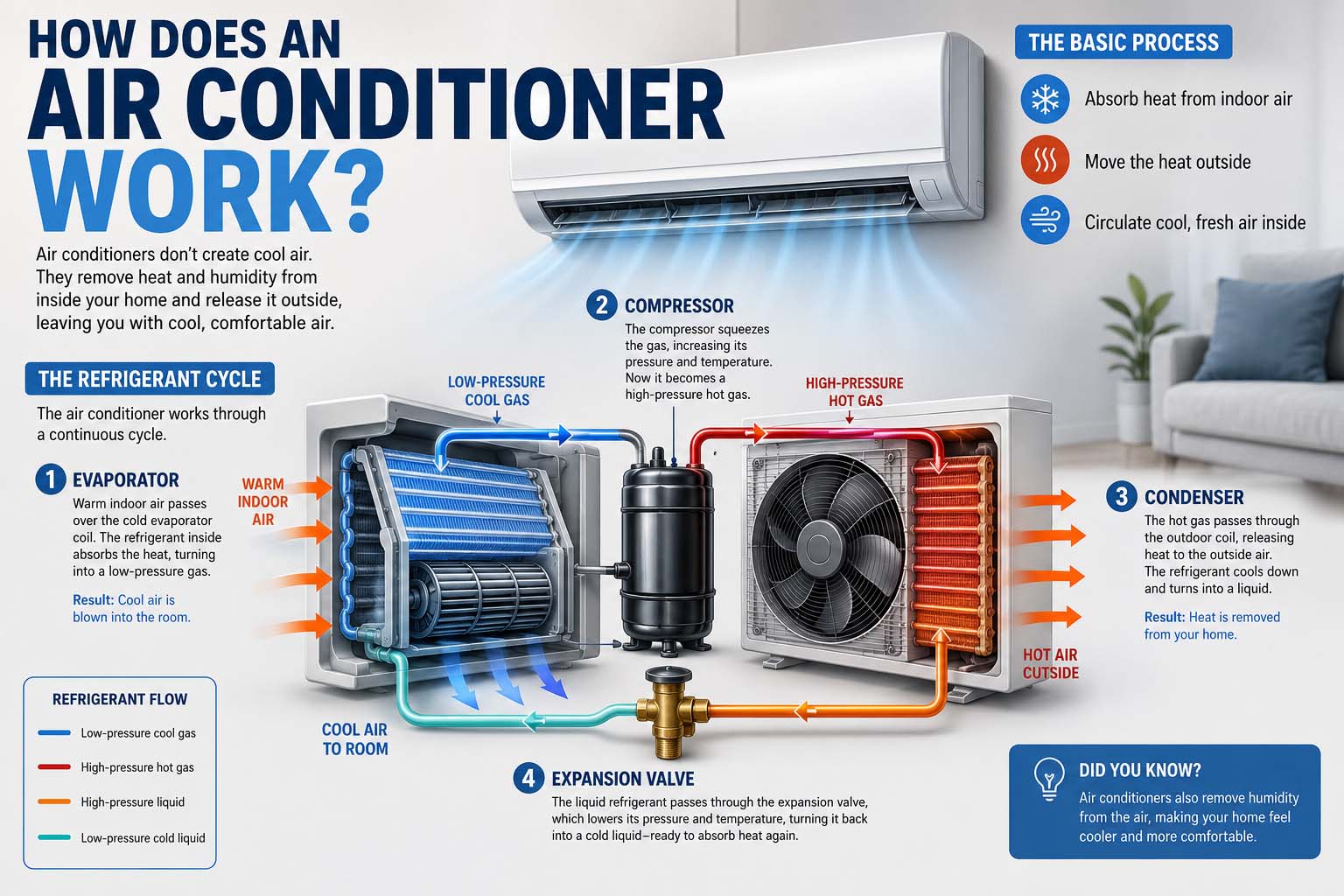
How does an air conditioner work? An air conditioner cools your home by absorbing heat from indoor air and transferring it outdoors. Instead of creating cold air, it uses refrigerant, a compressor, and special coils to remove unwanted heat through a continuous cooling cycle.
For example, when you turn on your AC during a hot summer day, the system draws warm air from your room, removes some of its heat, and sends cooler air back inside. Meanwhile, the outdoor unit releases the collected heat into the surrounding air.
As a result, your indoor temperature gradually drops until it reaches the setting on your thermostat.
Although the process involves several mechanical components, the basic principle is easy to understand.
This guide explains how air conditioning works, what each component does, why refrigerant matters, and how to keep your cooling system operating efficiently.
Although the process involves several mechanical components, the basic principle is easy to understand. Once you understand how does an air conditioner work in a typical home, you can better recognize how heat transfer, airflow, and refrigerant work together to maintain indoor comfort.
What Is an Air Conditioner and How Does It Work?
An air conditioner is a cooling system that transfers heat from an indoor space to the outdoors.
Most residential air conditioners also help:
- Lower indoor humidity
- Improve air circulation
- Filter dust and airborne particles
- Maintain a comfortable indoor temperature
However, air conditioners do not necessarily bring fresh outdoor air into your home. Most residential systems primarily recirculate indoor air.
Whether you use a window unit, portable air conditioner, ductless mini-split, or central cooling system, the basic refrigeration process remains similar.
How Does an Air Conditioner Work? Simple Explanation
The easiest way to understand air conditioning is to imagine moving heat rather than producing cold air.
Here’s how the cooling process works:
- Warm indoor air enters the air conditioning system.
- The evaporator coil absorbs heat from that air.
- Refrigerant carries the absorbed heat through the system.
- The compressor increases the refrigerant’s pressure and temperature.
- The outdoor condenser releases the collected heat.
- The refrigerant returns indoors to absorb more heat.
As a result, cooler air circulates through your home while the system continuously transfers heat outside.
This process repeats until the thermostat detects that the indoor temperature has reached the selected setting.
Main Air Conditioner Parts and Their Functions
Understanding the main AC components makes the refrigeration cycle easier to follow.
Although systems vary in design, most conventional air conditioners contain an evaporator coil, compressor, condenser coil, expansion device, and refrigerant.
Evaporator Coil: Absorbing Indoor Heat
The evaporator coil sits inside the indoor cooling section.
When warm indoor air passes over the cold coil, heat transfers from the air into the refrigerant.
As a result, the air becomes cooler before the blower sends it back into your living space.
In addition, moisture may condense on the coil when its surface temperature falls below the air’s dew point.
The temperature difference between the entering and leaving air also helps technicians evaluate cooling performance.
For a clearer understanding of temperature differences, read our guide on Delta T.
Compressor: Increasing Refrigerant Pressure
The compressor moves refrigerant through the system and raises the pressure of the refrigerant vapor.
As compression increases pressure, the refrigerant temperature also rises.
Consequently, the hot, high-pressure vapor can release heat to the outdoor air when it reaches the condenser.
Without a functioning compressor, a conventional vapor-compression air conditioner cannot complete its normal refrigeration cycle.
Condenser Coil: Releasing Heat Outdoors
The condenser coil usually sits inside the outdoor unit.
Here, hot refrigerant releases the heat it absorbed indoors, along with energy added during compression.
Meanwhile, an outdoor fan moves air across the condenser coil to support heat transfer.
As the refrigerant loses heat, it changes from vapor into liquid.
Therefore, warm air blowing from the outdoor unit is generally a normal sign of heat rejection.
Expansion Valve: Lowering Refrigerant Pressure
The expansion device controls refrigerant flow into the evaporator.
It also creates a pressure drop between the high-pressure and low-pressure sides of the system.
As a result, the refrigerant enters the evaporator at a lower pressure and temperature.
This allows it to absorb heat from indoor air during the next stage.
Refrigerant: Carrying Heat Through the System
Refrigerant is the working fluid that transfers heat between the indoor and outdoor coils.
During normal operation, it changes pressure, temperature, and physical state as it moves through the refrigeration circuit.
Unlike fuel, refrigerant is not normally consumed.
Instead, it circulates through a sealed system.
Therefore, a system that has lost refrigerant may have a leak that requires professional diagnosis and repair.
How Does an Air Conditioner Work Step by Step?
Following one complete refrigeration cycle provides a clearer picture of how an AC system cools your home.
Step 1: The Thermostat Detects the Need for Cooling
When the indoor temperature rises above the selected setting, the thermostat calls for cooling.
As a result, the air conditioning system starts the appropriate components.
Depending on the system design, these may include the compressor, indoor blower, and outdoor fan.
Modern systems also use sensors and electronic controls to monitor operating conditions.
For example, a Transducer can convert a physical quantity, such as pressure, into an electrical signal for monitoring and control.
Step 2: The Blower Pulls Warm Air Into the System
The indoor blower draws air through return vents or directly into the indoor unit.
Before reaching the evaporator coil, the air typically passes through a filter.
Depending on the filter, it may capture:
- Dust
- Pet hair
- Pollen
- Other airborne particles
However, a clogged filter restricts airflow and reduces system performance.
Therefore, regular filter maintenance helps maintain efficient cooling.
Step 3: The Evaporator Absorbs Indoor Heat
Next, the filtered air passes over the cold evaporator coil.
Because the refrigerant is colder than the surrounding air, heat naturally moves into the refrigerant.
During this process, the refrigerant absorbs energy and evaporates.
Meanwhile, the blower circulates the cooled air back into the room.
As a result, the indoor temperature gradually decreases.
Step 4: The Compressor Raises Refrigerant Pressure
After leaving the evaporator, the refrigerant travels toward the compressor as low-pressure vapor.
The compressor then increases its pressure and temperature.
Consequently, the refrigerant becomes hot enough to transfer heat to the outdoor environment.
The compressor sends this high-pressure vapor into the condenser coil.
Step 5: The Condenser Releases Heat Outside
At the outdoor condenser, a fan moves outside air across the coil.
Because the refrigerant is hotter than the surrounding air, heat flows outward.
As the refrigerant releases heat, it condenses into a high-pressure liquid.
Therefore, the outdoor unit can blow air that feels warmer than the surrounding environment.
Step 6: The Expansion Device Prepares the Refrigerant
Finally, the liquid refrigerant passes through the expansion device.
This component reduces its pressure, causing a corresponding drop in temperature.
The low-pressure refrigerant then enters the evaporator again.
As long as the thermostat calls for cooling, the system continues repeating this process.
Understanding the Air Conditioner Cooling Cycle
The refrigeration cycle follows a repeating sequence. Understanding how does an air conditioner work during each stage helps explain why the evaporator, compressor, condenser, and expansion device must operate together to cool your home efficiently.
The refrigeration cycle follows a repeating sequence.
Indoor air loses heat → Evaporator absorbs heat → Compressor raises refrigerant pressure → Condenser releases heat outdoors → Expansion device lowers pressure → Refrigerant returns to the evaporator
This sequence explains how a conventional air conditioner transfers heat from one location to another.
However, the refrigerant doesn’t simply travel outdoors and return at the same temperature or pressure.
Instead, each component changes its condition so the system can continue transferring heat.
How Does an Air Conditioner Work Diagram Help?
An air conditioner diagram usually shows two main sections.
The indoor section contains the evaporator coil and blower.
Meanwhile, the outdoor section contains the compressor, condenser coil, and fan in many common split-system designs.
Refrigerant lines connect the two sections.
Therefore, a diagram helps illustrate how heat moves from the indoor environment to the outdoors.
Why Air Conditioners Remove Heat Instead of Creating Cold
One common misconception is that an air conditioner produces cold air from nothing.
However, cooling actually involves removing thermal energy.
For example, imagine placing an ice cube into a glass of warm water.
Heat moves from the warmer water into the colder ice.
As a result, the water becomes cooler while the ice absorbs energy and melts.
An air conditioner follows the same basic principle of heat transfer.
However, it uses a compressor and circulating refrigerant to move heat continuously.
This mechanical process allows the system to cool a room even when the outdoor environment is warmer than the indoor space.
Why Air Conditioners Also Remove Humidity
Air conditioners often reduce indoor humidity while cooling the air.
When warm, moist air contacts the cold evaporator coil, water vapor may condense into liquid droplets.
These droplets collect in a drain pan and leave through a condensate drain.
As a result, the system removes some moisture from the indoor air.
Lower humidity can:
- Reduce the sticky feeling associated with humid weather
- Improve perceived comfort
- Help limit condensation on cool surfaces
- Support indoor moisture control
However, an oversized air conditioner may cool a room too quickly and run for short periods.
Consequently, it may remove less moisture than a properly sized system.
Therefore, correct equipment sizing matters for both temperature control and humidity management.
Factors That Affect Air Conditioner Cooling Performance
Several conditions influence how efficiently an air conditioner removes heat.
Outdoor Temperature and Cooling Efficiency
During extremely hot weather, the outdoor condenser must reject heat into warmer surrounding air.
As a result, the compressor may work harder, and the system may run longer.
However, unusually long operating periods can also indicate an equipment or airflow problem.
Therefore, performance should be evaluated alongside outdoor conditions, system capacity, and indoor temperature.
Dirty Air Filters and Restricted Airflow
A clogged filter reduces airflow across the evaporator coil.
Consequently, the system may experience:
- Reduced cooling capacity
- Higher energy consumption
- Increased blower strain
- Evaporator coil freezing
- Longer cooling periods
For this reason, inspect filters regularly and clean or replace them according to manufacturer recommendations.
Incorrect Refrigerant Charge
A conventional air conditioner requires the correct refrigerant charge to operate as designed.
If refrigerant escapes through a leak, the system may lose cooling capacity.
Possible symptoms include:
- Weak cooling
- Ice on the indoor coil
- Longer operating periods
- Reduced efficiency
However, these symptoms can also result from other problems.
Therefore, a qualified technician should diagnose refrigerant-related issues rather than simply adding more refrigerant.
Dirty Evaporator and Condenser Coils
Dust and debris can reduce heat transfer across the cooling coils.
For example, a dirty outdoor condenser may struggle to release heat efficiently.
Similarly, contamination on the indoor coil can interfere with airflow and cooling performance.
As a result, regular inspection and appropriate cleaning help maintain system efficiency.
Different Types of Air Conditioners and How They Work
Most conventional residential air conditioners rely on the same vapor-compression refrigeration process.
However, their installation methods and air distribution systems differ.
| Air Conditioner Type | Common Application |
|---|---|
| Window air conditioner | Cooling individual rooms |
| Portable air conditioner | Temporary or flexible room cooling |
| Split air conditioner | Homes, apartments, and individual zones |
| Central air conditioning | Cooling multiple rooms through ductwork |
| Ductless mini-split | Homes without ducts or individual cooling zones |
How Window Air Conditioners Work
A window air conditioner combines indoor and outdoor cooling components inside one cabinet.
The indoor section absorbs room heat, while the outdoor-facing section releases it.
As a result, one compact appliance performs the complete refrigeration cycle.
How Split Air Conditioners Work
A split system separates the indoor evaporator from the outdoor condenser and compressor.
Refrigerant lines connect the units.
Therefore, the system can transfer heat outdoors without placing the entire cooling assembly inside the room.
How Central Air Conditioning Works
Central air conditioning typically uses an indoor cooling coil, blower, ductwork, and an outdoor condensing unit.
The blower circulates cooled air through supply ducts.
Meanwhile, return ducts bring indoor air back for another cooling cycle.
How Portable Air Conditioners Work
Portable air conditioners usually contain the refrigeration components inside one movable cabinet.
They remove heat through an exhaust hose connected to a window or another suitable outlet.
However, single-hose designs can create negative indoor pressure and draw warmer replacement air into the space.
Therefore, their efficiency and performance may differ from those of other air conditioner types.
Why the Outdoor AC Unit Blows Hot Air
Some homeowners worry when the outdoor unit releases warm air.
However, this is generally normal during cooling operation.
The condenser must release the heat collected indoors, along with energy added by the compressor.
As a result, air leaving the outdoor condenser is often warmer than the surrounding air.
However, hot exhaust air alone doesn’t prove that the system is operating efficiently.
If indoor cooling remains weak, other components may require inspection.
Common Air Conditioner Problems and Solutions
Even well-maintained systems can develop cooling problems.
Fortunately, several symptoms can help identify possible causes.
Air Conditioner Runs but Doesn’t Cool
Possible causes include:
- Dirty air filter
- Restricted airflow
- Dirty condenser coil
- Thermostat problems
- Refrigerant leaks
- Compressor or electrical faults
First, check the thermostat settings and air filter.
Next, inspect accessible vents for obstructions.
However, leave refrigerant and electrical repairs to qualified professionals.
Air Conditioner Turns On and Off Frequently
Frequent short cycling may result from:
- Incorrect thermostat placement
- Oversized equipment
- Dirty coils
- Electrical problems
- Control-system faults
As a result, the system may experience reduced comfort and unnecessary component wear.
Therefore, persistent short cycling deserves professional evaluation.
Water Leaks From the Indoor Unit
A blocked condensate drain is a common cause of indoor water leakage.
However, damaged drain pans, installation problems, or frozen coils can also cause leaks.
If water appears near electrical components, turn off the equipment and seek professional assistance.
Ice Forms on the Evaporator Coil
Ice may develop because of restricted airflow, refrigerant problems, or faulty components.
For example, a dirty filter can reduce airflow enough to make the evaporator excessively cold.
If ice appears, stop cooling operation and allow the coil to thaw safely.
However, don’t continue operating the system without addressing the underlying problem.
Simple Air Conditioner Maintenance Tips
Regular maintenance helps preserve cooling performance and may reduce unnecessary energy consumption.
Start with these practical habits:
- Inspect air filters regularly.
- Clean or replace filters when necessary.
- Keep supply and return vents unobstructed.
- Remove debris around the outdoor unit.
- Check that the thermostat operates correctly.
- Watch for unusual noises, leaks, or odors.
- Arrange professional maintenance according to the equipment manufacturer’s guidance.
In addition, avoid opening electrical compartments or refrigerant lines without proper training.
For more information about efficient home cooling, the U.S. Department of Energy’s air conditioning guidance explains cooling technologies and practical efficiency considerations.
How Modern Air Conditioners Control Temperature
Modern air conditioners use sensors and electronic controls to regulate indoor comfort.
For example, a thermostat measures room temperature and compares it with the selected setting.
When the temperature rises above the cooling threshold, the control system requests cooling.
As a result, the equipment adjusts its operation to maintain the desired indoor conditions.
How Closed-Loop Control Improves Cooling
Many air conditioning systems operate using closed-loop control principles.
A closed-loop system continuously measures an output and uses feedback to adjust its operation.
For example, a thermostat monitors indoor temperature and signals the cooling system when adjustments are necessary.
This process relates to the concepts explained in our guide on Open Loop vs Closed Loop.
However, not every air conditioner adjusts its cooling capacity continuously.
Traditional single-stage systems often switch between full cooling and off.
Meanwhile, variable-speed systems can adjust compressor output more gradually.
As a result, some advanced systems provide more consistent temperature control and improved part-load efficiency.
How to Improve Air Conditioner Energy Efficiency
You can often reduce cooling costs without sacrificing indoor comfort.
For example, small changes in thermostat settings, airflow, and home insulation can make a difference.
Choose a Comfortable Thermostat Setting
Set the thermostat to a temperature that balances comfort and energy use.
Generally, a higher cooling setpoint reduces the amount of heat the system must remove.
However, the most suitable temperature depends on personal comfort and indoor humidity.
Use Fans to Improve Air Circulation
Ceiling and portable fans help move air across your skin.
As a result, you may feel comfortable at a slightly higher thermostat setting.
However, fans don’t lower the room’s air temperature in the same way an air conditioner does.
Therefore, turn them off when they aren’t needed for occupant comfort.
Seal Air Leaks
Warm outdoor air can enter through gaps around windows, doors, and other openings.
Consequently, the air conditioner must remove additional heat.
Sealing appropriate air leaks can reduce this unnecessary cooling load.
Maintain Proper Airflow
Blocked vents and dirty filters can interfere with system performance.
Therefore, keep airflow paths clear and follow the manufacturer’s maintenance recommendations.
Consider Efficient Equipment When Replacing an Old System
Modern high-efficiency air conditioners may use less electricity than older equipment under comparable conditions.
However, equipment sizing, installation quality, climate, and usage patterns affect actual savings.
Therefore, compare efficiency ratings and installation requirements before replacing an existing system.
Frequently Asked Questions About How Air Conditioners Work
How Does an Air Conditioner Work in Simple Words?
An air conditioner removes heat from indoor air and transfers it outside using circulating refrigerant.
As a result, cooler air returns to the room while the outdoor unit releases the collected heat.
Does an Air Conditioner Create Cold Air?
No. An air conditioner cools indoor air by removing thermal energy.
Therefore, the air feels colder because it contains less heat than before.
Why Does the Outdoor Unit Blow Hot Air?
The outdoor condenser releases heat collected from the indoor environment.
In addition, it rejects energy added by the compressor.
As a result, warm air leaving the outdoor unit is generally normal.
Why Does an Air Conditioner Remove Humidity?
When humid indoor air contacts the cold evaporator coil, some water vapor condenses into liquid.
The condensate then drains away.
Therefore, the system can reduce indoor humidity while cooling.
How Long Does an Air Conditioner Cooling Cycle Last?
Cycle length depends on outdoor temperature, thermostat settings, insulation, equipment size, and cooling demand.
For example, a system may run longer during extremely hot weather.
However, frequent short cycles or unusually long operation can indicate sizing or maintenance problems.
Does an Air Conditioner Need Fresh Refrigerant Every Year?
No. Refrigerant normally circulates inside a sealed system without being consumed.
However, leaks can reduce the refrigerant charge.
Therefore, a technician should investigate suspected leaks rather than automatically adding refrigerant.
Why Does My Air Conditioner Run but Not Cool the Room?
Common causes include restricted airflow, dirty coils, thermostat problems, refrigerant leaks, or equipment faults.
First, check accessible filters and thermostat settings.
However, persistent cooling problems require professional diagnosis.
Key Takeaways: How Does an Air Conditioner Work?
Understanding how does an air conditioner work becomes easier when you remember one principle: air conditioners move heat rather than create cold.
First, warm indoor air passes across the evaporator coil, where refrigerant absorbs heat.
Next, the compressor raises the refrigerant’s pressure and temperature.
Then, the outdoor condenser releases the collected heat into the surrounding air.
Finally, the expansion device reduces refrigerant pressure so the cooling cycle can begin again.
Meanwhile, the indoor blower circulates cooled air throughout the living space, and the evaporator may also remove excess moisture.
As a result, your home becomes cooler and more comfortable.
Whether you’re choosing a new AC system, troubleshooting weak cooling, or learning about refrigeration technology, understanding this process helps you recognize the importance of clean filters, proper airflow, correct refrigerant charge, and regular maintenance.