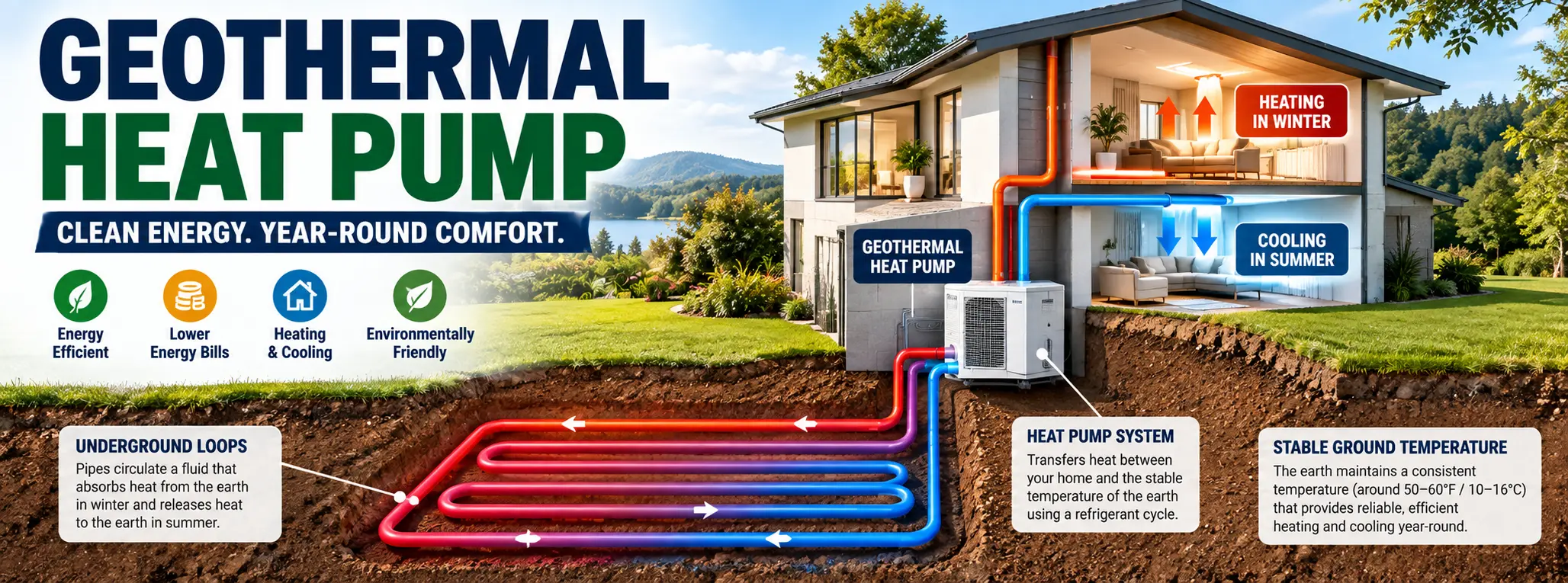
A geothermal heat pump heats and cools a building by transferring heat between the indoor space and the relatively stable temperatures below the ground. Instead of creating heat by burning fuel, the system moves existing thermal energy through underground pipes, a heat pump, and the home’s distribution system. Because underground temperatures change much less than outdoor air temperatures, geothermal systems can provide efficient heating and cooling throughout the year.
Although the technology requires more installation work than many conventional HVAC systems, it can offer low operating costs, quiet performance, and long service life when properly designed.
What Is a Geothermal Heat Pump?
A geothermal heat pump, also called a ground-source heat pump, is an electrically powered heating and cooling system. It uses buried piping to exchange heat with the ground rather than relying mainly on outdoor air.
During winter, the system collects heat from the ground and transfers it indoors. During summer, the process reverses.
That makes the technology different from a conventional furnace. If you are comparing heating methods, understanding how does a furnace work helps show the distinction: a furnace generally produces heat, while a geothermal system primarily transfers it.
The underground piping is known as a ground loop. Usually, water or a water-based antifreeze solution circulates through this closed piping network.
How Does a Geothermal Heat Pump Work?
A geothermal system operates using the same basic refrigeration principles found in other heat pumps and cooling equipment. However, it exchanges heat with the ground rather than directly with outside air.
The main components usually include:
- Ground loop
- Heat exchanger
- Compressor
- Refrigerant circuit
- Circulation pump
- Air handler or hydronic distribution equipment
- Thermostat and control system
During heating mode, fluid traveling through the ground loop absorbs thermal energy. The compressor then raises the refrigerant’s pressure and temperature so that useful heat can be delivered indoors.
During cooling mode, the cycle reverses. As a result, heat leaves the indoor air and travels into the ground.
The refrigeration principle is closely related to conventional cooling equipment. Therefore, learning how does an air conditioner work can make the cooling side of a geothermal system easier to understand.
Why Ground Temperature Matters
Outdoor air temperature can change dramatically between seasons and even between day and night. In comparison, temperatures several feet below the surface remain much more stable.
Consequently, a ground-source system often works against a smaller temperature difference than an air-source system during extreme weather.
Engineers frequently describe temperature differences using delta T. If you want to understand that measurement more clearly, what is delta t explains how the difference between two temperatures is calculated and why it matters in thermal systems.
Geothermal Heat Pump Installation Explained
Professional geothermal heat pump installation starts well before any underground pipe is installed. First, the contractor needs to determine the building’s heating and cooling loads. Then, the ground-loop design must match those requirements as well as local soil, land, and drilling conditions.
The installer may also inspect existing ductwork, electrical capacity, insulation, and available outdoor space.
Horizontal Ground Loops
Horizontal loops are installed in trenches across a relatively large area of land. Because they do not usually require deep drilling, they can be practical where sufficient open ground is available.
However, landscaping and site access can affect installation complexity.
Vertical Ground Loops
Vertical systems use deep boreholes with pipes running downward into the ground.
Since they need much less surface area, they are often considered for smaller properties or locations where horizontal excavation is impractical. However, drilling can raise installation costs.
Pond or Water-Based Loops
If a suitable body of water is available and local conditions permit it, loop piping may sometimes be installed underwater.
Still, site suitability, environmental requirements, water depth, and local regulations must be evaluated before this approach is chosen.
Open-Loop Systems
Unlike a sealed closed-loop system, an open-loop configuration uses groundwater directly as the heat-exchange fluid.
However, water quality, discharge requirements, local regulations, and groundwater availability make open-loop systems highly site-dependent.
How Much Does a Geothermal Heat Pump Cost?
The geothermal heat pump cost varies too widely for one price to accurately represent every property.
The total depends on factors such as:
- Building size
- Heating and cooling load
- Ground-loop configuration
- Soil and rock conditions
- Required drilling depth
- Local labor rates
- Equipment capacity
- Existing ductwork
- Landscaping restoration
- Permits and site access
The underground loop is one reason initial costs can exceed those of conventional HVAC equipment. For example, drilling several vertical boreholes can require specialized machinery and experienced contractors.
However, purchase price tells only part of the story. homes.
Therefore, compare installation cost, estimated energy use, maintenance, expected equipment life, financing, and any locally available incentives before deciding whether the system makes financial sense.
Geothermal Heat Pump vs Air-Source Heat Pump
Both systems use refrigeration cycles to transfer thermal energy. However, their heat sources are different.
| Feature | Geothermal Heat Pump | Air-Source Heat Pump |
|---|---|---|
| Heat exchange source | Ground | Outdoor air |
| Outdoor temperature exposure | Lower | Higher |
| Ground excavation required | Yes | No |
| Typical installation complexity | Higher | Lower |
| Outdoor condenser fan | Usually not required in the same way | Typically required |
| Heating and cooling | Yes | Yes |
| Site requirements | Ground-loop space or drilling access | Outdoor unit location |
Therefore, its operating conditions change as outdoor temperatures rise or fall.
Consequently, it can maintain efficient heat transfer across changing seasons.
However, geothermal is not automatically the right choice for every building. Limited site access, difficult geology, installation expense, or plans to move soon can influence the decision.
Controls and Temperature Management
Modern geothermal equipment relies on thermostats, sensors, control boards, pumps, and protective electronics to regulate operation.
For example, controls can monitor indoor temperature and determine when heating or cooling is required. Meanwhile, sensors can help protect the compressor and other components from unsuitable operating conditions.
Understanding what is a temperature controller can be useful here because temperature-based control is central to automated HVAC operation.
Some systems also support zoning. As a result, different areas of a building may receive heating or cooling according to their individual requirements.
However, repeatedly making extreme thermostat adjustments does not necessarily heat or cool the building faster. A stable, sensible setting is usually a better approach.
Geothermal Heat Pump Maintenance
Routine geothermal heat pump maintenance helps preserve efficiency and reduces the chance of unexpected problems.
Although underground loops require little routine attention when correctly installed, the indoor equipment still needs normal HVAC care.
Useful maintenance tasks can include:
- Replacing or cleaning air filters
- Inspecting ductwork
- Checking condensate drainage
- Inspecting electrical connections
- Checking circulating pumps
- Verifying thermostat operation
- Inspecting accessible piping
- Checking system pressures where applicable
- Cleaning indoor coils when needed
- Checking airflow through the distribution system
Homeowners can usually handle basic filter changes. However, refrigerant, electrical, pressure, and internal mechanical work should be left to qualified technicians.
Common Problems and Geothermal Heat Pump Repair
Even a well-installed system can eventually require geothermal heat pump repair.
One common complaint is inadequate heating or cooling. However, several different problems can cause the same symptom.
Likewise, thermostat problems can prevent proper operation. Circulation pump faults, refrigerant issues, electrical failures, or ground-loop problems can also reduce performance.
System Runs but the House Is Uncomfortable
First, check the thermostat settings and air filter.
If airflow seems normal but the problem continues, professional diagnosis may be necessary.
Heat Pump Will Not Start
Check whether the thermostat is calling for heating or cooling. Then, inspect the appropriate electrical breaker.
If the breaker trips repeatedly, do not keep resetting it. Instead, have the electrical or HVAC problem inspected.
Unusual Energy Consumption
A sudden increase in electricity use can have several causes. For instance, extreme weather, control problems, restricted airflow, failing components, or backup heating operation may increase consumption.
Therefore, compare energy use with system behavior rather than assuming the underground loop has failed.
Strange Sounds
Some operating noise is normal. However, new grinding, rattling, buzzing, or repeated clicking can indicate a mechanical or electrical issue.
Early inspection may prevent further damage.
Can Geothermal Provide Hot Water?
Some geothermal heat pumps can assist with domestic water heating through a device commonly called a desuperheater.
When operating conditions allow, the system captures some heat and transfers it to water. However, this feature does not necessarily replace a dedicated water heater.
The concept differs from a solar water heater, which collects energy from sunlight rather than exchanging thermal energy with the ground.
Whether geothermal-assisted water heating is worthwhile depends on the equipment design, climate, household hot-water demand, and system configuration.
Advantages of Geothermal Heating and Cooling
One major advantage is efficiency. Because the system moves thermal energy instead of relying entirely on electrical resistance heating or fuel combustion, it can provide substantial heating or cooling from the electricity it consumes.
Another benefit is consistent performance. Since underground conditions remain relatively stable, the system avoids some of the extreme outdoor conditions faced by air-source equipment.
Geothermal systems can also operate quietly because they do not require a conventional outdoor condenser unit with a large fan.
Meanwhile, buried ground loops can have a long service life when properly designed and installed.
Finally, one system can provide both heating and cooling. Therefore, homeowners do not necessarily need separate primary heating and cooling machines.
Disadvantages to Consider Before Installing One
The biggest obstacle is often upfront expense. Excavation or drilling makes installation more involved than replacing a conventional furnace or air conditioner.
Property conditions also matter. For example, limited outdoor space may rule out a horizontal loop, while difficult drilling conditions may increase the expense of a vertical design.
Installation quality is another major factor. An incorrectly sized loop or poorly designed distribution system can reduce comfort and efficiency.
Repairs to underground loops are uncommon compared with routine indoor maintenance, but locating and repairing a buried problem can be more complicated.
Therefore, contractor experience and proper system design matter just as much as the equipment itself.
How Long Does a Geothermal System Last?
The indoor heat-pump unit and the underground loop have very different working environments.
The indoor mechanical equipment contains compressors, pumps, electronics, and other moving or electrical parts. Consequently, these components experience normal wear over time.
The buried loop has fewer wear-prone components. Therefore, properly installed ground loops are generally expected to last much longer than the indoor equipment.
However, actual lifespan depends on materials, water chemistry, installation quality, usage, maintenance, and environmental conditions.
Rather than choosing equipment based only on a claimed lifespan, consider warranty coverage, installer experience, service availability, and replacement costs.
Is a Geothermal Heat Pump Worth Considering?
A geothermal system makes the most sense when the property can accommodate an appropriate ground loop and the owner expects to benefit from long-term energy savings and year-round heating and cooling.
Before buying, request a proper heating and cooling load calculation instead of choosing equipment based only on building area. Also, ask how the contractor determined loop length, system capacity, and expected energy consumption.
Then, compare the complete project cost with other HVAC options. Pay attention to installation, projected electricity use, maintenance, warranties, and available incentives rather than focusing on equipment price alone.
A geothermal heat pump can be an efficient and technically elegant way to control indoor temperature because it uses the relatively stable ground as a thermal energy source and sink. Still, its performance depends heavily on correct design and installation. For the right property, a well-designed system can provide dependable heating and cooling for many years while keeping much of its heat-exchange infrastructure quietly hidden underground.