Whether you’re buying a motorcycle, lawn equipment or a boat, knowing the difference between 2 stroke and 4 stroke engines helps you choose the right machine. Although both turn fuel into mechanical power, they use different cycles, lubrication methods and designs. As a result, they differ in performance, fuel economy, emissions, maintenance and reliability.
For example, have you ever wondered why a chainsaw sounds different from a car engine? Similarly, why do dirt bikes often use one engine type over the other? This guide explains it all in plain language.
Difference Between 2 Stroke and 4 Stroke at a Glance
The main difference is the number of piston strokes needed to finish one power cycle.
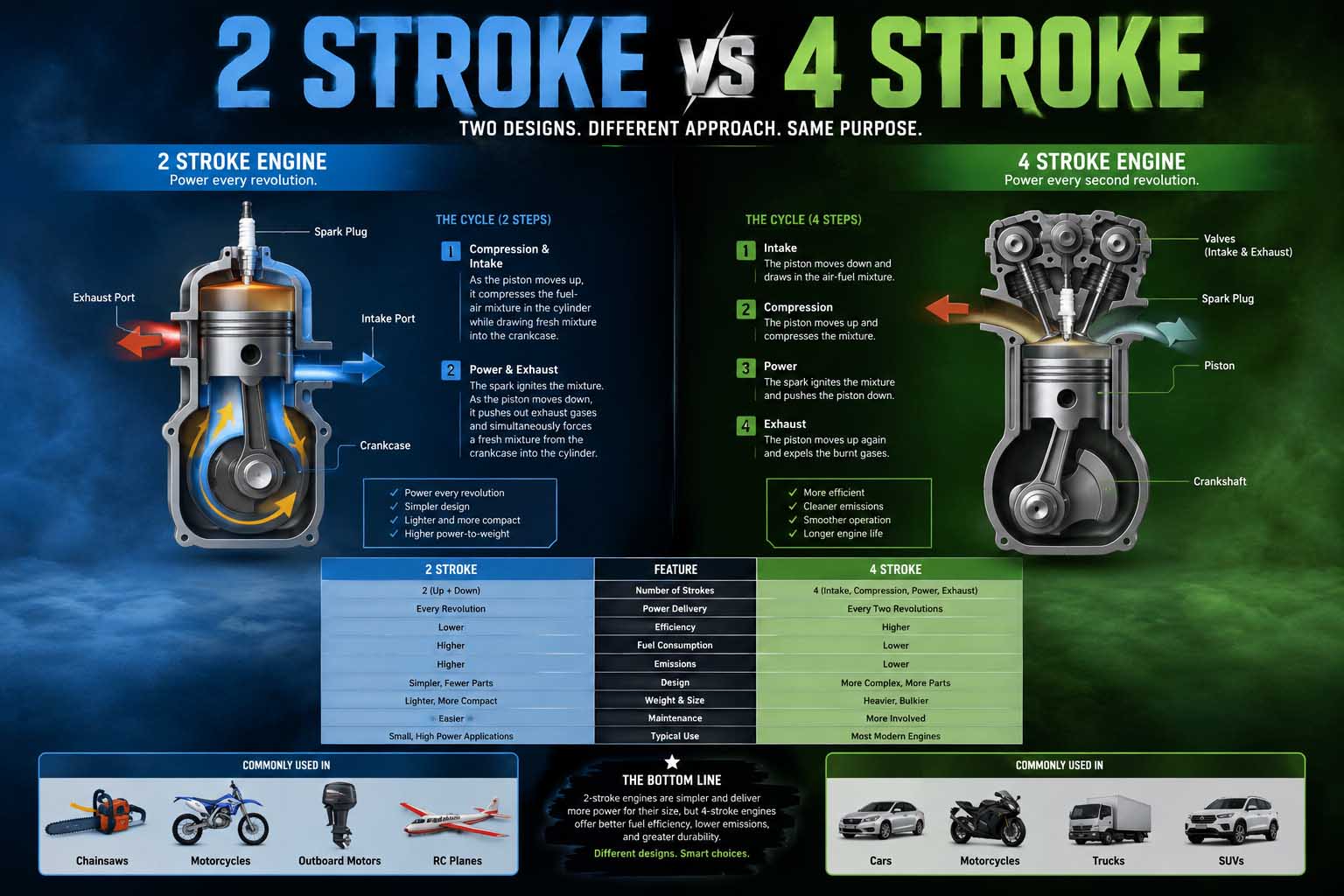
A 2-stroke engine completes one power cycle in two piston strokes, which takes one crankshaft turn. In contrast, a 4-stroke engine needs four piston strokes, which takes two crankshaft turns. According to Britannica, the two-stroke cycle is a working cycle for a piston in an internal combustion engine.
Because a 2-stroke engine fires more often, it usually makes more power for its size. Meanwhile, a 4-stroke engine focuses on efficiency, cleaner emissions and longer life.
| Feature | 2-Stroke Engine | 4-Stroke Engine |
|---|---|---|
| Power Cycle | 2 strokes | 4 strokes |
| Crankshaft Revolutions | 1 | 2 |
| Fuel Efficiency | Lower | Higher |
| Emissions | Higher | Lower |
| Lubrication | Oil mixed with fuel or separate injection | Separate engine oil |
| Maintenance | Simpler but more frequent | More complex but longer intervals |
| Engine Weight | Lighter | Heavier |
| Typical Lifespan | Shorter | Longer |
How Does a 2-Stroke Engine Work?
A 2-stroke engine squeezes several jobs into just two piston movements.
First Stroke
As the piston moves up, it squeezes the air-fuel mixture in the cylinder. At the same time, fresh fuel flows into the crankcase below.
Second Stroke
After the spark ignites the mixture, combustion pushes the piston down. Then, exhaust gases leave the cylinder while fresh fuel moves into the combustion chamber.
Since combustion happens on every crankshaft turn, 2-stroke engines make impressive power for their size.
Many small engines also use a carburetor to mix fuel and air. If you’re curious about that process, our guide on how does a carburetor work explains it in more detail.
How Does a 4-Stroke Engine Work?
A 4-stroke engine gives each stage its own piston stroke.
First, the intake stroke draws in air and fuel. Next, the compression stroke squeezes the mixture. Then, the power stroke burns it and pushes the piston down. Finally, the exhaust stroke clears out the burned gases.
Because each stage has its own stroke, combustion is cleaner and fuel efficiency is better.
Although the design has more moving parts, it runs more smoothly and lasts longer.
Difference Between 2 Stroke and 4 Stroke Engine Design
The difference between 2 stroke and 4 stroke engine construction goes beyond the number of strokes.
For instance, a typical 4-stroke engine has intake valves, exhaust valves, a camshaft, a timing chain or belt and valve springs.
By comparison, most 2-stroke engines skip the valve train altogether. Instead, they use intake and exhaust ports that open and close as the piston moves.
Therefore, fewer parts make the engine lighter and simpler.
Power Output Comparison
Racing motorcycles and light equipment often use 2-stroke engines because of their excellent power-to-weight ratio.
Since combustion occurs on every turn, acceleration feels quicker.
Meanwhile, 4-stroke engines make power on every second turn, so their acceleration feels smoother and more predictable.
However, modern engine technology has narrowed the gap, although each design still has its own strengths.
Fuel Efficiency and Emissions
Fuel economy is one of the biggest differences between these engines.
A 4-stroke engine burns fuel more completely, so it wastes less and produces lower emissions.
On the other hand, traditional 2-stroke engines lose some fresh fuel during exhaust scavenging. As a result, they use more fuel and release more emissions.
For this reason, many countries now restrict conventional 2-stroke engines in passenger vehicles.
Lubrication Systems
Lubrication is another major distinction.
2-Stroke Lubrication
Oil mixes directly with the fuel or enters through a separate oil injection system. Then, as combustion occurs, the oil burns along with the fuel.
Although this system is simple, it produces more smoke and carbon deposits.
4-Stroke Lubrication
In contrast, a dedicated oil reservoir circulates lubricant throughout the engine.
The oil protects bearings, pistons and moving parts without burning during combustion.
Consequently, this design helps the engine last longer and cuts emissions.
Common Applications
Different industries choose engines based on their performance needs.
Typical 2-Stroke Uses
You’ll find 2-stroke engines in chainsaws, leaf blowers, small dirt bikes, snowmobiles, personal watercraft and some portable generators. In short, they suit light machines that need a lot of power.
Typical 4-Stroke Uses
Meanwhile, 4-stroke engines power cars, trucks, SUVs, most motorcycles, lawn tractors, farm machinery and construction equipment.
Maintenance Requirements
Maintenance differs a lot between the two designs.
A 2-stroke engine has fewer moving parts, so repairs are fairly simple.
However, spark plugs, piston rings and exhaust ports often need attention more frequently.
A 4-stroke engine has extra parts such as valves and timing systems. Even so, it usually runs much longer between major repairs when you maintain it well.
Fuel delivery also affects servicing. For example, comparing carburetor vs fuel injection shows why many modern 4-stroke engines need less routine tuning than older carbureted models.
What Is the Difference Between 2 Stroke and 4 Stroke for Performance?
Performance depends on how you will use the engine.
Advantages of 2-Stroke Engines
A 2-stroke engine offers a higher power-to-weight ratio and faster acceleration. In addition, it is light, simple to build and cheaper to make.
Advantages of 4-Stroke Engines
On the other hand, a 4-stroke engine gives better fuel economy, lower emissions and quieter running. Moreover, it lasts longer and delivers better torque at low speeds.
Clearly, horsepower alone does not decide the better engine. Instead, it depends on the job.
Reliability and Engine Lifespan
A well-maintained 4-stroke engine generally lasts much longer.
This is because separate lubrication constantly protects internal parts from wear.
Meanwhile, 2-stroke engines run hotter and face more internal friction, since their lubrication is less consistent.
Even so, modern materials and better manufacturing have made both engine types far more durable.
Understanding Engine Components
Several internal parts work together in both engine types.
First, the piston passes combustion force to the connecting rod, which turns the crankshaft.
Many engines also include a flywheel, and our guide on what is a flywheel explains how it stores rotational energy. As a result, it keeps the engine running smoothly between power strokes.
Airflow is equally important. For instance, learning what is a manifold shows how intake systems spread air evenly to each cylinder in multi-cylinder engines.
Which Engine Is Better?
The answer depends on your priorities.
Choose a 2-stroke engine if you want light equipment, maximum power for its size, a simple mechanical design and strong acceleration.
On the other hand, choose a 4-stroke engine if you want better fuel economy, longer engine life, lower emissions, less noise and easier daily ownership.
For commuting, touring and passenger vehicles, 4-stroke engines remain the top choice.
However, for racing, forestry work or light portable equipment, 2-stroke engines still offer clear advantages.
What’s the Difference Between 2 Stroke and 4 Stroke in Motorcycles?
Motorcycles offer an excellent real-world comparison.
Smaller 2-stroke dirt bikes deliver explosive acceleration and light handling. So, they are popular for motocross and trail riding.
Meanwhile, most street motorcycles use 4-stroke engines, because they give smoother power, better fuel efficiency and easier compliance with emissions rules.
Also, it helps to understand the difference between motor and engine, since people often mix up the two terms.
Quick Comparison Checklist
| Category | 2-Stroke | 4-Stroke |
| Weight | Lighter | Heavier |
| Complexity | Simpler | More complex |
| Fuel Economy | Lower | Better |
| Maintenance | Frequent | Less frequent |
| Noise | Louder | Quieter |
| Emissions | Higher | Lower |
| Durability | Moderate | High |
| Cost | Usually lower | Usually higher |
Frequently Asked Questions
What is the difference between 2 stroke and 4 stroke?
A 2-stroke engine completes its power cycle in two piston strokes, whereas a 4-stroke engine needs four. As a result, they differ in power delivery, fuel use, maintenance and emissions.
Difference between 4 stroke and 2 stroke: which is more fuel efficient?
A 4-stroke engine is generally more fuel efficient, because it burns fuel more completely and uses a separate lubrication system.
What’s the difference between 2 stroke and 4 stroke for beginners?
For beginners, a 4-stroke engine is usually easier to own, since it needs less frequent maintenance, gives smoother power and uses less fuel.
Which engine lasts longer?
Most 4-stroke engines last much longer thanks to better lubrication and lower internal wear.
Are 2-stroke engines still used?
Yes. They remain common in chainsaws, outboard motors, light motorcycles, snowmobiles and other machines where low weight and high power matter most.
Choosing the Right Engine
In conclusion, the difference between 2 stroke and 4 stroke comes down to balancing power, efficiency, maintenance and intended use. So, before you choose, think about how you’ll use the machine, how often you’ll maintain it and whether efficiency or maximum performance matters most to you.