When you compare carburetor vs fuel injection, you probably want to know which system gives better performance, fuel economy and reliability. Both mix air and fuel before combustion. However, they reach that goal in very different ways.
Carburetors were the standard for decades and remain popular with classic car fans. On the other hand, fuel injection has become the modern standard, because it offers more precision, lower emissions and better efficiency. So, once you understand how each system works, choosing the right one gets much easier.
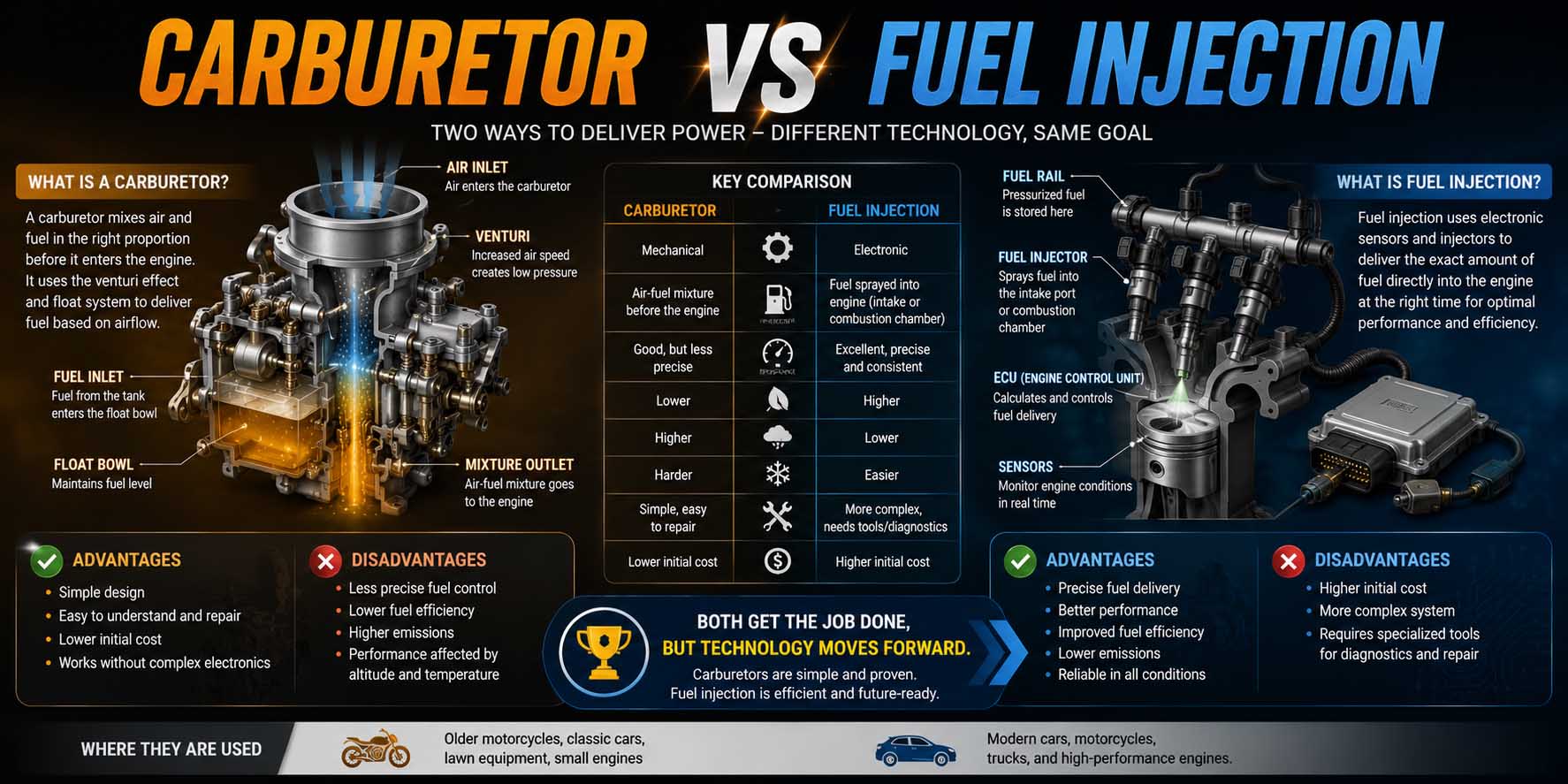
Carburetor vs Fuel Injection: Quick Comparison
Here’s a side-by-side overview of the two systems.
| Feature | Carburetor | Fuel Injection |
|---|---|---|
| Fuel delivery | Mechanical | Electronic or mechanical |
| Fuel efficiency | Moderate | Excellent |
| Cold starting | Less reliable | Very reliable |
| Maintenance | More frequent | Less frequent |
| Engine tuning | Manual | Automatic in most vehicles |
| Emissions | Higher | Lower |
| Performance | Good | More precise |
| Cost | Lower upfront | Higher initial cost |
Although both systems have strengths, injection generally performs better in everyday driving.
What Is a Carburetor?
A carburetor is a mechanical device that mixes fuel with incoming air before it sends the mixture into the engine.
Instead of electronic sensors, it relies on airflow and pressure differences to draw fuel into the intake stream.
For a detailed breakdown, our guide on how does a carburetor work explains each part and its role.
Carburetors were common on passenger cars until electronic injection slowly replaced them in the late twentieth century.
What Is Fuel Injection?
According to Britannica, fuel injection is the introduction of fuel into an engine’s cylinders by means of a pump. Today, most systems use electronically controlled injectors that spray fuel into the intake air or straight into the combustion chamber.
To do this, modern systems use sensors that track engine speed, air temperature, engine temperature, throttle position, airflow and oxygen levels in the exhaust.
Then, the engine control unit (ECU) reads this information and injects exactly the right amount of fuel.
Because these adjustments happen nonstop, the engine runs smoothly as driving conditions change.
How a Carburetor and Fuel Injection Work
Although both systems do the same job, their methods are very different.
The carburetor method: A carburetor mixes fuel and air using airflow from the engine. As air passes through a narrow section called a venturi, its pressure drops. As a result, the low pressure pulls fuel into the airflow, and the mixture then enters the cylinders. In short, the system depends entirely on mechanical principles.
The injection method: In contrast, injection relies on electronics. First, sensors watch engine conditions. Next, the ECU works out the correct fuel amount. Then, the injectors spray a fine mist of gasoline, so combustion happens with a tightly controlled mixture.
Because the fuel breaks into finer droplets, combustion becomes cleaner and more efficient.
Carburetor vs Fuel Injection Diagram Explained
A simple carburetor vs fuel injection diagram would show the biggest difference between the two systems.
Carburetor layout: Air Filter → Carburetor → Intake Manifold → Engine Cylinders
Injection layout: Air Filter → Throttle Body → Intake Manifold → Fuel Injectors → Engine Cylinders
In both designs, the intake manifold spreads the mixture evenly to each cylinder. For more detail, our what is a manifold article explains how it works.
Carburetor vs Fuel Injection Performance
Performance is one of the biggest reasons carmakers switched to injection.
Carburetor strengths: A carburetor has a simple mechanical design, and experienced mechanics can tune it easily. Also, replacement parts cost less.
Carburetor weaknesses: However, throttle response is slower and fuel delivery is less accurate. Moreover, performance drops when the elevation changes.
Injection strengths: By comparison, injection gives faster throttle response, better acceleration and improved fuel economy. In addition, it keeps performance consistent, cuts emissions and adjusts automatically for weather and altitude.
Therefore, for everyday driving, injection almost always runs more smoothly.
Carburetor vs Fuel Injection Fuel Economy
Fuel economy is another major difference.
A carburetor delivers fuel based mainly on airflow.
In contrast, injection checks operating conditions hundreds of times each second, so it delivers only the fuel the engine needs.
As a result, drivers often see lower fuel use, better highway mileage, less wasted fuel and lower emissions.
Over many years of driving, these savings can add up.
Cold Starts: Carburetor vs Fuel Injection
Cold starts highlight another difference.
With a carburetor: Cold weather often means manual choke adjustments, several attempts to start and a warm-up period. In fact, older drivers may remember pumping the accelerator before starting the engine.
With injection: On the other hand, injection adjusts fuel delivery automatically at startup. So, you get faster starts, better winter performance, less hesitation and no manual choke.
Today, most drivers simply turn the key or press the start button.
Carburetor vs Fuel Injection Maintenance
Maintenance differs a lot between the two systems.
Carburetor care: Carburetors need regular adjustment, because their mechanical parts slowly wear. For example, common jobs include cleaning jets, replacing gaskets, adjusting the float, tuning the idle and checking the choke. Also, dust, varnish and stale fuel can clog small passages over time.
Injection care: In contrast, injection systems generally need less routine maintenance. Common services include cleaning injectors, replacing the fuel filter, checking sensors and servicing the fuel pump.
Although repairs may cost more when electronic parts fail, service intervals are usually much longer.
Carburetor vs Fuel Injection Motorcycle
The carburetor vs fuel injection motorcycle comparison follows the same basic ideas as cars.
Motorcycles with carburetors often appeal to riders who enjoy mechanical simplicity and easy tuning.
Meanwhile, fuel-injected motorcycles offer easier cold starts, better fuel efficiency and automatic altitude adjustment. Furthermore, they give sharper throttle response and lower emissions.
For these reasons, almost all new motorcycles now use electronic injection, since it meets modern emissions rules and improves rideability.
Mechanical Fuel Injection vs Carburetor
Interestingly, not every injection system relies on electronics.
Mechanical fuel injection vs carburetor comparisons are common among owners of vintage performance cars.
Mechanical injection uses pumps and precisely engineered valves instead of electronic sensors.
Compared with carburetors, it usually gives more consistent fuel delivery, better high-performance capability and faster throttle response.
However, electronic injection has largely replaced mechanical systems, because it adapts better and runs more efficiently.
Carburetor and Fuel Injection Pros and Cons
Carburetor pros: A carburetor costs less to buy and is easier to understand. Also, repairs are simple, and it suits classic restorations and older engines.
Carburetor cons: However, it uses more fuel, needs more maintenance and makes cold starts harder. In addition, it delivers fuel less precisely and produces more emissions.
Injection pros: On the other hand, injection gives better fuel economy, improved reliability and cleaner emissions. Moreover, it adjusts itself automatically, boosts engine performance and makes daily driving easier.
Injection cons: Still, repairs can cost more, since the system has more electronic parts. Also, some problems need special diagnostic equipment.
Common Problems
Carburetor issues: Common problems include flooding, clogged jets, fuel leaks, rough idle and hard starting. Often, these issues appear after long periods of storage.
Injection issues: Similarly, injection systems can suffer from dirty injectors, faulty sensors, fuel pump failures, wiring problems or ECU faults. Fortunately, onboard diagnostics often make these problems easier to find.
Carburetor or Fuel Injection: Which Is Better?
The answer depends on your priorities.
Choose a carburetor if you own a classic vehicle, enjoy mechanical tuning, prefer simpler repairs or build vintage hot rods.
On the other hand, choose injection if you drive daily, want maximum fuel economy, need reliable cold starts, want lower emissions or value consistent performance.
Overall, injection is the better choice for most modern drivers.
How Fuel Delivery Works With Other Engine Components
The fuel system doesn’t work alone.
Once fuel enters the engine, several other parts help turn combustion into motion. For instance, our guide on what is a flywheel explains how it stores rotational energy and smooths the engine between power strokes.
Performance upgrades can also change how much air enters the engine. For example, understanding how does a supercharger work shows why forced induction often needs injection that can supply extra fuel under higher air pressure.
Finally, many beginners confuse an engine with the whole powertrain. Our guide to Motor vs Engine explains the difference and where fuel delivery fits in.
Frequently Asked Questions
Is fuel injection better than a carburetor?
For most modern vehicles, yes. Injection gives better efficiency, cleaner emissions, improved reliability and smoother performance.
Why do classic cars still use carburetors?
Many classic cars came with carburetors from the factory, so enthusiasts often keep them to preserve the original character.
Can you convert a carburetor to fuel injection?
Yes. Many aftermarket conversion kits exist. However, installation means replacing several fuel system parts and adding electronic controls.
Does fuel injection increase horsepower?
Not necessarily. Mainly, injection improves fuel control and efficiency, although it can help an engine make more consistent power in changing conditions.
Which system is easier to repair?
Carburetors are generally simpler to repair, because they have fewer electronic parts. In contrast, injection systems often need diagnostic tools but require maintenance less often.
Final Thoughts
In conclusion, the carburetor vs fuel injection debate has changed as car technology has advanced. Carburetors remain valued for their simplicity, low cost and link to classic vehicles, while injection has become the industry standard thanks to its precision, efficiency and reliability.
So, if you’re restoring a vintage car or enjoy hands-on tuning, a carburetor may still fit. For everyday driving, however, injection offers clear advantages in fuel economy, emissions, performance and ease of use.