Analog vs digital describes two different ways of representing, processing, storing, and transmitting information. Analog systems use continuously changing signals, while digital systems represent information using discrete values. From clocks and cameras to smartphones, audio equipment, and communication systems, both technologies remain part of everyday life.
Understanding analog vs digital makes it easier to see why modern devices work differently from many traditional technologies. Although digital systems dominate computing and data storage, analog technology still plays an essential role in sensors, audio equipment, measurement systems, and electronics.
This guide explains the difference between analog and digital systems, provides everyday examples, compares their advantages and disadvantages, and answers an important question: is digital better than analog?
What Is Analog in an Analog vs Digital Comparison?
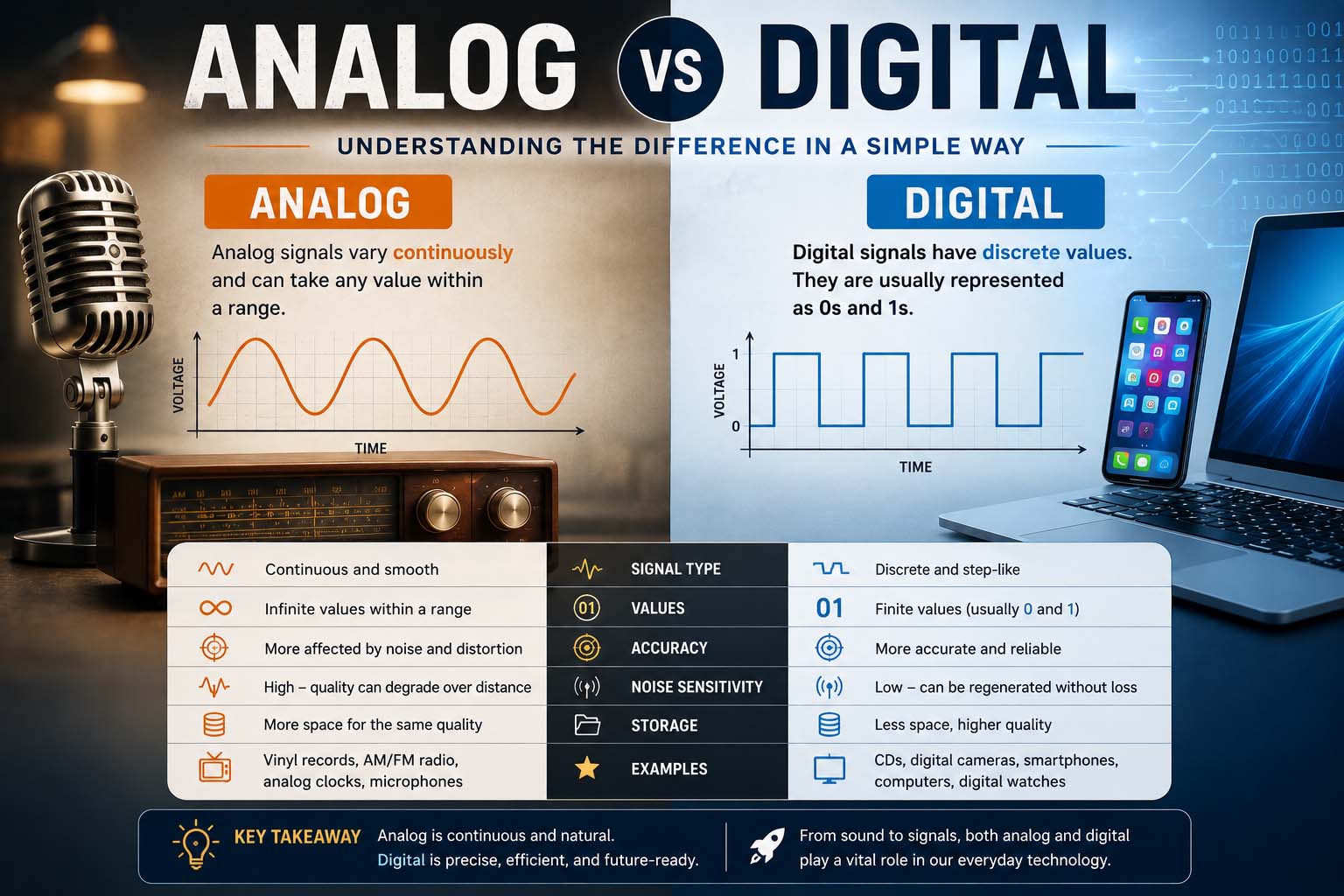
Analog refers to information represented by a continuously varying quantity. In other words, the signal can change smoothly across a range rather than moving only between predefined values.
For example, consider a traditional clock with moving hands. The hands move continuously around the face rather than displaying time only as separate numerical readings.
Other familiar analog examples include:
- Traditional analog clocks
- Vinyl records
- Some radio systems
- Analog gauges
- Certain microphones and sensors
Therefore, when comparing analog and digital systems, remember that analog representation follows continuous changes.
What Is Digital Technology?
Digital technology represents information using discrete values. In computing and many electronic systems, these values are ultimately represented using binary states associated with 0 and 1.
Common digital devices include:
- Smartphones
- Computers
- Smart TVs
- Digital cameras
- Digital thermometers
- Streaming devices
- Digital storage systems
As a result, digital information can be processed, copied, stored, edited, and transmitted efficiently by computers and other electronic devices.
Analog vs Digital at a Glance
The following comparison shows the basic analog vs digital difference:
| Feature | Analog | Digital |
|---|---|---|
| Representation | Continuous | Discrete |
| Signal | Continuously varying | Uses defined levels or values |
| Noise | Can directly affect the represented signal | Can often be detected or corrected within limits |
| Copying | Copies may accumulate degradation | Data can often be copied without changing the stored information |
| Storage | May use physical analog media | Usually uses digital storage |
| Editing | Often more difficult | Generally easier |
| Examples | Vinyl, analog gauges | Computers, smartphones, digital files |
However, these are general differences. Actual performance depends on the device, design, conversion process, storage medium, and application.
Digital vs Analog: What Is the Main Difference?
When comparing digital vs analog, the fundamental difference is how information is represented.
Analog systems represent changing information continuously. Digital systems, however, represent information using discrete values.
Consider recorded sound.
An analog recording can represent variations in the original sound through corresponding physical or electrical changes. A digital recording, by comparison, samples the incoming signal and represents those measurements numerically.
Therefore, both systems can represent the same original information even though they use different methods.
Analog vs Digital Signals
Understanding signals is one of the easiest ways to understand the overall analog vs digital comparison.
A signal carries information. However, analog and digital signals represent that information differently.
Analog Signal
An analog signal changes continuously over time.
Examples can include:
- Microphone signals
- Sensor outputs
- Temperature measurements
- Audio waveforms
- Some radio signals
Because the signal varies continuously, small changes in the measured physical quantity can appear as corresponding changes in the electrical signal.
Digital Signal
A digital signal represents information using discrete states or levels.
Examples include signals involved in:
- Computer systems
- USB communication
- Digital networks
- Digital storage interfaces
- Many electronic control systems
Consequently, digital electronics can process the represented information using logic circuits.
Electronic systems also depend on electrical circuits to control and transfer signals. Our guide to What Is a Circuit explains those fundamentals in more detail.
Difference Between Analog and Digital Systems
The difference between analog and digital systems extends beyond the shape of a signal.
An analog system processes continuously varying quantities. A digital system processes discrete representations of information.
For example, an analog measuring instrument may move a pointer continuously as the measured quantity changes. A digital instrument can instead convert the measurement into numerical data and display a specific value.
Therefore, the difference is not simply that one technology is old and the other is new. Both approaches can be useful depending on the application.
Analog vs Digital Signal Transmission
Signal transmission provides another useful comparison.
Analog transmission carries continuously varying information. As noise or interference enters the transmission path, it may become part of the received signal.
Digital communication works differently. Because the receiver interprets defined symbols or states, a sufficiently clear digital signal can often be regenerated rather than simply amplified along with accumulated noise.
However, digital transmission is not immune to interference. If distortion or noise becomes severe enough, data errors can still occur.
Engineers must also consider electrical properties such as impedance when designing signal paths. You can learn more in our guide to What Is Impedance.
Analog vs Digital Examples in Everyday Life
Many everyday technologies make the analog vs digital examples easy to understand.
| Analog Example | Digital Example |
|---|---|
| Analog clock | Digital clock |
| Vinyl record | Digital audio file |
| Film photography | Digital photography |
| Analog gauge | Digital display |
| Traditional analog audio recording | Digital audio recording |
| Analog measurement signal | Digitally processed measurement |
Nevertheless, some devices cannot be classified as purely analog or purely digital because they use both technologies.
A smartphone is a good example. Your voice begins as physical sound waves. A microphone converts those changes into an electrical signal, and the phone can then convert that signal into digital information for processing or transmission.
Analog and Digital Devices
Another common search question concerns analog and digital devices.
Analog devices work directly with continuously varying signals or quantities. Meanwhile, digital devices process information in discrete form.
Common Analog Devices
Examples may include:
- Analog gauges
- Traditional analog clocks
- Some audio equipment
- Certain sensors
- Vinyl playback equipment
Common Digital Devices
Examples include:
- Smartphones
- Computers
- Digital cameras
- Calculators
- Smartwatches
- Digital storage devices
However, many modern products contain both analog and digital components internally.
For example, sensors often detect real-world physical changes before electronics convert those measurements into digital information. Our explanation of What Is a Transducer provides more background on this process.
Analog vs Digital Media
The analog vs digital media comparison is especially easy to see in music, photography, and video.
Analog media stores information through continuously varying physical characteristics. Examples include vinyl records and magnetic tape.
Digital media stores encoded data. Examples include digital photographs, audio files, videos, and documents.
One major advantage of digital media is convenient duplication and distribution. Digital files can also be searched, edited, compressed, backed up, and transmitted using computer systems.
On the other hand, some people continue to prefer particular analog formats because of their physical experience, artistic qualities, collecting appeal, or personal preferences.
Advantages of Analog Systems
Analog technology still offers useful characteristics.
For example, advantages can include:
- Direct representation of continuously varying quantities
- Simple implementations for certain applications
- Immediate response in some measurement systems
- Natural integration with many physical sensors
- Useful operation in specialized audio and electronic systems
Moreover, the physical world itself contains continuously changing quantities such as sound pressure, temperature, light intensity, and motion. Therefore, analog interfaces remain important even in highly digital systems.
Advantages of Digital Systems
Digital technology offers several practical advantages, which helps explain its widespread use.
Advantages can include:
- Convenient data storage
- Easy editing and processing
- Efficient copying
- Error detection and correction possibilities
- Easy integration with computers
- Fast data transmission
- Encryption capabilities
- Compact storage
- Programmable processing
As a result, digital systems are particularly suitable for computing, telecommunications, multimedia, data analysis, and modern electronics.
During technology development, engineers also need to determine whether systems meet specifications and user requirements. Our Verification vs Validation guide explains that distinction.
Disadvantages of Analog Technology
Despite its usefulness, analog technology has limitations.
For instance:
- Noise can directly affect signal quality.
- Copies of analog media may accumulate degradation.
- Physical media can deteriorate.
- Long-distance transmission may require careful amplification and conditioning.
- Editing and duplication can be less convenient than with digital data.
For example, repeatedly copying an analog recording can introduce additional degradation.
Nevertheless, these limitations do not mean analog technology is obsolete. It remains valuable wherever continuous physical signals must be measured or controlled.
Disadvantages of Digital Technology
Digital systems also have disadvantages.
Possible limitations include:
- Conversion between real-world analog quantities and digital data requires additional circuitry.
- Sampling and quantization introduce finite resolution.
- Digital processing requires appropriate hardware and software.
- Electronic systems depend on reliable power and components.
- Digital storage devices can fail.
- Software and file formats can become obsolete.
- Data can become corrupted.
Therefore, digital does not automatically mean perfect.
Understanding electrical concepts such as Volts vs Amps can also help beginners understand how electronic devices receive and use electrical power.
Analog and Digital Systems Working Together
Analog and digital technologies are often presented as competitors. In reality, however, modern electronics frequently combine them.
Consider a smartphone call.
First, your voice creates continuously changing sound pressure. Next, the microphone converts those changes into an electrical signal. An analog-to-digital converter can then represent that signal as digital data for processing and transmission.
At the receiving end, the device can convert digital information back into an analog electrical signal. Finally, a speaker turns that signal into sound waves.
Therefore, modern digital technology still relies heavily on interfaces with the analog physical world.
For a deeper technical introduction to digital conversion and measurement, the National Institute of Standards and Technology guide to analog-to-digital converters provides information about ADC testing and measurement.
Is Digital Better Than Analog?
The GSC queries for this article show that readers specifically want to know is digital better than analog and digital vs analog: which is better.
There is no universal winner.
Digital is often better when you need convenient storage, processing, copying, editing, transmission, or integration with computers.
Analog can be appropriate when working directly with continuously changing physical quantities or when a particular analog implementation suits the application.
Therefore, the better choice depends on what the system needs to accomplish.
Why Is Digital Better Than Analog for Many Applications?
People often ask why digital is better than analog because digital technology dominates modern electronics.
Digital systems are particularly useful because information can be:
- Stored efficiently
- Processed by computers
- Copied reliably
- Encrypted
- Compressed
- Transmitted across networks
- Edited using software
- Analyzed automatically
Furthermore, digital systems can use error-detection and correction techniques that are extremely valuable in communication and storage.
However, saying digital is universally better would be misleading. Analog components still provide essential connections between electronic systems and physical phenomena.
Can Analog Be Better Than Digital?
Yes, depending on the application.
An analog solution may be simpler for a particular measurement or control task. Likewise, musicians and listeners may choose analog equipment because they prefer its workflow, physical format, or sound characteristics.
Therefore, analog vs digital should not always be treated as a contest. Engineers usually choose whichever approach best satisfies the technical requirements.
Difference Between Analog and Digital Output
Another GSC query asks about the difference between analog and digital output.
An analog output varies continuously across a range. For example, a sensor might provide a voltage that changes according to temperature, pressure, or another measured quantity.
A digital output, by comparison, communicates information using defined states or encoded digital values.
As a result, analog output is useful when a continuously varying signal is required, while digital output works naturally with computers, controllers, and digital communication systems.
Common Misunderstandings About Analog vs Digital
Several misconceptions can make the comparison confusing.
Analog Means Outdated
Analog does not simply mean old technology.
Although many older devices were analog, modern electronics still use analog circuits, sensors, amplifiers, microphones, radio-frequency components, and other analog technologies.
Digital Is Always More Accurate
Not necessarily.
Accuracy depends on the complete system, including sensors, converters, resolution, calibration, noise, component quality, processing, and design.
Therefore, a device being digital does not automatically make its measurements more accurate than every analog alternative.
Analog Always Has Better Quality
This is also too broad.
Quality depends on the application and implementation. High-quality digital systems can reproduce information extremely accurately, while analog systems may have characteristics that some users personally prefer.
Digital Signals Never Have Noise
Digital systems can also experience electrical noise and interference.
However, digital receivers can often distinguish valid states despite moderate disturbances. If interference becomes severe enough, though, errors can occur.
Frequently Asked Questions About Analog vs Digital
What Is Analog and Digital?
Analog represents information using continuously varying quantities. Digital represents information using discrete values that electronic systems can process and store.
What Is the Main Difference Between Analog and Digital?
The main analog vs digital difference is representation. Analog varies continuously, whereas digital uses discrete values.
What Are Some Analog vs Digital Examples?
Common examples include an analog clock versus a digital clock, vinyl versus digital audio, film photography versus digital photography, and an analog gauge versus a digital display.
Is Digital Better Than Analog?
Digital is better for many computing, storage, communication, and processing applications. However, analog remains useful for sensing, measurement, audio, electronics, and other applications involving continuously varying physical quantities.
Why Is Digital Better Than Analog for Data Storage?
Digital information can be copied, processed, compressed, searched, transmitted, and backed up efficiently. Therefore, digital formats are highly practical for large-scale data storage.
Are Analog Signals Still Used Today?
Yes. Analog signals remain essential in sensors, microphones, audio systems, measurement equipment, communications, and electronic interfaces.
Can Analog and Digital Work Together?
Yes. In fact, many modern electronic devices depend on both. A system may receive an analog signal, convert it into digital data for processing, and later convert the information back into analog form.
What Is the Difference Between Analog and Digital Systems?
Analog systems process continuously varying signals, whereas digital systems process discrete representations of information. However, many real-world systems combine both approaches.
What Is Analog vs Digital Media?
Analog media represents information through continuously varying physical characteristics, while digital media stores encoded data. Vinyl and magnetic tape are familiar analog examples, whereas digital audio files and digital video are digital media examples.
Final Thoughts on Analog vs Digital
Understanding analog vs digital provides a foundation for learning how modern technology handles information. Analog systems represent continuously varying quantities, whereas digital systems use discrete values that computers and electronic devices can process efficiently.
Digital technology offers major advantages for storage, processing, copying, editing, and communication. However, analog technology remains essential because the physical world contains continuously changing signals such as sound, temperature, pressure, light, and motion.
Therefore, the question is not simply whether digital or analog is better. Instead, the right technology depends on the application. In many modern devices, analog and digital systems work together, combining continuous real-world measurements with the speed and flexibility of digital processing.