Have you ever flipped a light switch, pressed a keyboard key, or powered on a computer without thinking about what happens behind the scenes? The answer lies in the many types of switches used in homes, electronics, industrial systems, and modern smart devices. Although they all perform the same basic job—opening or closing an electrical circuit—they come in many designs built for different purposes.
Whether you’re learning electronics, upgrading your home, or choosing mechanical keyboard switches, understanding the different types of switches makes selecting the right one much easier.
What Are Types of Switches?
A switch is a device that controls the flow of electricity by either completing or interrupting an electrical circuit. When the switch is turned on, electrical current flows through the circuit. When it is turned off, the current stops.
If you’re new to electrical systems, understanding What Is a Circuit first makes it easier to see how switches control the movement of electricity through connected components.
Switches range from simple mechanical designs found in household lighting to highly advanced electronic switches used in robotics, automation, networking equipment, and consumer electronics.
How Switches Work
Every switch performs one essential function:
- Connect a circuit
- Disconnect a circuit
Although this sounds simple, manufacturers have developed hundreds of switch designs optimized for specific tasks.
Most switches fall into one of two categories:
Mechanical Switches
Mechanical switches use moving parts that physically make or break electrical contact.
Examples include:
- Toggle switches
- Push-button switches
- Rocker switches
- Rotary switches
- Slide switches
These remain the most common switches in homes and workplaces.
Electronic Switches
Electronic switches rely on semiconductor components instead of moving contacts.
Examples include:
- Transistors
- MOSFETs
- Solid-state relays
- Integrated circuits
These switches are found in computers, smartphones, industrial automation, and smart home devices.
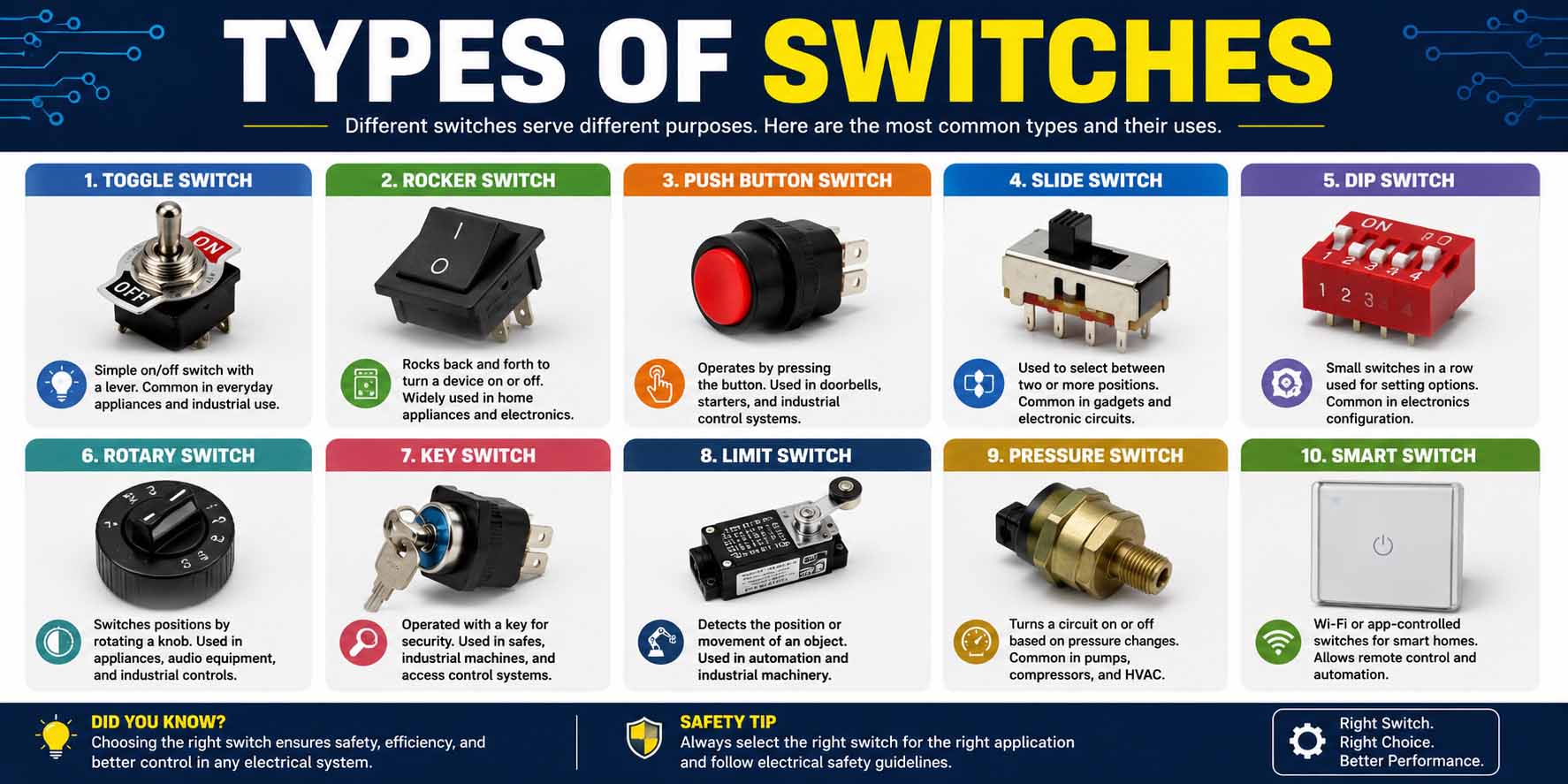
Different Types of Switches at a Glance
| Switch Type | Operation | Common Applications |
|---|---|---|
| Toggle | Lever | Lighting, machinery |
| Rocker | Rocking button | Household appliances |
| Push Button | Press | Doorbells, elevators |
| Slide | Sliding mechanism | Small electronics |
| Rotary | Rotating knob | Audio equipment |
| DIP | Tiny manual switches | Circuit boards |
| Limit | Mechanical detection | Industrial automation |
| Smart Switch | Wireless control | Smart homes |
| Keyboard Switch | Key press | Mechanical keyboards |
Each design offers unique advantages depending on how often it will be used and the environment where it operates.
Types of Switches for Home and Electrical Systems
Residential electrical systems use several common switch designs.
Toggle Switch
The classic toggle switch remains one of the most recognizable electrical devices.
Advantages include:
- Simple operation
- Affordable
- Long lifespan
- Easy installation
They’re commonly used for room lighting and electrical equipment.
Rocker Switch
Rocker switches have largely replaced toggle switches in many modern homes.
Instead of moving a lever, users press one side of a flat surface.
Benefits include:
- Modern appearance
- Easy operation
- Smooth movement
- Child-friendly design
They’re popular in appliances, vehicles, and smart home controls.
Push Button Switch
Push-button switches either activate only while the button is pressed or lock into an on or off position, depending on their design and intended application.
You’ll find them in:
- Doorbells
- Elevators
- Computer power buttons
- Industrial machinery
Types of Light Switches
When homeowners search for types of light switches, they often discover there are far more options than the standard wall switch.
Popular choices include:
Single-Pole Switch
Controls one light from one location.
This is the most common type of switch used in residential electrical installations.
Three-Way Switch
Allows one light fixture to be controlled from two separate locations.
Examples include:
- Hallways
- Staircases
- Large living rooms
Four-Way Switch
Works alongside two three-way switches to control lighting from three or more locations.
Dimmer Switch
Instead of simply turning lights on and off, dimmers adjust brightness.
Benefits include:
- Energy savings
- Mood lighting
- Extended bulb life
Smart Switch
Smart switches connect through Wi-Fi, Zigbee, Matter, or other smart home technologies.
Many allow:
- Voice control
- Smartphone operation
- Scheduling
- Remote access
If you’re deciding between different types of light switches, smart switches offer the greatest flexibility, while traditional toggle switches remain the simplest and least expensive.
Types of Keyboard Switches
Mechanical keyboards have become increasingly popular among gamers, programmers, and writers.
The most common types of keyboard switches are:
Linear Switches
Characteristics:
- Smooth movement
- No tactile bump
- Quiet operation
- Fast actuation
Best for:
- Gaming
- Rapid typing
Examples include Cherry MX Red and similar designs.
Tactile Switches
These provide a noticeable bump during key presses.
Advantages include:
- Better typing feedback
- Fewer accidental key presses
- Comfortable for office work
Popular examples include Cherry MX Brown.
Clicky Switches
Clicky switches combine tactile feedback with an audible click.
They’re preferred by users who enjoy traditional mechanical keyboard sounds.
Examples include Cherry MX Blue.
Choosing among the types of keyboard switches depends largely on personal preference rather than one design being objectively better.
Industrial Switches
Factories and automated production lines rely on specialized switches built for durability and safety.
Limit Switches
These switches detect physical movement.
Applications include:
- Conveyor belts
- Robotic arms
- Automated doors
- Manufacturing equipment
Selector Switches
Operators rotate selector switches to choose machine modes.
Common positions include:
- Off
- Manual
- Automatic
Emergency Stop Switches
Large red emergency buttons immediately disconnect power during dangerous situations.
These are required on many industrial machines.
Industrial automation frequently combines these devices with control components. Understanding how does a relay work helps explain how switches can safely control much larger electrical loads without carrying the full operating current themselves.
Analog and Digital Switching
Modern electronics rely on both analog and digital switching methods.
Traditional mechanical switches usually operate in simple on/off states.
Electronic systems, however, often process switching signals digitally.
If you’re comparing analog vs digital, digital switching offers greater precision, programmability, and integration with modern computing systems, while analog circuits continue to play important roles in audio equipment, sensors, and measurement devices.
Choosing the Right Switch
Selecting the best switch depends on several factors.
Consider:
- Electrical load
- Voltage rating
- Current rating
- Indoor or outdoor use
- Frequency of operation
- Environmental conditions
- Safety requirements
- Ease of installation
A switch that performs well in a home may be completely unsuitable for industrial machinery or automotive systems.
Common Switch Specifications
Before purchasing a switch, review these specifications carefully.
| Specification | Why It Matters |
| Voltage Rating | Maximum safe operating voltage |
| Current Rating | Maximum electrical load |
| Contact Type | Normally open or normally closed |
| Operating Force | Ease of activation |
| Mechanical Life | Expected number of operations |
| Environmental Rating | Resistance to dust and moisture |
Matching these specifications to your application improves both safety and long-term reliability.
Different Types of Switches Used in Electronics
Modern electronic devices contain dozens or even hundreds of switches working behind the scenes. Unlike traditional wall switches, many of these components operate automatically.
Slide Switches
Slide switches move horizontally between two or more positions.
You’ll commonly find them in:
- Portable speakers
- Toys
- Flashlights
- Small battery-powered devices
They’re inexpensive, reliable, and easy to integrate into compact products.
Rotary Switches
Rotary switches rotate through multiple positions instead of simply turning on or off.
Common uses include:
- Audio amplifiers
- Test equipment
- Industrial control panels
- Fan speed selectors
Because one rotary switch can select several circuits, it reduces the need for multiple separate switches.
DIP Switches
Dual In-line Package (DIP) switches are tiny manual switches mounted directly on circuit boards.
They’re often used to:
- Configure hardware settings
- Assign device addresses
- Enable or disable specific features
Although software settings have replaced many DIP switches, they’re still widely used in networking equipment and industrial electronics.
Types of Switches for Smart Homes
Smart home technology has changed how people interact with lighting and appliances.
Modern smart switches connect through:
- Wi-Fi
- Zigbee
- Z-Wave
- Matter
- Bluetooth
Many models support voice assistants such as Alexa, Google Assistant, or Apple Home.
Benefits of Smart Switches
Smart switches offer several advantages:
- Remote control from anywhere
- Scheduled automation
- Energy monitoring on some models
- Voice activation
- Integration with security systems
They’re an excellent upgrade for homeowners who want added convenience without replacing every light fixture.
Mechanical vs Electronic Switches
Choosing between mechanical and electronic switches depends on the application.
| Feature | Mechanical Switch | Electronic Switch |
|---|---|---|
| Moving Parts | Yes | No |
| Speed | Fast | Extremely fast |
| Wear Over Time | Higher | Lower |
| Audible Click | Often | Usually silent |
| Power Consumption | Very low | Low |
| Common Uses | Homes, machinery | Computers, automation |
Mechanical switches remain the best option for manual operation, while electronic switches dominate modern consumer electronics.
Common Problems and Troubleshooting
Even high-quality switches can develop issues after years of use.
Switch Doesn’t Turn On
Possible causes include:
- Loose wiring
- Worn contacts
- Blown fuse
- Failed switch mechanism
Start by disconnecting power before inspecting any electrical switch.
Flickering Lights
A flickering light may result from:
- Loose switch terminals
- Faulty light bulb
- Damaged wiring
- Poor electrical connection
If the problem continues after replacing the bulb, consult a qualified electrician.
Switch Feels Hot
Warm switches can sometimes occur under heavy electrical loads.
However, excessive heat may indicate:
- Overloaded circuit
- Loose wiring
- Internal switch failure
Stop using the switch until the issue has been inspected.
Best Practices for Safe Switch Installation
Whether you’re replacing a light switch or installing industrial controls, safety comes first.
Follow these guidelines:
- Turn off power at the breaker panel.
- Verify the circuit is de-energized with a tester.
- Match the switch voltage and current ratings.
- Follow the manufacturer’s wiring instructions.
- Use properly insulated tools.
- Tighten terminal connections securely.
- Test the switch before restoring normal use.
If you’re unfamiliar with household wiring, hiring a licensed electrician is the safest option.
Why Switch Ratings Matter
Every switch has limits.
Using an underrated switch may lead to:
- Excessive heat
- Contact damage
- Equipment failure
- Fire hazards
Pay attention to specifications such as:
- Voltage
- Current
- Duty cycle
- Environmental protection
- Temperature range
Industrial environments often require switches designed for moisture, dust, vibration, or corrosive conditions.
How Switches Work in Larger Electrical Systems
Individual switches rarely operate alone.
Many electrical systems combine switches with relays, sensors, circuit breakers, controllers, and protection devices.
For example, a wall switch activates a lighting circuit, while a relay may control larger equipment using that same low-power signal.
Likewise, electrical protection devices disconnect power during dangerous conditions. If you’ve ever wondered why does a breaker trip, overloads, short circuits, and ground faults are among the most common reasons. Breakers protect both wiring and switches from excessive current.
Some systems also rely on what is a series circuit concepts when connecting multiple components, although many household electrical installations use parallel wiring for greater reliability.
Frequently Asked Questions About Types of Switches
What are the most common types of switches?
The most common switches include:
- Toggle switches
- Rocker switches
- Push-button switches
- Slide switches
- Rotary switches
- Smart switches
- Keyboard switches
- Limit switches
Each serves different residential, commercial, or industrial purposes.
Which light switch is best for a home?
For most homes, single-pole switches remain the standard choice. However, dimmer switches work well for living rooms and bedrooms, while smart switches provide added convenience through automation and remote control.
What are the different types of light switches?
Common options include:
- Single-pole
- Three-way
- Four-way
- Dimmer
- Smart
- Motion-sensor
- Timer switches
The best option depends on your lighting layout and how you want to control it.
Which keyboard switch is best?
There’s no universal answer.
- Linear switches suit fast-paced gaming.
- Tactile switches balance gaming and typing.
- Clicky switches provide the strongest feedback for users who enjoy audible key presses.
Trying a keyboard switch tester before buying can help you find your preference.
How long do switches last?
Quality mechanical switches often last for tens of thousands of operations.Premium keyboard switches are often rated for 50 to 100 million keystrokes, while industrial-grade switches are engineered to withstand harsh operating conditions and provide reliable performance over many years of continuous use..
Choosing the Right Switch for Your Needs
With so many types of switches available, the right choice depends on where and how you’ll use them. A simple toggle switch may be perfect for a utility room, while a smart switch adds convenience to a connected home. For gaming or office work, the feel of a keyboard switch can noticeably improve comfort and productivity.
Before buying, compare electrical ratings, operating style, durability, and intended application instead of focusing only on price. A properly matched switch provides better performance, lasts longer, and improves safety.
Whether you’re upgrading your home, building an electronics project, or learning how electrical systems work, understanding the different types of switches gives you the confidence to choose the right solution for every application.