Open a faucet, run an air conditioner, inflate a bicycle tire, or operate industrial equipment and there is a good chance a valve is controlling something behind the scenes. The many types of valves regulate liquids and gases by starting, stopping, restricting, redirecting, or preventing flow. Although their basic purpose sounds simple, different valve designs can behave very differently under pressure.
Choosing the correct design matters because a valve that works perfectly as a simple water shutoff may perform poorly when precise flow control is needed. Temperature, pressure, fluid properties, pipe diameter, required flow rate, and automation also affect the decision.
Here is how the major valve designs work and where each one makes sense.
What Is a Valve and How Does It Work?
A valve is a mechanical device that controls the movement of a fluid through a pipe, hose, passage, or piece of equipment. In engineering, “fluid” can mean either a liquid or a gas.
Most valves control flow by moving an internal component. Depending on the design, that component may be a ball, disc, gate, plug, needle, or flexible diaphragm.
For example, rotating a ball valve by 90 degrees can align an opening in the ball with the pipe. Fluid then passes through. Turn the ball another 90 degrees, and its solid surface blocks the passage.
Some valves work automatically instead. A check valve, for instance, responds to the direction and pressure of the fluid rather than waiting for someone to turn a handle.
Valves also frequently operate as part of a larger distribution arrangement. Understanding what is a manifold can help explain these systems because manifolds often use multiple valves to distribute, isolate, or combine separate fluid paths.
Main Types of Valves and Their Uses
Valve designs have evolved around different jobs. Therefore, no single type is best for every system.
1. Ball Valves
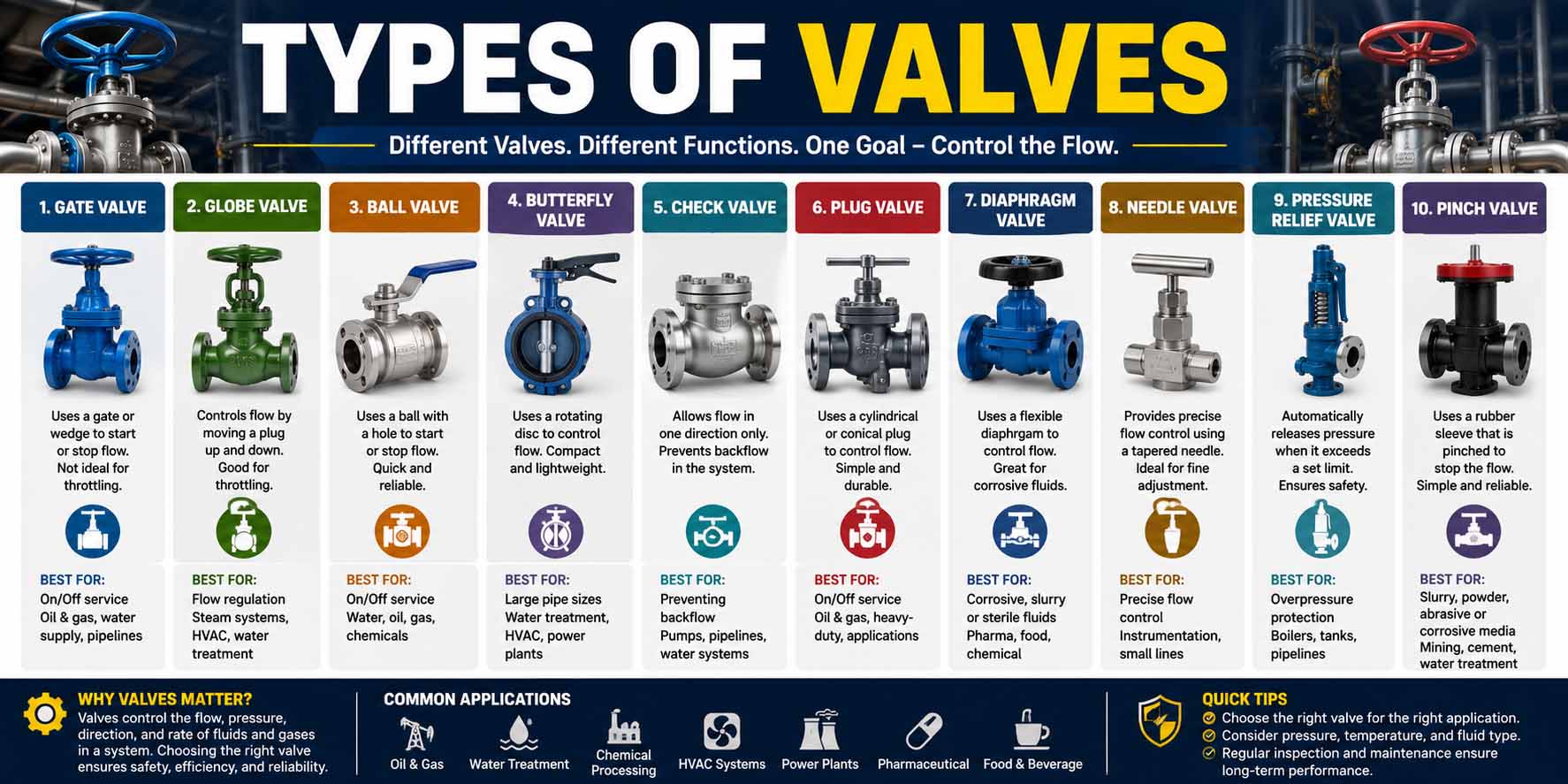
A ball valve contains a spherical internal component with a hole through its center. When the hole aligns with the pipe, fluid flows through it. When the ball rotates, the solid portion blocks the passage.
Most manual ball valves use quarter-turn operation. As a result, users can quickly tell whether the valve is open or closed by looking at the handle position.
Ball valves provide reliable shutoff and relatively low flow resistance when fully open. Consequently, they are common in plumbing, industrial piping, compressed-air systems, fuel systems, and process equipment.
However, a standard ball valve is usually better for isolation than fine throttling.
2. Gate Valves
Gate valves control flow by raising or lowering a gate-shaped barrier inside the valve body.
When fully open, the gate moves largely out of the flow path. Therefore, the fluid can pass through with relatively little obstruction.
Gate valves suit applications where a line needs to be either fully open or fully closed. They are common in water distribution networks, industrial piping, and larger pipelines.
However, partially opening a gate valve for long-term flow control can cause vibration, wear, and damage to sealing surfaces. For that reason, gate valves are generally treated as isolation valves rather than throttling devices.
3. Globe Valves
Globe valves are designed for better flow regulation.
Inside the valve, a movable plug or disc approaches or moves away from a stationary seat. Changing this distance changes how much fluid can pass.
Because operators can adjust the opening gradually, globe valves offer more precise throttling than typical gate valves. However, their internal flow path usually creates a larger pressure drop.
They commonly appear in cooling water, steam, process piping, and other systems that need controlled flow rather than simple on/off operation.
4. Butterfly Valves
A butterfly valve uses a disc mounted inside the flow passage. Turning the shaft rotates the disc.
When open, the disc sits roughly parallel to the direction of flow. When closed, it rotates across the passage and contacts a sealing surface.
Butterfly valves are compact and relatively lightweight, especially at larger pipe diameters. Therefore, they appear frequently in water systems, HVAC installations, industrial piping, and treatment plants.
However, the disc remains in the flow path even when the valve is fully open. That feature affects pressure loss and flow behavior.
5. Check Valves
Check valves are designed to prevent reverse flow.
Unlike common manual valves, they usually operate automatically.
Swing check, lift check, ball check, and spring-loaded check valves are common variations.
Pumps often rely on check valves to prevent water or another fluid from moving backward after the pump stops. Likewise, many plumbing and process systems use them to protect equipment from unwanted reverse flow.
Other Types of Valves for Specialized Control
Some applications need more than basic isolation or backflow protection. In those situations, specialized valve designs provide finer control or safety functions.
Needle Valves
A needle valve uses a long, tapered plunger that moves into a small opening.
Because the opening changes gradually as the stem moves, the valve can provide fine control over relatively small flow rates. Therefore, needle valves are common in instrumentation, gas systems, hydraulic circuits, and test equipment.
They are generally less suitable for quickly moving large volumes of fluid.
Diaphragm Valves
Diaphragm valves use a flexible membrane to regulate or stop flow.
The diaphragm separates some operating components from the process fluid. Consequently, this design is well suited for handling corrosive liquids, slurries, and fluids where minimizing contamination is important.
Material compatibility remains essential because the diaphragm must tolerate the fluid, temperature, pressure, and expected number of operating cycles.
Pressure-Relief Valves
A pressure-relief or safety valve protects equipment from excessive pressure.
When system pressure exceeds a predetermined limit, the valve opens and allows fluid to escape or move to a safer path. Once conditions return to an acceptable range, some designs close automatically.
These valves serve a safety function, so selection and settings should follow the relevant equipment specifications, codes, and engineering requirements.
Solenoid Valves
Applying electrical power creates a magnetic field that moves a plunger or similar component. As a result, a control system can start or stop fluid flow without a person manually operating the valve.
Their behavior can also illustrate open loop vs closed loop control. A basic timer might switch a solenoid without measuring the result, while a closed-loop system can use sensor feedback to adjust operation based on pressure, temperature, or flow.
Types of Water Valves
The types of water valves used in buildings and infrastructure vary according to their job.
Ball valves are now common for shutoff applications because they operate quickly and provide clear handle positioning. Gate valves also remain present in many water systems, especially in older installations and larger distribution networks.
Check valves prevent water from reversing direction, while pressure-reducing valves help maintain a lower downstream pressure when supply pressure is too high.
Butterfly valves become particularly useful on larger water lines because their compact design can reduce size and weight compared with some alternatives.
Material selection matters as well. Water valves may use brass, bronze, plastics, cast or ductile iron, carbon steel, or stainless steel depending on pressure, temperature, water chemistry, size, and applicable standards.
For demanding industrial environments, understanding stainless steel vs carbon steel helps explain why valve-body material affects corrosion resistance, cost, mechanical properties, and service life.
Types of Water Shut Off Valves
The types of water shut off valves found in homes include both whole-building isolation valves and smaller fixture valves.
A main shutoff valve stops the incoming water supply. Depending on the plumbing system, this may be a ball valve, gate valve, or another approved design.
Fixture shutoff valves sit closer to sinks, toilets, and appliances. Angle-stop valves are particularly common where the supply pipe comes from a wall and must turn toward a fixture.
Quarter-turn fixture valves are convenient because a short handle movement changes them from fully open to closed.
Older multi-turn valves often use a stem and washer arrangement. Although they can work for years, seals and washers may eventually wear, resulting in leakage around the stem or seat.
Types of Shower Valves
Shower plumbing requires more than simply turning water on and off.
Common types of shower valves include mixing, pressure-balancing, and thermostatic designs.
A basic mixing valve combines hot and cold water according to handle position. Meanwhile, a pressure-balancing valve reacts when the pressure of one supply changes. This response helps reduce sudden temperature swings.
Thermostatic valves take a different approach. They respond to changes in water temperature by automatically adjusting the balance of hot and cold water to maintain the selected temperature within their designed operating range.
These valves contain precision components, so mineral buildup, damaged cartridges, blocked inlets, or worn seals can affect performance over time.
Valves in HVAC and Cooling Systems
Heating and cooling equipment depends heavily on controlled movement of water, refrigerant, air, or gas.
For example, HVAC water loops may use ball valves for isolation, balancing valves for flow adjustment, and control valves connected to actuators for automatic regulation.
Refrigeration systems use specialized devices, such as expansion valves, to regulate the flow of refrigerant entering the evaporator and maintain efficient cooling performance.. Meanwhile, compressors and other components depend on pressure differences to keep refrigerant moving through the cycle.
If you are learning how does an air conditioner work, valve behavior is a useful part of the bigger picture because refrigerant flow and pressure control directly affect heat transfer.
Types of Bike Tire Valves
Not every valve belongs to a pipe. Bicycle tires use small valves to let air enter while preventing it from escaping.
The two most familiar types of bike tire valves are Schrader and Presta.
Schrader valves are wider and resemble the valves commonly found on automobile tires. They contain a spring-loaded center pin and are widely used on many recreational, mountain, and utility bicycles.
Presta valves are narrower and common on road bikes and many performance-oriented wheels. Their slim body works with narrower rim holes, and a small threaded nut at the tip closes the valve.
A less common Dunlop or Woods valve also appears on bicycles in some regions.
Pump compatibility matters, so riders should check which valve type their pump head supports before inflation.
How to Choose the Right Valve
Start by defining what the valve actually needs to do. If the goal is simple isolation, a ball or gate valve may be suitable.
Next, check the operating pressure and temperature. Every valve has operating limits, and exceeding them can damage seals, valve bodies, stems, and other critical components, potentially causing leaks or premature failure.
Then consider the fluid itself. Clean water, steam, compressed air, refrigerant, corrosive chemicals, viscous liquids, and slurries place very different demands on internal components.
Flow conditions matter too. Rapid pressure changes and poor valve selection can contribute to noise, vibration, erosion, and other problems. In liquid systems, understanding what is cavitation is especially useful because vapor bubbles can form and collapse in low-pressure regions, potentially damaging valve surfaces.
Finally, consider operation. A manually operated valve may be enough for occasional isolation, while an automated process may require pneumatic, hydraulic, or electric actuation.
Common Valve Problems and Troubleshooting
Valve trouble often appears as leakage, difficult operation, poor flow control, unusual noise, or failure to close completely.
If a valve leaks around the stem, worn packing or seals may be responsible. Meanwhile, leakage through a supposedly closed valve can point to debris, seat damage, internal wear, or an incorrectly positioned closure element.
A valve that becomes difficult to turn may have corrosion, deposits, mechanical damage, excessive pressure loading, or a failing actuator.
Unusual noise deserves attention as well. High flow velocity, flashing, cavitation, vibration, or an improperly sized control valve can all create sound.
Rather than applying excessive force to a stuck valve, identify the cause first. For pressurized, high-temperature, chemical, gas, refrigerant, or safety-critical systems, qualified service personnel should handle diagnosis and repair.
Frequently Asked Questions About Types of Valves
What are the most common types of valves?
Ball, gate, globe, butterfly, check, needle, diaphragm, relief, and solenoid valves are among the most widely encountered designs. However, specialized industries use many other configurations.
Which valve is best for shutting off water?
Ball valves are a popular choice for many modern water shutoff applications because they provide quick quarter-turn operation and effective isolation. Still, the correct valve must match the pipe, pressure, temperature, installation requirements, and local plumbing rules.
What is the difference between a gate valve and a ball valve?
A gate valve raises or lowers an internal gate and typically requires several handle turns. In contrast, a standard ball valve rotates a drilled ball by about 90 degrees, making operation much faster.
Which valve is best for flow control?
Globe valves work well for many throttling applications, while needle valves provide finer adjustment at smaller flow rates. Control valves with actuators are often preferred when automated regulation is required.
Do valves have a flow direction?
Some do. Check valves, many control valves, pressure regulators, and various specialized designs must be installed in the specified direction. Therefore, check the body markings and manufacturer instructions before installation.
A Practical Way to Think About Valve Selection
Learning the types of valves becomes easier when you focus on function rather than memorizing names. Ball and gate valves primarily handle isolation, globe and needle valves offer greater flow control, check valves prevent reverse flow, and relief valves protect systems against excessive pressure.
After identifying the required function, compare pressure, temperature, fluid compatibility, flow characteristics, pipe size, material, actuation method, and maintenance needs. For ordinary plumbing, those checks help prevent annoying leaks and poor performance. In industrial or safety-critical equipment, they can also prevent costly damage and hazardous failures.
A valve may be only one component in a larger system, yet selecting the right design has a direct effect on efficiency, reliability, controllability, and service life.