
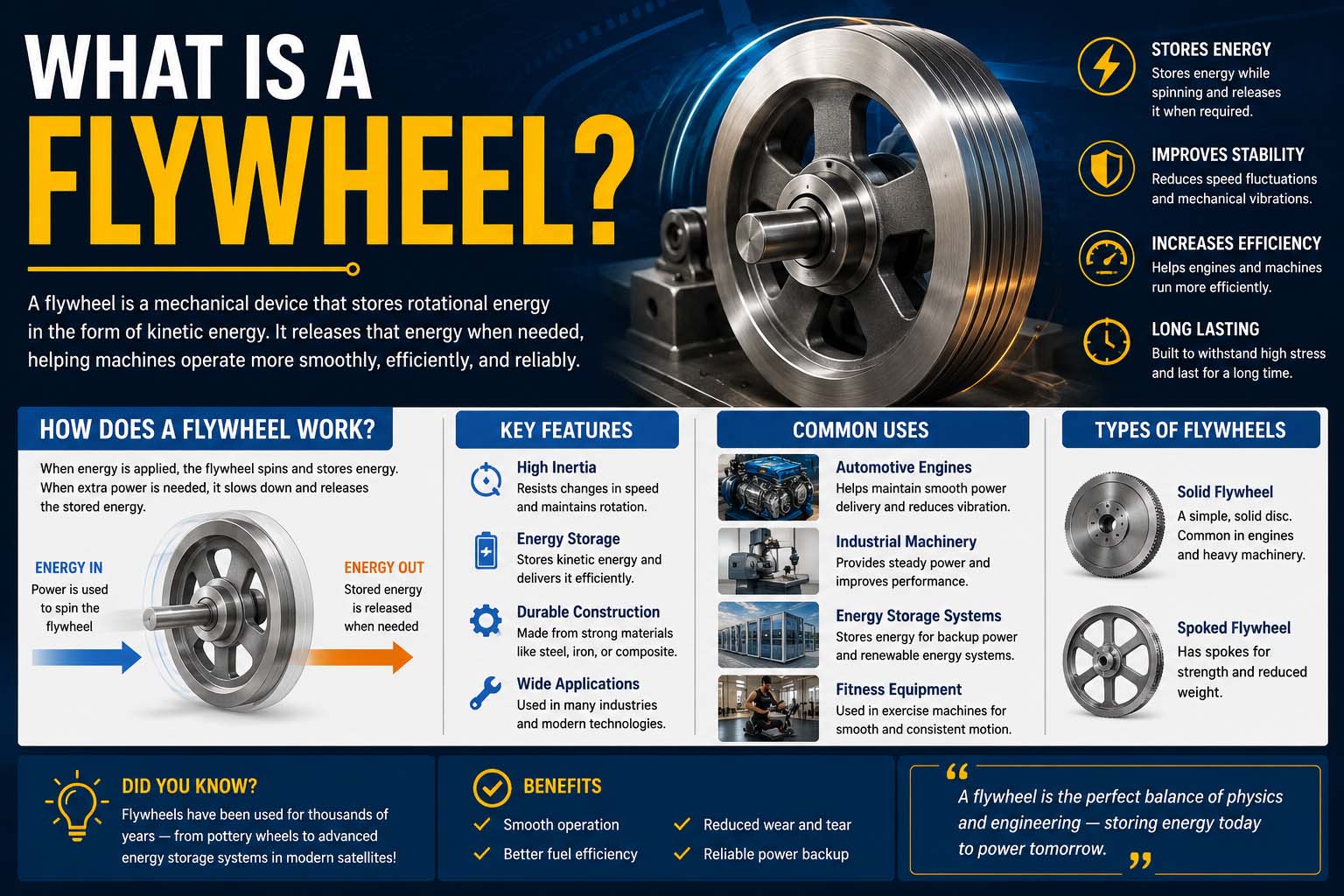
A flywheel is a rotating mechanical device that stores and releases energy to help keep a machine running smoothly. It is commonly used in engines and other mechanical systems to maintain consistent motion and reduce sudden changes in speed. Understanding what is a flywheel helps explain how engines maintain steady and efficient operation.
At its core, a flywheel is a rotating mechanical device that stores energy. As it spins, it builds up rotational energy that can be released whenever needed. This simple idea helps engines run smoothly, improves machine performance, and even inspires modern business strategies.
If you’ve ever wondered what is a flywheel?, this guide explains the concept in plain English while exploring how flywheels work, their advantages, limitations, and real-world applications.
What Is a Flywheel?
A flywheel is a heavy rotating wheel designed to store kinetic energy. It absorbs energy when extra power is available and releases that stored energy when additional power is needed.
Instead of allowing energy to go to waste, a flywheel acts like a temporary energy storage system. This helps maintain a consistent speed and reduces sudden changes in motion.
Flywheels have been used in:
- Car engines
- Industrial machines
- Manufacturing equipment
- Power generation systems
- Renewable energy storage
- Exercise equipment
- Mechanical clocks
Although a flywheel is not classified as What Is a Simple Machine, it often works alongside simple mechanical components to improve the overall performance of a system.
Despite advances in electronics and batteries, flywheels remain valuable because they respond quickly, last for many years, and require relatively little maintenance.
How Does a Flywheel Work?
The basic principle is surprisingly simple.
When an engine or motor generates extra power, some of that energy spins the flywheel faster.
Because the flywheel has mass, it stores rotational kinetic energy.
Later, when the power source slows down or momentarily produces less energy, the spinning flywheel releases part of its stored energy to keep the system running smoothly.
You can think of it like pushing a playground merry-go-round.
- The first push requires effort.
- Once spinning, it keeps moving.
- Small pushes help maintain its speed.
- The stored momentum makes movement smoother.
The same principle applies inside engines and industrial machines.
Understanding What Is Mechanical Advantage also helps explain how rotating components transfer force and improve the efficiency of mechanical systems.
The Main Components of a Flywheel
Although designs vary, most flywheels include the following parts.
| Component | Purpose |
|---|---|
| Wheel or Disc | Stores rotational energy |
| Hub | Connects the flywheel to the shaft |
| Shaft | Transfers rotational movement |
| Ring Gear (automotive) | Engages with the starter motor |
| Mounting Surface | Connects to clutch or driven equipment |
Modern flywheels may also include lightweight composite materials or advanced bearings for higher efficiency.
How Does a Flywheel Store Energy?
The amount of energy stored depends mainly on:
- Weight
- Diameter
- Rotational speed
- Material strength
A heavier wheel stores more energy.
A faster spinning flywheel stores even more energy because rotational energy increases rapidly with speed.
Engineers carefully balance these factors to achieve the desired performance while maintaining safety.
Common Types of Flywheels
Different applications require different designs.
Solid Disc Flywheel
This is the most common design.
It offers excellent durability and is widely used in cars, tractors, and industrial machines.
Rimmed Flywheel
More of the mass is concentrated around the outer edge.
This increases energy storage without making the entire wheel excessively heavy.
High-Speed Composite Flywheel
Modern energy storage systems often use carbon fiber composites.
Learning What Is Carbon Fiber explains why this lightweight material allows high-speed flywheels to store more energy while reducing overall weight.
These flywheels spin at extremely high speeds while remaining relatively lightweight.
Dual-Mass Flywheel
Many modern vehicles use dual-mass flywheels.
Instead of one solid piece, they contain two separate rotating masses connected by springs or dampers.
What Is a Flywheel on a Car?
Many people search for what is a flywheel on a car because it is an essential engine component.
In a manual transmission vehicle, the flywheel is attached directly to the engine’s crankshaft.
It’s also useful to understand Motor vs Engine, since flywheels are commonly associated with internal combustion engines rather than electric motors.
It performs several important jobs:
- Stores rotational energy
- Helps keep engine speed steady
- Reduces vibration
- Provides a mounting surface for the clutch
- Allows the starter motor to crank the engine
Without a flywheel, engines would run much less smoothly, especially at lower RPMs.
Automatic transmission vehicles often use a similar component called a flexplate instead of a traditional flywheel .
What Is a Flywheel in a Car and Why Is It Important?
Understanding what is a flywheel in a car becomes easier when looking at the engine cycle.
During combustion:
- Fuel burns.
- The piston moves.
- The crankshaft rotates.
- The flywheel stores part of the produced energy.
Between combustion cycles, the stored energy keeps the crankshaft turning.
This creates smoother engine operation and prevents sudden speed fluctuations.
Drivers benefit from:
- Smoother acceleration
- Easier gear shifting
- Reduced vibration
- Better overall engine performance
Flywheel Applications Beyond Cars
Flywheels appear in many types of technology.
Industrial Machinery
Large machines use flywheels to maintain consistent rotational speed during heavy workloads.
Examples include:
- Punch presses
- Rolling mills
- Textile machines
- Metal forming equipment
Energy Storage Systems
Modern energy storage systems store electricity as rotational energy.
When electricity demand increases, the spinning flywheel converts stored energy back into electrical power.
These systems are often used for:
- Grid stabilization
- Backup power
- Renewable energy support
- Data centers
Fitness Equipment
Exercise bikes often include flywheels.
A heavier flywheel creates smoother pedaling and more realistic resistance.
Mechanical Watches and Clocks
Some traditional timepieces use flywheel-like components to regulate motion and improve accuracy.
What Is a Flywheel in Business?
The phrase what is a flywheel in business refers to a completely different concept.
Instead of storing mechanical energy, a business describes a cycle of continuous growth.
The idea is that every positive action strengthens the next one.
A simple business flywheel might look like this:
Better products
↓
Happier customers
↓
Positive reviews
↓
More customers
↓
Higher revenue
↓
More investment in better products
↓
Even happier customers
As the cycle repeats, growth becomes easier because each success builds momentum for the next.
This business strategy has become popular among startups and technology companies because it focuses on sustainable long-term improvement rather than short-term wins.
Mechanical Flywheel vs Business Flywheel
| Mechanical Flywheel | Business Flywheel |
| Stores rotational energy | Builds business momentum |
| Used in machines | Used in business strategy |
| Reduces speed fluctuations | Improves long-term growth |
| Physical device | Management framework |
| Based on physics | Based on customer experience |
Although the names are the same, their purposes are completely different.
Advantages of Using a Flywheel
Flywheels offer several benefits across different industries because they efficiently store and release rotational energy whenever it is needed.
Smooth Operation
They reduce sudden speed changes and vibration.
Better Efficiency
Stored energy helps reduce wasted power.
Reliable Performance
Flywheels respond almost instantly when energy is needed.
Long Service Life
Many flywheels last for years with proper maintenance.
Low Maintenance
Compared with many energy storage technologies, flywheels require relatively little upkeep.
Limitations of Flywheels
Like every technology, flywheels have some drawbacks.
- Heavy designs increase system weight.
- High-speed flywheels require precise engineering.
- Damaged flywheels may cause vibration.
- Manufacturing costs can be higher for advanced composite models.
- Extremely high rotational speeds require strong safety enclosures.
Signs of a Failing Flywheel
Vehicle owners may notice several symptoms.
Unusual Vibrations
Excessive vibration often indicates wear or imbalance.
Burning Smell
A damaged clutch surface may overheat.
Difficulty Shifting Gears
Manual transmission vehicles may become harder to shift.
Strange Noises
Grinding or rattling sounds could indicate damage.
Starter Problems
Worn ring gear teeth can prevent proper engine starting.
Step-by-Step Guide to Inspecting a Flywheel
Basic visual inspection can help identify problems.
Step 1
Turn off the engine and disconnect the battery before working near engine components.
Step 2
Inspect for visible cracks or heat spots.
Step 3
Look for worn starter ring gear teeth.
Step 4
Check mounting bolts for proper tightness.
Step 5
If vibration or unusual noises continue, have the professionally inspected.
Because removing a usually requires separating the transmission from the engine, most repairs are best left to experienced technicians.
Modern Flywheel Technology
Today’s flywheels are far more advanced than older designs.
Recent improvements include:
- Carbon fiber construction
- Magnetic bearings
- Vacuum chambers
- Computer-controlled balancing
- High-speed energy storage systems
These innovations allow flywheels to store more energy while reducing friction and wear.
Some renewable energy systems combine flywheels with batteries to improve overall efficiency and deliver faster response times.
Understanding What Is a Battery Charge can also help explain how flywheel energy storage works alongside modern battery technologies in hybrid energy systems.
Everyday Examples of Flywheel Technology
You may encounter flywheels without realizing it.
Examples include:
- Manual transmission cars
- Stationary exercise bikes
- Wind turbine backup systems
- Factory equipment
- Emergency power systems
- Racing vehicles
- Mechanical energy storage installations
Quick Facts About Flywheels
| Feature | Description |
| Main Purpose | Store rotational energy |
| Energy Type | Kinetic energy |
| Common Material | Steel, cast iron, composite materials |
| Main Uses | Cars, machinery, energy storage |
| Benefits | Smooth operation, improved efficiency |
| Common Problems | Wear, vibration, cracking |
| Maintenance | Periodic inspection and balancing |
Frequently Asked Questions
What is a flywheel?
A flywheel is a rotating mechanical device that stores kinetic energy and releases it when needed to maintain smooth and consistent operation.
What is a flywheel on a car?
A flywheel on a car connects to the engine’s crankshaft, stores rotational energy, supports the clutch, and helps the engine run smoothly.
What is a flywheel in a car?
A flywheel in a car is a heavy rotating disc that reduces engine vibration, smooths power delivery, and assists during engine starting and gear changes.
What is a flywheel in business?
A business is a growth model where each successful activity creates momentum for future success, leading to continuous improvement over time.
Can a car run without a flywheel?
A manual transmission engine requires a flywheel for proper operation. Without it, the engine would struggle to maintain smooth rotation and clutch operation.
How long does a flywheel last?
A flywheel can often last well over 100,000 miles, though its lifespan depends on driving habits, clutch wear, and maintenance.
Are flywheels still used today?
Yes. Flywheels remain common in vehicles, industrial equipment, renewable energy systems, manufacturing, and modern mechanical engineering.
Final Thoughts
A flywheel may look like a simple spinning wheel, but it performs an essential job in many technologies. By storing rotational energy and releasing it when needed, it helps engines, machines, and energy systems operate more smoothly and efficiently.
Whether you’re learning what is a flywheel, trying to understand what is a flywheel on a car, or exploring what is a flywheel in business, the underlying idea is the same: building and maintaining momentum. In mechanics, that momentum keeps machines running efficiently. In business, it represents steady growth powered by consistent improvement. Understanding both meanings gives you a clearer picture of why the flywheel remains such an influential concept across engineering and modern technology.