
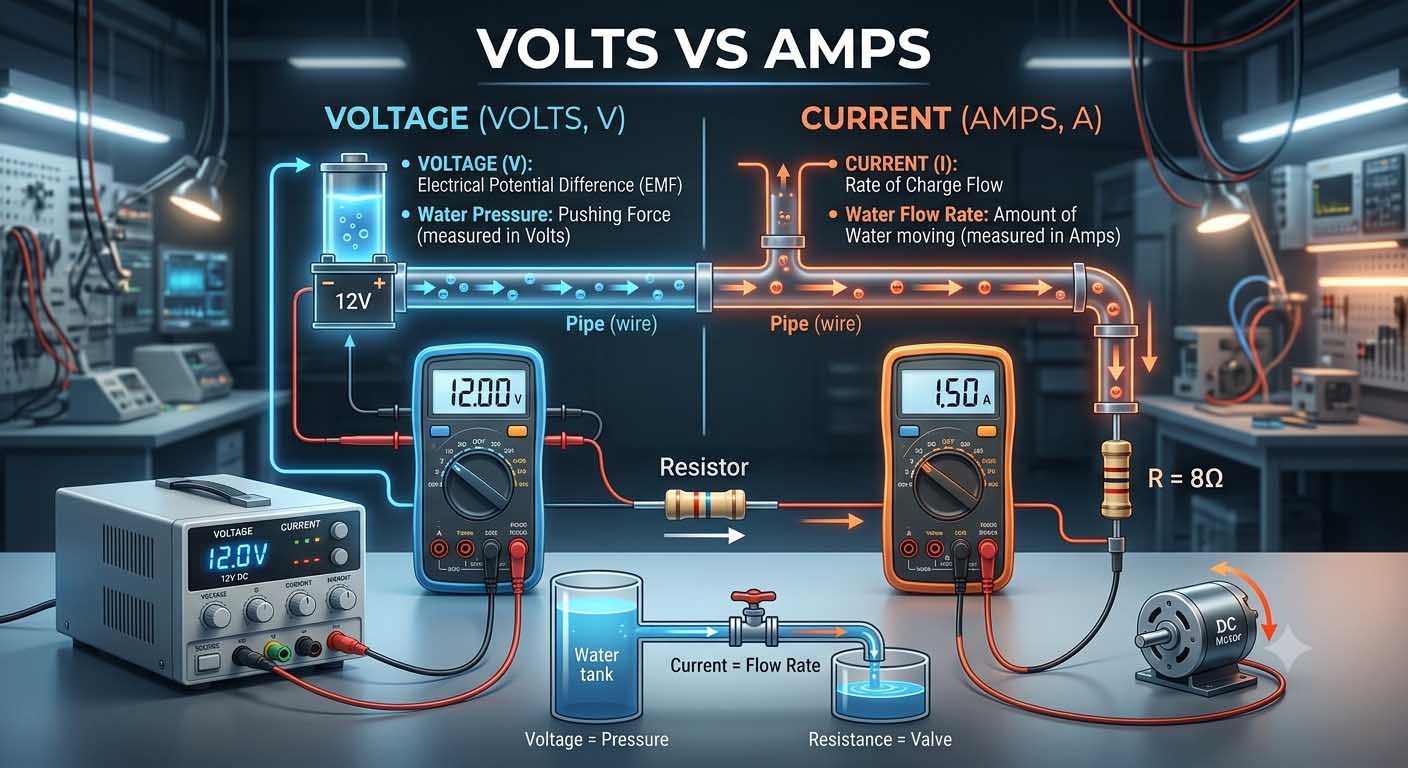
If you’ve ever looked at a charger, battery, extension cord, or appliance, you’ve probably seen ratings like 120V, 5A, or 60W. Understanding volts vs amps helps you interpret these numbers, compare electronics, and choose compatible chargers.
Volts and amps measure two different aspects of electricity. Volts measure electrical potential difference, while amps measure the amount of electric current flowing through a circuit. Both are important when choosing electrical devices, understanding power consumption, and using equipment safely.
Although these measurements are related, they aren’t interchangeable. Learning the difference between them makes electrical ratings easier to understand, even if you have no technical background.
What Are Volts? Understanding Voltage in Electrical Circuits
Volts measure voltage, which is the electrical potential difference between two points. Voltage provides the potential that drives electric charges through a circuit.
A simple way to understand voltage is to compare electricity with water flowing through a pipe. Voltage is similar to water pressure: greater pressure can provide a stronger force to move water through the system.
In an electrical circuit, voltage helps drive current through connected components. Batteries, wall outlets, and power adapters supply voltage to different devices.
For example, a standard household outlet in the United States typically supplies around 120 volts. A USB charger may provide 5 volts, while some laptop adapters supply 19 or 20 volts.
Different devices are designed to operate within particular voltage ranges. Supplying an incompatible voltage can prevent a device from working correctly or potentially damage its components.
What Are Amps? Understanding Electrical Current
Amps, short for amperes, measure electric current. Current describes how much electric charge passes a point in a circuit over time.
Using the water analogy, if voltage represents water pressure, current is similar to the amount of water flowing through a pipe.
A device’s current demand depends on its design, operating conditions, and electrical load. A small LED light may use very little current, while an electric heater can draw several amps.
Understanding current is useful when choosing power supplies, checking wire ratings, and determining whether a circuit can safely handle a device.
For example, a charger rated at 3 amps can provide current up to its rated capacity under suitable conditions. The connected device generally draws the current it needs rather than automatically receiving the charger’s maximum rated current.
Volts vs Amps: The Main Difference Explained
The main difference between voltage and current is what each measurement describes.
| Measurement | What It Means | Unit | Common Example |
|---|---|---|---|
| Voltage | Electrical potential difference | Volts (V) | A 5V USB charger |
| Current | Flow of electric charge | Amps (A) | A charger supplying 2A |
| Power | Rate of electrical energy transfer | Watts (W) | A 10W charger |
Voltage and current work together, but they answer different questions. Voltage tells you the electrical potential difference available, while current tells you how much charge flows through the circuit.
When comparing electrical devices, you should consider both measurements along with the power rating and the manufacturer’s specifications.
How Volts and Amps Work Together in a Circuit
Voltage and current are closely related in electrical circuits. Voltage can drive current through a circuit, but the amount of current that flows depends on the circuit’s resistance, impedance, and operating conditions.
For a simple resistive circuit, Ohm’s law describes the relationship:
[
V = I \times R
]
In this formula:
- (V) represents voltage in volts.
- (I) represents current in amps.
- (R) represents resistance in ohms.
For example, if a 12-volt supply is connected to a 6-ohm resistor, the current is 2 amps.
[
I = \frac{V}{R} = \frac{12}{6} = 2A
]
This relationship is especially useful when learning about What Is a Circuit, troubleshooting basic electronics, and understanding how electrical components interact.
Understanding volts vs amps makes it easier to see how voltage drives electric current through a circuit and why both measurements matter when evaluating electrical equipment.
Real circuits can be more complex than this example, particularly when they contain motors, capacitors, or other components whose electrical behavior changes over time.
Volts vs Amps vs Watts: Understanding Electrical Power
Watts measure electrical power, which describes how quickly electrical energy is transferred or used. Voltage and current help determine power in many common electrical situations.
For direct current (DC), electrical power is calculated using this formula:
[
P = V \times I
]
Here, (P) represents power in watts, (V) represents voltage, and (I) represents current.
For example, a device operating at 5 volts and drawing 2 amps uses 10 watts of electrical power.
[
5V \times 2A = 10W
]
This formula provides a straightforward way to understand the relationship between voltage, current, and power. For a deeper explanation, see this guide on Calculate Watts.
For AC equipment, the relationship between voltage, current, and real power can be more complicated because power factor and waveform characteristics may matter.
What Do Watts Tell You About Electrical Power?
Watts indicate the rate at which a device uses or transfers electrical energy. A higher wattage often means a device can deliver more power, although efficiency and operating conditions also affect performance.
Consider two chargers:
- A 5V, 2A charger has a rated output of 10 watts.
- A 20V, 3A charger has a rated output of 60 watts.
The second charger has a higher rated power output. However, that does not automatically make it suitable for every device. Voltage compatibility, charging standards, connector type, and device requirements still matter.
Amps vs Volts: Which Electrical Measurement Matters Most?
Neither voltage nor current is universally more important. The right measurement depends on what you’re trying to understand or select.
Voltage and Electrical Potential in Volts vs Amps
Voltage is especially important when checking whether a power supply matches the voltage requirements of a device. Using an unsuitable voltage can cause malfunction or damage.
For example, a device designed for a specific DC input voltage should be connected to a compatible adapter that meets the manufacturer’s requirements.
Current and Electrical Flow in Volts vs Amps
Current matters when evaluating how much electrical flow a device needs and whether wires, connectors, and power supplies are appropriately rated.
A circuit carrying more current may require thicker conductors or different protective equipment, depending on the installation and applicable electrical standards.
When comparing amps vs volts, remember that the measurements describe different electrical properties. You usually need to consider both rather than choosing one in isolation.
Comparing Amps, Volts, and Watts in Everyday Devices
The three measurements work together to describe different aspects of electricity.
- Volts: The electrical potential difference.
- Amps: The amount of electric charge flowing per second.
- Watts: The rate at which electrical energy is transferred or consumed.
For many simple DC devices, multiplying voltage by current gives power in watts. This relationship helps explain why two devices operating at different voltages can still have the same power rating.
For instance, a 10V device drawing 2A uses 20W. A 20V device drawing 1A also uses 20W.
Although their voltage and current differ, their calculated electrical power is the same.
Volts vs Amps: Practical Examples for Chargers and Appliances
Everyday electronics provide useful examples of how these measurements work.
Phone Charger: Understanding Volts and Amps
A phone charger may list several output combinations, such as 5V at 2A or a higher voltage at a lower current. Supported charging modes depend on the charger and phone.
The voltage, current, and power ratings help explain the charger’s output capabilities, but compatibility also depends on the charging protocol and manufacturer’s specifications.
Laptop Charger: Voltage, Current, and Wattage
Laptop chargers often provide higher power output than basic phone chargers. Some use a voltage around 19V or 20V, while USB-C Power Delivery chargers can support multiple voltage levels.
The correct charger must meet the laptop’s requirements. A connector that fits physically does not necessarily mean the adapter is electrically compatible.
Electric Heater: How Volts and Amps Affect Power
An electric heater converts electrical energy into heat. Its power rating helps indicate how much electricity it uses while operating at its rated conditions.
For example, a 1,500W heater operating at 120V draws approximately 12.5A under ideal resistive conditions.
[
I = \frac{P}{V} = \frac{1500}{120} = 12.5A
]
This example shows why current ratings are important when evaluating household appliances and electrical circuits.
These everyday examples show why volts vs amps matters when comparing chargers, appliances, and other electronic equipment.
Why Voltage Matters When Comparing Electrical Devices
Voltage affects whether an electrical supply is suitable for a particular device. Different products are designed for specific input voltages, and the manufacturer’s specifications should always guide your choice.
Batteries also have nominal voltage ratings that help identify their intended operating range. A battery’s actual voltage may change depending on its chemistry, charge level, and load.
For example, a rechargeable battery may have a nominal voltage that differs from its fully charged voltage. This is normal for many battery types, but the connected device must support the battery’s expected voltage range.
You can learn more about this topic in the guide to Battery Charge.
Why Amps Matter for Electrical Safety
Current is important for understanding electrical loads, wire capacity, and protective devices. When too much current passes through a conductor, it can generate excessive heat.
The safe current capacity of a wire depends on factors such as its material, thickness, insulation, installation method, and surrounding temperature.
Electrical circuits use protective devices, including fuses and circuit breakers, to help prevent dangerous overcurrent conditions. These devices must be selected and installed according to the applicable electrical requirements.
Understanding current is also useful when comparing power banks, batteries, and chargers. However, the maximum current printed on a power supply is not necessarily the amount that a connected device will draw.
Common Electrical Ratings: Volts vs Amps on Labels
Electrical ratings appear on power adapters, appliances, batteries, and other equipment. Knowing how to read them helps you make better comparisons.
A label might display:
- Input: 100–240V AC, 50/60Hz
- Output: 5V DC, 2A
- Rated power: 10W
The input rating describes the power conditions the adapter can accept. The output rating describes the voltage and current it can provide under specified conditions.
The frequency rating is relevant for AC supplies, while the DC marking indicates direct-current output. These details are important when using equipment in different countries or with different power systems.
If a label lists multiple output options, those options may be available only when the charger and connected device support the same charging standard.
Common Volts vs Amps Misunderstandings
More Volts Does Not Always Mean More Power
Higher voltage does not automatically mean a device uses more power. Current also affects power, and the relationship depends on the type of circuit and its operating conditions.
A device operating at a higher voltage may draw less current while delivering the same power as a lower-voltage device.
Higher-Amperage Chargers Aren’t Automatically Dangerous
A charger with a higher maximum current rating is not necessarily unsafe for a compatible device. In many cases, the device draws only the current it requires.
However, the charger’s voltage, charging protocol, construction quality, and safety certification still matter. Always follow the device manufacturer’s charging recommendations.
Watts Aren’t the Same as Volts or Amps
Voltage and power measure different things. A voltage rating alone does not tell you the total power a device uses.
To calculate power in a simple DC circuit, multiply voltage by current. For AC equipment, the calculation of real power may require additional information.
Electrical Safety Tips for Using Different Voltage and Current Ratings
Electrical safety requires more than understanding ratings. Follow these basic precautions when handling electrical equipment:
- Use power supplies that meet the manufacturer’s voltage and compatibility requirements.
- Avoid damaged cables, loose plugs, and exposed conductors.
- Never exceed the rated capacity of wires, outlets, or extension cords.
- Keep electrical equipment away from water unless it is specifically designed for that environment.
- Do not open power adapters or repair mains-powered equipment unless you are qualified to do so.
- Consult a qualified electrician for wiring problems or repeated circuit-breaker trips.
For additional background on basic electrical concepts, The Open University explains electricity and electrical circuits.
Choosing the Right Charger: Check Volts, Amps, and Watts
When selecting a charger, check the device’s supported input voltage, required power, charging protocol, and connector. A higher wattage rating alone does not guarantee compatibility.
For USB-C devices, look for support for the appropriate USB Power Delivery features if required. For other devices, follow the manufacturer’s adapter specifications.
You should also consider charger quality and safety certification. An inexpensive adapter with unclear specifications may not provide reliable or safe power, even if its connector fits.
Everyday Uses for Understanding Volts vs Amps
Knowing the difference between voltage and current helps with several everyday tasks. You can compare charger labels, understand battery specifications, estimate power consumption, and identify when electrical equipment may be unsuitable for a device.
It also helps explain why Series Circuit and Parallel Circuit arrangements behave differently. In a series circuit, the same current passes through each component; in an ideal parallel circuit, each branch has the same voltage across it.
These principles provide a foundation for learning more about electronics and household electrical systems.
Frequently Asked Questions About Volts vs Amps
Which Is More Dangerous: Volts or Amps?
Both voltage and current matter in electric shock hazards. The risk depends on factors such as the current passing through the body, its path, the duration of contact, and the electrical conditions. Never assume a source is safe just because one rating appears low.
Can I Use a Charger With Higher Amps?
Often, yes, if the charger is compatible with the device and follows the required charging standard. A higher current capacity generally indicates what the charger can supply, not what it forces into the device.
What Is the Relationship Between Volts and Watts?
For a simple DC circuit, watts equal volts multiplied by amps. For example, 12V at 2A equals 24W. AC circuits may require additional information to calculate real power accurately.
Why Do Laptops Use Higher Voltage Than Phones?
Laptops often require more electrical power than phones. Higher voltage can help deliver that power with less current, depending on the design. However, charging requirements vary by device and charging system.
Is Higher Voltage Always Better?
No. Devices are designed for specific voltage ranges. Using a voltage that falls outside those requirements can prevent normal operation or damage the device.
Remember the Simple Formula for Volts vs Amps
The easiest way to remember volts vs amps is to think about the different roles they play. Volts measure electrical potential difference, amps measure electric current, and watts measure electrical power.
For a simple DC circuit, use:
[
\text{Watts} = \text{Volts} \times \text{Amps}
]
Understanding these basic relationships makes it easier to read electrical labels, compare compatible chargers, and learn how electronic devices operate. Always check the manufacturer’s specifications and follow appropriate safety practices when working with electrical equipment.