If you’ve recently bought a new laptop, smartphone, or accessory, you’ve probably noticed that is becoming the standard. That naturally raises the question: what is the difference between USB A and USB C? While both connectors transfer data and deliver power, they differ in design, speed, charging capabilities, and long-term compatibility.
Understanding helps you choose the right cable, charger, and accessories while avoiding compatibility issues. Whether you’re connecting a flash drive, charging a laptop, or transferring large files, knowing how these connectors work can save time and frustration.
What Are USB A and USB C?
USB stands for Universal Serial Bus, a standard created to simplify connections between computers and electronic devices.
It’s found on desktop computers, TVs, gaming consoles, printers, and many older accessories.
USB is the newer connector introduced in 2014. It features a smaller, symmetrical design and supports faster data transfer, higher charging power, and modern display technologies.
Although both connectors belong to the USB family, they are physically different and often support different capabilities.
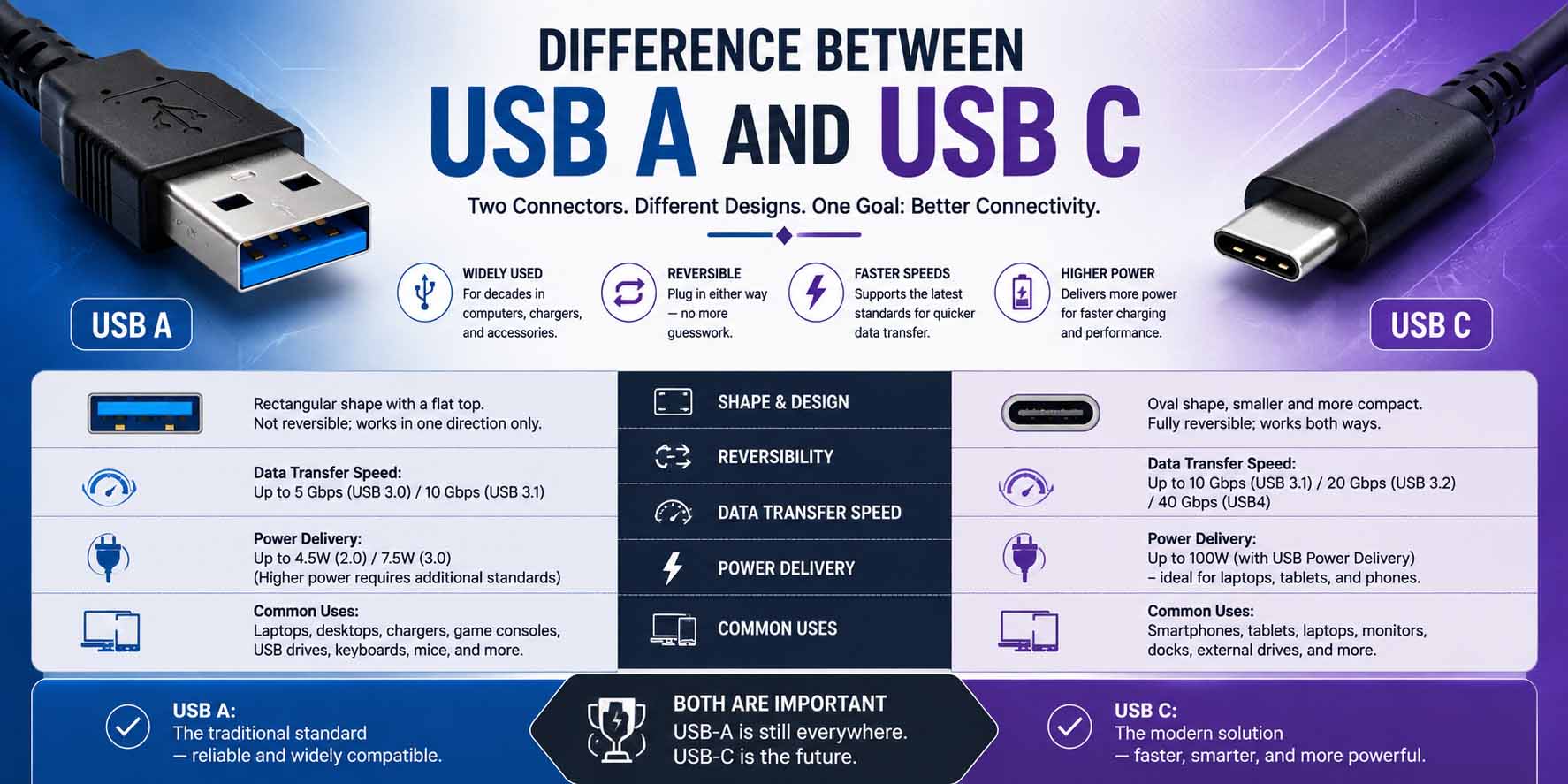
Difference Between USB A and USB C at a Glance
| Feature | USB-A | USB-C |
|---|---|---|
| Connector Shape | Rectangular | Small, oval, reversible |
| Plug Orientation | One-way only | Reversible |
| Maximum Charging Power | Limited (depends on version) | Up to 240W with USB Power Delivery |
| Data Speed | Up to 10 Gbps (USB 3.2 Gen 2) | Up to 80 Gbps (USB4 Version 2.0) |
| Video Output | Usually no | Supports DisplayPort, HDMI, and Thunderbolt (device dependent) |
| Common Devices | PCs, TVs, printers, flash drives | Phones, laptops, tablets, monitors, SSDs |
The connector itself doesn’t determine speed alone. The USB version supported by both the cable and device also matters.
What Is the Difference Between USB A and USB C?
Although they perform many of the same tasks, several key differences separate these connectors.
Physical Design
The most obvious difference is the connector itself.
USB-A:
- Large rectangular plug
- Fits only one direction
- Common on older devices
USB-C:
- Compact oval connector
- Fully reversible
- Easier to plug in
- Better suited for thin laptops and smartphones
The reversible design is one of the biggest reasons has become so popular.
Charging Capability
USB-C significantly improves charging performance.
Older USB-A ports typically provide between 2.5W and 15W depending on the device and USB version.
USB combined with Power Delivery (PD), can deliver:
- Fast charging for smartphones
- Laptop charging
- Tablet charging
- Power for monitors
- Up to 240W on supported hardware
This makes a universal charging solution for many modern devices.
If you’re curious about how electrical power affects charging speed, understanding volts vs amps makes it easier to see why chargers with similar wattage can behave differently.
Data Transfer Speeds
USB-A supports multiple USB standards.
Older versions include:
- USB 2.0 (480 Mbps)
- USB 3.0 (5 Gbps)
- USB 3.1 Gen 2 (10 Gbps)
USB supports these standards and newer ones, including:
- USB 3.2
- USB4
- USB4 Version 2.0
Depending on the hardware, connections can reach up to 80 Gbps with USB4 Version 2.0.
Remember that the connector alone doesn’t guarantee higher speed. Both connected devices and the cable must support the same specification.
Video Support
USB-A is designed mainly for data transfer and power delivery.
USB-C goes much further.
Many ports support:
- DisplayPort
- HDMI through adapters
- Thunderbolt
- External monitors
- Multiple displays
- High-resolution video
Because of this flexibility, many modern laptops use a single port for charging, video, networking, and storage.
Difference Between USB C and USB A for Everyday Devices
Different devices benefit from each connector in different ways.
Smartphones
Nearly all new Android phones now use USB-C.
Many newer tablets and laptops do as well.
Laptops
Modern ultrabooks often feature only ports because they save space and support charging.
Desktop computers may still include both A and USB-C.
Gaming Consoles
Many gaming accessories now connect through , although consoles themselves often still include -A ports.
External Storage
Portable SSDs increasingly use because faster transfer speeds reduce backup times.
USB Versions Matter Too
Many people confuse connector type with USB version.
These are separate concepts.
For example:
- USB-A can support USB 3.2.
- USB-C can support 2.0.
- USB-C can also support USB4.
That means not every cable is automatically faster than every -A cable.
Always check:
- USB version
- Cable rating
- Device specifications
Difference Between USB-A and USB-C for Charging
Charging is one area where clearly leads.
USB-A Advantages
- Works with millions of existing devices
- Affordable cables
- Excellent for accessories like keyboards and mice
USB-C Advantages
- Faster charging
- Smarter power negotiation
- One charger for multiple devices
- Supports larger electronics like laptops
For most people buying new devices today, offers greater convenience.
Compatibility and Adapters
One concern people have is compatibility.
Fortunately, adapters make transitioning simple.
Common options include:
- USB-A to cable
- USB-C to -A adapter
- USB-C docking station
- Multi-port hubs
These accessories allow newer devices to work with older computers and vice versa.
However, adapters cannot add features unsupported by the original hardware. For example, an adapter won’t make a USB 2.0 port transfer files at USB4 speeds.
Common Uses for USB-A
USB-A remains useful for many situations.
You’ll commonly find it on:
- Desktop computers
- Older laptops
- Smart TVs
- Printers
- Flash drives
- External keyboards
- Computer mice
- Barcode scanners
Businesses with older equipment may continue using USB-A for many years.
Common Uses for USB-C
USB-C has become the preferred connector for modern electronics.
Examples include:
- Smartphones
- Tablets
- Ultrabooks
- External SSDs
- Portable monitors
- Drones
- Digital cameras
- Gaming handhelds
Many manufacturers now include only ports on premium devices.
Difference Between USB A B and C
People often search for the difference between USB A B and because all three connector types still exist.
Here’s a simple comparison:
| USB Type | Common Use |
|---|---|
| USB-A | Computers, chargers, flash drives |
| USB-B | Printers, scanners, audio interfaces |
| USB-C | Phones, laptops, tablets, modern accessories |
USB-B is much less common today but still appears on many office printers and specialized equipment.
How to Identify Your USB Port
If you’re unsure which port your device has, look at its shape.
USB-A:
- Wide rectangle
- Plastic tab inside
- Only fits one direction
USB-C:
- Thin oval
- Rounded edges
- Reversible
- Smaller than USB-A
Most manufacturers also label faster USB ports with symbols such as “SS” (SuperSpeed).
Should You Replace USB-A Accessories?
Not necessarily.
USB-A accessories still work perfectly for:
- Mouse
- Keyboard
- Printer
- Basic flash drive
- Webcam
There’s no need to replace functioning equipment unless you need faster charging or higher data speeds.
Adapters make it easy to use existing accessories with newer devices.
Troubleshooting USB Connection Problems
If your USB connection isn’t working correctly, try these steps.
Device Isn’t Recognized
- Try another port.
- Restart the computer.
- Test another cable.
- Update USB drivers.
Slow File Transfers
- Verify cable specifications.
- Check USB version compatibility.
- Avoid inexpensive low-quality cables.
Charging Is Slow
- Use a charger that supports USB Power Delivery.
- Replace damaged cables.
- Make sure both device and charger support fast charging.
Choosing Between USB-A and USB-C
The best choice depends on your needs.
Choose USB-A if:
- You mainly use older computers.
- You connect printers and legacy peripherals.
- You don’t need fast charging.
Choose USB if:
- You buy new laptops.
- You frequently transfer large files.
- You want fast charging.
- You connect external displays.
- You prefer one cable for multiple devices.
For most buyers today, offers the best long-term value.
Why USB-C Is Becoming the Industry Standard
Manufacturers have largely standardized on because it simplifies connectivity.
Benefits include:
- One connector for phones, laptops, and tablets
- Faster charging
- Higher data throughput
- Support for video output
- Smaller connector size
Many countries now encourage or require charging for certain consumer electronics to reduce electronic waste and improve compatibility.
Understanding How Data Travels
USB transfers digital information between devices.
If you’d like a broader understanding of how computers represent and move information, learning about analog vs digital provides helpful background that complements USB technology.
Similarly, when USB is used for networking devices such as adapters or docking stations, understanding what is the difference between a router and a modem helps explain where USB networking accessories fit into a home network.
If you’re using high-speed internet with docking stations or network adapters, the benefits of fiber internet become more noticeable because faster storage and networking hardware reduce bottlenecks.
At the hardware level, USB ports are also part of electrical pathways on a circuit board. Readers interested in electronics fundamentals may find what is a series circuit useful for understanding how electrical components are connected in different applications.
Frequently Asked Questions
Is USB-C always faster than USB-A?
No.
Speed depends on the USB version supported by the cable and connected devices, not just the connector.
Can USB-C replace laptop chargers?
Yes.
Many modern laptops support Power Delivery through
Can USB-A and USB-C work together?
Yes.
USB-A to cables and adapters allow the two connector types to communicate.
Is USB-C more durable?
Generally, yes.
Its symmetrical design reduces wear caused by incorrect insertion.
Will USB-A disappear?
Not immediately.
USB-A remains widely used for desktop computers, office equipment, and many accessories. However, is steadily becoming the primary connector for new consumer devices.
Final Thoughts
The difference between USB A and USB C comes down to far more than connector shape. offers faster charging, higher data transfer speeds, reversible connectivity, and support for video output, making it the preferred option for most modern devices. USB-A, however, remains reliable and compatible with millions of existing peripherals.
If you’re purchasing a new laptop, smartphone, or external storage device, choosing will give you better long-term compatibility and performance. At the same time, keeping a few USB-A adapters on hand makes it easy to continue using older accessories while you transition to newer technology.