Look closely at a steel railway bridge or an older highway crossing and you may notice a repeating pattern of triangles along its sides. Those triangular patterns are the key to understanding the different types of truss bridges engineers use to distribute loads efficiently across long spans. rivers, valleys, roads, and other obstacles. While truss bridges share the same basic structural principle, their internal members can be arranged in several ways to suit different spans, loads, materials, and construction conditions.
Some designs place diagonal members primarily under tension, while others use them mainly in compression. Meanwhile, certain trusses work well for short crossings, whereas modified designs can handle much longer spans.
Knowing how these designs differ makes it easier to understand why one truss appears on a railway bridge while another supports a road, pedestrian crossing, or industrial structure.
What Is a Truss Bridge?
A truss bridge uses a framework of interconnected structural members arranged primarily in triangular patterns.
The individual members meet at connection points called nodes or joints. As loads travel across the bridge, the truss transfers forces through these members toward the supports and foundations.
Triangles work especially well because their shape remains geometrically stable when loads are applied. A four-sided frame can distort unless it receives extra bracing. In contrast, a properly connected triangular frame resists shape changes much more effectively.
As a result, engineers can create relatively lightweight structures that carry substantial loads.
Truss bridges represent just one option among the many types of construction used for transportation infrastructure. Designers select a bridge system according to span length, site conditions, traffic loads, available materials, construction methods, maintenance needs, and project cost.
How Does a Truss Bridge Carry Weight?
A truss does not simply support weight at one location. Instead, its interconnected members distribute forces throughout the structure.
When a vehicle crosses the deck, its weight creates loads that enter the truss system. Those forces then move through vertical, diagonal, upper, and lower structural members before reaching the bridge supports.
Truss members primarily experience two types of force: tension and compression.
A member under tension is being pulled apart. Conversely, a member under compression is being pushed together.
This division of forces helps explain what is mechanical advantage in a broader engineering sense, because carefully arranged structural members allow a system to control and transfer forces more efficiently than an unsupported beam of similar size.
However, the exact force pattern changes according to the truss design. That difference is one reason engineers developed multiple configurations.
Main Types of Truss Bridges
Although dozens of variations have appeared throughout engineering history, several designs are especially common and influential.
Pratt Truss Bridge
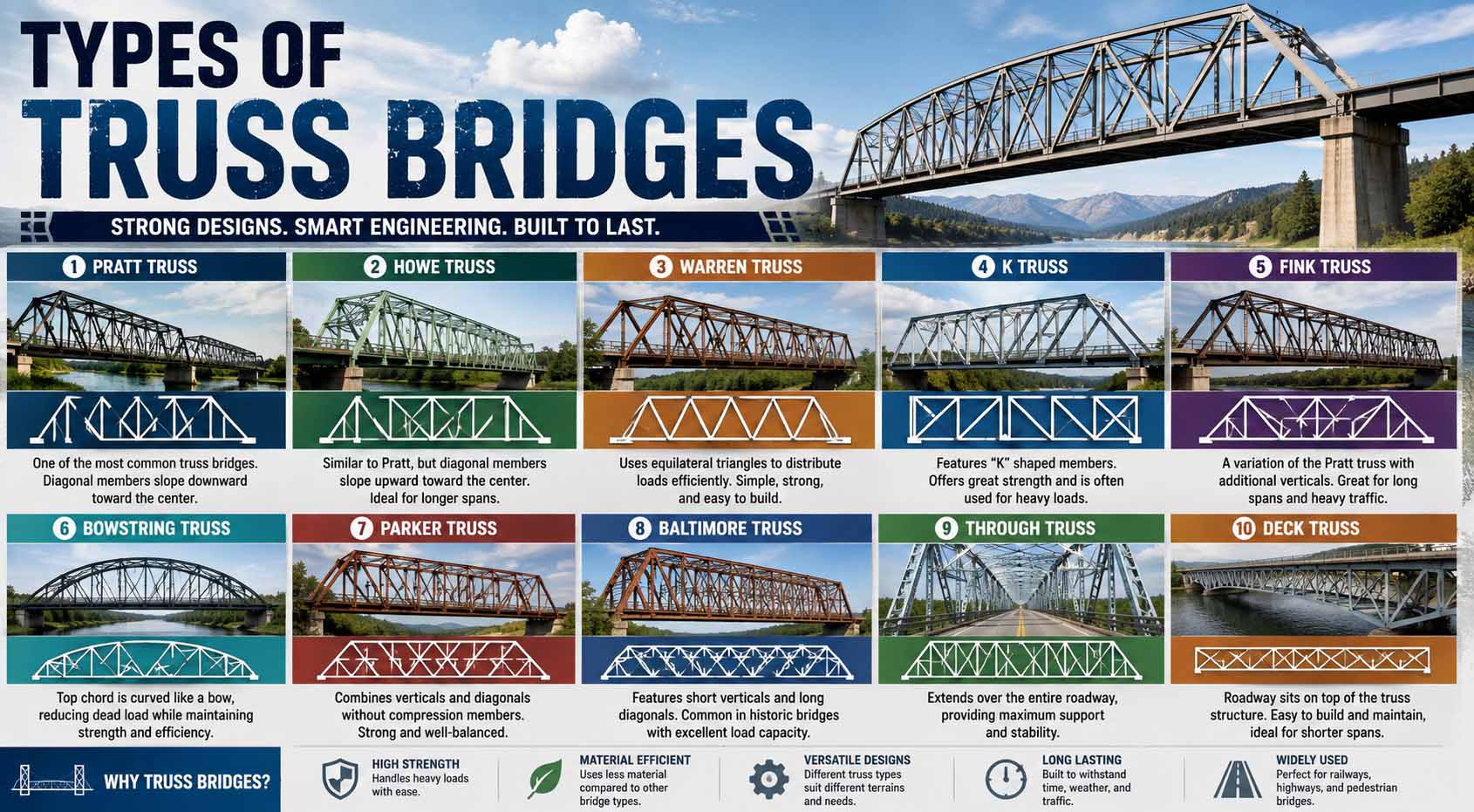
The Pratt truss uses diagonal members that typically slope downward toward the center of the span.
Under conventional gravity loading, its longer diagonal members primarily work in tension, while vertical members commonly carry compression. This arrangement became particularly practical as iron and steel replaced timber in bridge construction.
Because metal structural members can handle tensile forces efficiently, the Pratt design became widely used for railway and highway bridges.
Its straightforward geometry also makes the load path relatively easy to understand.
Howe Truss Bridge
The Howe truss looks somewhat similar to a Pratt truss, but its diagonal orientation is reversed.
As a result, the diagonal members generally carry compression under typical loading, while vertical members take tension.
William Howe patented the design in the 19th century. Early versions worked well with timber compression members combined with iron tension rods.
Today, the Howe truss remains an excellent example of how material properties can influence structural geometry.
Warren Truss Bridge
The Warren truss creates a repeating sequence of triangles, often without vertical members in its simplest form.
Because of this arrangement, loads move through alternating members experiencing tension and compression. The design can also use less material than some more complex truss configurations.
Warren trusses commonly appear on road, rail, and pedestrian bridges. However, engineers may add vertical members when a structure needs better load distribution or support at specific deck locations.
Parker Truss Bridge
A Parker truss is essentially a modified Pratt design with a polygonal upper chord.
Instead of maintaining the same height across the entire span, the truss becomes deeper toward the middle. This shape more closely follows the changing bending demands along the bridge.
Consequently, designers can use structural material more efficiently on longer spans.
Parker trusses became particularly recognizable on older highway bridges and remain an important part of bridge engineering history.
Baltimore Truss Bridge
The Baltimore truss developed as a variation of the Pratt truss.
It adds extra bracing in the lower sections of the main panels. Therefore, it can improve control of forces on longer spans or structures carrying heavy loads.
Railroad construction helped drive the use of this design because locomotives introduced substantial concentrated loads.
Although modern bridge technologies offer many alternatives, surviving Baltimore trusses still demonstrate how engineers adapted basic truss geometry to demanding applications.
K-Truss Bridge
A K-truss divides each large panel into smaller sections that resemble the letter K.
This configuration can reduce the unsupported length of compression members. Consequently, designers can better control buckling in certain situations.
However, the extra members and connections make analysis, fabrication, inspection, and maintenance more complicated.
For that reason, K-trusses are less common than simpler Pratt or Warren arrangements.
Different Types of Truss Bridges at a Glance
The best design depends on much more than appearance. Each configuration manages structural forces differently.
| Truss Type | Recognizable Feature | Typical Structural Characteristic | Common Application |
|---|---|---|---|
| Pratt | Diagonals slope toward span center | Diagonals mainly in tension | Road and railway bridges |
| Howe | Diagonals slope away from center | Diagonals mainly in compression | Historic timber and mixed-material bridges |
| Warren | Repeating triangles | Alternating tension and compression | Road, rail and pedestrian bridges |
| Parker | Polygonal upper chord | Greater depth near midspan | Longer highway spans |
| Baltimore | Extra lower-panel bracing | Handles concentrated loads efficiently | Heavy railway and road bridges |
| K-truss | K-shaped internal members | Shorter compression members | Specialized medium-to-long spans |
These are not all types of truss bridges ever designed. Variations such as Pennsylvania, Camelback, Fink, Bollman, and lenticular trusses also exist.
However, Pratt, Howe, and Warren are often the 3 types of truss bridges beginners encounter first because their structural layouts clearly demonstrate how diagonal orientation changes force distribution.
Why Steel Became So Important for Truss Bridges
Early truss bridges often relied heavily on timber. Later, iron and then structural steel changed what engineers could build.
Steel offers high strength, predictable mechanical properties, and the ability to form standardized structural sections. As a result, engineers could design longer and stronger trusses while controlling the amount of material required.
When considering what is the strongest metal, however, it is important to remember that bridge engineering does not simply rely on the material with the highest strength value.Cost, stiffness, fatigue behavior, weldability, availability, corrosion resistance, weight, and fabrication requirements all influence material selection.
Modern structural steel provides a practical combination of these characteristics.
Meanwhile, bridge components exposed to water, road salt, humidity, and changing weather need protection against corrosion. Comparing stainless steel vs carbon steel helps explain why corrosion-resistant alloys can be valuable for selected components even though conventional structural steels remain more economical for many large bridge members.
Protective coatings, drainage design, inspection, and maintenance also help extend bridge life.
Through Truss, Deck Truss, and Pony Truss
Truss bridges can also be classified according to the position of the roadway relative to the structural framework.
Through Truss
On a through truss bridge, the roadway passes between two tall trusses.
Cross-bracing usually connects the trusses above the traffic. As a result, vehicles effectively travel through the structural frame.
This configuration works well when substantial truss depth is needed.
Deck Truss
A deck truss places the roadway on top of the structural trusses.
Therefore, most of the main framework sits below the traffic deck. This arrangement can provide an open roadway without overhead structural members.
However, adequate clearance must exist beneath the deck for the truss.
Pony Truss
A pony truss also places the roadway between two side trusses. However, these trusses are not tall enough to require overhead bracing across the roadway, allowing the bridge deck to remain relatively open while the truss members support the structural load.
Pony trusses commonly serve shorter spans where a full through-truss configuration would be unnecessary.
How Many Types of Truss Bridges Are There?
People often ask how many types of truss bridges are there, but there is no single universal number.
The answer changes because engineers can classify trusses by structural geometry, roadway position, material, span arrangement, connection method, or variations of established designs.
For instance, Pratt, Howe, Warren, Parker, Baltimore, Pennsylvania, K, Fink, and Camelback are recognized structural configurations. Meanwhile, through, deck, and pony describe how the roadway relates to the truss.
A bridge can therefore belong to more than one category. A structure might be both a Pratt truss and a through truss.
This overlapping classification system explains why lists of truss bridge types often contain different numbers.
Advantages of Truss Bridges
One major benefit of a truss is efficient material use.
Because the triangular framework distributes loads through individual tension and compression members, a truss can support significant weight without requiring one enormous solid beam.
Truss bridges can also be prefabricated in sections. Therefore, components may be manufactured away from the site and assembled during construction.
Another benefit is versatility. Engineers can modify truss geometry for different spans, traffic requirements, materials, and site conditions.
Meanwhile, the exposed structural system makes many components accessible for visual inspection.
Limitations and Maintenance Challenges
Truss bridges also have drawbacks.
First, they contain many individual members and connections. Consequently, inspection and maintenance can be time-consuming, particularly when engineers must assess numerous structural members and hard-to-reach areas.
Older steel structures may also develop corrosion around joints, drainage areas, and locations where moisture collects.
Fatigue is another concern. Repeated traffic loads can create small cracks that grow over time, especially around connections or stress concentrations.
Space can also become an issue. Large trusses require considerable structural depth, which may conflict with clearance restrictions above or below a bridge.
When major components need replacement, projects may require temporary supports and specialized lifting equipment. Different types of cranes can play a role during bridge construction and rehabilitation, depending on component weight, site access, reach, and available working space.
How Engineers Choose a Truss Design
Engineers start with the span and the loads the bridge must carry.
A pedestrian crossing may need a very different structure from a railway bridge carrying heavy freight trains. Likewise, a rural road bridge faces different requirements from a heavily traveled urban crossing.
Site geometry matters as well. River width, foundation conditions, required clearance, environmental restrictions, and access for construction equipment can all affect the design.
Engineers then evaluate structural efficiency, fabrication complexity, transportation, erection procedures, durability, inspection access, and long-term maintenance costs.
Modern structural analysis software can model thousands of load combinations. However, the underlying principles remain familiar: provide a clear load path, control tension and compression, prevent buckling, limit deformation, and maintain adequate safety margins.
FAQs About Types of Truss Bridges
Which truss bridge design is most common?
Pratt and Warren configurations are among the best-known truss designs. However, the preferred system varies according to span, loading, material, and project requirements.
What Is the Strongest Truss Bridge for Heavy Loads and Long Spans?
There is no universally strongest truss configuration. Strength depends on dimensions, member sizes, materials, connections, bracing, foundations, and loading conditions rather than the truss name alone.
Why do truss bridges use triangles?
Triangles provide geometric stability. Unlike an unbraced rectangular frame, a triangle cannot easily change shape without changing the length of one or more of its sides.
What is the difference between Pratt and Howe trusses?
Their diagonal members slope in opposite directions. Under typical gravity loading, Pratt diagonals generally work in tension, whereas Howe diagonals generally work in compression.
Are truss bridges still built today?
Yes. Truss systems remain useful for road, rail, pedestrian, temporary, and specialized crossings. Modern materials, fabrication techniques, and structural analysis tools allow engineers to adapt the basic truss concept to current design requirements.
A Practical Way to Recognize Truss Bridge Designs
When identifying the types of truss bridges, start by looking at the diagonal members. Diagonals sloping toward the center often indicate a Pratt truss, while the opposite arrangement suggests a Howe design. Repeating triangular patterns point toward a Warren truss, whereas a polygonal upper chord may indicate a Parker or related design.
Next, look at the roadway. If traffic passes between tall trusses with overhead bracing, you are probably looking at a through truss. If the entire structural framework sits beneath the roadway, it is likely a deck truss.
More broadly, they show why truss bridges remain such a useful engineering concept: a basic triangular framework can be rearranged in many ways to manage forces efficiently, suit different sites, and carry everything from pedestrians to heavy railway traffic.