Look across a city skyline, busy port, factory, or major infrastructure project and you’ll probably see a crane somewhere. However, the types of cranes used in these environments can be very different. A tower crane may lift materials hundreds of feet above a construction site, while an overhead crane moves heavy components across a factory floor and a mobile crane travels between jobs.
Each design solves a different lifting problem. Some cranes prioritize height, whereas others provide mobility, lifting capacity, reach, or precise material handling.
Understanding these differences helps explain why construction companies and industrial facilities don’t simply use one universal crane for every task.
One quick clarification also matters: people sometimes search for types of cranes birds or types of cranes bird while looking for crane species. This guide is about mechanical lifting equipment rather than birds.
What Is a Crane and How Does It Work?
Although designs vary, most cranes combine several basic components, including a boom or bridge, lifting mechanism, wire rope or chain, hook, counterweights, structural supports, and controls.
The underlying principle is relatively straightforward.
A motor, hydraulic system, or other power source operates the lifting mechanism. Meanwhile, pulleys and wire ropes help control the load. The crane’s structure transfers forces into its base, tracks, outriggers, building foundation, or supporting runway.
This makes cranes a practical example for anyone learning what is a simple machine, since their lifting systems commonly incorporate basic mechanical principles such as pulleys and levers within much more advanced machinery.
However, lifting capacity isn’t determined by motor power alone. Boom length, load radius, crane configuration, counterweight, ground conditions, wind, and structural limits all affect what a crane can safely lift.
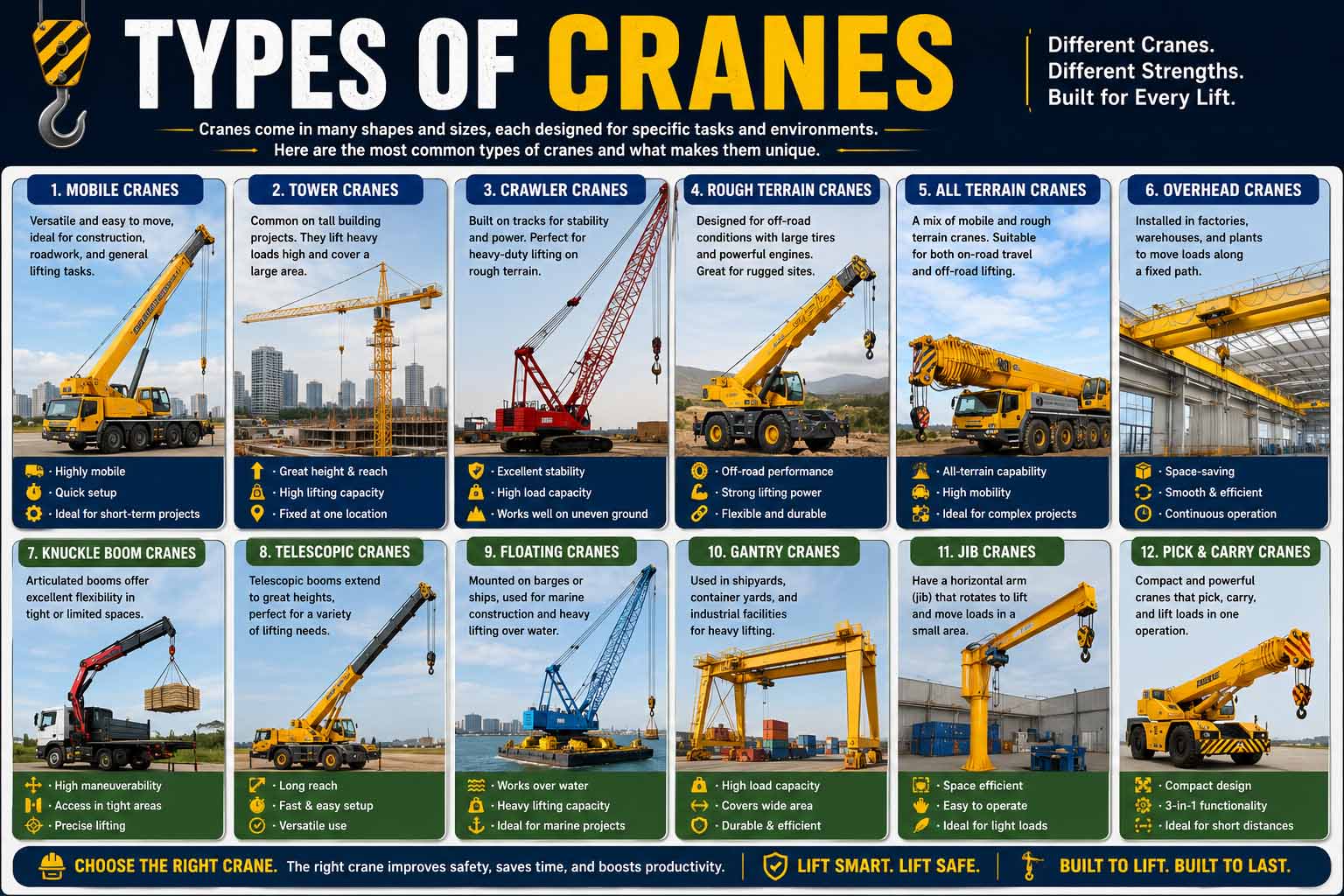
12 Types of Cranes at a Glance
The following quick-reference table compares 12 types of cranes commonly encountered across construction and industry.
| Crane Type | Main Advantage | Typical Application |
|---|---|---|
| Tower crane | Great height and reach | High-rise construction |
| Mobile crane | Easy relocation | General construction |
| Crawler crane | Heavy lifting on tracks | Infrastructure projects |
| Rough-terrain crane | Off-road mobility | Difficult job sites |
| All-terrain crane | Road and site versatility | Large construction projects |
| Truck-mounted crane | Fast road travel | Short-term lifting jobs |
| Overhead crane | Precise indoor handling | Factories and warehouses |
| Gantry crane | Independent support structure | Shipyards and industrial yards |
| Jib crane | Compact working radius | Workshops and production lines |
| Floating crane | Heavy lifting on water | Ports and marine construction |
| Telescopic crane | Adjustable boom length | Construction and recovery |
| Hammerhead crane | Wide horizontal coverage | Large building projects |
These categories can overlap. For example, a mobile crane may also use a telescopic boom, while some tower cranes use hammerhead configurations.
Therefore, crane terminology often describes either the machine’s overall platform or a particular structural design.
Types of Cranes Used on Construction Sites
Construction is probably where most people encounter cranes. Yet even within one industry, different projects require very different machines.
The right crane depends on the building height, available space, load weight, terrain, project duration, and required reach.
This variety reflects the broader types of construction found across residential, commercial, industrial, and infrastructure projects. A crane suitable for a skyscraper may be completely impractical for roadwork or a small commercial building.
1. Tower Cranes
Tower cranes are among the most recognizable cranes in modern cities.
A vertical mast supports a horizontal working structure high above the ground. One side carries the working jib, while the opposite side helps balance the system with counterweights and structural components.
Tower cranes provide excellent height and reach while occupying relatively little ground space.
As a result, they’re widely used for:
- High-rise buildings
- Apartment towers
- Office developments
- Large concrete structures
- Dense urban projects
Their biggest limitation is mobility. Unlike road-going cranes, tower cranes usually require planned installation and dismantling.
2. Mobile Cranes
Mobile cranes mount their lifting equipment on a movable carrier.
Because they can travel between locations, they offer far more flexibility than permanent or semi-permanent crane installations.
They commonly handle short-duration lifting jobs such as positioning structural components, placing HVAC equipment, assisting bridge work, and moving machinery.
Before lifting, operators often deploy outriggers to create a wider and more stable support base.
Mobility makes these cranes useful across many industries, although their safe lifting capacity changes with boom angle, extension, counterweight configuration, and load radius.
3. Crawler Cranes
Crawler cranes move on tracks rather than conventional tires.
The large track area spreads the machine’s weight across the ground and provides good stability on prepared job sites. Consequently, crawler cranes are widely used for heavy infrastructure, industrial projects, wind energy installations, and major structural work.
They can handle very large loads depending on the model and configuration.
However, transportation can be challenging. Large crawler cranes may need to be partially dismantled before being moved between distant projects.
Once on site, though, their stability and lifting capability make them valuable for demanding operations.
Mobile Crane Designs for Difficult Terrain
Not every construction project happens on smooth pavement.
Energy projects, remote infrastructure, industrial facilities, and large civil works may involve uneven or undeveloped terrain. Therefore, manufacturers build specialized mobile cranes for these conditions.
4. Rough-Terrain Cranes
Rough-terrain cranes typically use large tires and a compact chassis designed for job-site mobility.
They perform well on uneven ground where conventional road vehicles may struggle.
Unlike truck-mounted designs built primarily for highway transportation, rough-terrain cranes prioritize movement around the work site.
However, they’re generally transported between distant sites rather than driven long distances on public roads.
5. All-Terrain Cranes
All-terrain cranes combine road mobility with better off-road performance.
Multiple axles, sophisticated suspension systems, and powerful drivetrains allow these cranes to travel on public roads and then operate across challenging sites.
That versatility makes them popular for major industrial and construction work.
Still, advanced capability comes with greater cost and complexity. Therefore, contractors typically choose an all-terrain crane when its mobility and lifting performance justify the expense.
6. Truck-Mounted Cranes
Truck-mounted cranes place the crane system on a road-going truck chassis.
Their major advantage is transportation speed.
Instead of requiring separate heavy-haul equipment for every relocation, many truck cranes can travel directly between jobs where road regulations allow.
That makes them practical for projects requiring frequent movement.
However, outriggers are normally needed during lifting because road mobility alone doesn’t provide the stability required for safe crane operation.
Mechanical Advantage and Crane Lifting Systems
Cranes can lift loads far heavier than a person could move manually because their systems combine power with carefully designed mechanical arrangements.
Understanding what is mechanical advantage helps explain why pulley systems are so useful in crane engineering. By routing wire rope through multiple sheaves, a lifting system can distribute forces while allowing controlled movement of substantial loads.
However, there’s always a trade-off.
Increasing mechanical advantage generally means more rope must move to raise the load through a given distance.
Modern cranes add electric motors, diesel engines, hydraulic systems, sensors, brakes, and computerized controls to these basic mechanical principles.
As a result, today’s lifting machines combine centuries-old physics with sophisticated engineering.
Types of Cranes Used Inside Factories
Cranes aren’t limited to outdoor construction.
Factories, warehouses, steel plants, power facilities, and maintenance workshops frequently use permanently installed lifting equipment.
7. Overhead Cranes
An overhead crane typically uses a bridge that travels along elevated runways.
A trolley moves across the bridge, while a hoist raises and lowers the load.
Because movement occurs along defined paths, overhead cranes provide precise material handling without occupying large amounts of floor space.
They’re commonly used for moving:
- Steel products
- Manufacturing components
- Machinery
- Dies and molds
- Maintenance equipment
- Heavy assemblies
Unlike construction cranes, overhead cranes may remain inside the same building for decades.
Their predictable operating area makes them especially useful for repetitive industrial processes.
8. Gantry Cranes
Gantry cranes resemble overhead bridge cranes, but the bridge is supported by legs rather than relying entirely on a building’s runway structure.
Those legs may travel along rails or wheels.
Large gantry cranes are common in shipyards, ports, fabrication yards, and heavy manufacturing. Meanwhile, smaller versions can serve workshops and maintenance facilities.
Their independent support structure is especially valuable where installing an overhead runway isn’t practical.
9. Jib Cranes
Jib cranes provide lifting capability within a smaller working area.
A horizontal arm extends from a wall, column, or freestanding support. The hoist then moves the load within the crane’s available rotation and reach.
They’re often used at individual workstations.
For example, a worker may use a jib crane to position a heavy component onto a machine rather than moving it manually.
Their compact design makes them particularly useful where a full overhead crane would be unnecessary.
Bearings and Rotation in Crane Systems
Many crane movements depend on carefully engineered rotating components.
Tower cranes and mobile cranes, for instance, often need to rotate their upper structure while supporting substantial forces.
Different types of bearings can support radial, axial, or combined loads within machinery. In crane applications, large slewing bearing systems can help enable controlled rotation between major structural sections.
Bearings also appear in pulleys, gearboxes, wheels, and other moving assemblies.
Their condition matters because crane components operate under significant loads. Therefore, inspection, lubrication, wear monitoring, and preventive maintenance form essential parts of equipment management.
Specialized Types of Cranes
Some lifting jobs require machines built for unusual environments or specific movements.
10. Floating Cranes
Floating cranes operate from barges, pontoons, or specialized vessels.
They’re used where lifting needs to happen on or beside water.
Common applications include bridge construction, port development, offshore work, shipbuilding, and marine salvage.
Some floating cranes can handle extremely heavy loads. However, marine conditions introduce extra engineering challenges, including vessel stability, waves, currents, and wind.
11. Telescopic Cranes
This design provides adjustable reach without requiring a long fixed boom at all times.
Hydraulic systems commonly control the extension process.
Telescopic booms appear on several mobile crane designs because they combine compact transportation dimensions with useful working height and reach.
However, maximum lifting capacity generally decreases as load radius increases, so operators must follow the crane’s specific load chart.
12. Hammerhead Cranes
Hammerhead cranes are a recognizable tower-crane configuration with a long horizontal jib.
This design can provide broad site coverage and has been widely used on large construction projects.
Still, modern tower crane designs vary considerably. Therefore, contractors choose configurations based on available space, lifting requirements, nearby structures, and project layout.
Materials Used in Modern Crane Construction
Cranes need materials that can handle heavy loads while remaining practical to manufacture, transport, inspect, and repair.
Structural steel remains central to crane construction because it combines strength, predictable engineering properties, availability, and established fabrication methods.
However, manufacturers continually explore ways to reduce weight in machinery.
Anyone researching what is carbon fiber may wonder whether lightweight composites could replace steel throughout cranes. Carbon-fiber composites offer impressive strength-to-weight characteristics, but cost, impact behavior, inspection requirements, joint design, and large-scale structural demands mean traditional metals remain dominant in major crane structures.
Still, advanced materials can appear in selected components where reduced weight provides a practical advantage.
Material choice always depends on more than strength alone.
How Engineers Choose the Right Crane
Selecting a crane begins with the load.
Engineers and lifting specialists need to know the object’s weight, dimensions, center of gravity, lifting points, required height, and destination.
Next comes load radius.
A crane may safely lift a heavy object close to its center but have far less capacity when that same load must be positioned much farther away.
Ground conditions also matter.
A powerful crane cannot operate safely if the supporting surface can’t handle the forces transferred through tracks, tires, or outriggers.
Other factors include:
- Available setup space
- Overhead obstacles
- Nearby buildings
- Power lines
- Wind conditions
- Access routes
- Crane configuration
- Required lifting height
- Frequency of lifts
Therefore, the “largest crane available” isn’t automatically the correct crane.
The right choice is the machine that can perform the planned lift safely within its rated configuration and site conditions.
Crane Safety and Modern Technology
Modern cranes increasingly combine mechanical systems with electronic monitoring.
Depending on the machine, operators may have access to load information, boom-angle monitoring, cameras, anti-collision systems, position sensors, and computerized safety functions.
These systems improve situational awareness, but they don’t replace proper planning or trained personnel.
Before lifting, teams need to consider load weight, rigging, communication, weather, site conditions, and exclusion zones.
Routine inspection is equally necessary.
Wire ropes, hooks, sheaves, structural connections, hydraulic components, brakes, and safety systems can experience wear over time.
Consequently, crane safety depends on both technology and disciplined operating procedures.
FAQs About Different Types of Cranes
What are the most common types of cranes?
Common designs include tower, mobile, crawler, rough-terrain, all-terrain, truck-mounted, overhead, gantry, jib, floating, telescopic, and hammerhead cranes. However, many additional specialized designs exist.
Which crane is used for skyscrapers?
Tower cranes are commonly used for high-rise construction because they provide significant height and horizontal reach while requiring relatively little ground space.
What type of crane can move around a construction site?
Mobile, crawler, rough-terrain, and all-terrain cranes can move around job sites, although their mobility characteristics differ. Crawler cranes use tracks, while rough-terrain models use tires designed for difficult ground.
What type of crane is used in factories?
Overhead bridge cranes are common in factories because they can move heavy materials along defined paths above the production floor. Jib and gantry cranes are also widely used.
What is the difference between a gantry crane and an overhead crane?
An overhead bridge crane typically travels on runways supported by the building or dedicated elevated structures. A gantry crane carries its bridge on supporting legs that transfer loads toward the ground.
Are all mobile cranes telescopic?
No. Telescopic describes a boom design, while mobile describes the crane’s ability to travel. Many mobile cranes use telescopic booms, but mobile crane configurations can vary.
Choosing Between Different Types of Cranes
The many different types of cranes exist because lifting a steel beam onto a skyscraper, moving machinery across a factory, handling cargo near water, and placing equipment on rough terrain are completely different engineering problems.
Tower cranes provide height and site coverage, while mobile cranes emphasize flexibility. Meanwhile, crawler cranes handle demanding heavy lifts, and overhead systems provide controlled movement inside industrial buildings.
So, when comparing crane designs, don’t focus only on maximum lifting capacity. Reach, load radius, mobility, terrain, working height, available space, setup requirements, and operating environment matter just as much.
Once those factors are clear, the reason behind each crane design becomes much easier to understand: every type is engineered around a particular way of moving heavy loads safely and efficiently.