If you’ve ever driven past a wind farm, you may have wondered, how does a wind turbine work? At first glance, the process seems simple: wind spins the blades, and the turbine produces electricity. However, several connected components transform the movement of air into usable electrical power.
Wind turbines capture kinetic energy from moving air and convert it into mechanical energy before generating electricity. As a result, they provide a renewable way to supply homes, businesses, and communities with power. Understanding the process also explains why blade design, wind speed, generators, and control systems all matter.
How Does a Wind Turbine Work? The Basic Process
The principle behind wind energy is straightforward. Moving air carries kinetic energy, and a turbine captures part of that energy to produce electricity.
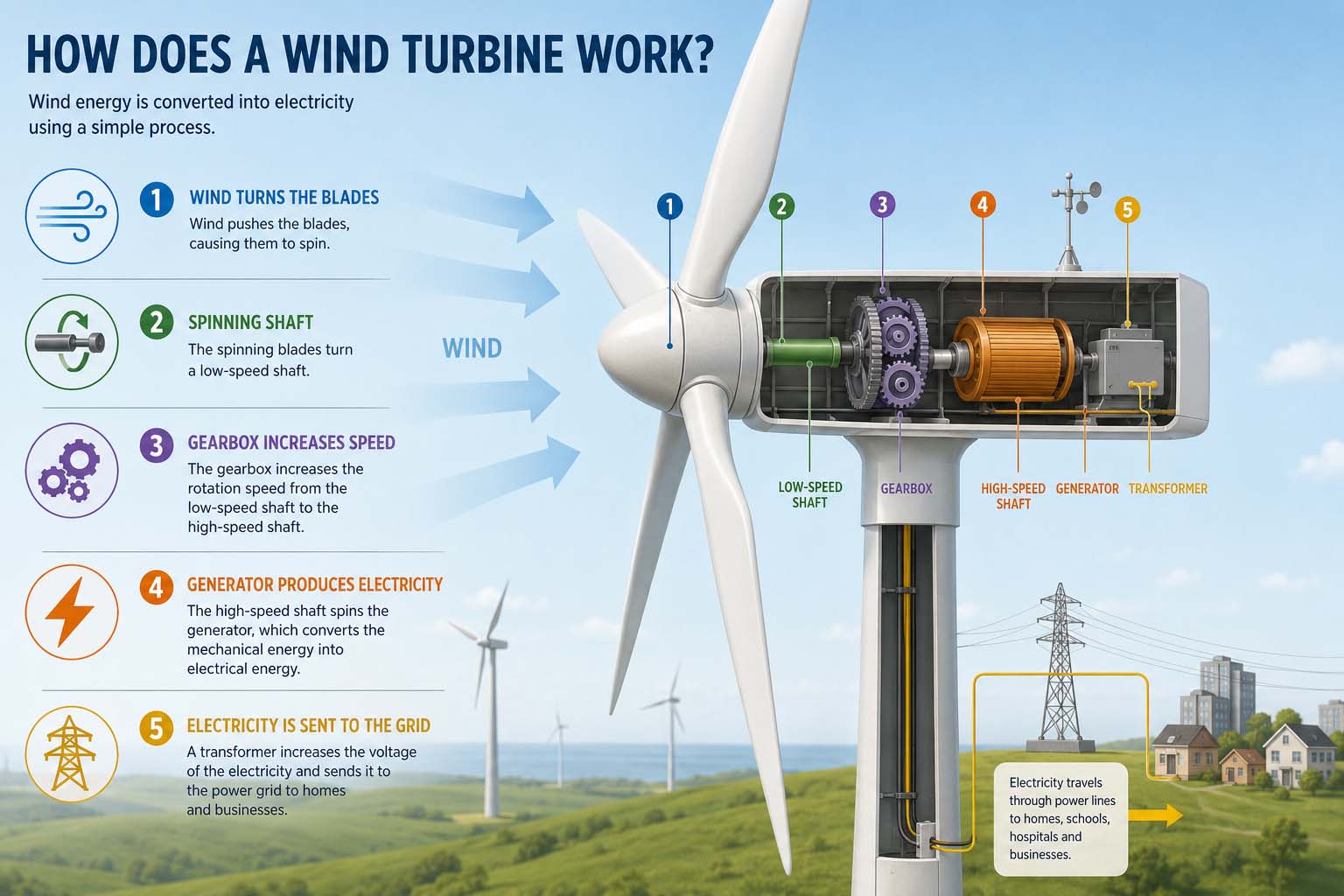
Here is how the process works:
- Wind flows across the turbine blades and creates lift.
- The blades rotate the rotor.
- The rotor transfers mechanical energy through a shaft.
- A generator converts that rotation into electrical energy.
- Electrical equipment adjusts the power to meet grid requirements.
- A transformer increases the voltage for efficient transmission.
Each stage has a specific purpose. Together, these components allow a wind turbine to turn naturally occurring wind into electricity that people can use.
For a detailed technical explanation, the U.S. Department of Energy’s guide to how wind turbines work explains the aerodynamic and electrical principles behind this process.
Main Parts of a Wind Turbine
Before examining each stage, it helps to understand the equipment inside a typical utility-scale turbine.
| Component | Main function |
|---|---|
| Blades | Capture energy from moving air |
| Rotor | Combines the blades and hub to create rotation |
| Main shaft | Transfers rotational energy |
| Gearbox | Increases rotational speed in geared designs |
| Generator | Converts mechanical energy into electricity |
| Nacelle | Houses major mechanical and electrical components |
| Tower | Supports the turbine at a suitable height |
| Transformer | Adjusts voltage for electrical transmission |
| Controller | Monitors operating conditions and manages turbine operation |
Although manufacturers use different designs, these components perform the main tasks involved in wind power generation. Some turbines also use direct-drive generators, which eliminate the need for a gearbox.
Step 1: Wind Turns the Turbine Blades
The process starts when wind flows across the blades. Each blade has an aerodynamic shape similar to an airplane wing.
Rather than relying only on the wind pushing against a flat surface, the blade creates lift because air pressure differs across its two sides. This aerodynamic force causes the rotor to turn.
As wind speed increases, more energy becomes available for the turbine to capture. However, the relationship is not unlimited. Turbine controls adjust blade angles and rotor speed to maintain safe operation and manage electrical output.
Blade design also affects performance. Therefore, manufacturers carefully shape each blade to capture energy while limiting unnecessary aerodynamic drag and mechanical stress.
Step 2: The Rotor Transfers Mechanical Energy
Once the blades begin turning, they rotate the rotor, which consists of the blades and their central hub. The rotor connects to the drivetrain inside the nacelle.
The drivetrain transfers rotational energy toward the generator. Depending on the turbine design, it may include a main shaft, bearings, a gearbox, and other mechanical components.
A gearbox increases the shaft’s rotational speed so a smaller generator can operate effectively. However, not every turbine uses one. Direct-drive systems connect the rotor to a specially designed generator without a gearbox.
This is related to the broader engineering concept of what is mechanical advantage, which explains how mechanical systems can change the relationship between force, speed, and movement.
Step 3: How Does a Wind Turbine Generator Work?
The generator performs the essential task of converting mechanical energy into electrical energy.
Inside a typical generator, the movement of magnetic fields relative to conductive windings produces an electric current. This process is known as electromagnetic induction.
The basic sequence is simple:
- The rotor and drivetrain provide mechanical rotation.
- Magnetic fields and conductive windings interact inside the generator.
- This interaction produces electrical energy.
- Cables carry the generated electricity to the turbine’s electrical systems.
Generator designs vary. Some use a gearbox to increase rotational speed, while others generate electricity directly from the slower rotation of the rotor.
Without this conversion process, the turbine would produce mechanical motion but not the electrical power needed by homes and businesses.
Step 4: Electrical Equipment Prepares the Power
Electricity leaving a generator may require further processing before the turbine can deliver it to the grid.
Electrical converters and control equipment manage power characteristics, monitor operating conditions, and help the turbine meet grid requirements. The exact equipment depends on the generator and turbine design.
For example, power electronics can regulate the electrical output and help synchronize it with the grid. Protection systems also detect certain faults and initiate appropriate responses.
Understanding these electrical pathways becomes easier when you learn what is a circuit. A wind turbine relies on interconnected electrical circuits, sensors, and protective devices to deliver power safely.
Step 5: Electricity Travels to the Power Grid
Understanding how does a wind turbine work also means knowing how transformers adjust the generated electricity’s voltage for efficient transmission.
A step-up transformer increases voltage, which helps reduce electrical losses when power travels over long distances. The electricity then moves through cables and transmission lines toward substations.
At a substation, other equipment can reduce the voltage for distribution. Consequently, electricity can travel from a wind farm to the local network and eventually reach homes, schools, factories, and businesses.
The turbine itself is only one part of the larger electricity system. Transformers, cables, substations, and grid controls help deliver the generated power to the places where people need it.
How Does a Wind Turbine Work? A Simple Explanation
If you want an easy way to understand the entire process, imagine a bicycle dynamo.
When a bicycle wheel turns the dynamo, the dynamo converts mechanical movement into electricity. A wind turbine follows a similar principle, although it uses aerodynamic blades and a much larger generator system.
The process can be summarized in five steps:
- Wind moves the blades.
- The blades rotate the rotor and shaft.
- The drivetrain transfers mechanical energy.
- The generator produces electricity.
- Electrical equipment delivers the power to the grid.
Although large turbines contain advanced control systems, the central idea remains the same: capture energy from moving air and convert it into electricity.
Why Wind Turbines Sometimes Stop Spinning
To understand how does a wind turbine work in changing weather, it helps to examine the wind-speed limits that control its operation. Instead, their controllers monitor wind speed and other operating conditions to determine whether generation is safe and practical.
Three important wind-speed thresholds help explain their behavior.
- Cut-in speed: The wind speed at which a turbine can begin generating electricity.
- Rated speed: The point at which the turbine reaches its rated power under specified conditions.
- Cut-out speed: A high wind-speed threshold at which the turbine shuts down to protect its components.
Many large turbines have cut-in speeds around 3–4 meters per second. Rated wind speeds often fall around 12–15 meters per second, while some designs use cut-out speeds near 25 meters per second.
These values vary by model, so they should not be treated as universal specifications. In addition, turbines may stop because of maintenance, electrical faults, grid restrictions, or other protective controls.
How Modern Turbine Control Systems Improve Performance
Modern turbines use sensors and automated controls to respond to changing conditions. These systems monitor wind speed, wind direction, rotor speed, vibration, temperature, and electrical output.
For example, a yaw system turns the nacelle so the rotor faces the wind on turbines designed to track wind direction. Meanwhile, a pitch system changes the angle of the blades to control how much energy they capture.
When wind conditions become unsuitable, the controller can reduce output or stop the turbine. As a result, these systems help balance energy production, equipment protection, and operational reliability.
Materials Used in Wind Turbine Blades
Wind turbine blades must withstand repeated loading while remaining light enough to rotate efficiently. Manufacturers therefore use strong composite materials that combine structural strength with relatively low weight.
Fiberglass composites are common in turbine blades. Certain designs also incorporate carbon fiber, especially where its strength-to-weight characteristics provide an engineering advantage.
If you have wondered what is carbon fiber, it is a lightweight material made from thin carbon filaments combined into a material suitable for structural applications.
Material selection depends on blade size, cost, manufacturing methods, and performance requirements. In addition, designers consider durability, maintenance needs, and the challenges of handling materials at the end of a blade’s service life.
Why Turbine Size Matters
Larger wind turbines can capture more energy because their longer blades sweep a greater area. Taller towers can also reach wind conditions that differ from those closer to the ground.
However, size alone does not determine electricity production. Wind speed, air density, blade design, turbine efficiency, and local conditions all influence output.
Larger installations also create practical challenges. For instance, manufacturers and developers must consider transportation, foundations, lifting equipment, and installation costs.
Therefore, turbine size reflects a balance between energy potential, engineering requirements, and the economics of a particular project.
How Does a Floating Wind Turbine Work?
Floating wind turbines allow developers to access offshore wind resources in deeper waters where conventional fixed-bottom foundations may not be suitable.
Instead of relying on a foundation attached directly to the seabed, a floating turbine sits on a buoyant platform. Mooring lines and anchors help keep the platform in position while allowing controlled movement with waves and currents.
The electricity generation process remains similar to that of a land-based turbine:
- Wind rotates the blades.
- The rotor transfers energy through the drivetrain.
- The generator produces electricity.
- Electrical cables carry power toward shore.
However, floating installations require additional engineering for platform stability, mooring systems, underwater cables, and offshore maintenance.
These systems can expand the areas suitable for offshore wind development, although their cost and technical requirements differ from those of fixed-bottom projects.
Advantages of Wind Turbines
Wind power offers several benefits, particularly when developers choose locations with suitable wind resources.
Renewable Energy Source
Wind naturally replenishes, so turbines do not need a continuous supply of fuel to generate electricity. As a result, wind power can contribute to a more diverse energy supply.
Low Operating Emissions
Wind turbines generate electricity without directly burning fossil fuels during normal operation. Nevertheless, manufacturing, transportation, installation, and maintenance still have environmental impacts.
Flexible Installation Options
Developers can install turbines on land or offshore. Smaller systems can also support certain homes, farms, businesses, and remote facilities where local conditions make wind power practical.
No Ongoing Wind-Fuel Costs
Unlike conventional power stations that burn coal or natural gas, wind turbines do not purchase fuel to generate electricity. However, owners still pay for construction, maintenance, repairs, and other operating expenses.
Limitations of Wind Energy
Despite its advantages, wind power also has limitations that developers must consider.
Variable Wind Conditions
Wind speed changes throughout the day and across seasons. Therefore, a turbine’s electrical output can rise or fall as weather conditions change.
Energy storage, grid connections, and other generation sources can help electricity systems manage this variability.
High Initial Investment
Large wind projects require substantial investment in turbines, foundations, roads, electrical infrastructure, transportation, and installation.
Offshore projects can involve additional expenses because construction and maintenance require specialized vessels and equipment.
Maintenance Challenges
Turbines operate in exposed environments and experience repeated mechanical loads. Offshore machines face additional challenges from saltwater, waves, and difficult access.
Regular inspections and timely repairs help reduce equipment wear and maintain reliable operation.
Common Wind Turbine Maintenance Tasks
Routine maintenance helps operators identify potential problems before they cause major failures.
Common tasks include:
- Inspecting blades for cracks, erosion, or other damage.
- Checking bearings and lubricating components according to manufacturer requirements.
- Examining gearbox oil in turbines equipped with gearboxes.
- Monitoring electrical connections and control systems.
- Testing braking and safety mechanisms.
- Inspecting structural bolts and other critical connections.
- Checking lightning protection systems.
Modern monitoring systems can detect unusual vibration, temperature changes, or other warning signs. However, technicians still need to perform inspections and maintenance according to the turbine manufacturer’s procedures.
Common Wind Turbine Problems and Solutions
Although wind turbines use automated controls and protective systems, several problems can affect their performance.
| Problem | Possible cause | Appropriate response |
|---|---|---|
| Low power output | Weak wind or unfavorable operating conditions | Review wind data and turbine performance |
| Excessive vibration | Imbalance, bearing wear, or another mechanical issue | Arrange a qualified inspection |
| Unexpected shutdown | High winds, electrical faults, or a protective trigger | Review alarms and diagnostic information |
| Unusual gearbox noise | Wear or a mechanical problem | Schedule professional assessment |
| Electrical fault | Wiring, sensor, or power-system issue | Have qualified technicians inspect the system |
These symptoms do not always point to one specific fault. Consequently, operators should use monitoring data and diagnostic procedures rather than assuming a single cause.
Onshore vs. Offshore Wind Turbines
Wind turbines can operate on land or in bodies of water. Each setting offers different advantages and practical challenges.
| Feature | Onshore turbines | Offshore turbines |
|---|---|---|
| Installation | Often simpler | Usually more complex |
| Initial costs | Generally lower | Generally higher |
| Wind conditions | Depend on local terrain | Can offer stronger, steadier winds |
| Maintenance access | Usually easier | Often more difficult |
| Infrastructure | Roads and land-based connections | Marine equipment and offshore cables may be needed |
Offshore wind farms can benefit from favorable wind conditions, but those advantages do not guarantee greater output at every site. Project performance depends on local resources, turbine design, availability, and operating costs.
Why Modern Wind Turbines Are More Efficient
Engineering improvements continue to help turbines capture wind energy and operate reliably.
Some important developments include:
- Improved blade aerodynamics.
- Taller towers and larger rotor diameters.
- More advanced generator designs.
- Smarter electronic control systems.
- Better condition monitoring and maintenance planning.
Electrical machine design also plays a role. For example, understanding brushless motor meaning can help explain how magnetic fields and electrical control contribute to efficient motor operation. However, a motor consumes electrical energy to create movement, whereas a wind turbine’s generator converts mechanical energy into electrical energy.
Together, these developments help manufacturers improve turbine performance while managing mechanical stress, maintenance requirements, and project costs.
Frequently Asked Questions
How does a wind turbine work?
A wind turbine captures energy from moving air. Its blades rotate a rotor and drivetrain, which drive a generator. The generator produces electricity, and electrical equipment prepares that power for delivery to the grid.
Do wind turbines generate electricity all the time?
No. Turbines need suitable wind conditions to generate power. They may stop when winds fall below their operating range, become too strong, or trigger a protective shutdown. Maintenance and grid conditions can also affect operation.
Why are wind turbine blades so large?
Longer blades sweep a larger area, allowing a turbine to capture more wind energy. However, blade size must also account for structural strength, weight, transportation, and installation requirements.
Are all wind turbines the same?
No. Turbines differ in size, generator design, drivetrain, rotor configuration, and installation location. For example, a small turbine for a remote property may have very different requirements from a large offshore installation.
How long do wind turbines last?
Many modern wind turbines are designed around an operating life of approximately 20–30 years. Actual service life depends on the design, operating environment, maintenance, and decisions about repair or replacement.
Can wind turbines work without a gearbox?
Yes. Direct-drive turbines connect the rotor to a generator designed to operate at lower rotational speeds. This arrangement eliminates the gearbox, although the generator and other components still require maintenance.
Understanding the Wind-to-Electricity Process
Understanding how wind turbines generate electricity reveals how aerodynamics, mechanical engineering, and electrical systems work together. Wind turns the blades, the drivetrain transfers rotational energy, and the generator converts that energy into electricity.
From there, transformers and electrical infrastructure help deliver power to the grid. Meanwhile, modern controls adjust turbine operation to changing wind conditions and protect equipment from excessive loads.
As turbine designs evolve, larger rotors, improved materials, advanced controls, and floating offshore platforms continue to expand the possibilities for wind power. The underlying principle remains straightforward: capture energy from moving air and convert it into useful electricity.