
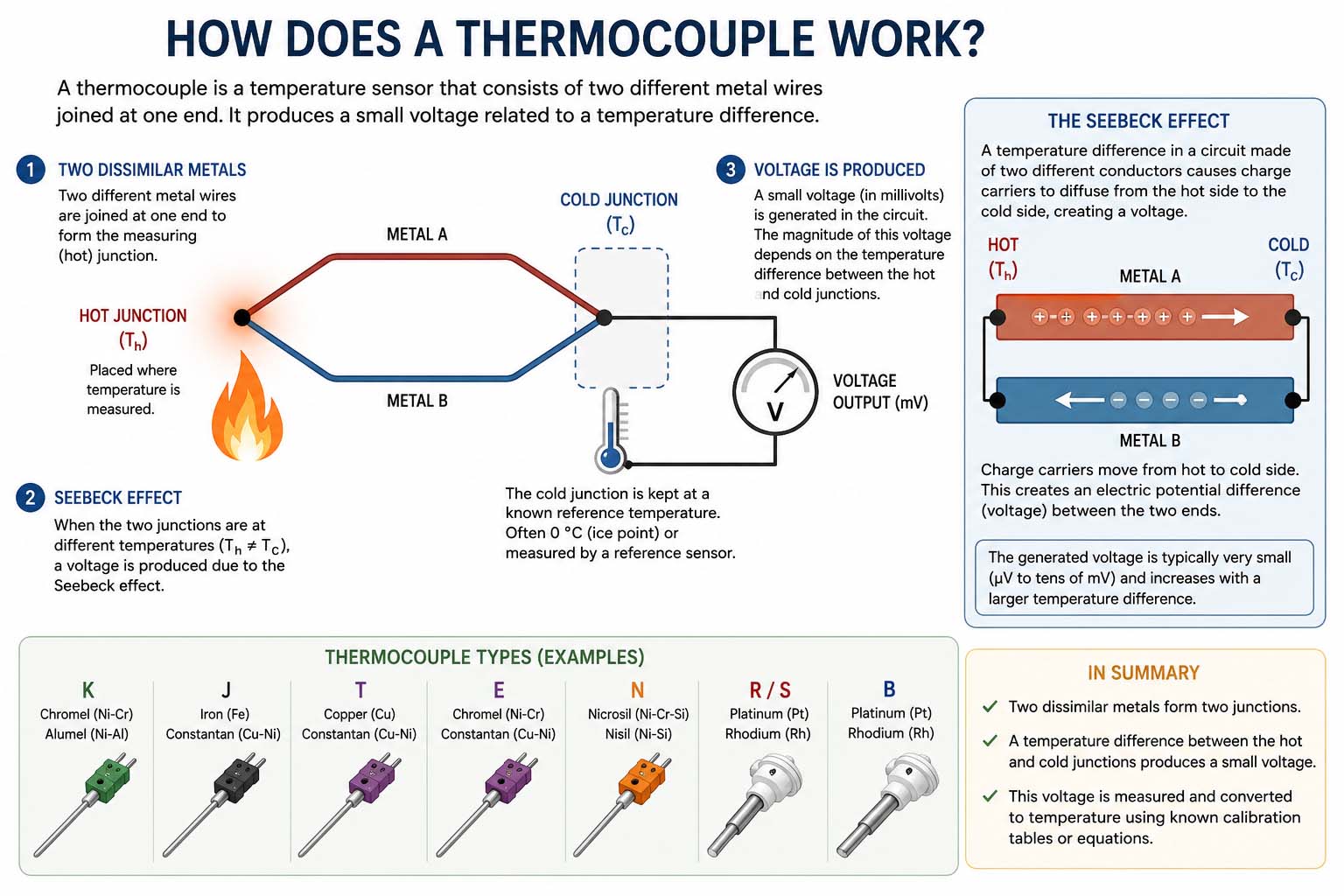
How does a thermocouple work? A thermocouple measures temperature using two different conductive materials that generate a small electrical voltage when their sensing and reference connections experience different temperatures. A compatible measuring instrument then converts this voltage into a temperature reading.
Thermocouples are widely used because they are durable, affordable, and suitable for demanding environments. Therefore, you can find them in industrial machinery, heating systems, ovens, engines, laboratories, and manufacturing equipment.
Unlike resistance-based sensors, a thermocouple generates its sensing signal through a natural thermoelectric phenomenon. As a result, the sensing element does not require an external excitation current.
This guide explains the working principle, thermocouple types, measurement process, applications, installation requirements, and common problems.
What Is a Thermocouple and How Does It Work?
A thermocouple is a temperature sensor made from two different conductive materials. These conductors are joined at a sensing junction, while their other ends connect to a measuring instrument.
When a temperature difference exists between the sensing and reference connections, the circuit develops a small thermoelectric voltage.
The measuring instrument detects this voltage and calculates the corresponding temperature.
Therefore, a thermocouple converts a temperature difference into an electrical signal that equipment can interpret.
Unlike resistance temperature detectors, thermocouples do not measure temperature through changes in electrical resistance.
Moreover, modern industrial systems frequently combine thermocouples with automated controllers and mechanical equipment.
For example, understanding what is mechatronics? helps explain how temperature sensors work alongside motors, controllers, and automated machinery.
How Does a Thermocouple Work Using the Seebeck Effect?
The fundamental principle behind thermocouple operation is the Seebeck effect.
This phenomenon occurs when different conductive materials experience a temperature difference, producing a measurable thermoelectric voltage.
The voltage depends on the conductor materials and their temperature distribution.
Therefore, different thermocouple types produce different voltage-versus-temperature relationships.
How Does a Thermocouple Work Through the Seebeck Effect?
The process involves several steps:
- Two different conductive materials form the thermocouple circuit.
- The sensing junction experiences the temperature being measured.
- A temperature difference produces a thermoelectric voltage.
- The measuring instrument detects the electrical signal.
- The instrument compensates for the reference-junction temperature.
- Finally, it calculates and displays the sensing temperature.
Although the generated voltage is small, modern measuring equipment can detect it accurately.
Consequently, thermocouples provide a practical method for measuring temperature across many industrial applications.
Why Does a Thermocouple Generate Voltage?
Different conductive materials have different thermoelectric properties.
When temperature varies along the conductors, these properties contribute to the voltage measured across the circuit.
As a result, the instrument can relate the measured voltage to the temperature difference.
However, the relationship is not perfectly linear. Therefore, measuring instruments use standardized reference data to convert voltage into temperature.
How Does a Thermocouple Work to Measure Temperature?
A thermocouple does not directly display temperature. Instead, it produces an electrical signal that changes with the temperature difference between the sensing and reference connections.
For example, imagine placing a thermocouple probe inside an oven.
As the oven becomes hotter, the sensing junction experiences a temperature increase.
Consequently, the thermoelectric voltage changes.
The connected thermometer then measures this signal and calculates the corresponding temperature.
Modern instruments normally use cold-junction compensation to account for the temperature at the instrument connection.
As a result, the display shows a temperature value rather than a voltage measurement.
For authoritative technical reference data, the National Institute of Standards and Technology (NIST) provides standardized thermocouple reference functions and tables.
How Does a Thermocouple Work With Cold-Junction Compensation?
A thermocouple measures a temperature difference rather than an absolute temperature directly.
Therefore, the measuring instrument must account for the reference-junction temperature.
For example, the reference connection may be at room temperature while the sensing junction is inside a heated chamber.
The instrument measures or estimates the reference temperature using an internal sensor.
Then, it combines that information with the thermocouple voltage.
Consequently, the instrument can calculate the temperature at the sensing junction.
How Does a Thermocouple Work Through Its Main Components?
Understanding the components helps explain how thermocouples operate in practical measurement systems.
| Component | Function |
|---|---|
| Sensing Junction | Responds to the measured temperature |
| Thermocouple Conductors | Provide the thermoelectric material combination |
| Reference Connection | Establishes the reference temperature for measurement |
| Protective Sheath | Protects the sensing element in many probe designs |
| Connecting Cable | Carries the thermocouple signal |
| Measuring Instrument | Converts voltage into a temperature reading |
However, not every thermocouple uses the same construction.
For example, some probes have exposed sensing junctions for fast response. Meanwhile, others use protective sheaths for industrial environments.
Therefore, probe construction should match the intended application.
How Does a Thermocouple Work With Different Metals?
Different thermocouple types use different conductive material combinations.
Each combination has a characteristic voltage-versus-temperature relationship.
Consequently, manufacturers standardize these combinations so instruments can interpret their signals correctly.
Common Thermocouple Types and Their Uses
Type K is the most common choice for general-purpose industrial temperature measurement.
Many industrial applications also use Type J, as long as you keep it within its recommended operating conditions.
For lower-temperature measurements, Type T is often the pick.
Type E offers relatively high thermoelectric sensitivity, so it gives a stronger signal for each degree of change.
Meanwhile, Type N offers better stability in certain high-temperature environments.
In addition, Types R, S, and B are used in specialized high-temperature applications.
However, no thermocouple type is ideal for every environment.
Therefore, selection should consider temperature range, atmosphere, accuracy, and equipment compatibility.
How Does a Thermocouple Work in a Thermometer?
A thermocouple thermometer converts the probe’s electrical signal into a readable temperature value.
However, the thermometer must support the thermocouple type being used.
For example, a Type K probe should connect to an instrument configured for Type K measurements.
Otherwise, the displayed temperature may be incorrect.
How to Use a Thermocouple Thermometer
Follow these steps:
- Identify the thermocouple type.
- Connect the probe to a compatible thermometer.
- Select the correct thermocouple type.
- Position the sensing junction at the measurement point.
- Allow the reading to stabilize.
- Record the displayed temperature.
- Remove and store the probe safely.
Additionally, follow the manufacturer’s instructions regarding temperature limits and probe placement.
How Does a Thermocouple Work for Accurate Readings?
Correct placement is essential for accurate temperature measurement.
First, position the sensing junction where it represents the temperature you want to measure.
For example, when measuring liquid temperature, immerse the appropriate portion of the probe according to its design.
Meanwhile, surface measurements require suitable contact between the sensing junction and the measured surface.
Additionally, avoid exposing cables and connectors to temperatures beyond their ratings.
Therefore, correct installation and instrument configuration are just as important as choosing the sensor itself.
How Does a Thermocouple Work in Industrial Equipment?
Industrial thermocouples use the same thermoelectric principle as handheld temperature probes.
However, industrial versions often include protective materials designed for demanding environments.
For example, a thermocouple may operate inside a furnace, boiler, engine, or processing machine.
The sensing junction responds to the process temperature.
Meanwhile, the connected instrument measures the thermocouple signal.
A controller can then use the temperature reading to regulate equipment.
For instance, if a furnace becomes too cool, the controller may increase heating.
Conversely, if the temperature exceeds the desired setpoint, the system may reduce heating.
Consequently, thermocouples support both temperature monitoring and automated process control.
How Does a Thermocouple Work With Temperature Controllers?
A temperature controller compares the measured temperature with a desired setpoint.
It then determines whether the equipment requires heating, cooling, or another adjustment.
For example, an industrial oven may use a thermocouple to maintain consistent operating conditions.
However, thermocouple signals are relatively small, so reliable electrical connections are important.
In addition, understanding what is impedance provides useful background on electrical signal behavior and measurement circuits.
How Does a Thermocouple Work With Digital Systems?
A thermocouple naturally generates an analog electrical signal.
However, modern measuring instruments can convert that signal into digital information.
Understanding analog vs digital helps explain how electronic measuring systems process temperature information.
First, the thermocouple produces a voltage related to the temperature difference.
Next, electronic circuitry measures and conditions the signal.
Then, an analog-to-digital converter transforms the measured signal into digital data.
Finally, a controller or computer processes the information and displays the temperature.
As a result, thermocouples can support digital thermometers, automated monitoring systems, and industrial data recording.
How Does a Thermocouple Work in Different Applications?
Thermocouples are used across many industries because they can operate in different environments.
Common applications include:
- Industrial furnaces
- Boilers and heating equipment
- Manufacturing machinery
- Automotive engines
- HVAC systems
- Scientific laboratories
- Food-processing equipment
- Chemical processing
- Power generation
- Kilns and ovens
- Refrigeration testing
- Metal-processing equipment
Moreover, specialized probes can measure gases, liquids, surfaces, and internal process temperatures.
Thermocouples in Heating Systems
Heating equipment frequently requires continuous temperature monitoring.
For example, industrial furnaces use temperature sensors to maintain suitable operating conditions.
The thermocouple provides the temperature signal, while the controller manages the heating equipment.
Consequently, the system can respond when the measured temperature changes.
Thermocouples in Scientific Laboratories
Laboratories use thermocouples during experiments, equipment testing, and temperature monitoring.
For example, researchers may record temperature changes during heating or cooling processes.
However, some experiments require extremely precise measurements.
Therefore, the appropriate sensor depends on the required accuracy and operating conditions.
Benefits of How a Thermocouple Works
Thermocouples offer several practical advantages.
Wide Temperature Range
Different thermocouple types support different temperature ranges.
Therefore, engineers can select suitable sensors for both relatively low and very high temperatures.
Fast Temperature Response
Small sensing junctions can respond quickly to temperature changes.
However, response time also depends on sheath construction, probe diameter, and installation.
Durable Construction
Manufacturers can protect thermocouple elements with rugged sheaths.
As a result, suitable probes can operate in demanding industrial environments.
Simple and Affordable Design
Thermocouples use a relatively straightforward sensing principle.
Consequently, they can provide an economical solution for many temperature-measurement applications.
Limitations of How a Thermocouple Works
Although thermocouples are useful, they also have limitations.
Measurement Accuracy
Accuracy depends on the thermocouple type, measuring instrument, wiring, calibration, and installation.
Therefore, high-precision applications require careful equipment selection.
Electrical Interference
Thermocouples generate small electrical signals.
Consequently, electrical noise can affect measurements when wiring and instrumentation are poorly designed.
Sensor Degradation
Certain operating environments can gradually affect thermocouple materials.
For example, prolonged exposure to unsuitable temperatures or chemical conditions may cause measurement drift.
Therefore, periodic inspection and calibration may be necessary.
How Does a Thermocouple Work After Proper Installation?
Proper installation improves measurement reliability and sensor life.
First, select the thermocouple type and probe construction that suit the environment.
Next, position the sensing junction at the correct measurement location.
Then, connect the conductors with the correct polarity.
Additionally, follow these practices:
- Protect cables from mechanical damage.
- Use compatible thermocouple or extension wiring.
- Avoid unnecessary sharp bends.
- Keep wiring away from strong electrical interference when possible.
- Check the measuring instrument’s configuration.
- Follow the probe’s operating temperature limits.
- Verify the measurement before relying on it.
Most importantly, follow the equipment manufacturer’s instructions.
For hazardous or high-temperature installations, use appropriately rated equipment and qualified personnel.
Common Thermocouple Problems and Solutions
Several problems can affect thermocouple measurements.
| Problem | Possible Cause | Recommended Check |
|---|---|---|
| No temperature reading | Open circuit or damaged probe | Inspect wiring and connections |
| Incorrect temperature | Wrong thermocouple type | Check instrument configuration |
| Unstable reading | Electrical interference | Inspect cable routing and connections |
| Slow response | Large probe or poor placement | Check probe design and position |
| Measurement drift | Sensor degradation | Inspect and calibrate the sensor |
Therefore, troubleshooting should consider the complete measurement system rather than assuming the sensing junction has failed.
Why Does a Thermocouple Show the Wrong Temperature?
Incorrect readings may result from damaged wiring, poor connections, unsuitable probe placement, or incorrect instrument settings.
For example, using a Type K probe with an instrument configured for Type J can produce misleading results.
Therefore, verify the thermocouple type before replacing the sensor.
Why Does a Thermocouple Reading Fluctuate?
Unstable readings can result from electrical interference, loose connections, or actual temperature changes.
Additionally, damaged cables may affect signal quality.
Consequently, inspecting the wiring and surrounding environment can help identify the cause.
How Does a Thermocouple Work Compared With RTDs and Thermistors?
Thermocouples are only one category of temperature sensor.
RTDs measure temperature through predictable resistance changes in a metal element.
Similarly, thermistors use resistance changes, although their resistance often varies more strongly with temperature.
Thermocouples, by contrast, rely on thermoelectric voltage.
| Feature | Thermocouple | RTD | Thermistor |
|---|---|---|---|
| Working Principle | Thermoelectric voltage | Resistance change | Resistance change |
| Temperature Range | Often very broad | Broad | Usually more limited |
| Rugged Options | Excellent | Good | Application dependent |
| Response Time | Can be fast | Depends on design | Can be fast |
| Accuracy | Application dependent | Often selected for precision | High sensitivity over limited ranges |
Therefore, no temperature sensor is universally superior.
Instead, engineers select equipment based on temperature range, accuracy, response time, environmental conditions, and cost.
How to Choose the Right Thermocouple
Choosing the correct thermocouple requires understanding the measurement environment.
Important factors include:
- Operating temperature range
- Required accuracy
- Response time
- Probe diameter
- Sheath material
- Chemical exposure
- Pressure
- Vibration
- Junction construction
- Cable compatibility
- Measuring instrument requirements
For example, a thermocouple designed for an industrial furnace may require different materials from one used with a handheld thermometer.
Therefore, matching the probe to the application improves measurement quality and service life.
Additionally, consider whether the sensor will remain installed permanently or be used for occasional measurements.
Frequently Asked Questions: How Does a Thermocouple Work?
How Does a Thermocouple Work?
A thermocouple produces a thermoelectric voltage when its sensing and reference connections experience different temperatures.
The measuring instrument then uses the voltage and reference-junction temperature to calculate the sensing temperature.
What Does a Thermocouple Do?
A thermocouple senses temperature and provides an electrical signal that measuring equipment can interpret.
Therefore, it allows thermometers, controllers, and monitoring systems to measure temperature.
How Does a Thermocouple Work Without External Power?
The sensing element generates its thermoelectric signal without an external excitation current.
However, the connected thermometer, display, or controller may require electrical power.
How Does a Thermocouple Work in a Gas Appliance?
In some gas appliances, a thermocouple is heated by a pilot flame and generates a small electrical signal.
That signal can help operate a compatible flame-safety mechanism.
If the pilot flame goes out, the thermocouple cools, and the safety system may close the gas valve.
However, appliance designs vary. Therefore, gas-safety components should be inspected and serviced by qualified technicians.
How Does a Thermocouple Work for Accurate Temperature Measurement?
A thermocouple measures temperature through its thermoelectric voltage.
The instrument then applies the appropriate reference-junction compensation and thermocouple calibration relationship.
Additionally, correct probe placement and instrument configuration improve measurement accuracy.
How Do You Use a Thermocouple Thermometer?
First, connect a compatible probe to the thermometer.
Next, select the correct thermocouple type.
Then, place the sensing junction at the measurement point and wait for the reading to stabilize.
Finally, record the displayed temperature.
Can a Thermocouple Measure High Temperatures?
Yes. Certain thermocouple types and probe constructions can measure very high temperatures.
However, the safe operating limit depends on the materials, probe construction, atmosphere, and application.
Can a Damaged Thermocouple Be Repaired?
Some thermocouple assemblies may be serviceable.
However, many small or inexpensive probes are replaced when damaged because correct junction construction and calibration are important for reliable measurements.
Key Takeaways: How Does a Thermocouple Work?
Understanding how does a thermocouple work begins with the Seebeck effect. Two different conductive materials develop a small thermoelectric voltage when their sensing and reference connections experience different temperatures.
A compatible measuring instrument then interprets that signal and calculates the sensing temperature.
In addition, correct thermocouple selection, installation, and reference-junction compensation are essential for reliable results.
For practical measurements, always match the probe type to the instrument, position the sensing junction correctly, and allow the temperature reading to stabilize.
Ultimately, thermocouples remain valuable because they provide durable, economical, and versatile temperature measurement across many applications, from handheld thermometers to industrial control systems.