Have you ever wondered how does fiber optic internet work and why it’s so much faster than traditional broadband? Whether you’re streaming 4K videos, joining video meetings, gaming online, or backing up large files to the cloud, fiber internet has become the gold standard for speed and reliability.
Unlike older internet technologies that send electrical signals through copper wires, fiber optic internet uses pulses of light to carry data. This simple difference allows information to travel at incredibly high speeds with very little signal loss.
In this guide, you’ll learn how fiber optic internet works, what makes it different from cable internet, its advantages and drawbacks, and whether it’s the right choice for your needs.
What Is Fiber Optic Internet?
Fiber optic internet is a broadband connection that transmits data using thin strands of glass or plastic known as optical fibers.
Instead of relying on electricity, these fibers carry information as flashes of light generated by lasers or LEDs. Because light travels extremely fast and experiences minimal interference inside the cable, fiber connections can deliver gigabit and even multi-gigabit internet speeds.
Today, many internet service providers continue expanding fiber networks because they support increasing demand for remote work, cloud services, AI applications, smart homes, and high-definition streaming.
How Does Fiber Optic Internet Work?
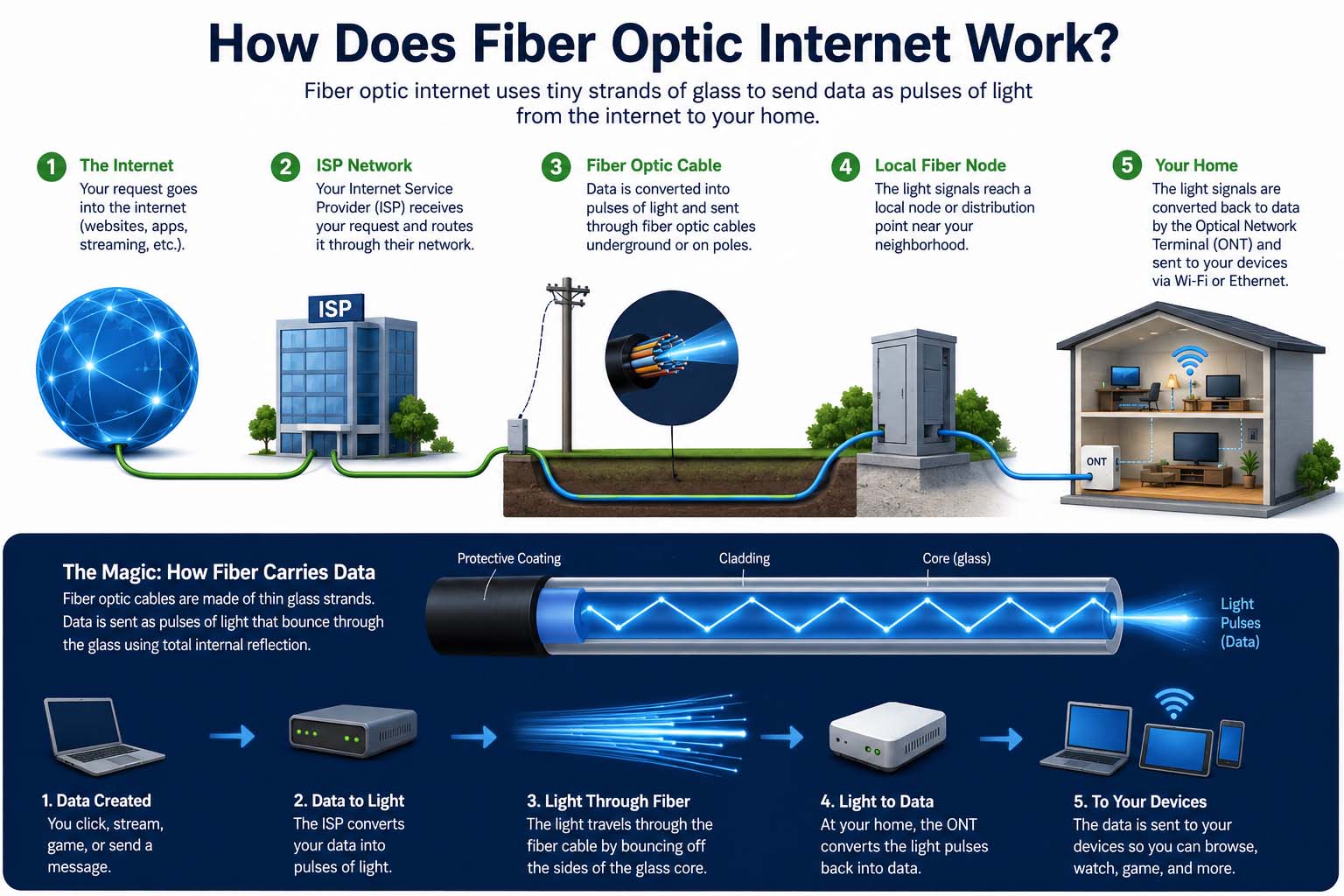
The short answer is simple: fiber optic internet sends data as pulses of light through ultra-thin glass fibers.
Here’s the process step by step.
1. Your Device Sends a Request
Whenever you open a website, play an online game, or stream a movie, your phone, computer, or smart TV sends a request through your home router.
2. The Optical Network Terminal Converts Signals
Most homes with fiber have an Optical Network Terminal (ONT).
The ONT converts electrical signals from your router into optical signals that can travel through fiber cables. When data returns, the ONT converts the light signals back into electrical signals your devices understand.
This conversion happens almost instantly.
3. Light Travels Through Fiber Cables
The converted data moves through fiber optic cables as tiny flashes of light.
Each flash represents digital information using binary code (1s and 0s). The light repeatedly reflects off the inner walls of the fiber without escaping, allowing it to travel long distances with very little loss.
If you’re curious about other technologies that convert physical measurements into electrical signals, our guide on how does a thermocouple work explains another fascinating real-world example.
4. Data Reaches Your Internet Provider
The optical signals travel through neighborhood fiber lines until they reach your Internet Service Provider (ISP).
The ISP connects your request to the wider internet, retrieves the requested information, and sends it back using the same fiber network.
5. Information Appears Almost Instantly
The returned light signals arrive at your ONT, which converts them into electrical signals.
Your router distributes the data to your connected devices, allowing web pages, videos, and apps to load within milliseconds.
How Does Optic Fiber Internet Work Inside the Cable?
A fiber optic cable has several protective layers, each serving a specific purpose.
| Cable Layer | Purpose |
|---|---|
| Core | Carries the light signals |
| Cladding | Reflects light back into the core |
| Protective Coating | Prevents moisture and physical damage |
| Outer Jacket | Shields the cable from environmental wear |
The magic happens because of total internal reflection.
Rather than escaping, light continually bounces inside the glass core until it reaches its destination. This lets data travel much farther than electrical signals in copper wiring while maintaining excellent signal quality.
Although the word “fiber” appears in both technologies, what is carbon fiber is a different topic entirely. Carbon fiber is a lightweight composite material used in products like bicycles, aircraft, and sporting equipment, while fiber optic cables use ultra-pure glass or plastic strands to transmit light.
Fiber Optic Internet How Does It Work Compared With Traditional Broadband?
Many people ask fiber optic internet how does it work differently from older internet connections.
The biggest difference is the transmission method.
| Fiber Internet | Traditional Copper Internet |
| Uses light signals | Uses electrical signals |
| Extremely high bandwidth | Lower bandwidth |
| Low latency | Higher latency |
| Less signal interference | More vulnerable to interference |
| Supports multi-gigabit speeds | Speed decreases over distance |
| Better upload speeds | Often slower uploads |
This difference explains why fiber has become the preferred option for households with multiple connected devices.
How Does Cable Internet Work vs Fiber Optic?
A common question is how does cable internet work vs fiber optic.
Cable internet typically uses coaxial cables originally designed for television services. Data travels as electrical signals through copper wiring.
Fiber internet uses light instead.
Here are the main differences:
- Fiber delivers much faster upload speeds.
- Fiber experiences lower latency.
- Fiber is less affected by electrical interference.
- Cable speeds can slow during busy hours because neighbors often share bandwidth.
- Fiber connections usually provide more consistent performance.
For activities like video conferencing, cloud storage, and online gaming, fiber often provides a noticeably smoother experience.
Why Is Fiber Internet So Fast?
Several technologies work together to make fiber remarkably fast.
Light Travels Extremely Quickly
Although signals don’t move at the full speed of light in glass, they still travel incredibly fast compared to electrical signals.
Huge Data Capacity
Fiber cables can carry enormous amounts of information simultaneously.
Modern fiber infrastructure supports gigabit and even 10 Gbps residential connections in many regions.
Minimal Signal Loss
Electrical signals weaken as they travel through copper wires.
Light inside fiber loses far less energy, allowing longer transmission distances without major performance drops.
Less Interference
Unlike copper cables, fiber isn’t affected by electromagnetic interference from nearby electrical equipment.
This results in more stable internet connections.
Advantages of Fiber Optic Internet
Fiber offers benefits that go beyond raw download speed.
Faster Upload Speeds
Uploading large files, cloud backups, and video content becomes much quicker.
Better Streaming
Multiple people can stream 4K or even 8K video without noticeable buffering.
Lower Gaming Latency
Competitive gamers benefit from faster response times and more consistent network performance.
Reliable Video Calls
Remote workers enjoy smoother video meetings with fewer interruptions.
Future-Proof Infrastructure
Fiber networks are built to handle growing internet demands for many years.
Just as modern renewable energy systems continue evolving—as explained in how does a wind turbine work—fiber networks are designed with long-term scalability in mind.
Are There Any Disadvantages?
No technology is perfect.
Fiber internet also has a few limitations.
Availability
Fiber infrastructure hasn’t reached every neighborhood.
Many rural areas still rely on DSL, cable, or wireless internet.
Installation Costs
Installing new fiber lines can cost more than using existing copper infrastructure.
Physical Damage
Although protected by several layers, fiber cables can be damaged if bent sharply or cut.
Fortunately, they resist electrical interference much better than copper cables.
How Does Fiber Optic Work for Internet in Your Home?
Many people wonder how does fiber optic work for internet after installation.
A typical home setup looks like this:
- Fiber cable enters your house.
- The cable connects to the Optical Network Terminal.
- The ONT connects to your Wi-Fi router.
- The router distributes internet through Wi-Fi or Ethernet cables.
- Your devices access the internet normally.
Most users don’t notice anything different except dramatically faster internet speeds.
Common Uses of Fiber Internet
Fiber has become essential across many industries.
Businesses use it for:
- Cloud computing
- Large file transfers
- Video conferencing
- Data centers
- AI workloads
- Real-time collaboration
Homes use fiber for:
- Streaming movies
- Online gaming
- Smart home devices
- Remote learning
- Video calls
- Cloud backups
Even organizations focused on ETL process optimization often depend on high-speed fiber connections because massive datasets need to move quickly between servers and cloud platforms.
Troubleshooting Slow Fiber Internet
If your fiber connection feels slower than expected, the fiber itself may not be the problem.
Use this checklist.
| Check | Why It Matters |
| Restart your router | Clears temporary issues |
| Restart the ONT | Refreshes the connection |
| Test with Ethernet | Rules out Wi-Fi problems |
| Move closer to the router | Improves wireless signal |
| Update router firmware | Fixes bugs and improves performance |
| Check for ISP outages | Confirms network issues |
| Reduce network congestion | Too many devices can share bandwidth |
In many cases, slow speeds are caused by Wi-Fi limitations rather than the fiber connection itself.
Is Fiber Internet More Secure?
Fiber offers several security advantages.
Intercepting optical signals is much harder than tapping traditional copper lines.
Also, because fiber doesn’t emit electromagnetic signals like copper cables, passive interception becomes more difficult.
Even so, cybersecurity still depends on:
- Strong passwords
- Updated software
- Secure Wi-Fi encryption
- Firewalls
- Multi-factor authentication
A fast internet connection doesn’t replace good digital security habits.
Building secure systems also involves proper software development practices, which is why understanding verification vs validation remains valuable for technology professionals.
Frequently Asked Questions
Is fiber internet better than cable?
For most users, yes. Fiber usually delivers faster speeds, lower latency, better upload performance, and more reliable connections.
Does weather affect fiber internet?
Heavy storms may affect above-ground equipment, but fiber cables themselves are generally less vulnerable to weather-related interference than copper wiring.
Can I use my existing Wi-Fi router?
Sometimes. Your provider may supply a compatible router, or you may use your own if it supports your fiber service.
Is fiber worth it for gaming?
Yes. Fiber’s low latency and stable performance make it one of the best internet options for online gaming.
Does fiber internet require special cables inside the house?
Usually, the fiber line terminates at the ONT. Standard Ethernet cables then connect the ONT to your router.
Final Thoughts
Understanding how does fiber optic internet work makes it easier to see why it has become the preferred internet technology for homes and businesses alike. Instead of sending electrical signals through copper wires, fiber carries data as pulses of light through ultra-thin glass fibers. That approach delivers higher speeds, lower latency, stronger reliability, and excellent scalability.
If fiber service is available in your area, it’s often the best long-term choice for streaming, gaming, remote work, cloud computing, and everything else that depends on a fast, stable internet connection. As internet usage continues to grow, fiber infrastructure is well positioned to support the demands of tomorrow just as effectively as it handles today’s.